
Yamaha Drive2 Won't Move? Tow Switch, Fuses, Battery and Gas Checks
Most Yamaha Drive2 no-go problems start under the seat: a tow switch left on TOW after charging, a 3 amp MCU fuse or a flat pack. Here's the order to check an electric (AC, DC fleet or lithium) or gas Drive2, with Yamaha's own values, the recalls to rule out and when it's a dealer job.
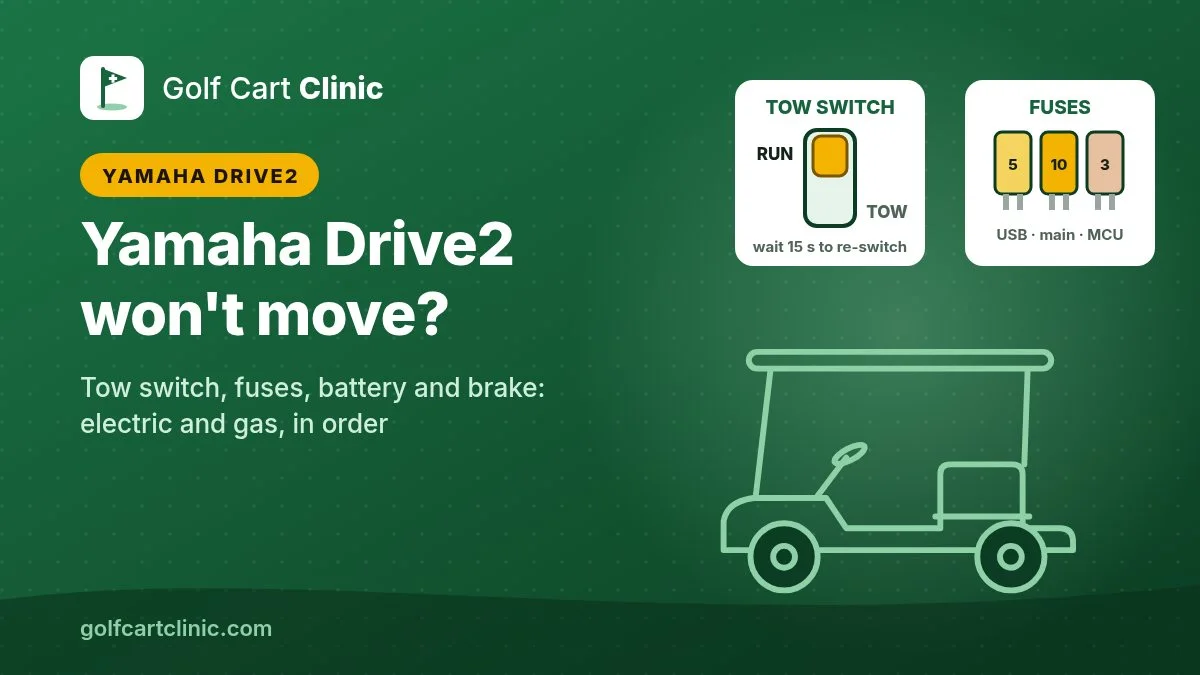
Quick answer: on an electric Yamaha Drive2, the first suspect is the tow switch under the seat. Yamaha tells you to put it on TOW before every charge, so it often gets left there; move it to RUN, and if you just switched it, wait 15 seconds. Then check that the charger is unplugged, the drive select switch is fully in FWD or REV, the battery gauge isn't down to one blinking light, and the small MCU fuse next to the tow switch is good. On a gas Drive2, find out first whether the engine runs: if it doesn't, it's a starting problem (12V battery, fuel, plug, fuse); if it runs and the cart sits, look at the F/R lever, the drive belt and the parking brake.
Safety first. An electric Drive2 runs on a 48V pack that can push hundreds of amps through a wrench, ring or watch. Take jewelry off, wear safety glasses and use insulated tools. Yamaha's rule before fuse work: key OFF, and put the tow switch on TOW. Set the parking brake before any maintenance. If you need the drive wheels off the ground for a test, lift the rear only at the rear lifting point shown in your owner's manual, put it on stands, and keep everyone away from the wheels. Never push the accelerator while turning the key: Yamaha warns the car may suddenly start moving, and the parking brake releases by itself when the pedal goes down.
Towing: put the drive select switch in FWD, then move the tow switch to TOW before you tow an electric Drive2. Yamaha says towing in RUN can damage the drive system, and that after moving the switch from RUN to TOW you should wait at least 15 seconds before switching it again.
Check the recalls before you drive it. In October 2025 Yamaha recalled 2017 to 2024 Drive2 PTVs with serial numbers starting J0D, J0E or J2D because they can fail to brake (CPSC recall 26-027). In June 2025 it expanded a recall covering 2017 to 2024 Drive2 gas and electric cars whose accelerator pedal spring can fail to return to idle (recall 25-321). CPSC says to stop using an affected car and call a Yamaha dealer for the free repair. If a cable is melted, a battery is hot or swollen, or you smell burning, stop and get a technician.
First: which Drive2 do you have?
The Drive2 has been built since 2017 as a carbureted gas car, a QuieTech EFI gas car, a 48V electric with an AC motor (PowerTech AC), a 48V DC-motor fleet car, and since 2022 a lithium version. The fixes differ, so check the serial number first. Yamaha's owner's manuals say the first three characters identify the model. These prefixes come from Yamaha's PID bulletin GC2018-005 and the model list in CPSC recall 25-321:
| Serial starts with | Model | Power |
|---|---|---|
| J0A | Drive2 Fleet | Gas, carbureted |
| J0B, J0K | Drive2 QuieTech (fleet), Drive2 EFI | Gas, fuel injected |
| J0D | Drive2 QuieTech PTV | Gas, fuel injected |
| J0C | Drive2 Fleet 48V DC motor | Electric, flooded lead-acid |
| J0J, J0E, J0S | Drive2 AC (fleet), PowerTech AC PTV, PowerTech AC | Electric 48V AC motor, flooded lead-acid |
| J5A, J5B, J5C | Drive2 PowerTech AC Li, AC Li, PowerTech AC Li PTV | Electric AC motor, lithium |
"PTV" is Yamaha's personal transportation vehicle, the privately owned version; "fleet" cars were built for golf courses. Our serial number lookup decodes Yamaha PIDs through the 2018 model year. If your cart has an aftermarket controller, a lithium conversion or a lift and big-tire kit, the factory numbers below only partly apply.
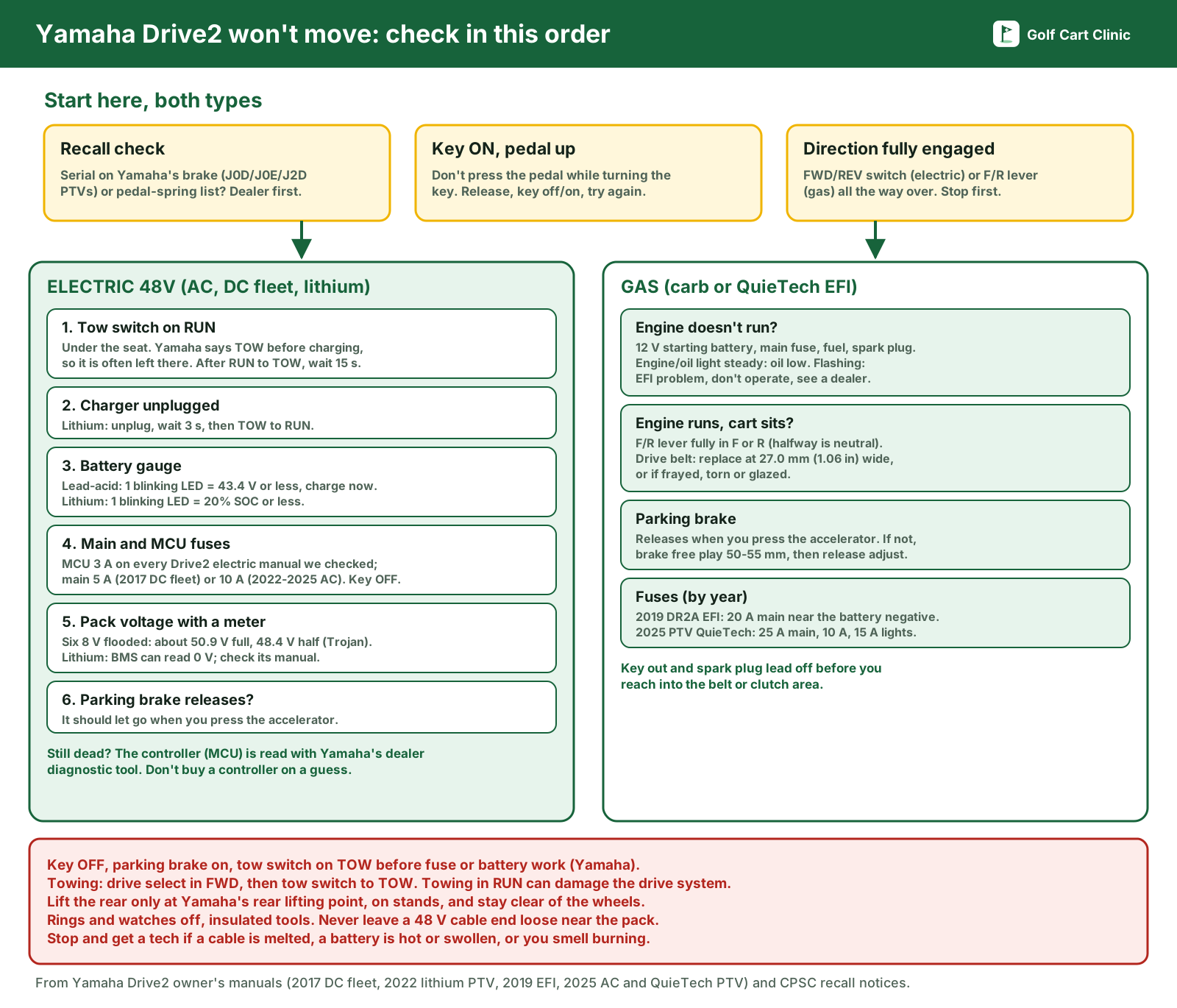
Electric Drive2: six checks before you buy anything
- Tow switch on RUN. Lift the seat; the tow switch is under it, with the fuse holder right next to it on the 2022 and 2025 PTV manuals. Yamaha says the switch must be on RUN to drive, and every Drive2 electric manual we checked says to put it on TOW before charging, which is exactly why a freshly charged car sits dead. Yamaha also says that after moving it from RUN to TOW, you should wait at least 15 seconds before moving it again. If you flipped it back and forth quickly, set it to TOW, count to 15, then go to RUN.
- Charger unplugged, in the right order. Yamaha says not to pull the DC plug while the charger is running: unplug the charger's AC cord from the wall first, then pull the DC plug out of the car by its body. On the lithium Drive2, Yamaha's manual adds one more step: after pulling the DC plug, wait at least 3 seconds before moving the tow switch from TOW to RUN.
- Key on, pedal up, then direction. Turn the key with your foot off the accelerator. If the pedal was down, let it all the way up, turn the key off and on, and try again. The drive select switch has to be fully in FWD or REV, and Yamaha says to change it only after a complete stop. In REV the reverse alarm should sound; if it doesn't, the car may not be seeing the switch at all.
- Read the battery gauge. If only one LED is blinking, Yamaha says to charge immediately (the table below has the voltages). Charge fully and try again before you chase anything else.
- Check the two small fuses. Every Drive2 electric manual we checked lists a 3 amp MCU fuse (the motor control unit, Yamaha's name for the controller) and a main fuse: 5 amp on the 2017 DC fleet car, reached through the rear service access panel, and 10 amp (58V) on the 2022 lithium and 2025 AC PTVs, in the holder next to the tow switch. The 2022 and 2025 PTVs also have a 5 amp USB fuse there. Key OFF and tow switch on TOW before you pull one. If a new fuse blows again, something is shorted: find it before you fit another.
- Does the parking brake let go? On the Drive2 the parking brake releases when you press the accelerator. If the pedal goes down and the brake stays locked, it's mechanical, not electrical (see the brake section below).
What the battery gauge is telling you (flooded lead-acid)
Yamaha's 2025 PowerTech AC PTV manual gives this table for the 9-LED gauge on cars with six 8V batteries. For example, with 7 of 9 LEDs lit the pack has about 47.4V left:
| LEDs lit | 9 | 8 | 7 | 6 | 5 | 4 | 3 | 2 | 1 | 1 blinking |
|---|---|---|---|---|---|---|---|---|---|---|
| Pack volts | 48.95 | 47.8 | 47.4 | 46.9 | 46.4 | 46.0 | 44.8 | 44.0 | 43.5 | 43.4 or less |
On the lithium Drive2 the gauge has 10 LEDs and reads state of charge instead: one blinking LED means 20% or less, and Yamaha again says to charge right away.
Electric: test the batteries with a meter
A gauge only tells you so much. Set a multimeter to DC volts and measure across the whole pack, then across each battery.
- Flooded lead-acid (six 8V batteries). Yamaha's 2025 manual lists six 8V deep-cycle batteries (Trojan T-875). Let the car sit a few hours off the charger, because a pack fresh off the charger reads high. Trojan's open-circuit chart puts an 8V battery at 8.49V fully charged and 8.07V at half charge, so a rested 48V pack should read about 50.9V full and 48.4V at half. One battery well below the others is your weak link.
- Hydrometer. Yamaha's 2017 DR2E17 manual lists a satisfactory uncorrected reading of 1.260 at 80°F, 1.264 at 70°F and 1.268 at 60°F, and says to see a dealer if any reading is low or the cells differ by more than one point.
- Charger won't even start? Yamaha's charger troubleshooting table says the charger won't start charging if the pack is under 20V, or if the wiring between the DC cord, receptacle and batteries is wrong or disconnected. A pack that far down needs a shop to bring the batteries back up, or new batteries. It also tells you to check polarity if the AC light is on but nothing happens. If the charger's red Fault LED blinks, count the flashes and match them to the table in your owner's manual: the causes run from high or low battery voltage and charge timeout to over-temperature and an internal charger fault.
- Connections. Clean corrosion off the battery tops with baking soda and water, as Yamaha describes, without letting it into the cells, and make sure every cable is tight. A loose jumper can read fine at rest and drop out under load. For a dead-battery pattern after watering or a battery swap, see how to water golf cart batteries and lights not working after new batteries.
Lithium Drive2: different rules
Yamaha's 2022 PowerTech AC Li PTV manual lists a 51-volt, 5.3 kWh lithium battery made by RoyPow. A few things in that manual explain lithium no-go and no-charge complaints:
- Temperature. Yamaha lists a charging range of 42 to 121°F (5 to 49°C) and an operating range of -4 to 131°F (-20 to 55°C). A cart left in a freezing garage may not charge until the battery warms up.
- Charger match. Use only the Yamaha lithium charger made for the car. Yamaha says the dummy pin sits in a different spot on lithium and flooded receptacles, so a plug that won't go in is the wrong charger. Don't force it.
- BMS communication. The lithium charger's fault table includes "unable to communicate with Battery Management System". If you see that, it's a battery-side issue for a dealer, not a fuse you can swap.
- Storage. For storage over a month, Yamaha says to leave the battery at 30 to 50% charge (48 to 52.8V), keep it between 32 and 95°F, don't leave the charger connected, and discharge and recharge it every 6 months.
Lithium packs can also shut their own output off to protect themselves, so a 0V reading doesn't always mean a dead battery. If the car moves but cuts out, see lithium BMS keeps tripping.
Electric: when the basics check out
Yamaha's Drive2 owner's manuals don't publish drive-system fault codes. A Yamaha parts dealer's guide says the Drive2 fault list is in the service manual and that dealers read the controller with the Yamaha Diagnostic Tool (YDT). That changes the strategy compared with an older cart you can test pin by pin:
- Note what you hear and see. Does the gauge light with the key on? Does the reverse alarm sound in REV? Any beeping with the key on? Write it down; it helps the dealer.
- Look for obvious damage. With the key off and the tow switch on TOW, look for chewed, melted or unplugged connectors around the batteries, controller and motor. Water and rodents cause a lot of "it just quit".
- Don't swap a controller on a guess. On an AC car the motor control unit, motor and pedal sensor work as one system, and a controller is an expensive guess. Get the fault read first.
The older 2017 to 2020 DC-motor fleet Drive2 (J0C) works more like other DC carts: our golf cart won't move guide covers the click or no-click tests and solenoid clicking but won't move covers the solenoid.
Gas Drive2 won't move
Start with one question: does the engine run?
Engine doesn't run
- Engine/oil warning light. On the QuieTech EFI cars, Yamaha says a steady light means the oil level is low: stop, check the oil and top it up. A flashing light with the key on may mean a fuel injection problem; Yamaha says not to operate the car and to have it serviced.
- Starting battery. The gas Drive2 has a 12V battery that provides starting power. Check that the terminals are clean and tight and the hold-down is secure. Yamaha says to have an experienced mechanic charge it if it loses its charge.
- Fuel and spark. Yamaha's no-start chart starts with an empty tank, then fuel pump, fuel line, filter and injector (dealer items), then a dirty or wet spark plug, which you can clean or dry. The plug is a BPR2ES gapped 0.7 to 0.8 mm (0.028 to 0.031 in.) in the 2019 DR2A EFI manual.
- Fuses. The 2019 DR2A EFI manual lists a 20 amp main fuse about 6 in. (15 cm) from the negative battery terminal, plus a 10 amp fuse and an optional 5 amp fuse under the cup holder. The 2025 PTV QuieTech manual lists a 25 amp main, a 10 amp fuse, a 15 amp light fuse, a 10 amp DC outlet fuse and a 5 amp USB fuse. Turn the key off before you pull one.
Engine runs, cart sits
- F/R lever. It has to be fully in F or R. Halfway between is the position Yamaha uses for removing the belt, so it won't drive there. Only shift at a complete stop; Yamaha warns that shifting while moving can damage the transmission.
- Drive belt. With the key out, check the belt for frayed edges or tears and measure its width. Yamaha's limit is 27.0 mm (1.06 in.) in both the 2019 and 2025 manuals; new is 31.0 mm on the 2019 car and 32.0 mm on the 2025 PTV. To remove it, Yamaha says to set the lever halfway, pull the belt up and out over the edge of the secondary sheave, and turn the secondary sheave clockwise so the belt rolls off. Install it in reverse.
- Parking brake. See below. A brake that won't release will hold a gas car as well as an electric one.
Yamaha also says never to hold the car on a hill with the accelerator, gas or electric: use the brake, or you can damage the transmission.
Parking brake won't release (both types)
On the Drive2 the parking brake latches when you press the parking brake pedal and lets go when you press the accelerator. If it stays on, Yamaha's 2025 manual says to set the brake pedal free play first: 50 to 55 mm (1.97 to 2.17 in.), measured with two fingers of light pressure, adjusted at the locknut and adjusting nut under the floor service lid. Then adjust the parking brake release: latch the pedal on the first notch, loosen the locknut, turn the bolt counterclockwise until it touches the sector, turn it back clockwise one-third of a turn (120 degrees) and tighten the locknut. Yamaha warns not to over-tighten the brake cables. If your serial number is on the brake recall, skip the adjustment and call the dealer.
When to call a Yamaha dealer
- Your serial number is on one of the recalls (brake, accelerator pedal spring or stop lights).
- An AC or lithium car still won't drive with the tow switch on RUN, a charged pack and good fuses.
- The engine light is flashing on a gas car, or the fuel pump, injector or ignition is suspect.
- Any wire, connector or battery terminal shows heat damage, or a fuse keeps blowing.
For the bigger picture across brands, see the golf cart won't move troubleshooting guide. Own a Club Car or E-Z-GO too? See Club Car Precedent won't move and EZGO TXT won't move. More Yamaha guides are in the Yamaha section.
Frequently asked questions
Why won't my Yamaha Drive2 move after charging?
Yamaha's manuals say to put the tow switch on TOW before charging, so the most common cause is that it's still on TOW. Unplug the charger (AC cord first, then the DC plug), move the tow switch under the seat to RUN, and try again. On a lithium Drive2, wait at least 3 seconds after unplugging before switching to RUN.
Where is the tow switch on a Yamaha Drive2?
Under the seat. Lift the seat to reach it. On the 2022 and 2025 PTVs the fuse holder sits right next to it. RUN is for driving; TOW is for towing, charging, fuse work and storage.
Where is the fuse on a Yamaha Drive2 electric?
On the 2022 lithium and 2025 AC PTVs, the fuse holder is under the seat next to the tow switch, with a 10 amp main fuse, a 3 amp MCU fuse and a 5 amp USB fuse. On the 2017 DC fleet car the fuses are in-line on the main harness, reached through the rear service access panel: 5 amp main and 3 amp MCU. Check your own year's manual.
What does one blinking light on the Drive2 battery gauge mean?
The pack is nearly empty. On flooded lead-acid cars Yamaha says it means 43.4V or less; on lithium cars it means 20% charge or less. Either way, charge immediately.
Is my Yamaha Drive2 recalled?
Possibly. CPSC lists a brake recall for 2017 to 2024 Drive2 PTVs with serials starting J0D, J0E or J2D, an accelerator pedal spring recall covering 2017 to 2024 Drive2 gas and electric cars, and a stop light recall for some 2021 to 2025 Drive2 PTVs. Call Yamaha at 866-747-4027 or a dealer with your serial number. The repairs are free.
Can I tow a Yamaha Drive2 with the switch on RUN?
No. Yamaha says to put the drive select switch in FWD and the tow switch on TOW before towing, because towing in RUN can damage the drive system.
Sources
- Yamaha Golf-Car Company, 2025 DR2 PTV PowerTech AC IRS owner's/operator's manual, LIT-19626-A3-84 (tow switch, 15-second wait, TOW before charging and storage, fuse holder and ratings, battery gauge table, parking brake release, brake pedal free play, charger LED and hardware fault tables, six 8V T-875 batteries): golfcars.yamaha-owners-manuals.com (PDF)
- Yamaha Golf-Car Company, 2022 DR2 PTV PowerTech AC IRS Li owner's/operator's manual, LIT-19626-A2-17 (lithium gauge, 3-second wait, charger dummy pin, temperature ranges, storage SOC, RoyPow 51V 5.3 kWh, fuses): golfcars.yamaha-owners-manuals.com (PDF)
- Yamaha Golf-Car Company, 2017 DR2E17 48 volt golf car owner's/operator's manual, LIT-19626-21-17 (tow switch, TOW before charging, 5 A main and 3 A MCU fuses, hydrometer table): golfcars.yamaha-owners-manuals.com (PDF)
- Yamaha Golf-Car Company, 2025 DR2 PTV QuieTech owner's/operator's manual, LIT-19626-A3-81 (engine/oil warning light, starting, no-start chart, drive belt, fuses, 12V battery): golfcars.yamaha-owners-manuals.com (PDF)
- Yamaha Golf-Car Company, 2019 DR2A EFI golf car owner's/operator's manual, LIT-19626-A0-05 (fuses, spark plug, belt specs): golfcars.yamaha-owners-manuals.com (PDF)
- U.S. CPSC, recall 26-027 (Drive2 PTV brakes), 26-028 (Drive2 PTV stop lights) and 25-321 (accelerator pedal spring, with the Drive2 model and serial list): 26-027, 26-028, 25-321
- Yamaha Golf-Car Company, bulletin GC2018-005, starting PID numbers 1979 to 2018 (Drive2 model codes), as used in our serial number lookup
- Yamaha Online Parts, common Yamaha golf cart problems guide (Drive2 fault codes read with the Yamaha Diagnostic Tool): yamahaonlineparts.com
- Trojan Battery, open-circuit voltage chart: trojanbattery.com
- Your cart's own owner's and service manual. Where it differs from this guide, follow it.
Last checked against the documents above on October 26, 2026. Yamaha, Drive2, QuieTech and PowerTech are trademarks of their owner; Golf Cart Clinic is independent and not affiliated with Yamaha.
#Electric carts #Won't move #Lithium batteries #Yamaha Drive2
Questions and comments
No comments yet. Corrections and notes from your own repair are welcome.