
Golf Cart Won't Move? Troubleshooting by Symptom, Step by Step
Most electric carts that won't move have a simple cause: Tow/Run left on Tow, the charger cord still in, F/R between gears or a weak pack. Here are the quick checks, the pack voltages to expect and a test path for every symptom.
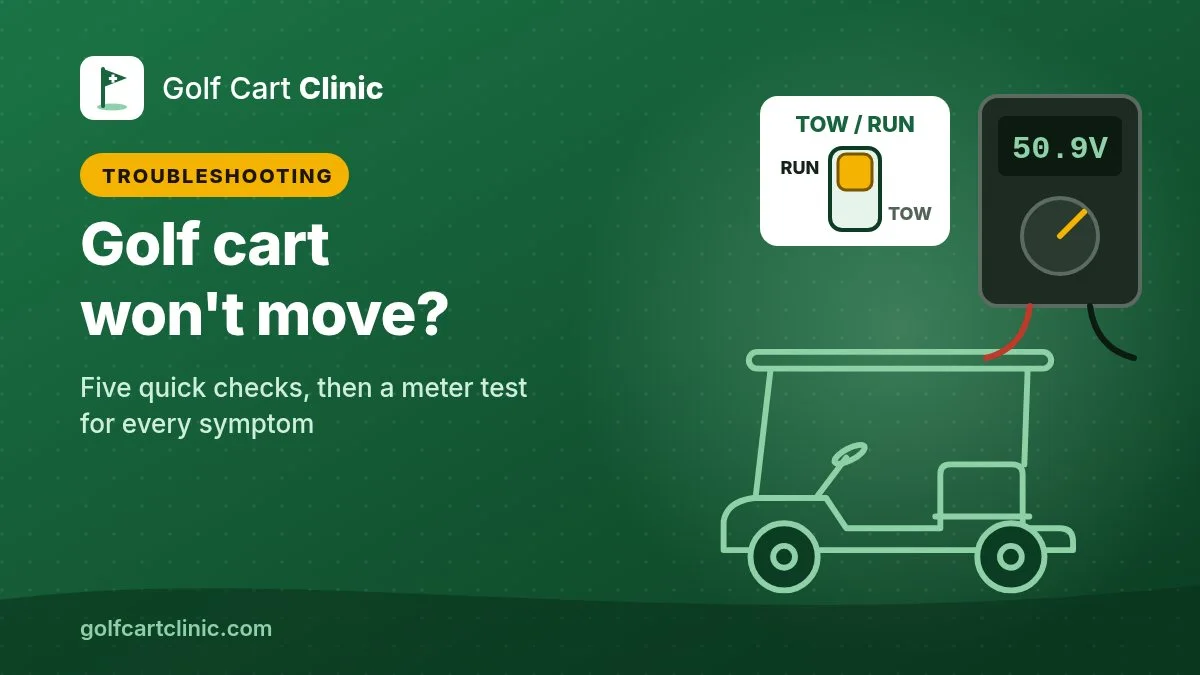
Quick answer: on an electric golf cart, check the cheap things first: Tow/Run switch on Run (then wait 10 to 30 seconds), charger cord unplugged, Forward/Reverse fully in gear, and the pedal off the floor when you turn the key. If that doesn't do it, put a meter on the pack. A healthy, rested 48V lead-acid pack reads about 50.9V full and 48.4V at half charge. Then go by what you hear: no click at all is a control-side problem, a click with no movement is the solenoid or the high-current side, and a cart that moves a few feet and quits is almost always batteries or a connection.
Safety first. A 36V or 48V pack can push hundreds of amps through a wrench or a ring. Take off rings and watches, wear safety glasses and use insulated tools. Before any test where the wheels could turn, park on level ground, chock the front wheels and lift the drive wheels securely, or keep the cart in Tow/Maintenance until the step says otherwise. Club Car and E-Z-GO both say to put the Tow/Run switch in Tow before connecting or disconnecting batteries. Never jump the solenoid's large posts to "see if it goes." If a cable or terminal has melted, a battery is swollen or hot, or you smell burning, stop and get a qualified tech.
Start here: five checks that fix a lot of "dead" carts
These take two minutes and cost nothing. Most shop calls that turn out to be "nothing wrong" are one of these.
- Tow/Run switch on Run, then wait. In Tow, the cart is meant to be dead. E-Z-GO's TXT Freedom owner's guide says the Tow position deactivates the controller, and that after connecting a battery or any wiring you should wait at least 30 seconds before moving the switch to Run. Club Car's Precedent manual says to wait 10 seconds after switching to Run before you drive, and 10 seconds before going from Tow back to Run. Yamaha's YDRE manual simply says to make sure the tow switch is on Run before operating. On all three it's under the seat. If someone just worked on the cart, this is the first suspect.
- Charger cord out of the cart. E-Z-GO says all its vehicles in that guide have an interlock that disables the controller while the charger is connected. Club Car's manual says the same: with the DC cord plugged in, the control circuit is locked out. Pull the plug fully out of the receptacle.
- Forward/Reverse fully in a direction. On a Precedent, the rocker switch in the middle (neutral) position means the cart won't move even with the pedal down. A lever or rocker that's halfway can do the same thing. Snap it firmly into Forward, then try Reverse. If the reverse buzzer sounds, the key and selector are getting power.
- Foot off the pedal when you turn the key. E-Z-GO's "high pedal disable" blocks the drive if the key is turned on, or the direction is changed, while the pedal is pressed. Yamaha's manual warns against pressing the pedal while turning the key on. Let the pedal all the way up, turn the key off and on, then press the pedal again.
- Look before you measure. Lift the seat. A loose main cable, green or white crust on a terminal, a melted post, low water in flooded batteries or a lithium battery with a red status light tells you where to go next.
What is the cart doing? Pick your symptom
| What you notice | Where the problem usually is | Go to |
|---|---|---|
| Completely dead: no click, no reverse buzzer, no meter or charge light | No power reaching the control circuit: pack, main cable, Tow/Run, control fuse, lithium BMS shut off | Path A |
| Buzzer or dash works, but no solenoid click when you press the pedal | Control side: pedal switch or throttle sensor, F/R switch, interlock, solenoid coil, controller | Path B |
| Solenoid clicks, cart doesn't move | High-current side: solenoid contacts, weak pack, cables, controller, motor | Path C |
| Moves a little, then stops, or quits on hills | Weak or discharged batteries, a bad connection, lithium low-voltage cutoff | Path D |
| Goes one direction only | Forward/Reverse switch or its wiring | Path E |
| Only crawls at walking speed | Controller protective or diagnostic mode, low voltage, parking brake dragging | Path F |
The whole diagnosis at a glance
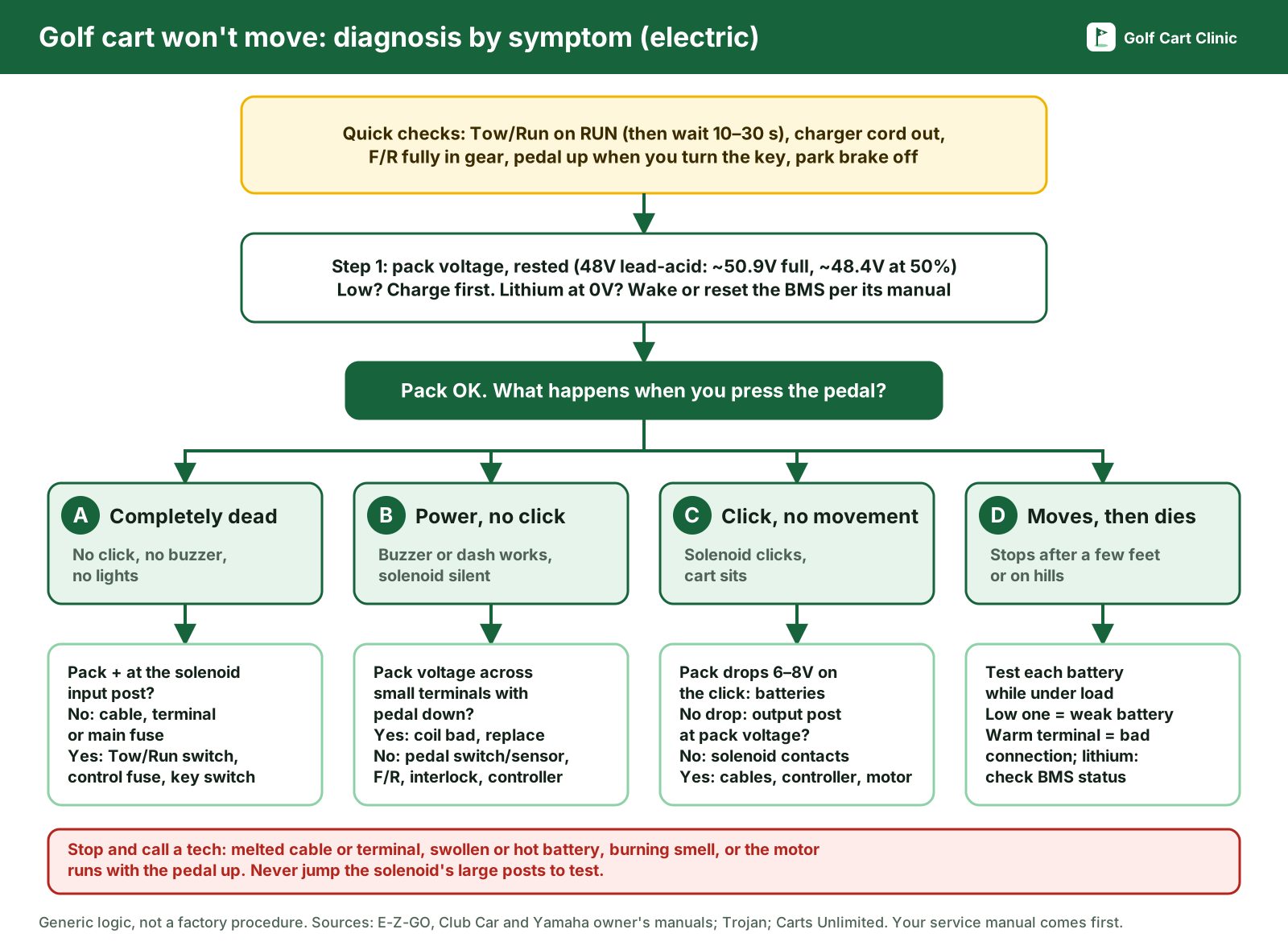
- If Tow/Run is on Tow, the charger is plugged in, or the F/R selector is between positions → fix that, wait the 10 to 30 seconds your manual gives, and try again.
- If the pack reads well under the 50% numbers below, or a lithium pack reads 0V → charge it or wake the battery first (Step 1).
- If there's no click and nothing at all works → Path A: follow the power from the pack to the control circuit.
- If there's power but no click → Path B: check the solenoid's small terminals while pressing the pedal.
- If it clicks but doesn't move → Path C: watch pack voltage on the click, then test the solenoid's large posts.
- If it moves and dies → Path D: test each battery while the cart is under load.
Step 1: Read the pack voltage (every path starts here)
Set a digital multimeter to DC volts, black lead on the pack's main negative, red lead on the main positive. For lead-acid, take the reading after the cart has sat a few hours off the charger, because a pack fresh off the charger reads high.
Trojan's open-circuit voltage chart gives these figures for flooded lead-acid batteries (Trojan battery maintenance guide):
| Battery or pack | 100% charged | 50% charged |
|---|---|---|
| 6V battery | 6.37V | 6.02V |
| 8V battery | 8.49V | 8.07V |
| 12V battery | 12.73V | 12.10V |
| 36V pack | 38.20V | 36.31V |
| 48V pack | 50.93V | 48.41V |
If you're well under the 50% figure, charge fully and test again before you chase anything else. A pack that won't take a charge is its own problem; our battery and charging guides cover that side.
Lithium packs read differently. A lithium battery's built-in BMS can switch the output off completely, so you may see 0V at the terminals even though the cells are fine. Trojan's GC2 48V lithium guide, for example, lists a low-voltage shutoff below 40.5V (it restarts above 42.1V or when a charger is attached and charging), a short-circuit shutoff that needs the status button held to clear, and an automatic sleep mode after 30 days without use, or 5 days if the state of charge is under 24%. Sleep mode doesn't restart on its own: you press and hold the status button. Other brands do it differently. Eco Battery's manual says a pack in protect mode can be reset by disconnecting the terminals for one minute. Check your battery's manual before you condemn the cart.
Path A: Completely dead (no click, no buzzer, no lights)
Nothing works, so power isn't getting from the pack to the control circuit. Work outward from the battery.
- Pack voltage at the pack. If it's 0V on lithium, see the BMS notes above. If it's 0V or very low on lead-acid, look for a broken or disconnected jumper cable between batteries: measure each battery on its own.
- Pack voltage at the solenoid. Black lead on pack negative, red on the large solenoid post fed by the battery positive. You should see full pack voltage. If you don't, the problem is a main cable, a terminal or a main fuse between the pack and the solenoid.
- Tow/Run switch itself. Switches and their wiring fail. Club Car's Precedent service manual lists a Tow/Run switch left on Tow, failed welds in the tow switch circuit and a failed tow circuit among the reasons its diagnostic tool can't talk to the controller. Cycle the switch to Tow, wait 10 seconds, back to Run, wait again.
- Control fuse. Many carts have a small inline fuse feeding the key and control circuit. On the Yamaha YDRE (Drive) it's a 3 amp blade fuse in an inline holder on the main harness next to the tow switch. Turn the key off before you pull it, and replace it only with the rating your manual specifies.
- Key switch. With the key on, there should be voltage on the key switch output. A worn key switch can feel normal and still not make contact. The exact test points are in your service manual's wiring diagram.
Path B: Power is on, but there's no solenoid click
The reverse buzzer sounds or the dash lights up, so the pack and key circuit are alive. The solenoid's coil isn't being energized when you press the pedal. Carts Unlimited, a golf cart shop, splits every electric cart into two circuits: the small wires that tell the cart when and how fast to go (control circuit), and the big cables that carry motor current (supply circuit). No click means the control circuit or the solenoid coil (Carts Unlimited troubleshooting tips).
- Measure across the two small solenoid terminals while a helper presses the pedal, wheels off the ground. Carts Unlimited notes the coil needs positive on one small terminal and negative on the other, and you should read close to pack voltage between them.
- Voltage there, no click: the solenoid coil has failed. Replace the solenoid with one that matches your cart's coil voltage and terminal layout.
- No voltage there: something upstream isn't closing. In order, check the pedal microswitch or throttle sensor, the Forward/Reverse switch, the charger interlock and the controller.
A few things worth knowing on this path:
- Charger interlock that won't let go. Even with the cord out, a faulty interlock circuit can keep the cart locked. Club Car's Precedent service manual tells techs who see a "Lockout Fault" to inspect and test the charger interlock circuit before replacing the controller. A corroded or damaged charge receptacle is worth a look on any brand.
- Water and pedal sensors. E-Z-GO TXTs from 1994.5 on use an inductive throttle sensor (ITS) under the floor, and older Marathons use a potentiometer. Carts Unlimited notes both can act up after getting wet and can often be dried out with a hair dryer. If the cart quit right after a wash or a rainy drive, that's a good lead.
- Controller fault codes. Many controllers report a fault by blinking an LED or through a dealer tool. Club Car dealers read Precedent faults with the CDT handset; that manual's list includes low battery voltage under load (below 34V), throttle, speed sensor, solenoid coil open and lockout faults. If your controller has a status LED, count the blinks and look the code up in its manual before buying parts.
Path C: The solenoid clicks, but the cart won't move
The click proves the coil pulled in. It doesn't prove the contacts inside are passing hundreds of amps. Watch the pack voltage while a helper presses the pedal. Carts Unlimited's rule of thumb: if the pack voltage drops significantly (6 to 8 volts) you have a battery problem; if it doesn't move at all, current isn't flowing, so look at a connection, the solenoid contacts or another component. Then check the solenoid's output post: it should come up to full pack voltage when the solenoid clicks.
That whole test sequence, with the pre-charge resistor gotcha and what to do when the output post is fine, is in our full guide: golf cart solenoid clicking but won't move.
Path D: It moves a few feet, then stops (or dies on hills)
A cart that starts and then quits is usually telling you the pack can't hold its voltage under load. One bad battery is enough.
- Charge fully and let it rest, then check pack voltage against the chart above.
- Test under load. With the drive wheels safely lifted, have a helper hold the pedal down while you measure each battery in turn. A battery that reads clearly lower than the others under load is the weak one. Club Car's Precedent service manual treats a pack below 34V under load as a low-voltage condition, which is far below a healthy 48V pack.
- Feel for heat. After a short run, carefully check terminals and cable ends with the back of your hand held just above them. A connection that's warmer than the others has resistance: clean it and tighten it to your manual's torque. Club Car's Precedent owner's manual gives 110 in·lb (12.4 N·m) for its lead-acid battery terminals; lithium packs often use a different value, so use your battery maker's figure.
- Check the water. Low electrolyte in flooded batteries cuts capacity fast. Top up the right way, after charging: see how to water golf cart batteries.
- Hydrometer, if you have one. E-Z-GO's owner's guide says a fully charged cell reads 1.275 to 1.280 specific gravity and a discharged one around 1.140. Don't test right after watering: E-Z-GO says the battery needs at least one charge and discharge cycle for the water to mix.
- Lithium cutting out. If a lithium pack shuts off on a hill or under hard acceleration, it may be hitting its low-voltage or overcurrent limits. Look at the battery's status light and its manual's protection table.
Path E: It goes forward but not reverse (or the other way)
One direction working rules out the batteries, the solenoid and most of the controller. The difference between the two directions is the Forward/Reverse switch and its wiring. On series-wound carts the F/R switch carries main motor current, so its contacts can burn; on sepex carts it's part of the control circuit and just sends a signal to the controller (Carts Unlimited explains the split). Look for burned contacts or loose cables on a series cart's F/R assembly, or a broken wire or dirty microswitch on a sepex cart's selector.
Path F: It only crawls
A cart that creeps along at walking pace is usually being held back on purpose. E-Z-GO's owner's guide describes a diagnostic mode that, after certain electrical failures, lets the cart move only at a very reduced speed so you can drive it back to be serviced. Low pack voltage, an overheated controller and a parking brake that isn't fully releasing can also slow a cart to a crawl. Check the brake first: with Tow/Run on Tow (so the electronic braking is off), release the park brake and push the cart on level ground. It should roll freely, then pack voltage, then have the controller faults read.
Won't move right after new batteries or other work?
This comes up constantly. Before you suspect the new parts, check these:
- Tow/Run timing. Connect everything with the switch on Tow, then wait the 30 seconds (E-Z-GO) or 10 seconds (Club Car Precedent) before switching to Run. Club Car also says to wait 90 seconds after disconnecting the batteries for the controller capacitors to discharge.
- Jumper order and polarity. Every battery should run positive to negative to the next battery, with the main cables on the right ends. Measure the full pack. A reversed battery subtracts twice its own voltage from the total, so one backwards 8V battery leaves a 48V pack about 16V short; a skipped jumper reads 0V. Compare with the photo you took before you started.
- Accessory wiring. A new meter or reducer wired to the wrong post or to the frame can blow a fuse or cause a short. If you got sparks when you connected the pack, read golf cart sparks when connecting the battery before you go further. If the cart drives but the lights, horn or turn signals died after the swap, see golf cart lights not working after new batteries.
- Lithium conversions. The new pack may need to be woken up, or the cart may need the charger profile and any wiring the conversion kit requires. Follow the kit's instructions to the letter.
Gas carts
This guide is about electric carts. A gas cart that won't move has a different set of causes: the 12V battery and starter/generator if the engine won't turn over, and the drive belt or clutches if the engine runs but the cart doesn't go. Use your model's service manual for those. If you're not sure which model or year you have, our golf cart serial number lookup helps identify Club Car and Yamaha model years.
When to stop and call a technician
- A cable, terminal or connector has melted or burned.
- A battery is swollen, cracked, leaking or hot.
- The controller shows a fault that its manual says means "replace controller", or you'd need a dealer tool to read it.
- The motor hums or the cart lurches with the pedal up.
- You've worked through the path for your symptom and the readings don't match anything here.
Own an E-Z-GO TXT? Our EZGO TXT won't move guide has the PDS beep codes and the controller plug tests for each TXT drive system. On a Club Car DS, Club Car DS won't move covers the onboard computer lockout and the IQ controller pin tests. More guides by symptom are in our golf cart troubleshooting section.
Frequently asked questions
Why won't my golf cart move when everything seems fine?
The most common reasons are simple: the Tow/Run switch left on Tow, the charger cord still in the receptacle, the Forward/Reverse selector between positions, or the pedal pressed while the key was turned on. After that, it's usually a discharged pack or one weak battery.
How long should I wait after flipping the Tow/Run switch to Run?
Club Car's Precedent manual says 10 seconds before driving. E-Z-GO's TXT Freedom guide says to wait at least 30 seconds after connecting a battery or any wiring before moving the switch to Run. Check your own manual; waiting the longer time doesn't hurt.
Can a golf cart have voltage and still not move?
Yes. A resting pack can read normal and then collapse under load because one battery is weak or a connection is bad. That's why you test while pressing the pedal, with the drive wheels lifted, and measure each battery on its own.
My lithium golf cart won't move after sitting. Is the battery dead?
Probably not. Many lithium packs go into sleep or protection mode after sitting or after a low-voltage event and show 0V at the terminals. Trojan's GC2 48V lithium, for example, sleeps after 30 days unused (5 days below 24% charge) and wakes when you press and hold its status button. Follow your battery's manual, then charge it.
Does a blown fuse stop a golf cart from moving?
It can. Many carts have a small control-circuit fuse; on a Yamaha Drive (YDRE) it's a 3 amp blade fuse next to the tow switch. If it's blown, nothing on the control side works. Find out why it blew before you replace it.
Why does my golf cart only go in reverse?
If one direction works, the batteries and solenoid are fine. Look at the Forward/Reverse switch: burned contacts on series carts, or a bad microswitch or wire on sepex carts.
Sources
- E-Z-GO, TXT Freedom 48V owner's guide (Run - Tow/Maintenance switch, 30-second wait, charger interlock, high pedal disable, diagnostic mode, hydrometer readings): ezgo.txtsv.com (PDF)
- Club Car, Precedent owner's manual, electric with ERIC charging (Tow/Run switch and 10-second waits, neutral position, charger interlock, 90-second capacitor discharge, 110 in·lb terminal torque): PDF hosted by CartPros
- Club Car, 2019 Precedent Villager 2 maintenance and service manual, CDT quick reference (lockout fault, low battery voltage under load, Tow/Run circuit causes): easymanua.ls
- Yamaha Golf-Car Company, YDRE 48V owner's/operator's manual (tow switch, key-on with pedal up, 3 A control fuse): PDF hosted by Kruizinga
- Trojan Battery, open-circuit voltage chart: trojanbattery.com
- Trojan Battery, GC2 48V lithium user's guide (protection shutoff, sleep mode, restart): trojanbattery.com (PDF)
- Eco Battery, lithium owner's manual (BMS protect mode reset): PDF hosted by Active Golf Carts
- Carts Unlimited, troubleshooting tips (control vs supply circuit, load voltage drop, solenoid coil and contact tests, throttle sensors and water): cartsunlimited.net
- Your cart's owner's and service manual and your battery's manual. They take priority where they differ from this guide.
Last checked against the documents above on October 23, 2026.
Questions and comments
No comments yet. Corrections and notes from your own repair are welcome.