
Virginia Golf Cart Laws (2026): Designated Streets, 25 MPH and LSV Rules
Virginia lets golf carts on public streets only where a county, city or town has designated them by ordinance, and only on roads posted 25 mph or less. Drivers need a valid license, carts need a slow-moving vehicle triangle and daylight or proper lights, and no state plate is required. Here are the crossing rules, the exceptions, the LSV rules and what towns like Colonial Beach and Chase City add.
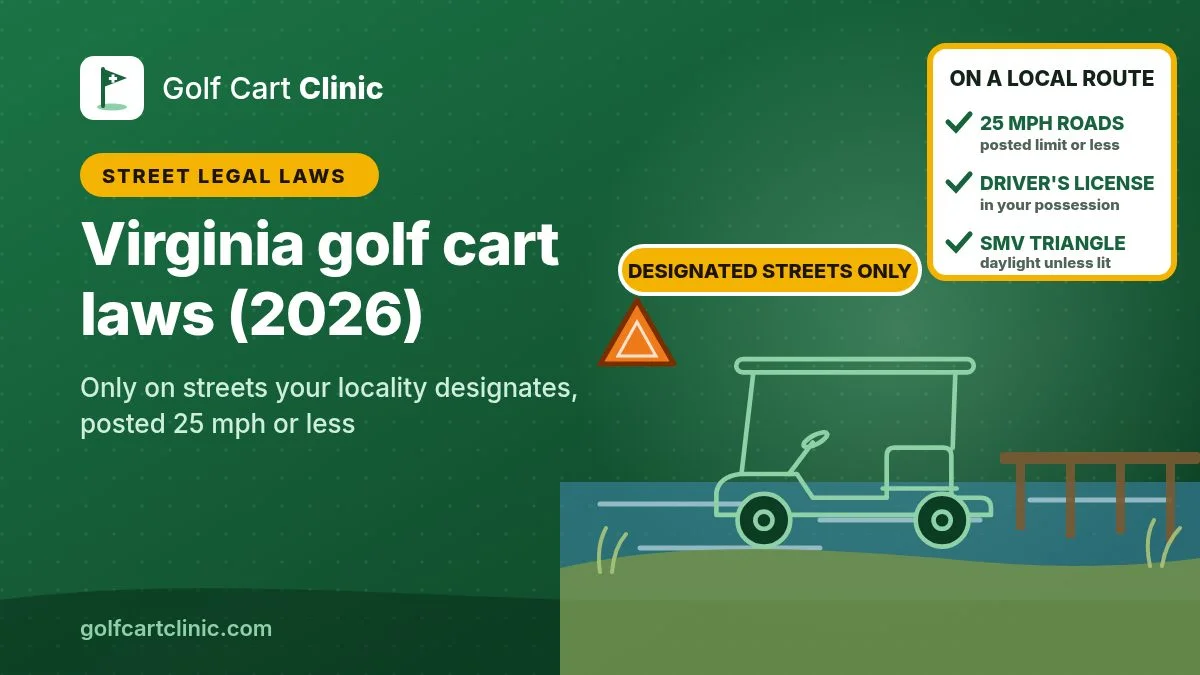
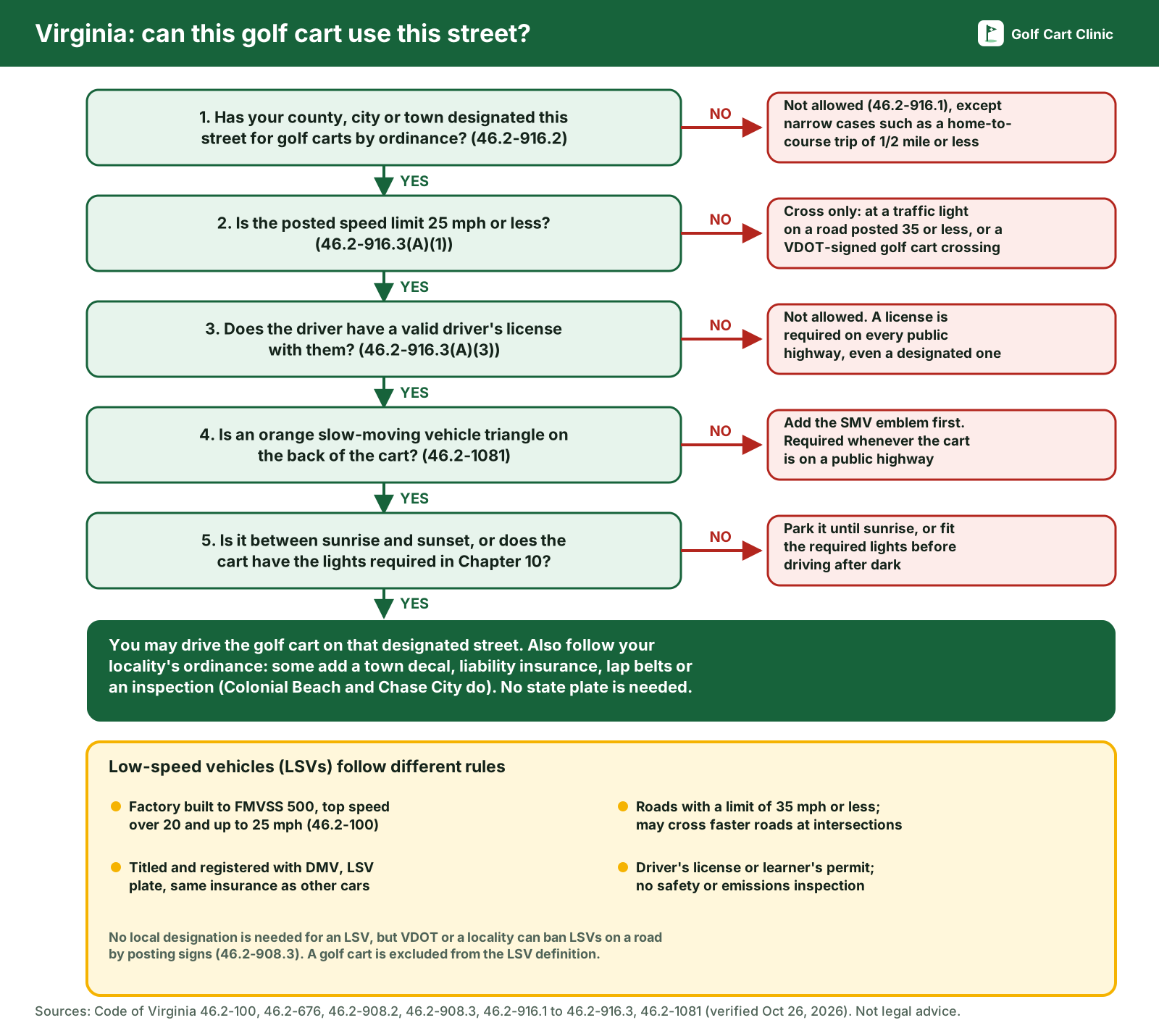
In Virginia, a golf cart may use a public road only if your county, city or town has designated that road for golf carts by ordinance, and only where the posted speed limit is 25 mph or less. On a designated street, the driver must carry a valid driver's license, the cart must show an orange slow-moving vehicle triangle, and it may run only from sunrise to sunset unless it has the lights the Code requires. No state registration, plate or fee is needed, but many towns add a decal, insurance or an inspection. Factory-built low-speed vehicles (LSVs) are different: titled, plated and insured, they may use roads with a limit of 35 mph or less without any local designation.
Not legal advice. Last verified: October 26, 2026. This guide summarizes Title 46.2 of the Code of Virginia as published by the Virginia General Assembly's Legislative Information System (law.lis.virginia.gov), guidance from the Virginia Department of Motor Vehicles (DMV) and the published ordinances of two Virginia towns. Your county, city or town decides which streets, if any, are open to golf carts, and it can add stricter rules. Before you drive, check your locality's ordinance and the signs on the street.
Safety first. A golf cart has no doors, airbags or crash structure, and many have no seat belts. On a street shared with cars, even a slow crash can throw riders out, and a cart is hard to see from a pickup or an SUV. Seat only as many people as the cart has seats, keep everyone seated with hands and feet inside, never let anyone ride on the bag rack or the roof, and don't drive in rain, fog or after dark without real lights. Young children need a proper seat and belt, which most carts don't have. If a route has fast traffic, find another one or leave the cart at home.
Virginia golf cart rules at a glance
Virginia treats golf carts and utility vehicles (UTVs used for maintenance, security, farm or garden work) the same way on public roads, and treats low-speed vehicles as regular motor vehicles. Here is how the two sets of rules compare:
| Rule | Golf cart or utility vehicle | Low-speed vehicle (LSV) |
|---|---|---|
| Which roads | Only public highways your county, city or town has designated by ordinance (§ 46.2-916.2) | Any public highway with a maximum speed limit of 35 mph or less, unless signs ban LSVs (§ 46.2-908.3) |
| Speed limit of the road | Posted 25 mph or less; may cross a road posted no more than 35 mph at a traffic light (§ 46.2-916.3(A)(1)) | 35 mph or less; may cross faster highways at intersections |
| Driver | "A valid driver's license" in the driver's possession (§ 46.2-916.3(A)(3)) | Driver's license or learner's permit, carried with the registration card |
| Title, registration, plate | None required by the state (§ 46.2-676); some towns require a local decal | Titled and registered with DMV; LSV license plate (§ 46.2-711(D)) |
| Insurance | No state requirement in the golf cart article; some towns require it | Same insurance requirements as other motor vehicles (§ 46.2-908.3) |
| Equipment | Slow-moving vehicle emblem; lights if driven outside sunrise to sunset | Full list in § 46.2-908.2, including belts, windshield, wipers, mirrors and a VIN |
| Hours | Sunrise to sunset, unless equipped with the required lights | Any time |
How Virginia defines a golf cart, a utility vehicle and an LSV
The definitions in Code of Virginia § 46.2-100 decide which rules apply:
- Golf cart: "a self-propelled vehicle that is designed to transport persons playing golf and their equipment on a golf course."
- Utility vehicle: "a motor vehicle that is (i) designed for off-road use, (ii) powered by a motor, and (iii) used for general maintenance, security, agricultural, or horticultural purposes." Riding lawn mowers are excluded.
- Low-speed vehicle: "any four-wheeled electrically powered or gas-powered vehicle, except a motor vehicle or low-speed vehicle that is used exclusively for agricultural or horticultural purposes or a golf cart, whose maximum speed is greater than 20 miles per hour but not greater than 25 miles per hour and is manufactured to comply with safety standards contained in Title 49 of the Code of Federal Regulations, § 571.500."
Two words in the LSV definition matter: "manufactured" and "golf cart." A golf cart is carved out of the definition, and an LSV must be built to the federal standard (FMVSS 500) by its maker. A standard cart with a light kit and mirrors added is still a golf cart under these definitions. We didn't find a DMV process for re-titling a converted golf cart as an LSV, so if you want an LSV, buy one that left the factory with a 17-digit VIN and a certificate of origin that says low-speed vehicle. Our serial number lookup helps you tell a golf cart serial from a real VIN.
Where can you drive a golf cart in Virginia?
The starting rule is a ban: "No person shall operate a golf cart or utility vehicle on or over any public highway in the Commonwealth except as provided in this article" (§ 46.2-916.1). The DMV's off-road vehicles page puts it the same way: "It is illegal to operate a golf cart on any public highway unless proper authorities designate that portion of public highway for golf cart use."
"Public highway" is broad. Virginia defines a highway as "the entire width between the boundary lines of every way or place open to the use of the public for purposes of vehicular travel in the Commonwealth, including the streets and alleys" (§ 46.2-100). Neighborhood streets maintained by VDOT or your city are public highways, even quiet ones.
Golf carts are free to use:
- Private property, with the owner's permission.
- Golf courses, under the course's rules.
- Private community roads, under the association's rules. One catch: the highway definition also covers, "for law-enforcement purposes," private roads "that have been specifically designated 'highways' by an ordinance" of the locality. If your community's roads were designated that way, ask the HOA or the police how carts are treated there.
How a county, city or town opens streets to golf carts
Only a local governing body can open public streets to carts, and § 46.2-916.2 sets the conditions:
- An ordinance is required. No part of a public highway may be designated "unless the governing body of the county, city, or town in which that portion of the highway is located has reviewed and approved such highway usage." Before adopting the ordinance, the locality must consider "the speed, volume, and character of motor vehicle traffic" and find that cart use fits state and local transportation plans and the Statewide Pedestrian Policy.
- Not where carts would block traffic. "No public highway shall be designated for use by golf carts and utility vehicles if such golf cart and utility vehicle operations will impede the safe and efficient flow of motor vehicle traffic."
- Towns need their own police department. A town "that has not established its own police department" may not authorize golf carts, except the Towns of Claremont, Clifton, Dendron, Irvington, Ivor, Jarratt, Saxis, Stony Creek, Urbanna and Wachapreague, which the statute names.
- The locality pays for the signs. The county, city or town installs and maintains golf cart signs and may recover the cost from whoever asked for the designation; VDOT doesn't pay for them.
So the practical question is never "Are golf carts legal in Virginia?" but "Has my locality designated this street?" Your town or county clerk, the local ordinance (often online through Municode or the town's website) and posted golf cart signs answer it. If there's no ordinance, plain golf carts stay off public streets.
Speed limits and crossing roads
Even on a designated route, § 46.2-916.3(A) limits where a cart can go:
- 25 mph roads only. "A golf cart or utility vehicle may be operated only on designated public highways where the posted speed limit is 25 miles per hour or less."
- Crossing at a traffic light. A cart "may cross a highway at an intersection controlled by a traffic light if the highway has a posted speed limit of no more than 35 miles per hour." A road posted 40 mph or more can't be crossed under this rule, even at a light.
- Marked crossings in small towns. In towns with a population of 2,000 or less, a cart may cross a road posted no more than 35 mph at an intersection "conspicuously marked as a golf cart crossing by signs posted by the Virginia Department of Transportation," if that crossing is the only way to get from one part of town to another.
- Colonial Beach. The statute names one town: in Colonial Beach a cart "may cross any highway at an intersection marked as a golf cart crossing by signs posted by the Virginia Department of Transportation."
Virginia law limits the road, not the cart: the rule is the posted limit, and the statute doesn't set a top speed for the golf cart itself. Remember that a cart doing 12 to 15 mph on a 25 mph street is still much slower than the cars around it.
Exceptions to the 25 mph rule
Section 46.2-916.3(B) lifts the 25 mph limit in a few narrow situations, always on roads posted 35 mph or less:
- Golf course trips. To cross a highway "from one portion of a golf course to another portion thereof or to another adjacent golf course," or "to travel between a person's home and golf course if (i) the trip would not be longer than one-half mile in either direction and (ii) the speed limit on the road is no more than 35 miles per hour."
- Government and campus work. Local government employees on their locality's highways, employees of two-year and four-year colleges on highways within campus limits, and Department of Conservation and Recreation (DCR) employees on or next to DCR property.
- Race days. On a secondary road posted no more than 35 mph within three miles of a motor speedway seating at least 25,000 but fewer than 90,000, on the day of a race or race-related event.
- Horse events. Crossing a one-lane or two-lane highway between parts of a venue hosting an equine event, on the day of the event, inside a temporary traffic control zone of 35 mph or less, with a uniformed officer controlling the crossing.
Note what the exceptions change: they lift the 25 mph limit for those trips. The other limits in § 46.2-916.3(A) (driver's license, the slow-moving vehicle emblem and daylight-only driving unless lit) still apply on any public highway.
Driver's license and age
"No person shall operate any golf cart or utility vehicle on any public highway unless he has in his possession a valid driver's license" (§ 46.2-916.3(A)(3)). That applies to every public highway, designated or not, including the golf course and home-to-course exceptions. Because Virginia issues driver's licenses to minors no younger than "16 years and three months" (§ 46.2-334), younger teens can't drive a cart on any public street. The golf cart section says "valid driver's license" and doesn't mention learner's permits; the LSV section, by contrast, expressly allows "driver's licenses or learner's permits." If your teen only has a permit, keep the cart off public streets.
On private property there's no state age rule for golf carts; the owner, course or HOA decides. Many communities set a minimum age, and some towns repeat the license rule in their own ordinance.
Registration, title and plates
The state doesn't register golf carts. "No person shall be required to obtain the registration certificate, license plates, or decals for or pay any registration fee for any golf cart or utility vehicle that either (i) is not operated on or over any public highway in the Commonwealth or (ii) is operated on or over a public highway as authorized by Article 13.1" (§ 46.2-676). That covers both private use and legal use on designated streets.
Your town may still require its own registration. Colonial Beach requires a town vehicle license (the 2026 decal application fee is $30), and Chase City charges $25 a year for a town decal; see the local section below.
Insurance
The golf cart article of the Code (§§ 46.2-916.1 through 46.2-916.3) has no insurance requirement, and § 46.2-676 exempts golf carts from registration, which is where Virginia's vehicle insurance rules normally attach. Some localities fill the gap. Colonial Beach requires a policy that meets the minimum liability amounts in § 46.2-472 (for policies effective on or after January 1, 2025: $50,000 for injury to one person, $100,000 per accident and $25,000 for property damage) and covers the cart on public highways. Chase City requires proof of liability coverage before it registers a cart.
Even where it isn't required, ask your insurer before you drive on a street. Homeowners policies may limit or exclude coverage for carts away from your property, and a crash with a car can bring injury claims far larger than the cart is worth.
Required equipment
- Slow-moving vehicle emblem. "Every golf cart or utility vehicle, whenever operated on a public highway, shall display a slow-moving vehicle emblem in conformity with § 46.2-1081" (§ 46.2-916.3(A)(4)). Section 46.2-1081 calls for a "triangular slow-moving vehicle emblem on the rear of the vehicle" that meets the standards of the American Society of Agricultural Engineers, the Society of Automotive Engineers, ANSI or the federal Department of Transportation. Buy a standard SMV emblem rather than a homemade sign.
- Lights after dark. Carts "shall be operated upon the public highways only between sunrise and sunset, unless equipped with such lights as are required in Article 3 (§ 46.2-1010 et seq.) of Chapter 10" (§ 46.2-916.3(A)(5)). Our upgrades guides cover lighting, but a light kit only lets you drive after dark where your street is already designated.
- Local additions. Towns may add equipment. Colonial Beach requires a speed governor on gas carts, safety lap belts and an annual inspection of lights, tires, horn, steering, brakes, a mirror and the driver's seat.
Low-speed vehicles in Virginia
If you want to drive on more than a few town streets, an LSV is the legal way. Section 46.2-908.3 sets the rules:
- Roads. "Low-speed vehicles may be operated on public highways where the maximum speed limit is no greater than 35 miles per hour," and may cross intersections with faster highways. No local designation is needed, but LSVs are banned on any highway where VDOT or the locality has prohibited them "in the interest of safety" with "conspicuously posted signs."
- Driver. Only "persons who hold driver's licenses or learner's permits," and the driver must carry the registration card and the license or permit.
- Title, registration and insurance. LSVs "shall be titled and registered" like other vehicles and are "subject to the same requirements as to insurance applicable to other motor vehicles." The DMV issues a Low Speed Standard Plate with no extra plate fee beyond registration ($10 a year if personalized).
- No state inspection. The safety inspection article (§ 46.2-1176 et seq.) "shall not apply to low-speed vehicles," and the section's title says emissions inspections aren't required either.
- Equipment. Section 46.2-908.2 requires "head lights, brake lights, tail lights, reflex reflectors, an emergency or parking brake, an externally mounted rearview mirror, an internally mounted rearview mirror, a windshield, one or more windshield wipers, a speedometer, an odometer, braking for each wheel, a safety belt system, and a vehicle identification number."
An LSV tops out at 25 mph by definition, so on a 35 mph road you'll be the slowest vehicle. Stay right, signal early and choose quieter routes.
Penalties, drinking and other traffic laws
The golf cart article doesn't set its own fine. Under § 46.2-113, violations of Title 46.2 and of local ordinances adopted under it are, unless otherwise stated, "traffic infractions punishable by a fine of not more than that provided for a Class 4 misdemeanor," which is "a fine of not more than $250" (§ 18.2-11(d)). Local ordinances can set their own penalties.
Don't drink and drive a cart. Virginia's DUI law makes it unlawful "to drive or operate any motor vehicle" with a blood alcohol concentration of 0.08 or more or while under the influence (§ 18.2-266), and Title 46.2 defines a motor vehicle as "every vehicle as defined in this section that is self-propelled," which describes a golf cart. Colonial Beach's ordinance also says carts must follow all laws on "the possession and use of alcoholic beverages."
Local ordinances: two examples
Under § 46.2-916.3(C), a county, city or town "may by ordinance impose additional restrictions or limitations" that are "no less stringent" than the state's, and the local rule controls if it conflicts with the statute. Two published ordinances show how far towns go:
- Colonial Beach: Town Code Chapter 14, Article V (§§ 14-90 to 14-97) requires a speed governor if gas powered, safety lap belts, a yearly safety inspection by an official inspection station or a golf cart dealer, insurance at the § 46.2-472 minimums and a town vehicle license. Carts may not be driven on State Route 205 and may cross it only at designated crossings (the town's resident guide names the crossing at McDonald's). Drivers must be licensed, keep to the extreme right and yield to all traffic and pedestrians; carts may use bike lanes if they don't impede bicycles; no driving in bad weather or poor visibility; only as many riders as there are seats, and no passengers on the bag area; no carts on the beaches. The 2026 decal application costs $30, and the decal goes in the middle of the slow-moving vehicle triangle.
- Chase City: Sec. 8-2-13 (effective August 14, 2023) allows licensed drivers on streets the Town Council designates where the posted limit is 25 mph or less, but not on Main Street or Second Street. Carts may cross Main Street at Sycamore, Fifth and Third Streets and Second Street at Marshall and Endly Streets. Every cart must be registered with the town, with proof of liability insurance, for $25 a year; the decal goes on the bottom left corner of the windshield, and renewal is due every July 1. Riders are limited to the number of seats the cart was designed for.
Other localities, including Chesapeake Bay and Eastern Shore towns, set their own maps, hours and fees, and some have no golf cart ordinance at all. Check yours before you buy a cart for street use.
Before you drive on a Virginia street: a checklist
- Find your locality's golf cart ordinance and the list or map of designated streets. No ordinance means no public streets.
- Confirm each street on your route is posted 25 mph or less, and plan crossings only at traffic lights on roads posted 35 mph or less (or at signed golf cart crossings where allowed).
- Make sure every driver has a valid driver's license and carries it.
- Mount a standard orange slow-moving vehicle triangle on the back.
- Drive only between sunrise and sunset unless the cart has the lights Chapter 10 requires.
- Get the town decal, inspection and insurance your locality requires, and ask your insurer about coverage on public streets even if the town doesn't.
- If you need 35 mph roads, buy a factory-built LSV and title, register and insure it with the DMV.
Frequently asked questions
Are golf carts street legal in Virginia?
Only on public highways your county, city or town has designated for golf carts by ordinance, and only where the posted speed limit is 25 mph or less (Code of Virginia §§ 46.2-916.1 to 46.2-916.3). The driver needs a valid driver's license, the cart needs a slow-moving vehicle emblem, and it may run only from sunrise to sunset unless properly lit. Everywhere else, golf carts stay off public roads.
Do I need to register or put a plate on a golf cart in Virginia?
Not with the state. Under § 46.2-676, no registration, plates, decals or fee are required for a golf cart that stays off public highways or is driven on them as Article 13.1 allows. Some towns require their own decal; for example, Chase City charges $25 a year and Colonial Beach's 2026 decal application is $30.
How old do you have to be to drive a golf cart on the road in Virginia?
Old enough to hold a valid driver's license, which the driver must carry (§ 46.2-916.3(A)(3)). Virginia licenses minors starting at 16 years and three months (§ 46.2-334). The golf cart statute doesn't mention learner's permits, so permit holders should keep carts off public streets.
Can I drive a golf cart at night in Virginia?
Only if the cart is equipped with the lights required by Article 3 of Chapter 10 of Title 46.2. Otherwise golf carts may be driven on public highways only between sunrise and sunset (§ 46.2-916.3(A)(5)), and your town may add its own limits.
Can I cross a busy road in a golf cart in Virginia?
Only in limited cases. A cart may cross a highway posted no more than 35 mph at an intersection controlled by a traffic light. Towns of 2,000 people or fewer may use VDOT-signed golf cart crossings on roads posted 35 mph or less when that's the only way across town, and Colonial Beach may use signed golf cart crossings on any highway. Roads posted above 35 mph can't be crossed under these rules.
Can I drive my golf cart from my house to the golf course?
Yes, if the trip is no longer than one-half mile in either direction and the road's speed limit is no more than 35 mph (§ 46.2-916.3(B)(1)). That exception lifts the 25 mph rule for the trip; you still need a driver's license, the slow-moving vehicle emblem and daylight or proper lights.
What is the difference between a golf cart and an LSV in Virginia?
A low-speed vehicle has a top speed over 20 and up to 25 mph and is "manufactured to comply" with FMVSS 500; the definition expressly excludes golf carts (§ 46.2-100). LSVs are titled, registered, plated and insured, and may use any road with a limit of 35 mph or less unless signs ban them, with no local designation needed. Golf carts need no state registration but may use only locally designated streets posted 25 mph or less.
Virginia sits in the middle of the states we've covered. Like North Carolina golf cart laws, it leaves street use to local governments, but it caps cart routes at 25 mph roads. Tennessee and Delaware are stricter: plain golf carts stay off their public roads, and only registered low-speed vehicles may use them. For more states, browse our golf cart laws by state.
Sources
- Code of Virginia, Title 46.2, Chapter 8, Article 13.1 (Golf Cart and Utility Vehicle Operation), § 46.2-916.1, § 46.2-916.2, § 46.2-916.3 (law.lis.virginia.gov)
- Code of Virginia, Article 12.1 (Low-Speed Vehicles), § 46.2-908.2 and § 46.2-908.3; § 46.2-711(D) (LSV plates)
- Code of Virginia, § 46.2-100 (definitions), § 46.2-113 (penalties), § 46.2-334 (licenses for minors), § 46.2-472 (liability limits), § 46.2-676 (golf cart registration exemption), § 46.2-1081 (slow-moving vehicle emblems); § 18.2-11 and § 18.2-266
- Virginia DMV: Off-Road Vehicles; Low Speed Standard Plate (dmv.virginia.gov)
- 49 C.F.R. § 571.500 (FMVSS 500, low-speed vehicles): ecfr.gov
- Local: Town of Colonial Beach Code Chapter 14, Article V, golf cart ordinance, 2026 decal application and New Resident Guide (colonialbeachva.gov); Town of Chase City Code Sec. 8-2-13 (Municode ordinance change, effective August 14, 2023)
Questions and comments
No comments yet. Corrections and notes from your own repair are welcome.