
Golf Cart Solenoid Clicking but Won't Move? How to Find the Cause
A click with no movement usually means the control circuit works but current isn't reaching the motor. Here's how to test the batteries, solenoid contacts and cables in order.
You turn the key, press the pedal, hear a solid click from under the seat, and nothing happens. On an electric golf cart that click is a clue. It tells you the control side of the system is probably doing its job, and the problem is most likely in the high-current side: the solenoid's internal contacts, the battery pack, a cable, the controller or the motor. This guide walks through the checks in the order a technician would, starting with the ones that cost nothing.
Safety first. A 36V or 48V pack can deliver hundreds of amps. Remove rings and watches, wear safety glasses, use insulated tools and never lay a wrench across battery terminals. Before any test where the cart might move, park on level ground, chock the front wheels and securely lift the drive wheels off the ground, or follow the test-mode procedure in your owner's manual. If you're not comfortable with a step, stop and call a qualified technician.
What does the solenoid click actually mean?
The solenoid is a heavy-duty relay. It has two small terminals that feed its coil and two large terminals that carry pack current toward the controller and motor. When you press the pedal, the control circuit (key switch, Forward/Reverse selector, pedal microswitch and, on many carts, the controller) puts voltage across the coil. The coil pulls a plunger, and a copper disc bridges the two large posts.
The click is the plunger moving. It proves the coil got power. It does not prove the contacts inside are closing well enough to pass hundreds of amps. As one long-running golf car Q&A column puts it, "Just because they click doesn't always indicate a working solenoid" (Golf Car News).
So a click with no movement usually comes down to one of these:
- burned or pitted solenoid contacts;
- a weak or failing battery pack (voltage collapses under load);
- a loose, corroded or broken high-current cable;
- a controller that isn't sending current to the motor;
- a motor problem (brushes, windings, or a seized motor);
- on series carts, a worn Forward/Reverse switch in the main current path.
Symptom, likely cause and fix
| What you notice | Most likely cause | What to do |
|---|---|---|
| Click, no movement, pack voltage drops several volts | Weak or discharged battery, or a bad connection in the pack | Charge fully, clean and tighten terminals, test each battery under load (Step 1) |
| Click, pack healthy, solenoid output post stays low | Burned or pitted solenoid contacts | Replace the solenoid with the correct coil voltage (Step 2) |
| Click, output post reaches pack voltage, still no movement | Cable, F/R switch (series carts), controller or motor | Inspect cables, check controller fault codes, test motor (Step 3) |
| Click only when you wiggle the F/R lever | F/R selector or its microswitch not engaging | Engage fully; inspect the F/R switch and microswitch |
| No click at all | Control circuit or solenoid coil | Check key, Tow/Run, F/R and pedal microswitches; measure the coil terminals |
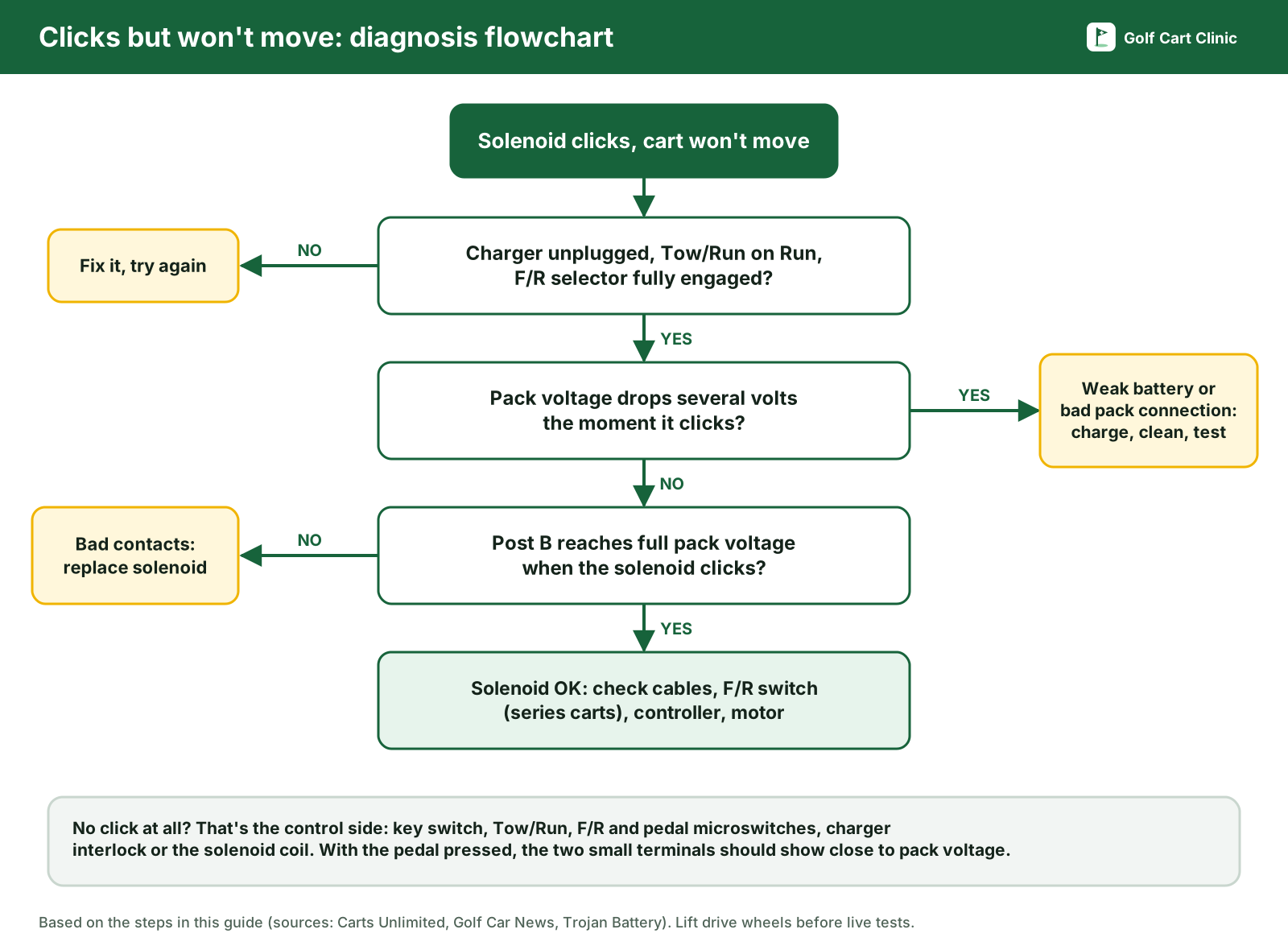
Diagnosis path at a glance
- If the charger is plugged in, Tow/Run is on Tow, or the F/R selector is between positions → fix that first and try again.
- If pack voltage drops by several volts when the solenoid clicks → suspect a weak battery or bad pack connection (Step 1).
- If the pack is healthy but the solenoid's output post doesn't reach pack voltage when it clicks → the solenoid contacts are bad. Replace the solenoid (Step 2).
- If the output post does reach pack voltage → follow the power to the cables, F/R switch, controller and motor (Step 3).
- If there's no click at all → it's a control-circuit or solenoid-coil problem (see the last section).
What should I check before getting the meter out?
- Charger unplugged? Many carts have an interlock that prevents driving while the charger cord is connected.
- Tow/Run switch on Run? On carts that have one, Tow disables the drive system (and on some models the regenerative braking). Check your manual for its location; it's often under the seat.
- Forward/Reverse fully engaged? A selector sitting between positions can let the solenoid click while the motor circuit stays open. Move it firmly into Forward, then into Reverse, and try both directions.
- Parking brake released and no wheel jammed against an obstacle.
- Look at the batteries and cables. While the seat is up, check the electrolyte level too: low water is a common cause of weak flooded batteries (see how to water golf cart batteries). White or green crust, a cable you can twist by hand, a melted or discolored terminal, or a cracked battery case all point to the cause right away. With the key off, pull and twist each large cable end gently. Nothing should move.
Step 1: Is the battery pack strong enough?
Set a digital multimeter to DC volts on a range above your pack voltage. Put the black lead on the pack's main negative terminal and the red lead on the main positive.
A rested, fully charged flooded lead-acid pack reads a little above its nominal voltage. Trojan's chart lists about 38.2V for a 36V pack and 50.9V for a 48V pack at 100% state of charge. At about 50% charge, the same packs read around 36.3V and 48.4V (Trojan Battery maintenance guide). Those figures are taken after the batteries have rested several hours off the charger. If your pack reads well below the 50% numbers, charge it fully before going further. Our battery and charging guides cover the full voltage chart and battery care.
Next, watch the meter while a helper presses the pedal with the drive wheels lifted. A healthy pack sags a little. A big drop (several volts) the moment the solenoid clicks suggests a weak battery or a bad connection somewhere in the pack. If the voltage doesn't move at all, current isn't flowing, which points to the solenoid contacts, a cable or the controller. That load-drop test is also the first step in Carts Unlimited's troubleshooting tips.
To find a single bad battery, measure each battery on its own while the pedal is pressed. One battery that reads noticeably lower than the others is the weak link.
Step 2: How do I test the golf cart solenoid?
This is the key test for a clicking-but-not-going cart, and it works on most 36V and 48V carts.
- Keep the drive wheels safely off the ground, with the key on, the selector in Forward and Tow/Run on Run.
- Put the meter's black lead on the pack main negative.
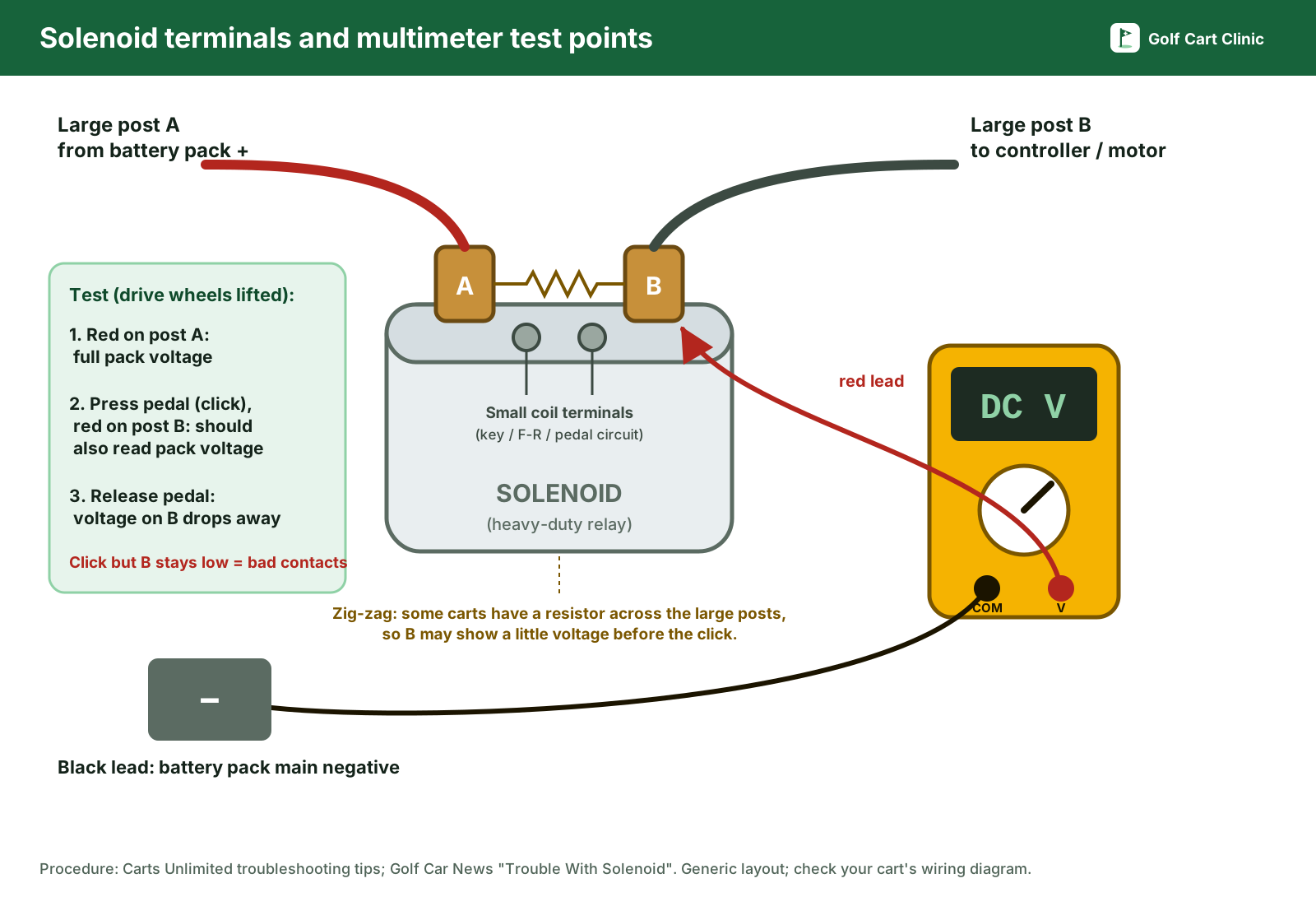
- Touch the red lead to the large solenoid post that comes from the battery positive. It should read full pack voltage. If it doesn't, the problem is between the pack and the solenoid: a cable, a fuse or a connection.
- Move the red lead to the other large post (the side going to the controller). Have a helper press the pedal. When the solenoid clicks, this post should also read full pack voltage.
- Release the pedal. The voltage on that output post should drop away.
If you get the click but the output post doesn't come up to pack voltage (or reads much lower), the contacts inside the solenoid are burned or worn. Replace the solenoid. Repeat the test several times, because worn contacts can work intermittently.
Why the output post may show voltage before the click. Many carts have a small resistor across the large solenoid posts (a pre-charge resistor for the controller), so you may see some voltage on the output side even with the pedal up. Carts Unlimited's procedure removes that resistor first so the reading is clear. What matters is that the output reaches full pack voltage when the solenoid clicks.
When replacing a solenoid, match the coil voltage (36V or 48V), the duty rating and the small-terminal setup, including any diode or resistor, to the original part for your model. Note the wiring or take a photo before you remove anything. If the new solenoid has a diode or resistor the old one didn't, see golf cart solenoid diode and resistor for which way the diode goes.
Step 3: The solenoid is fine. What next?
If full pack voltage reaches the solenoid output when it clicks, the solenoid is doing its job. The current is stopping further along:
- Cables from the solenoid to the controller and motor. Look for heat discoloration, corrosion inside the lug, or a loose nut. A connection can look fine and still fail under load, so check that each cable end feels tight. If a battery post sparks continuously when you reconnect it, find that short first: see golf cart sparks when connecting the battery.
- Forward/Reverse switch (series-wound carts). On series carts the F/R switch carries motor current. Burned contacts there give the same symptom. On separately excited (sepex) carts, direction is handled by the controller instead.
- Controller. Many aftermarket and OEM controllers have a status LED or fault codes. Check the manual for your controller (or the cart's service manual) to read them. A controller that won't output current needs model-specific testing; don't guess.
- Motor. Worn brushes or damaged windings can stop the cart. Motor testing is model-specific; if everything up to the motor checks out, a qualified technician or a motor rebuild shop is usually the next stop.
What if there's no click at all?
No click means the coil isn't getting power, or the solenoid coil itself has failed. That's the control side. The usual suspects are the key switch, the Forward/Reverse microswitch, the pedal-box microswitch, the Tow/Run switch, a charger interlock, or a controller that doesn't complete the coil circuit. A quick confirmation: with the pedal pressed, measure across the two small terminals of the solenoid. You should see close to pack voltage (Carts Unlimited notes the coil needs positive on one small terminal and negative on the other). If the voltage is there but there's no click, the coil is bad. If it isn't, trace the control wiring back. For the full no-click checklist (Tow/Run timing, charger interlock, control fuse, pedal sensors), see golf cart won't move: troubleshooting by symptom. On an E-Z-GO TXT, the EZGO TXT won't move guide lists the controller pin readings for each drive system, and our Club Car DS won't move guide does the same for PowerDrive 48 and IQ carts. You can also browse our golf cart troubleshooting guides.
Does this apply to gas golf carts?
On a gas cart, a click without the engine turning over usually involves the starter/generator solenoid and the 12V battery, not a 36V/48V pack. The meter logic is similar, but the voltages and circuits are not, so use your model's service manual.
Frequently asked questions
Can a golf cart solenoid click and still be bad?
Yes. The click only shows that the coil pulled the plunger. Burned or pitted contacts can fail to pass current even though you hear the click. The voltage test in Step 2 is how you confirm it.
Can bad batteries make the solenoid click but the cart not move?
Yes. A pack that is discharged, or has one failing battery or a loose connection, can have enough voltage to pull in the solenoid but collapse as soon as the motor tries to draw current. Check pack voltage at rest and while pressing the pedal.
Is it safe to bypass the solenoid to test the cart?
We don't recommend it. Jumping the large posts sends full pack current to the controller and motor with no control and can make the cart lurch, arc violently or damage the controller. Use the meter test instead.
How do I know which solenoid to buy?
Match your cart's brand, model, year and pack voltage, plus the coil voltage and terminal layout of the original. Our serial number lookup helps identify Club Car and Yamaha model years.
Sources
- Golf Car News, "Trouble With Solenoid" (solenoid voltage test): golfcarnews.com
- Carts Unlimited, troubleshooting tips (load-drop test, solenoid open/close test, control vs supply circuits): cartsunlimited.net
- Trojan Battery, battery maintenance and open-circuit voltage chart: trojanbattery.com
- Your cart's owner's and service manual (Tow/Run switch, controller fault codes, wiring).
Questions and comments
No comments yet. Corrections and notes from your own repair are welcome.