
Delaware Golf Cart Laws (2026): No Public Roads, LSV Rules and Beach Towns
Golf carts aren't allowed on Delaware's public roads, and the DMV won't number a converted cart. Only factory-built low-speed vehicles that meet FMVSS 500, with a title, plate, insurance and a licensed driver, may use roads posted 35 mph or less. Here's what the 2026 OHV change means, the LSV rules and what Fenwick Island and other towns add.
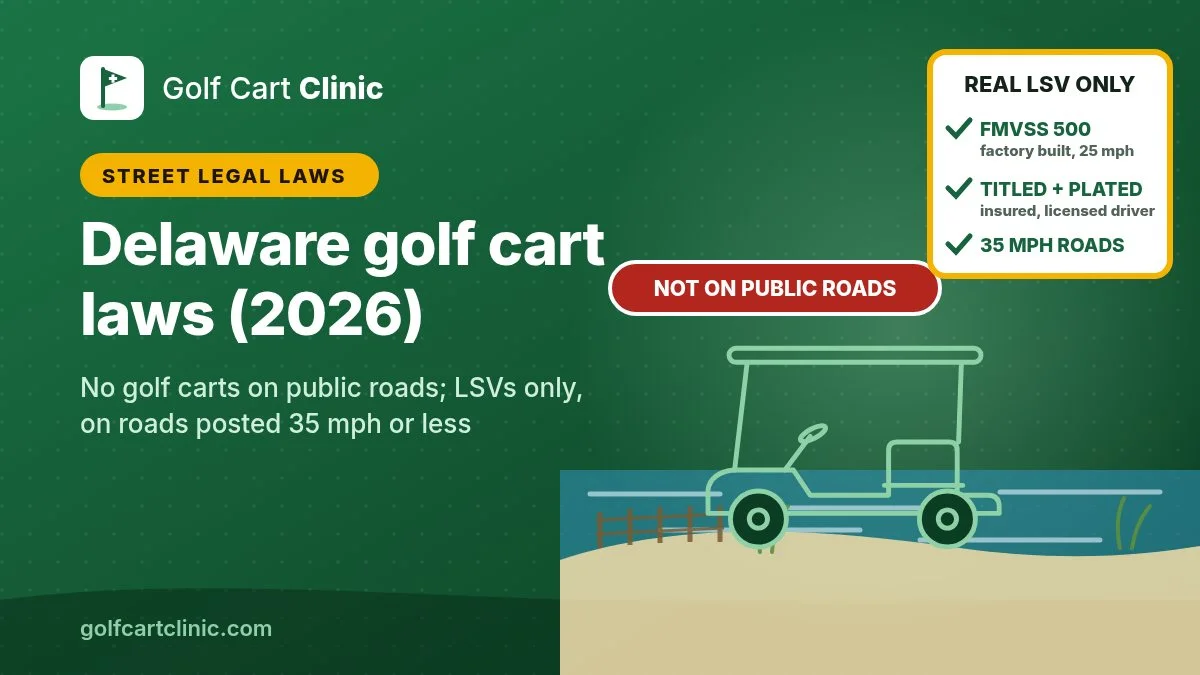
In Delaware, a golf cart may not be driven on public roads at all. The Division of Motor Vehicles says plainly that "golf carts are not allowed to operate on Delaware highways," Title 21 has no golf cart permit, plate or local opt-in provision, and the DMV won't issue a VIN to a retrofitted golf cart unless it meets the federal low-speed vehicle standard. The only street-legal option is a factory-built low-speed vehicle (LSV): titled, plated, insured, driven by a licensed driver and kept to roads posted 35 mph or less. Plain golf carts stay on private property, golf courses and private community roads where the owner or association allows them.
Not legal advice. Last verified: October 26, 2026. This guide summarizes Title 21 of the Delaware Code as published on the official Delaware Code Online (delcode.delaware.gov), session laws and bill records from the Delaware General Assembly, and guidance from the Delaware Division of Motor Vehicles (DMV). Beach towns and private communities add their own rules. Before you drive, check with your town hall, your homeowners' association and the DMV.
Safety first. A golf cart has no doors, airbags or crash structure, and many have no seat belts. On a road shared with cars and trucks, even a low-speed crash can throw riders out. Keep every rider seated, never let anyone ride on the back or the roof, don't tow people on boards or wagons, and keep young children out of carts that aren't built with a proper seat and belt for them. If you want to use real roads, buy a real LSV.
What changed in 2026 (and 2024)
Two recent laws matter for Delaware cart owners:
- Golf carts are no longer treated as OHVs (July 23, 2026). House Bill 471, signed July 23, 2026 and effective that day (85 Del. Laws c. 411), rewrote part of the off-highway vehicle chapter. House Amendment 3, whose synopsis says it "removes golf carts from the definition" of OHV, added this sentence to 21 Del. C. § 6821(a): "For purposes of this chapter, a golf cart shall not be considered an OHV." The same law says that "operating an OHV on shared private roadways is presumed to be unauthorized" and changed the penalties for repeat OHV offenses, adding permanent impoundment for a third offense within 24 months (21 Del. C. § 6831).
- The LSV weight limit went up (September 19, 2024). 84 Del. Laws c. 403 (House Bill 416) changed the low-speed vehicle weight cap in 21 Del. C. § 2113A from a gross vehicle weight rating "less than 2,500" pounds to "3,000 pounds or less." Some older pages, including town codes, still show the 2,500-pound figure.
What the 2026 change did not do is make golf carts street legal. It takes golf carts out of the OHV chapter (Chapter 68 of Title 21) and its rules, such as the new presumption about shared private roadways. But no section of Title 21 authorizes golf carts on public roads, and the DMV still says they aren't allowed on highways. One older official page now reads differently: a 2016 Delaware State Police traffic-safety advisory for Long Neck described § 6814 as the law that "prohibits off-highway vehicles which includes golf carts on public roadways." Since July 23, 2026, golf carts are outside that chapter, so that explanation is out of date, but the bottom line (no golf carts on public roads) hasn't changed.
Golf cart, LSV or OHV? How Delaware sorts them
Delaware law doesn't have a separate "golf cart" definition, a golf cart registration class or a golf cart road statute. The two sections that name golf carts are § 2113A (low-speed vehicles) and § 6821 (OHVs). Here is how the three vehicle types compare:
| Vehicle | Delaware definition | Public roads? | Title, plate, insurance |
|---|---|---|---|
| Golf cart | No Title 21 definition; "shall not be considered an OHV" for Chapter 68 (§ 6821(a), since July 23, 2026) | No. DMV: "Golf carts are not allowed to operate on Delaware highways" | None available. DMV won't issue a VIN to a "retrofitted golf cart" unless it meets FMVSS 500 (§ 2113A(f)(1)) |
| Low-speed vehicle (LSV) | "A 4-wheeled motor vehicle, other than a truck," with a top speed over 20 and up to 25 mph, GVWR "3,000 pounds or less," meeting 49 C.F.R. § 571.500 (§ 2113A(a)-(b)) | Yes, on roads posted 35 mph or less; may cross faster roads at intersections | Delaware title that identifies it as an LSV, regular rear plate, § 2118 insurance, licensed driver |
| Off-highway vehicle (OHV), ATV | Motor-driven off-road vehicle "capable of cross-country travel without benefit of a road or trail" (§ 101(50)) | No, except pushed across in neutral or at a permitted special event (§ 6814) | OHV registration decal ($6 for 3 years, § 6803) |
Where can you drive a golf cart in Delaware?
Not on public roads. The DMV's Special Vehicles page says: "Golf carts are not allowed to operate on Delaware highways. These carts do not meet Federal motor vehicle safety standards." Title 21 defines a highway as "the entire width between boundary lines of every way or place of whatever nature open to the use of the public as a matter of right for purposes of vehicular travel" (21 Del. C. § 101(29)). That covers town streets, county roads and state routes, including the shoulders. We found no Delaware law that lets a town or county open its streets to plain golf carts, the way Florida or Michigan do.
Where golf carts do belong:
- Private property, with the owner's permission.
- Golf courses, under the course's rules.
- Private community roads. The highway definition "does not include a road or driveway upon grounds owned by private persons, colleges, universities or other institutions" (§ 101(29)). In a community with private roads, the association's rules decide whether carts are allowed. The 2026 presumption that OHV use on "shared private roadways" is unauthorized applies to OHVs, and golf carts are no longer OHVs under that chapter, but your HOA can still ban or limit carts.
One catch for private communities: under 21 Del. C. § 4101(a)(4), a majority of the property owners on a private road can, through their town or county, ask the state to take over traffic jurisdiction. Once the state accepts, "all provisions of Title 17 and this title shall apply to the affected private property." If your community did that, treat its roads like public roads and ask the HOA before you drive a cart there.
Can you make a golf cart street legal in Delaware?
Not by adding parts. Delaware ties street use to the federal LSV standard, and the DMV won't number a converted cart: "The Division shall not issue vehicle identification numbers to homemade low-speed vehicles or retrofitted golf carts unless these vehicles meet all of the requirements of the Federal Motor Vehicle Safety Standard, 49 C.F.R. § 571.500" (21 Del. C. § 2113A(f)(1)). The same subsection requires that "the manufacturer's certificate of origin and Delaware title shall clearly identify the vehicle as a low-speed vehicle." In practice that means buying a vehicle built and certified as an LSV by its maker, with a 17-digit VIN and an MCO that says LSV. A light kit, mirrors and belts on a standard golf cart don't change what the MCO says. If you're shopping, our serial number lookup helps you tell a golf cart serial from a real VIN.
Low-speed vehicles: where and how fast
Section 2113A(b) sets the road rules for LSVs:
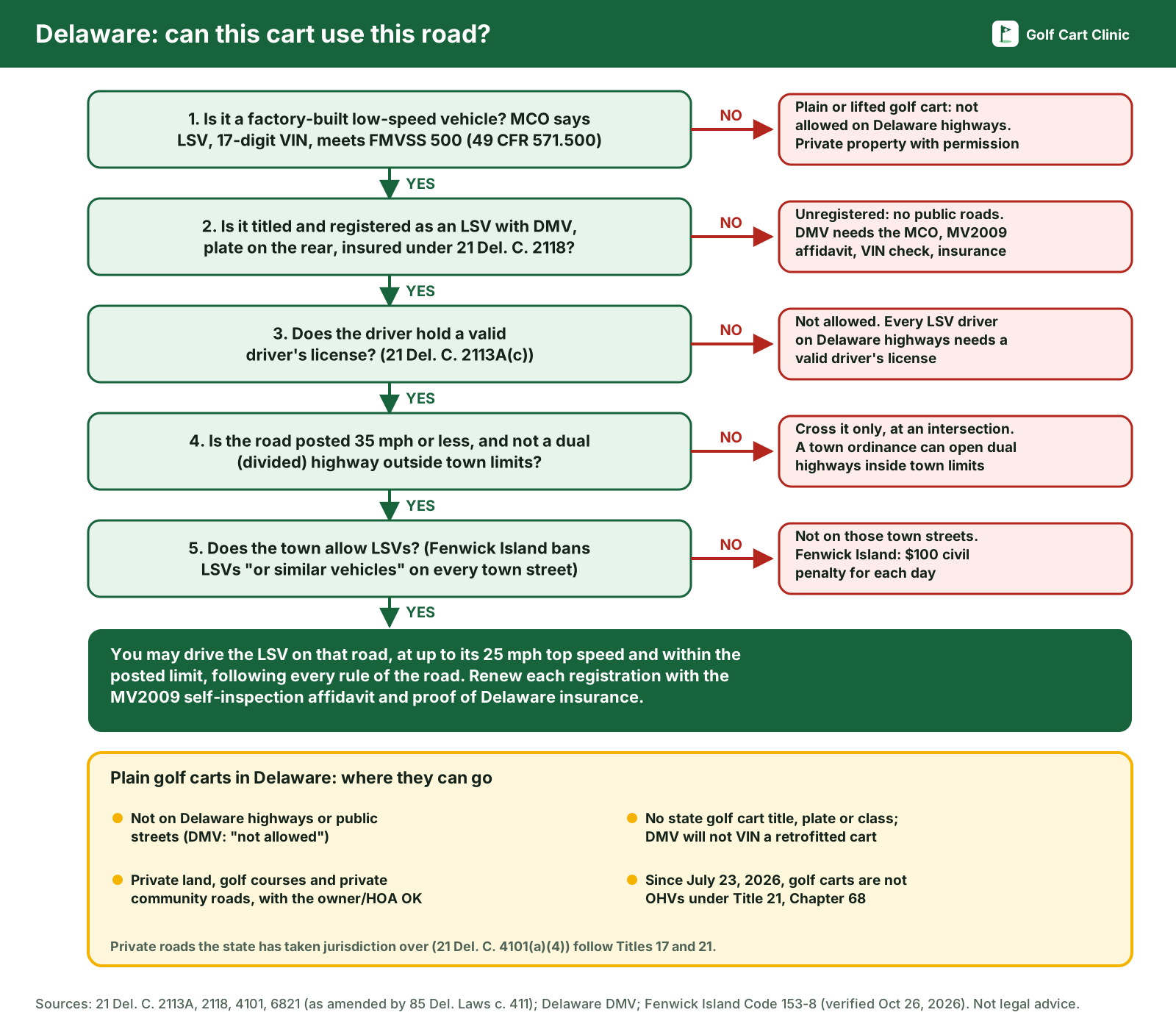
- 35 mph roads only. "Low-speed vehicles shall only be operated on roads where the posted speed limit is not more than 35 miles per hour."
- Crossing faster roads. "A low-speed vehicle may cross a highway at an intersection where the highway has a posted speed limit of more than 35 miles per hour." Cross at an intersection, not mid-block.
- No dual highways outside towns. LSVs "shall not be operated on dual highways, as defined in § 135 of Title 17 and located in the unincorporated portions of the State, except as needed to cross them." Dual highways are state highways DelDOT has divided into separate roadways with a median, curbs or other separation (17 Del. C. § 135).
- Towns can open their dual highways. LSVs "may be operated on such dual highways within incorporated cities and towns if the respective municipal government enacts an ordinance permitting such movement," still subject to the 35 mph rule.
- Top speed. An LSV can't go faster than 25 mph by definition (§ 2113A(a)), so on a 35 mph road you'll be well below the flow of traffic. Use the right lane, signal early and pick quieter routes.
Driver's license and age
For LSVs the rule is simple: "All persons operating a low-speed vehicle on the highways of this State shall hold a valid driver's license" (§ 2113A(c)).
For plain golf carts, there's no state age or license rule because there's no legal road use to regulate; on private property, the owner or association sets who may drive. The OHV chapter's age rules (§ 6824, for example the under-12 supervision rule) are written for OHVs, and since July 23, 2026 golf carts aren't OHVs for that chapter. Many communities and rental agreements set their own minimum ages, so check before you hand over the key.
Registration, title and plates
Plain golf carts: none. Delaware has no golf cart title, plate or decal, and you can't register one as an LSV unless it meets FMVSS 500 (§ 2113A(f)(1)). Driving an unregistered vehicle "of a type required to be registered" on a highway is itself a violation (21 Del. C. § 2101(a)).
LSVs are titled and registered like cars, with a few differences. According to the DMV's Low Speed Vehicles FAQ and § 2113A:
- New LSV: the Manufacturer's Certificate of Origin "identifying the vehicle as a low-speed vehicle," the Low-Speed Vehicle Self-Inspection Affidavit (MV2009), a VIN check by the DMV inspection lane (which gives you the MV212 Application for Title) or by the selling dealer, and proof of Delaware insurance.
- Used LSV: the current LSV title (an out-of-state title "must indicate it is a low-speed vehicle"), a DMV VIN check if it's titled elsewhere, the MV2009 and proof of insurance.
- No safety inspection. "Low-speed vehicles shall be exempt from Delaware's safety inspection." Instead, at each registration and renewal "the owner shall certify, under penalty of perjury, that all lights, brakes, tires, seat belts and other vehicle equipment are in good working condition" (§ 2113A(d)). An offsite VIN check by DMV technicians costs $15.
- Fees and plate. Registration fees "shall be the same as a normal passenger vehicle," and "a regular license plate shall be displayed on the rear of the vehicle" (§ 2113A(f)(2)). The DMV says LSVs get pleasure plates only ("number plates only").
- Dealers. Anyone selling LSVs at retail must be a DMV-licensed motor vehicle dealer (§ 2113A(g)).
Breaking the LSV rules in § 2113A carries a fine of $50 to $100 for a first offense, and $100 to $200, 10 to 30 days in jail, or both for later offenses (§ 2113A(h)).
Insurance
An LSV must carry the same insurance as any registered car: "Low-speed vehicles shall be required to maintain insurance as required by § 2118 of this title" (§ 2113A(e)). Section 2118 requires liability coverage at the financial responsibility limits, which Title 21 sets at $25,000 for bodily injury or death of one person, $50,000 for two or more people and $10,000 for property damage in one accident (§ 101(63)), plus personal injury protection for medical bills and lost earnings (§ 2118(a)(2)). There's a catch: insurers "may provide automobile insurance on these vehicles at their option" and "shall not be mandated to provide insurance on low-speed vehicles," so get a quote before you buy.
For a plain golf cart used on private property, there's no state insurance rule. Ask your homeowner's insurer whether the cart is covered, especially on community roads, and check whether your HOA requires proof of coverage.
Required equipment for an LSV
Delaware requires every LSV to "meet the requirements of 49 C.F.R. § 571.500" (§ 2113A(b)). Federal Motor Vehicle Safety Standard 500 lists the equipment an LSV must have from the factory:
| FMVSS 500, S5(b) | Required equipment | Typical golf cart |
|---|---|---|
| (1) | Headlamps | Often missing or an add-on kit |
| (2) | Front and rear turn signal lamps | Usually missing |
| (3), (4) | Taillamps and stop lamps | Often missing |
| (5) | Red reflex reflectors: one on each side as far to the rear as practicable, and one on the rear | Usually missing |
| (6) | Driver's side exterior mirror, plus a passenger side exterior mirror or an interior mirror | Usually missing |
| (7) | A parking brake | Usually present |
| (8) | A windshield meeting the federal glazing standard (49 CFR 571.205) | Often a plain acrylic windshield, not safety glazing |
| (9) | A VIN that meets 49 CFR part 565 | A manufacturer serial number, not a 17-digit VIN |
| (10) | A Type 1 or Type 2 seat belt at each designated seating position | Usually missing |
| (11), (12) | Rear visibility as specified in FMVSS 111 S6.2, and an alert sound where 49 CFR 571.141 requires one | Missing |
The parts list is why a kit can't turn a golf cart into an LSV in Delaware: the windshield, belts and VIN have to meet federal standards, and the manufacturer has to certify the whole vehicle. Our golf cart upgrades guides are for safer private-property and community use, not a path to plates. Keep the equipment working, because at renewal you sign the MV2009 under penalty of perjury.
Local rules: beach towns and Delaware City
Because state law already keeps golf carts off public roads, most local rules in Delaware are about LSVs. These are examples from official town codes and ordinance pages, not a complete list:
- Fenwick Island: the town bans LSVs outright. Town Code § 153-8 (added March 4, 2022) says "no low-speed vehicles (LSV), or similar vehicles, may be operated or driven on any Town street," except construction equipment, lawn mowers, emergency and town vehicles and electric personal assistive mobility devices. The penalty is $100 for each day of violation, plus the town's costs and reasonable attorney's fees, as a civil penalty. Note that § 153-7 still uses the old 2,500-pound LSV weight figure.
- South Bethany: no golf cart or LSV section, but town streets have a low speed limit that matters for LSV drivers: 20 mph, and 15 mph on Evergreen Road, Russell Road, Canal Drive, Tamarack Drive, Cattail Road and Black Gum Drive, with Route 1 as posted by DelDOT (South Bethany Code § 134-2).
- Bethany Beach: its vehicle operation article (Town Code Chapter 227, Article VII) has no golf cart or LSV section, so state law applies: no plain golf carts on town streets, and registered LSVs on roads posted 35 mph or less.
- Delaware City: the city's ordinance list includes Ordinance 25-1117-01 on "low-speed vehicles and modified golf carts." The posted revised text (December 15, 2025) limits use to registered city residents with a permit from the City Manager and a city sticker ($50 per calendar year). It requires LSVs and "modified golf carts" to be titled and carry a 17-digit VIN that DMV issues only for vehicles meeting FMVSS 500, drivers to be 18 or older and licensed, and no operation from 10:00 p.m. to 6:00 a.m. Plain golf carts were struck from that revision, and an earlier 2021 version is marked "not passed." Ask the city for the adopted text before relying on it.
We didn't find an LSV or golf cart ordinance to cite for Rehoboth Beach, Dewey Beach or Lewes, but towns can set their own speed limits and parking rules, so check with town hall before you drive an LSV there.
Drinking and other traffic laws
Delaware's DUI law says "no person shall drive a vehicle" while under the influence or with an alcohol concentration of .08 or more (21 Del. C. § 4177(a)), and that subchapter applies "upon highways and elsewhere throughout the State" (§ 4101(a)(2)). An LSV is a motor vehicle, so the rules of the road in Chapter 41 apply to it like any car. Don't drink and drive a golf cart on private roads either: a cart tips easily, and riders fall out.
Before you buy or drive in Delaware: a quick checklist
- Decide what you need. For private land, a golf course or a community with private roads, a golf cart is fine; for public roads, you need a factory-built LSV.
- For an LSV, confirm the MCO or title says "low-speed vehicle," it has a 17-digit VIN and it was certified to FMVSS 500.
- Get an insurance quote first, since insurers don't have to write LSV policies.
- Title and register it with the DMV: MCO or title, MV2009 affidavit, VIN check and proof of insurance.
- Make sure every driver has a valid driver's license.
- Plan routes on roads posted 35 mph or less, crossing faster roads only at intersections and skipping dual highways outside town limits.
- Check the town's code (Fenwick Island bans LSVs) and your HOA's rules for carts on community roads.
Frequently asked questions
Are golf carts street legal in Delaware?
No. The Delaware DMV says "golf carts are not allowed to operate on Delaware highways," and Title 21 has no provision letting towns or counties open streets to golf carts. Only factory-built low-speed vehicles that meet FMVSS 500 and are titled, registered and insured may use public roads, and only roads posted 35 mph or less.
Can I convert my golf cart into a street-legal LSV in Delaware?
Generally no. Under 21 Del. C. § 2113A(f)(1), the DMV "shall not issue vehicle identification numbers to homemade low-speed vehicles or retrofitted golf carts unless these vehicles meet all of the requirements" of FMVSS 500, and the MCO and title must identify the vehicle as an LSV. Adding a light kit, mirrors and belts doesn't make a golf cart meet that standard.
What changed in Delaware's golf cart law in 2026?
House Bill 471 (85 Del. Laws c. 411), effective July 23, 2026, added to 21 Del. C. § 6821(a): "For purposes of this chapter, a golf cart shall not be considered an OHV." It also made OHV use on shared private roadways presumptively unauthorized and changed repeat OHV penalties. It did not create any right to drive golf carts on public roads.
Can I drive a golf cart in my private community in Delaware?
Usually, if the community's roads are private and the association allows it; Delaware's definition of a highway excludes "a road or driveway upon grounds owned by private persons." If your community's roads are public, or the state has taken jurisdiction over them under 21 Del. C. § 4101(a)(4), treat them as public roads.
Do LSVs need insurance and plates in Delaware?
Yes. An LSV must carry the insurance required by 21 Del. C. § 2118, be titled as an LSV and display a regular license plate on the rear. Registration fees are the same as for a passenger car, and LSVs are exempt from the state safety inspection; instead, the owner signs a self-inspection affidavit (MV2009) at each registration and renewal.
Can an LSV drive on Route 1 or other 45 and 55 mph roads in Delaware?
Only to cross. An LSV may be driven only on roads posted 35 mph or less and may cross a faster highway at an intersection (21 Del. C. § 2113A(b)). It also may not use dual (divided) highways in unincorporated areas except to cross them, unless a town ordinance allows it within that town's limits.
Can I drive an LSV in Fenwick Island?
No. Fenwick Island Town Code § 153-8 says no LSVs "or similar vehicles" may be driven on any town street, with narrow exceptions, and sets a $100 civil penalty for each day of violation.
Delaware is among the strictest states we've covered for plain golf carts, along with Tennessee, where golf carts also stay off public roads and only registered LSVs and MSVs may use them, and California, where carts are limited to golf course areas and city golf cart plans. By contrast, Florida golf cart laws let cities and counties designate roads for golf carts, and Michigan golf cart laws let smaller towns allow them by resolution. For more states, browse our golf cart laws by state.
Sources
- Delaware Code, Title 21, § 2113A (low-speed vehicles), § 2101 (unregistered vehicles), § 2118 (insurance): Chapter 21, Subchapter I (delcode.delaware.gov)
- Delaware Code, Title 21, § 101 (definitions: highway, motor vehicle, OHV, financial responsibility, vehicle): Chapter 1; § 4101 and § 4177: Chapter 41, Subchapter I and Subchapter IX; Chapter 68 (OHVs, §§ 6803, 6814, 6821, 6824, 6831): Chapter 68; Title 17 § 135 (dual highways): Title 17, Chapter 1, Subchapter III
- House Bill 471 with House Amendments 1, 2 and 3, 85 Del. Laws c. 411 (signed July 23, 2026): bill detail; engrossed text; House Amendment 3 (legis.delaware.gov)
- 84 Del. Laws c. 403 (House Bill 416, approved September 19, 2024, LSV weight limit): legis.delaware.gov
- Delaware DMV: Special Vehicles, Golf Carts; Low Speed Vehicles FAQ (dmv.de.gov)
- Delaware State Police, Traffic-Safety Advisory for Long Neck Road and Surrounding Area (June 13, 2016; predates the 2026 change)
- 49 C.F.R. § 571.500 (FMVSS 500, low-speed vehicles): ecfr.gov
- Local: Town of Fenwick Island Code Chapter 153 (ecode360.com); Town of South Bethany Code Chapter 134 (ecode360.com); Town of Bethany Beach Code Chapter 227, Article VII (ecode360.com); City of Delaware City ordinances and Ordinance 25-1117-01 (delawarecity.org)
Questions and comments
No comments yet. Corrections and notes from your own repair are welcome.