
How to Water Golf Cart Batteries (When, How Much and What Water)
Watering at the wrong time or with the wrong water shortens battery life. Follow the battery maker's rules: after charging, distilled water, 1/8 inch below the well.
Flooded lead-acid golf cart batteries lose water every time they charge, and topping them up at the wrong time or with the wrong water is one of the most common ways owners shorten battery life. The rule that matters most comes straight from battery maker Trojan: add water after a full charge, using distilled water, to 1/8 inch below the bottom of the fill well. Before charging, add only enough to cover exposed plates.
Safety first. Battery electrolyte is sulfuric acid, and charging produces explosive hydrogen gas. Wear safety goggles and gloves, keep sparks and flames away, remove metal jewelry, and charge only in a well-ventilated area. Never lay tools across the battery tops. If a terminal keeps sparking when you reconnect a cable, stop and read why a golf cart sparks when connecting the battery.
Do your golf cart batteries need water?
Only flooded (wet-cell) lead-acid batteries need water. They have removable vent caps on top, usually three caps on a 6V battery, four on an 8V and six on a 12V. AGM, gel and lithium batteries are sealed: never open them or add water. If your cart has a single large battery box with a display or Bluetooth app, it's probably lithium; check the label. Not sure what you have? Find your cart's model year with our golf cart serial number lookup, then check the owner's manual for that year.
What you need
- distilled water (Trojan recommends distilled; deionized is acceptable but distilled is preferred);
- safety goggles and acid-resistant gloves;
- a battery filler bottle or watering gun with automatic shut-off, or a small funnel;
- a flashlight;
- baking soda, water and an old brush for cleaning;
- optional: a voltmeter or hydrometer to check state of charge.
Never use tap water, bottled spring or mineral water, or acid. Trojan warns against water with high mineral content, and you should add water, never acid, to the cells.
Should you water before or after charging?
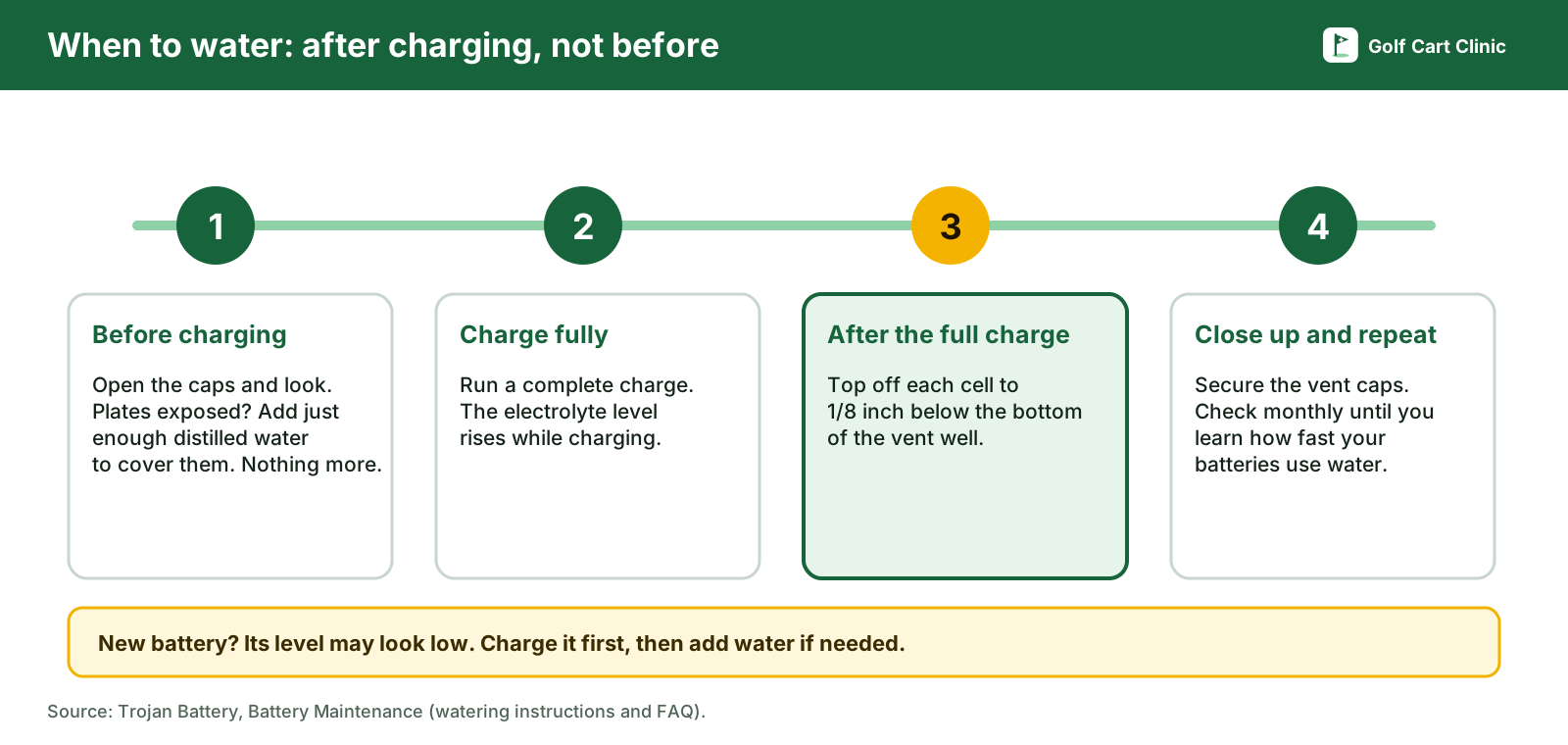
Electrolyte level rises as the battery charges. If you fill to the top before charging, it can overflow during the charge, spilling acid, corroding the battery tray and cables, and lowering the battery's capacity. That's why Trojan's rule is to water after a full charge.
The one exception: if the plates are exposed before charging, add just enough water to cover them, charge fully, then top off to the correct level. Exposed plates corrode and lose capacity permanently.
How to water golf cart batteries, step by step
- Park and prepare. Turn the key off, set the parking brake, unplug the charger and lift the seat. Put on goggles and gloves.
- Clean the tops first. Dirt and acid residue can fall into the cells when you open the caps. Wipe the battery tops with a cloth or brush and a solution of baking soda and water, keeping the caps closed so nothing gets inside. Rinse with plain water and dry.
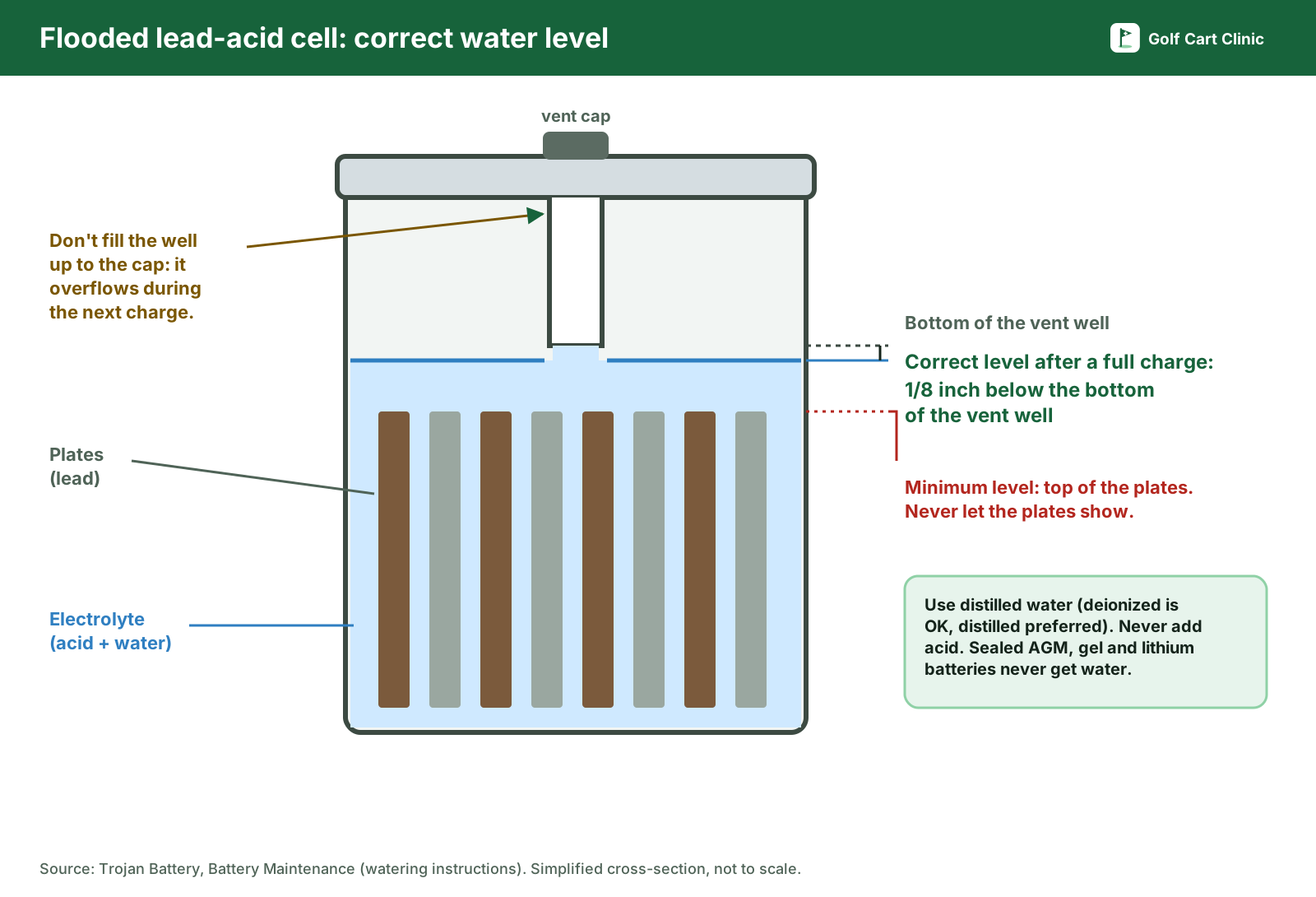
- Open the vent caps and look in. Use a flashlight. The minimum level is the top of the plates.
- If plates are exposed and the batteries aren't fully charged, add just enough distilled water to cover the plates, close the caps and run a complete charge.
- After a full charge, top off each cell to 1/8 inch below the bottom of the vent well (the plastic tube that extends down into the cell). Some Trojan Plus Series batteries have a maximum level indicator instead. Fill to that mark.
- Don't overfill. Never fill the well up to the cap; that's what causes acid overflow during the next charge.
- Close every vent cap firmly and wipe up any drips.
How often should you check battery water?
There isn't one schedule for every cart. Water loss depends on climate, how much you drive, and your charger. Trojan's guidance is to check monthly until you learn how quickly your batteries use water, then adjust. Carts driven daily in hot weather usually need checking more often than a cart used on weekends in a mild climate.
New batteries: a brand-new battery may have a low electrolyte level. Charge it first, then add water if needed. Adding water before the first charge can cause overflow. If the lights or horn stopped working after the new batteries went in, see golf cart lights not working after new batteries.
What voltage should golf cart batteries read?
Watering day is a good time to make sure the pack is healthy. Trojan's open-circuit voltage chart (batteries rested at least 6 hours, preferably 24, with no charging or load):
| State of charge | Specific gravity | 6V battery | 8V battery | 12V battery | 36V pack | 48V pack |
|---|---|---|---|---|---|---|
| 100% | 1.277 | 6.37 | 8.49 | 12.73 | 38.20 | 50.93 |
| 80% | 1.238 | 6.25 | 8.33 | 12.50 | 37.49 | 49.99 |
| 70% | 1.217 | 6.19 | 8.25 | 12.37 | 37.12 | 49.49 |
| 50% | 1.172 | 6.02 | 8.07 | 12.10 | 36.31 | 48.41 |
| 20% | 1.098 | 5.83 | 7.77 | 11.66 | 34.97 | 46.63 |
Source: Trojan Battery maintenance guide. Specific gravity is corrected to 80°F.
More battery testing and charging guides are in our golf cart batteries section. Trojan recommends charging after each period of use and says 50% or shallower discharges are best, with 80% discharge as the maximum. If one battery reads clearly lower than the others after a full charge and rest, it may be weak. A weak battery is also a classic cause of a cart that clicks but won't move or moves a few feet and quits. If you take hydrometer readings, take them before adding water: fresh water lowers specific gravity and skews the reading.
What are the signs of over- or under-watering?
- Wet battery tops, white or green corrosion, or acid in the tray after charging usually means overfilling. Clean with baking soda solution and lower your fill level next time.
- Plates visible above the electrolyte means the batteries were under-watered. Cover them, charge and top off. Range may be permanently reduced if it happened often.
- Water disappearing much faster than usual can point to overcharging or a charger problem. Check your charger's manual, or have it tested.
Are single-point watering systems worth it?
Single-point watering kits replace the vent caps with valves connected by tubing, so you fill every cell at once from one hand pump or reservoir, and each valve shuts off at the set level. They save time and reduce spills. Follow the kit maker's instructions, and still water only after a full charge, unless the kit's instructions say otherwise.
Frequently asked questions
Can I use tap water in golf cart batteries?
No. Trojan recommends distilled water and warns against water with high mineral content. Minerals in tap water can harm the battery. Deionized water is acceptable, but distilled is preferred.
Should I add water before or after charging?
After. Electrolyte rises during charging, so filling beforehand can cause overflow. The only time to add water before charging is when the plates are exposed. Then add just enough to cover them.
How full should golf cart batteries be?
For standard deep-cycle flooded batteries, fill to 1/8 inch below the bottom of the vent well after a full charge. The level should never drop below the top of the plates.
Do lithium golf cart batteries need water?
No. Lithium, AGM and gel batteries are sealed and must never be opened or watered.
Sources
- Trojan Battery, Battery Maintenance (watering, testing, cleaning, charging and discharging guidance, open-circuit voltage table): trojanbattery.com
- Your battery manufacturer's instructions and your cart's owner's manual.
Questions and comments
No comments yet. Corrections and notes from your own repair are welcome.