
Lithium Golf Cart Battery BMS Keeps Tripping? Causes and Fixes
A lithium golf cart battery that keeps shutting off is usually being asked for more amps than its BMS allows, or, on 12V batteries in series, one battery has drifted low and hits its cutoff first. Here's how to tell which, with the makers' ratings, and how to fix it without bypassing the BMS.
Quick answer: when a lithium golf cart battery's BMS keeps shutting off, it's almost always one of two things. Either the controller is pulling more current than the battery is rated for (it trips on takeoff, on hills or at full throttle), or, on carts running three or four 12V lithium batteries in series, one battery has drifted lower than the others and hits its low-voltage cutoff first (the same battery trips every time, often a block or two after a charge). Lower the controller's current limit or use a pack rated for your controller's amps, and charge series 12V batteries individually so they stay matched. Cold weather, loose terminals and the wrong charger profile are the next things to check.
Safety first. A golf cart lithium pack can deliver hundreds of amps into a short, enough to weld a wrench or burn a hand. Put the cart in Tow/Maintenance (if it has the switch), key off, charger unplugged, before you touch battery cables. Take off rings and watches, wear safety glasses and use insulated tools. Never bypass, jumper or "bridge" a BMS, and don't keep reviving a tripped battery by clamping another battery across it: the BMS is the only thing protecting those cells. Reset it the way your battery's manual says. If a battery is hot, swollen, smells burnt or hisses, stop using it, move away from it and contact the battery maker. Test drives after a fix belong on a flat, empty area where a sudden cutout can't strand you in traffic.
What a BMS trip actually is
Every lithium iron phosphate (LiFePO4) golf cart battery has a battery management system inside. It watches the cells and opens an internal switch when something is outside its limits. Battery makers list the same basic protections: over-charge (high voltage), over-discharge (low voltage), over-current, short circuit, high temperature and low temperature. When one trips, the output goes dead and the cart stops as if you'd pulled the key.
Most BMS trips reset on their own once the cause is gone. Battle Born says its BMS resets after about five seconds in most fault conditions, and that disconnecting the loads also resets it. LiTime's instructions for a battery that has shut itself off are to disconnect everything, let it sit for 30 minutes so it recovers above 10V, then fully charge it. Other brands want a button held or a charger connected, so check your manual. A reset only clears the trip. If you don't fix the cause, it'll trip again.
Match your symptom
| When it trips | Most likely cause | What to do |
|---|---|---|
| On hard takeoff, climbing a hill, towing or at full throttle, even with a full charge | Over-current: the controller asks for more amps than the BMS allows | Lower the controller current limit, or move to a pack rated for your controller |
| Same battery in a 12V series string every time, often a block or two after charging | That battery is at a lower state of charge (or weaker) than the others | Charge each battery to full on its own, then compare resting voltages |
| Gets worse over weeks, ran fine for months | Series imbalance building up with each charge, or one battery losing capacity | Individual charging; if one battery still lags, have it checked under warranty |
| Only on cold mornings, or it won't take a charge in the cold | Low-temperature protection | Charge in a warmer garage; check your battery's temperature limits |
| While charging, or right as the charger finishes | High-voltage protection: wrong charger profile or voltage | Use a LiFePO4 charger that matches your pack voltage |
| Randomly over bumps, sometimes with a flicker of the dash | Loose terminal or cable lug | Torque every lug to the battery maker's spec and look for heat marks |
| Trips at light load even when charged and balanced | Failing battery or BMS | Contact the battery maker; don't keep resetting it |
Cause 1: the cart pulls more amps than the battery is rated for
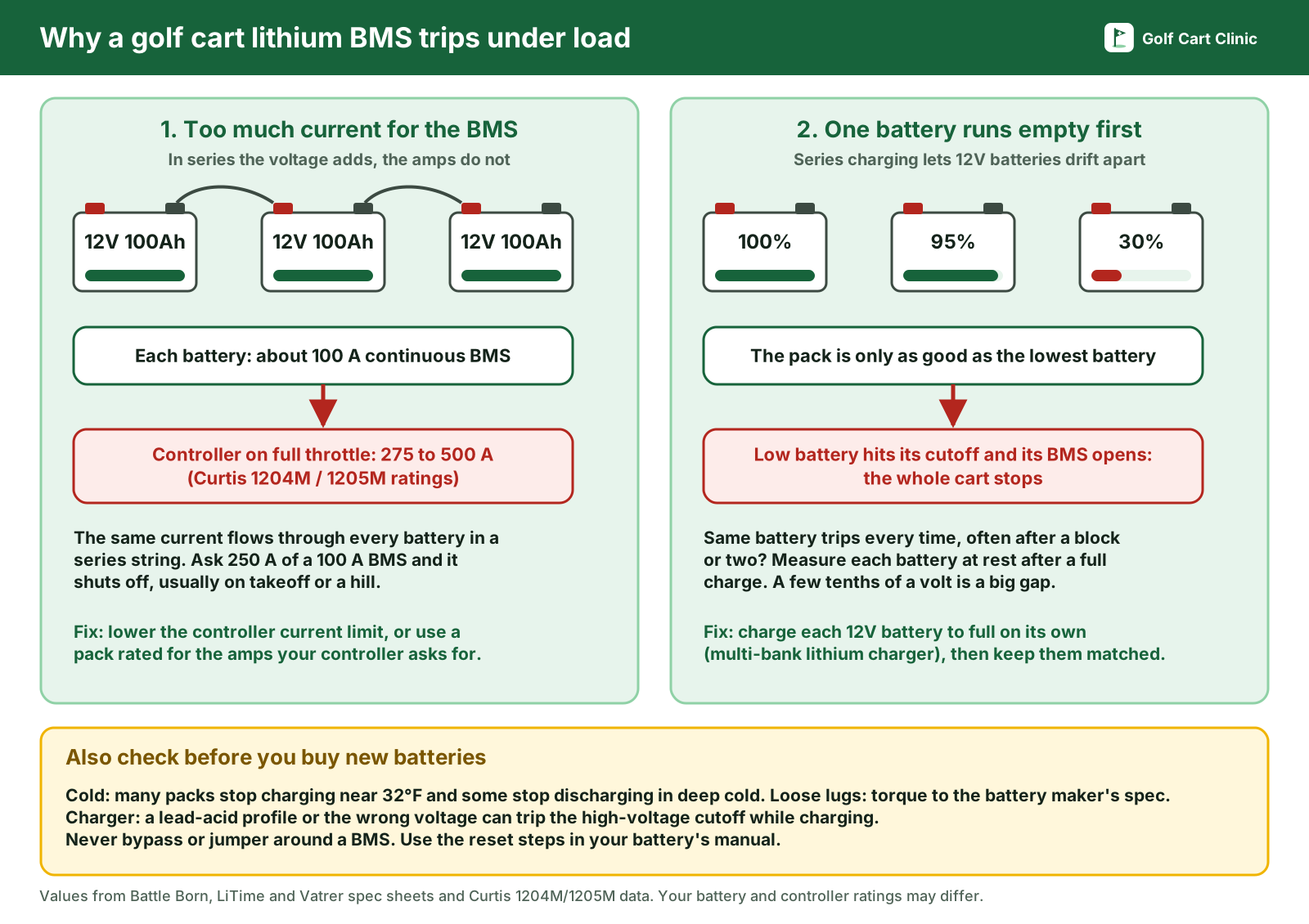
This is the big one, and it catches a lot of people who swap lead-acid for budget 12V lithium batteries. When you wire batteries in series, the voltage adds up but the current rating doesn't. Battle Born puts it plainly: in series, current capacities stay the same. Three 12V batteries rated at 100 amps make a 36V pack that's still rated at 100 amps.
Here's what typical 12V 100Ah lithium batteries are rated for, straight from the makers' spec sheets:
- LiTime 12V 100Ah (Group 24): 100 A continuous, 280 A for 5 seconds, 400 A for 1 second.
- Battle Born BB10012: 100 A continuous, 200 A for 30 seconds, and a half-second surge allowance above that.
Now look at what a golf cart controller can ask for. Curtis lists its 1204M series controllers at 275 A or 325 A for two minutes, and the 36/48V 1205M-5603 at 500 A for one minute, with a further 10% boost for 5 seconds. Your controller won't pull its full rating all the time, but a hard takeoff, a hill or a heavy load can push it well past 100 A, and a hopped-up controller with a high-speed motor will get there sooner. When the current goes past what the BMS allows for longer than it allows, the BMS opens.
Batteries built for golf carts are rated much higher. Vatrer's 48V 105Ah golf cart battery, for example, lists 200 A continuous and 400 A for 35 seconds. LiTime's 48V 100Ah golf cart battery lists 100 A continuous, 200 A for 2 minutes and 600 A for 1 second. That's why the same cart can be fine on one pack and trip constantly on another.
Fix it
- Find both numbers. Read the controller's current rating (on its label or in its manual) and the battery's continuous and peak ratings, including how many seconds the peak is allowed for.
- Turn the controller's current limit down if it's programmable. Curtis 1204M and 1205M controllers can be set with the Curtis 1311 handheld programmer or 1314 PC station: the 1205M-5601/5602 range is 250 to 500 A, and the 1204M-5201/5202 range is 125 to 275 A. Bring it down toward what the battery can hold for a few seconds, then test. You'll give up some hill pull and takeoff punch. Many stock factory controllers aren't owner-programmable, so this option may need a dealer tool or isn't available.
- Or use a battery that matches the controller. If you want to keep the power, the battery's continuous rating should be near the controller's working current and its peak rating should cover your hard takeoffs. On a high-amp controller that usually means a dedicated 36V or 48V golf cart pack with a 200 A or larger BMS, not stacked 12V batteries.
- Check the cables. Heavier current needs heavy, tight cables. A warm cable or lug after a drive means a bad connection or undersized wire.
Cause 2: one battery in a series string runs empty first
If your cart runs on three or four 12V lithium batteries in series and it's always the same battery that shuts off, the batteries have probably drifted apart. No two batteries charge with exactly the same efficiency, and a 36V or 48V charger only sees the total pack voltage. One battery can finish full while another is still short, and the gap grows a little with every cycle. On the road, the series string is only as good as the lowest battery. When that one reaches its low-voltage cutoff, its BMS opens and the whole cart stops, even though the other batteries still have plenty left.
Battery makers know this, which is why they're strict about series setups. Battle Born says to charge every battery to 14.2 to 14.6V with a lithium charger and get them all to the same state of charge before connecting them in series, otherwise you'll get balance issues. LiTime says batteries in series should be identical (same capacity and BMS), from the same brand, and bought within about a month of each other.
Check for imbalance
- Fully charge the pack, then let it sit with no load and no charger for at least 3 hours. LiTime says resting voltage is more meaningful than a reading under load.
- Meter each battery on its own posts and write the numbers down.
- Compare. LiFePO4 voltage is very flat, so small differences matter. LiTime's chart for a rested 12V battery puts about 13.33V at roughly 100%, 13.1 to 13.2V at roughly 50% and 13.0 to 13.1V at roughly 25%. Two batteries a few tenths of a volt apart can be most of a charge apart.
Fix it
- Charge the batteries individually to full with a 12V lithium charger, then reconnect. A multi-bank charger saves you from moving clips around: NOCO's GENPRO10X3 and GENPRO10X4, for example, have three or four independent 10 A banks with a 12V lithium mode (for batteries that have a BMS), so each battery gets its own charge while the cart stays wired in series.
- Keep them matched. Some owners use a multi-bank charger every time; others use the pack charger day to day and top up each battery individually now and then. If the trips stop after a balanced charge and come back weeks later, the batteries are drifting again.
- If one battery still lags after an individual full charge, it may have lost capacity. Note its voltage and how fast it drops, and take it up with the battery maker.
- Long term, a single 36V or 48V golf cart pack avoids series imbalance between batteries altogether, because one BMS manages all the cells.
Other causes to rule out
- Cold. LiFePO4 batteries won't charge near freezing. Vatrer's golf cart pack stops charging below 32°F and resumes at 41°F, and cuts discharge below 4°F. LiTime's 12V batteries have low-temperature charge protection with the same 32°F/41°F points. If it only acts up on cold mornings, that's probably it.
- Charger profile. A lead-acid charger or one set to the wrong voltage can push a pack past its high-voltage cutoff, so it trips near the end of a charge. Use a LiFePO4 charger built for your pack voltage. On a 4 x 12V string, Battle Born calls for 57.6V bulk/absorption and float below 54.4V.
- Loose or dirty terminals. A loose lug heats up and causes voltage drops under load. Torque to the battery maker's spec: Battle Born calls for 9 to 11 ft-lb on the BB10012, and LiTime lists 106 to 124 in-lb on its 12V 100Ah. Look for discolored lugs or melted terminal caps.
- A short or a bad accessory wire. If the BMS dropped out right as you connected something, see golf cart sparks when connecting the battery before you reset anything.
Resetting a tripped BMS the right way
- Stop, key off, Tow/Maintenance on.
- Follow your manual's reset. For example, Battle Born resets after about five seconds or when the load is disconnected; LiTime says to disconnect everything, wait 30 minutes and then charge it fully.
- Check the battery's voltage. If it stays at 0V or won't come back, contact the maker. A battery that's been run all the way down may need its maker's wake-up procedure, usually with a proper charger.
- Fix the cause before you drive hard again.
When to stop and call for help
Call the battery maker or a qualified golf cart tech if a battery gets hot, swells or smells, if it trips at light load when it's fully charged and balanced, or if the Bluetooth app (on batteries that have one) shows a cell or BMS fault you can't clear. If your cart won't move at all and you're not sure the battery is the problem, start with golf cart won't move troubleshooting.
FAQ
Why does my lithium golf cart cut out when I floor it?
The controller is drawing more current than the battery's BMS allows, so it shuts off to protect the cells. Turn the controller's current limit down if it's programmable, or use a battery with higher continuous and peak ratings.
Can I use 12V lithium batteries in series in a golf cart?
You can, if they're identical, matched before you connect them and rated for the current your controller pulls. Many 12V 100Ah batteries are rated at only 100 A continuous, which a golf cart can exceed on takeoff. Charge them individually from time to time so they stay balanced.
Why is it always the same battery that trips?
That battery is usually at a lower state of charge than the others, or has lost capacity, so it reaches its low-voltage cutoff first. Charge each battery to full on its own, let them rest and compare voltages.
Will turning down the controller current limit hurt the cart?
No, but you'll lose some takeoff and hill power. It's a tradeoff between performance and staying inside the battery's ratings.
Is it safe to jump a tripped lithium battery with another battery?
Don't make a habit of it. Clamping another battery across one with a tripped BMS forces current around its protection with no fuse in the way. Use the reset steps in your battery's manual and fix why it tripped.
Sources
- Battle Born Batteries, BB10012 data sheet (100 A continuous, 200 A for 30 seconds, BMS discharge cut-off 10V): battlebornbatteries.com (PDF)
- Battle Born Batteries, BB10012 manual (series connection keeps the same current rating, charge each battery to 14.2 to 14.6V and match state of charge before connecting, BMS reset, terminal torque 9 to 11 ft-lb): battlebornbatteries.com (PDF)
- Battle Born Batteries manual, as published by Tiffin Motorhomes (48V series charge voltages): knowledge.tiffinmotorhomes.com
- LiTime, 12V 100Ah Group 24 battery specifications (100 A continuous, 280 A for 5 s, 400 A for 1 s; series rules): litime.com
- LiTime, lithium battery user manual (resting-voltage state of charge chart, BMS protection recovery): au.litime.com
- LiTime, 12V 100Ah TM battery user manual (terminal torque, low-temperature charging protection, series conditions): PDF
- LiTime, 48V 100Ah golf cart battery specifications (100 A continuous, 200 A for 2 minutes, 600 A for 1 s): litime.com
- Vatrer Power, 48V 105Ah golf cart battery specifications (200 A continuous, 400 A for 35 s, BMS protections, temperature cutoffs): vatrerpower.com
- Curtis Instruments, 1204M/1205M/1221M data sheet (current ratings by model, 5 s 10% boost): curtisinstruments.com (PDF)
- Curtis Instruments, 1204M/1205M manual (programmable current limit ranges, 1311/1314 programmers): PDF hosted by Noco-EVCO
- NOCO, GENPRO10X4 specifications and support (four independent 10 A banks, 12V lithium mode for batteries with a BMS): no.co
- Your battery's and controller's own manuals. They take priority where they differ from this guide.
Last checked against the documents above on October 26, 2026.
Questions and comments
No comments yet. Corrections and notes from your own repair are welcome.