
South Carolina Golf Cart Laws (2026): Permit Decal, 4-Mile Rule and LSVs
South Carolina golf carts need a $5 SCDMV permit decal, insurance and a licensed driver 16 or older. Without a local ordinance they stay on 35 mph secondary roads, in daylight, within 4 miles of home. Here is the 2025 law change, the LSV and UTV rules and the official links.
South Carolina has its own golf cart permit system. To drive a golf cart on a public road you need a $5 permit decal and registration certificate from the SCDMV, liability insurance and a driver who is at least 16 with a valid license. Unless your city or county has passed its own golf cart ordinance, the cart may only be driven in daylight, on secondary roads posted 35 mph or less, within 4 miles of the address on the registration. The statute is S.C. Code §56-2-90, and this guide walks through it with links so you can check each rule yourself.
Not legal advice. Last verified: October 23, 2026. This is a plain-English summary of the South Carolina Code of Laws (Title 56) and SCDMV guidance. Cities and counties can pass golf cart ordinances that change the hours, roads and areas where carts may drive, and HOAs, gated communities and private property owners can add their own rules. Check your city or county code, your community association or the local police before you drive a golf cart on a public road.
The law changed in 2025: §56-2-105 is now §56-2-90
If you read older articles about South Carolina golf carts, you'll see them cite §56-2-105. That section was repealed by 2025 Act No. 64 (H.3292, signed May 22, 2025) and replaced with §56-2-90. The core rules stayed the same (permit decal, $5 fee, age 16 and a license, daylight, 35 mph roads, 4 miles), but three things changed:
- Cities and counties got real control. A municipality, or a county in its unincorporated areas, may now set the hours, methods and locations of golf cart use by ordinance, allow night driving, and build golf cart paths on road shoulders (§56-2-90(C)). The old section only let a town shrink the 4-mile zone to no less than 2 miles, and it had a separate rule for islands not reachable by a car bridge (as quoted on the City of Myrtle Beach golf cart page). Neither of those is in the current text.
- Children under 12 must wear a seat belt on public streets and highways (§56-2-90(E)).
- A 2026 amendment (2026 Act No. 164, S.222, effective May 18, 2026) exempted golf-course-owned carts used for golf from the seat belt rule and added a game-day rule for big stadium and arena events (see below).
Where can you drive a golf cart in South Carolina?
It depends on whether your city or county has adopted a golf cart ordinance under §56-2-90(C).
Default state rule (no local ordinance)
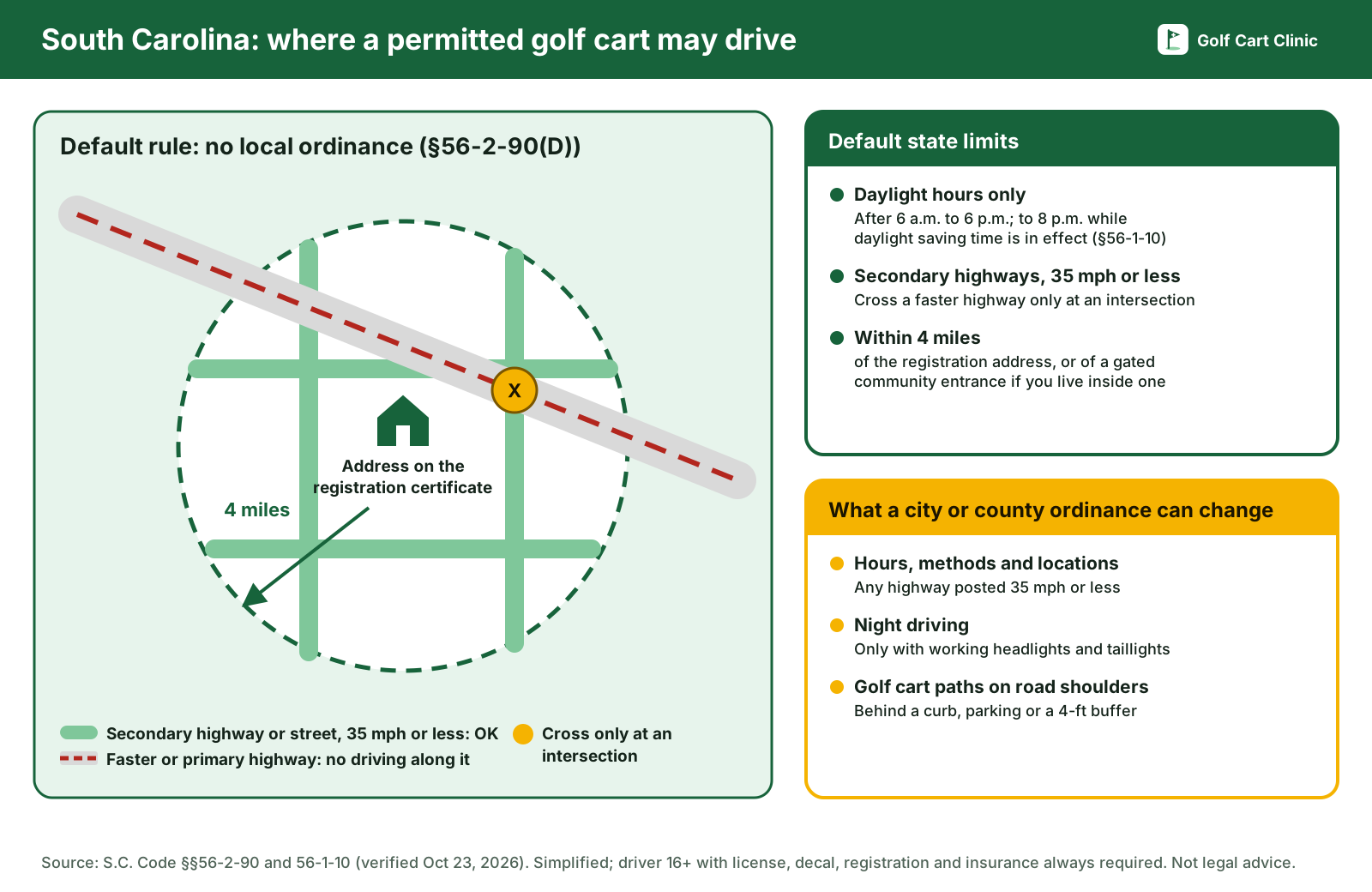
Under §56-2-90(D), a permitted golf cart may:
- be operated only during daylight hours;
- be operated only on a secondary highway where the speed limit is 35 miles per hour or less;
- be operated only within four miles of the address on the registration certificate, or within four miles of a point of ingress and egress of a gated community if the address is inside a gated community; and
- cross a highway with a speed limit above 35 mph, but only at an intersection.
"Daylight hours" has an exact legal meaning in South Carolina: after 6 a.m. and no later than 6 p.m., and from the day daylight saving time starts until the day it ends, after 6 a.m. and no later than 8 p.m. (§56-1-10(27)). So a summer evening ride that ends at 8:30 p.m. is outside the default rule even if it's still light out.
When your city or county has a golf cart ordinance
A municipality, or a county within its unincorporated areas, may by ordinance (§56-2-90(C)):
- Set the hours, methods and locations of golf cart operation, but only on highways where the speed limit is 35 mph or less. Note the difference: the default rule says secondary highways; an ordinance can open any highway posted 35 mph or less.
- Allow night driving, as long as the carts have working headlights and taillights, again only on roads posted 35 mph or less.
- Designate golf cart paths on the shoulder of primary and secondary highways, streets and roads, if the path is separated from the traffic lanes by a hard concrete curb, by parking spaces, or by four feet or more.
Local governments also may not require proof of property ownership or a long-term rental agreement as a condition for getting a decal to drive a golf cart within their limits (§56-2-90(C)(4)).
Game-day exception near big stadiums and arenas
Since May 18, 2026, a golf cart may be driven along a primary highway, secondary highway, street or road within a half-mile radius of a Division I college athletic event, or of an event at a coliseum or arena that holds at least 19,000 people, from three hours before the event starts until one hour after it ends. Two conditions apply: a law enforcement agency must be controlling traffic for the event, and the cart and driver must still meet the permit, license, insurance and child seat belt rules. At night, the cart needs working headlights and taillights (§56-2-90(F)).
Speed and road limits at a glance
| Situation | Which roads | When | How far | Section |
|---|---|---|---|---|
| No local ordinance | Secondary highways posted 35 mph or less; cross faster highways only at intersections | Daylight hours only (6 a.m.–6 p.m., or to 8 p.m. during daylight saving time) | Within 4 miles of the registration address (or a gated community entrance) | §56-2-90(D), §56-1-10(27) |
| Local golf cart ordinance | Whatever the ordinance allows, but never a highway posted above 35 mph; shoulder cart paths if separated from traffic | Hours set by the ordinance; night use only with working headlights and taillights | Set by the ordinance | §56-2-90(C) |
| Division I game or 19,000-seat arena event | Primary or secondary highways, streets and roads within a half mile of the venue | 3 hours before to 1 hour after the event, with police controlling traffic | Half-mile radius | §56-2-90(F) |
The statute doesn't set a top speed for the cart itself. It controls which roads you may use by their posted speed limit.
Age and driver's license rules
A person driving a golf cart on a public highway must be at least 16 years old and hold a valid driver's license, and must have three things with them: the golf cart registration certificate, proof of liability insurance, and the driver's license itself (§56-2-90(B)). There is no younger "golf cart age" on public roads. Golf courses, private property and private community streets set their own rules.
Permit decal and registration: how to get one
South Carolina doesn't put a license plate on a golf cart. Instead, the owner gets a permit decal and a registration certificate from the SCDMV by showing proof of ownership and proof of liability insurance and paying a $5 fee (§56-2-90(A)). The SCDMV's golf cart page lists the steps:
- Fill out the Golf Cart Permit Decal and Registration Application (Form GC-2, Rev. 05/2026). It asks for the VIN (if the cart has one), make and year, your residence address and an optional "additional operating address."
- Provide proof of insurance for the golf cart and your valid driver's license number. On the form you certify, under penalty of perjury, the name of your insurance company and that you'll keep liability coverage for the whole registration period.
- Pay $5 at any SCDMV branch, or mail the form and payment to SCDMV, Titles and Registration, PO Box 1498, Blythewood, SC 29016-0024.
- Put the permit decal on the golf cart and keep the registration document in the cart at all times.
| GC-2 service | Fee | When |
|---|---|---|
| First-time decal and registration | $5 | New cart, or the old permit expired more than 5 years ago |
| Decal and registration renewal | $5 | Before the permit expires |
| Replace permit decal | $5 | Decal missing or damaged |
| Replace permit registration | $1 | Registration modified, lost or stolen |
The decal must be replaced every five years, or when the owner changes address, whichever comes first (§56-2-90(A)). Because the default 4-mile zone is measured from the address on the registration, moving also moves your zone. When you sell a cart, Form GC-2 says to notify the SCDMV in writing right away with the new owner's name and address and the date of sale, and the seller must remove the permit decal. If you're buying a used cart, our serial number lookup helps confirm the model year of a Club Car or Yamaha for the "Year" box.
Insurance requirements
You need proof of liability insurance both to get the decal (§56-2-90(A)) and to drive (§56-2-90(B)(2)). The statute ties the coverage to S.C. Code §38-77-140, which sets these minimum limits:
- $25,000 for bodily injury to one person in any one accident;
- $50,000 for bodily injury to two or more persons in any one accident;
- $25,000 for injury to or destruction of property of others in any one accident.
Ask your insurer which policy covers the cart on public roads before you apply, because you'll need the insurance company's name for Form GC-2.
Required equipment
For daytime driving under the default rule, §56-2-90 doesn't list any equipment. The statute's equipment rules are narrower than in many states:
- Headlights and taillights are required for night driving, which is only allowed where a local ordinance permits it (§56-2-90(C)(2)) or under the game-day rule (§56-2-90(F)(2)).
- Seat belts for children: every passenger under 12 must wear a fastened safety belt on public streets and highways (§56-2-90(E)). If your cart has no belts, you can't legally carry a child under 12 on the road. The only exception is a golf-course-owned cart used for playing golf on that course.
- Local ordinances can add more. Check your city or county code before you buy lights, mirrors or turn signals for road use; our golf cart upgrades section covers what fits.
Golf cart vs low speed vehicle (LSV) vs UTV in South Carolina
South Carolina treats these as three different vehicles with very different paperwork. A low speed vehicle is "a four-wheeled motor vehicle, other than an all terrain vehicle, whose speed attainable in one mile is more than twenty miles an hour and not more than twenty-five miles an hour on a paved level surface," with a gross vehicle weight rating under 3,000 pounds (§56-1-10(19)).
| Golf cart | Low speed vehicle (LSV) | UTV (from Nov. 18, 2026) | |
|---|---|---|---|
| Paperwork | $5 permit decal and registration certificate, every 5 years (§56-2-90(A)) | Titled, registered and plated like a passenger vehicle, with a special LSV plate (§56-2-120); SCDMV Form 400 has a "Low Speed Vehicle" box | Title branded "off road use only," registration, rear license plate, $10 biennial fee (§56-2-5090) |
| Roads | Default: secondary highways posted 35 mph or less, within 4 miles, daylight only | Highways posted 35 mph or less; may cross faster highways at intersections (§56-2-100) | Default: secondary highways posted 55 mph or less, within 10 miles; never interstates (§§56-2-5110, 56-2-5080) |
| Driver | 16+ with a valid driver's license (§56-2-90(B)) | 16+ with a valid driver's license (§56-2-110) | 17+ with a license valid at any time; no beginner's permits (§§56-2-5010, 56-2-5020) |
| Equipment | Headlights and taillights for night use; belts for passengers under 12 | Must meet FMVSS 500 at all times (§56-2-100(C)) | Seat belts at each seat, headlights, brake lights, taillights, turn signals (§56-2-5060) |
| Insurance | Liability per §38-77-140 | Same as other motor vehicles (§56-2-120(C)) | Liability per §38-77-140 (§56-2-5010) |
The federal standard, FMVSS 500 (49 C.F.R. §571.500), requires headlamps, front and rear turn signals, taillamps, stop lamps, red reflex reflectors, mirrors, a parking brake, a safety-glass windshield, a VIN and a seat belt at each seating position.
You can't turn a golf cart into an LSV in South Carolina. The certificate of origin must identify the vehicle as an LSV and certify it was built to FMVSS 500, and the state "shall not issue vehicle identification numbers to homemade low speed vehicles, retrofitted golf carts, or any other similar vehicles, and these vehicles shall not qualify as low speed vehicles in this State" (§56-2-120(A)). Adding lights and a windshield to your cart doesn't change its legal status; it stays a golf cart under the permit decal rules. A speed upgrade doesn't help either: a vehicle that can go faster than 25 mph is outside the LSV definition too.
Compare this with Arizona, where carts on public streets are registered and insured like other motor vehicles (Arizona golf cart laws), Florida, where carts may only use roads a city or county has designated (Florida golf cart laws), and Texas, which uses a special golf cart license plate (Texas golf cart laws). California is stricter still: outside designated golf course roads and city golf cart plans, a golf cart can't use public roads at all (California golf cart laws). North Carolina, next door, has no state golf cart permit: carts may only use roads posted 35 mph or less where a city or county ordinance allows them, and the driver must be at least 16 (North Carolina golf cart laws). In Georgia, across the Savannah River, golf carts are "personal transportation vehicles" that may only use streets a city or county designates, and in towns with ordinances from 2012 or later only streets posted 25 mph or less (Georgia golf cart laws).
Local rules: Myrtle Beach, Hilton Head and your town
Because §56-2-90(C) lets cities and counties write their own golf cart ordinances, the rules can change at a town line. Two examples from official sources:
- Myrtle Beach. The city reminds drivers that golf carts are not allowed on Kings Highway or US 501, on roads posted above 35 mph, on sidewalks, multipurpose lanes or bike lanes, or "with more people than seats in the golf cart" (City of Myrtle Beach, May 29, 2025). After the 2025 law change, the city said it was reviewing its local golf cart ordinance (June 25, 2025).
- Hilton Head Island. Town Code §12-1-511 bans golf carts from any publicly owned pathway or lane designed for pedestrians or bicycles, and the town lists golf carts among the vehicles prohibited on its public pathways (Town of Hilton Head Island). Private developments such as gated plantations set their own rules for their roads and paths.
Before driving on a public road, look up your city or county code of ordinances, ask the local police whether a golf cart ordinance is in force, and check your HOA rules. A violation of the Chapter 2 rules without another stated penalty is a misdemeanor with a fine of up to $100 or up to 30 days in jail (§56-2-4000).
Before you drive on a South Carolina road: a quick checklist
- Get the $5 SCDMV permit decal with Form GC-2, stick the decal on the cart and keep the registration certificate in it.
- Insure the cart for at least $25,000/$50,000/$25,000 and carry proof.
- Make sure the driver is 16 or older and has a valid driver's license on them.
- Find out if your city or county has a golf cart ordinance. If not, stay on secondary roads posted 35 mph or less, within 4 miles of the address on the registration, between 6 a.m. and 6 p.m. (8 p.m. during daylight saving time).
- Cross faster highways only at intersections, and keep off sidewalks and bike paths where local rules ban carts.
- Buckle up any passenger under 12, and fit working headlights and taillights if local rules let you drive at night.
- Check the battery pack before a longer trip; our battery watering guide covers the basics for flooded lead-acid batteries.
Frequently asked questions
Is a golf cart street legal in South Carolina?
Yes, with a permit. The owner needs an SCDMV permit decal and registration certificate ($5, renewed every 5 years) and liability insurance, and the driver must be 16 or older with a valid license (§56-2-90(A)–(B)). Without a local ordinance, the cart is limited to daylight hours, secondary roads posted 35 mph or less, and 4 miles from the registration address (§56-2-90(D)).
Can you drive a golf cart at night in South Carolina?
Only where a city or county ordinance allows it, and then only with working headlights and taillights on roads posted 35 mph or less (§56-2-90(C)(2)), or under the game-day rule near qualifying stadium and arena events (§56-2-90(F)). Otherwise the limit is daylight hours: after 6 a.m. until 6 p.m., or until 8 p.m. during daylight saving time (§56-1-10(27)).
What is the 4-mile rule for golf carts in South Carolina?
Without a local ordinance, a permitted golf cart may only be driven within four miles of the address on its registration certificate, or within four miles of an entrance of a gated community if that address is inside one (§56-2-90(D)(3)). A local ordinance can set different locations.
Can a 14- or 15-year-old drive a golf cart in South Carolina?
Not on a public road. The driver must be at least 16 and hold a valid driver's license (§56-2-90(B)). Private property and golf courses can set their own rules.
Do kids have to wear seat belts in a golf cart in South Carolina?
Yes. Every passenger under 12 must wear a fastened safety belt when the cart is on public streets and highways. The rule doesn't apply to a golf-course-owned cart being used for golf on that course (§56-2-90(E)).
Can I register my golf cart as an LSV in South Carolina?
No. Only vehicles built and certified to FMVSS 500 qualify as low speed vehicles. South Carolina won't issue VINs to retrofitted golf carts, and they "shall not qualify as low speed vehicles in this State" (§56-2-120(A)).
Is §56-2-105 still the South Carolina golf cart law?
No. Section 56-2-105 was repealed effective May 22, 2025, and the golf cart rules are now in §56-2-90, amended again in 2026.
Sources
- S.C. Code §56-2-90 (golf carts), §§56-2-100 to 56-2-120 (low speed vehicles), §§56-2-5000 to 56-2-5110 (UTVs) and §56-2-4000 (penalties): scstatehouse.gov, Title 56 Chapter 2
- S.C. Code §56-1-10(19) and (27) (definitions of low speed vehicle and daylight hours): scstatehouse.gov, Title 56 Chapter 1
- S.C. Code §38-77-140 (minimum liability limits): scstatehouse.gov, Title 38 Chapter 77
- 2025 Act No. 64 (H.3292, golf carts) and 2026 Act No. 164 (S.222, UTVs and golf cart amendments): H.3292, S.222
- SCDMV, Golf Carts: dmv.sc.gov; Form GC-2 (Rev. 05/2026): dmv.sc.gov; Form 400 (title and registration, LSV box): dmv.sc.gov
- 49 C.F.R. §571.500 (FMVSS 500, low-speed vehicles): ecfr.gov
- City of Myrtle Beach golf cart notices (May 29 and June 25, 2025) and golf cart laws page: May 2025, June 2025, cityofmyrtlebeach.com (local example)
- Town of Hilton Head Island, Public Pathways and Town Code §12-1-511: hiltonheadislandsc.gov (local example)
Questions and comments
No comments yet. Corrections and notes from your own repair are welcome.