
Arizona Golf Cart Laws (2026): Registration, Insurance and Road Rules
Arizona treats a golf cart on a public street like other motor vehicles: MVD registration, liability insurance, lights, brakes, a horn and a licensed driver. Here are the statutes, the 35 mph question and the NEV rules with official links.
Arizona doesn't have a special "golf cart permit" system. Once a golf cart leaves the golf course for real use on a public street, state law mostly treats it like any other motor vehicle: it has to be registered with ADOT's Motor Vehicle Division (MVD), carry Arizona liability insurance, have working lights, brakes and a horn, and be driven by someone with a valid driver license. This guide goes through each rule in the Arizona Revised Statutes (A.R.S. Title 28), with links so you can check the text yourself.
Not legal advice. Last verified: October 23, 2026. This is a plain-English summary of Arizona Revised Statutes Title 28 and ADOT MVD guidance. Cities, towns, HOAs, retirement communities and private property owners can add their own rules, and police apply the statutes to the facts of each stop. Check with your city or town, your community association or the local police before you drive a golf cart on a public road.
How Arizona defines a golf cart
Under A.R.S. §28-101, a golf cart is "a motor vehicle that has not less than three wheels in contact with the ground, that has an unladen weight of less than one thousand eight hundred pounds, that is designed to be and is operated at not more than twenty-five miles per hour and that is designed to carry not more than four persons including the driver."
Two things follow from that definition:
- A golf cart is a "motor vehicle" in Arizona law. That's why the general registration, insurance, equipment and driver license rules apply once it is used on a highway (in Title 28, "highway" and "street" both mean any way open to the public for vehicle travel).
- The 25 mph limit is part of the definition. A cart that is built or modified to go faster, or that carries more than four people, is no longer a "golf cart" under §28-101, and the golf cart exemptions below may not apply to it.
Where can you drive a golf cart in Arizona?
Arizona's statutes don't list golf-cart-only roads the way Florida and Texas do. Instead, the rules turn on how the cart is used:
- On a golf course, or only incidentally on a highway. A golf cart "used in the operation of a golf course or only incidentally operated or moved on a highway" doesn't need registration (§28-2153(D)(7)) or liability insurance (§28-4132(8)). The statutes don't define "incidentally"; think of a short crossing or move between parts of a course, not a regular trip to the store.
- On public streets for regular driving. The cart then needs registration, insurance, the equipment described below and a licensed driver, like any other motor vehicle.
- Not on sidewalks or multi-use paths. The Marana Police Department, for example, reminds residents that golf carts "are not permitted on sidewalks or multi-use paths" (Town of Marana, Dec. 17, 2025).
What about the 35 mph rule?
You'll often read that Arizona golf carts may only use streets posted at 35 mph or less. The statute with that limit, §28-966, is written for neighborhood electric vehicles (and electric shuttles and quadricycles): they "shall not be driven on a highway that has a posted speed limit of more than thirty-five miles per hour," except to cross it at an intersection. We didn't find a separate Arizona statute that applies the same 35 mph road limit to golf carts by name. Local police do apply it, though: Marana police tell residents that, under Arizona law, golf carts "may only be operated on public streets with posted speed limits of 35 mph or less."
In practice, the safe reading is the same. A golf cart is operated at no more than 25 mph by definition, and Arizona law says you can't drive "at such a slow speed as to impede or block the normal and reasonable movement of traffic" (§28-704(A)). Stay on low-speed neighborhood streets, cross busy arterials only at intersections, and ask your local police department how they enforce it.
Shoulder driving in age-restricted communities (Sun City-style rule)
Arizona has one golf-cart-specific road rule. In "an age restricted community that is located in an unincorporated area of a county with a population of more than three million persons," you may drive a golf cart or a neighborhood electric vehicle on a paved shoulder next to the roadway, or as close as practicable to the right-hand curb or edge if there's no marked shoulder (§28-721(C)). Maricopa County, with an estimated 4.69 million residents (U.S. Census Bureau, 2025 estimate), is the only Arizona county above that threshold, so this applies to age-restricted communities in unincorporated Maricopa County.
When you use that shoulder rule, you must "yield the right-of-way to a vehicle that is traveling in the same direction and that is intending to turn to the right" (§28-777). In other words, a car turning right across your path at a driveway or side street goes first.
Does a golf cart need to be registered in Arizona?
Yes, if you drive it on public roads. Section 28-2153(A) says a person "shall not operate, move or leave standing on a highway a motor vehicle" unless it is registered with the department for the current registration year. The only golf cart exception is the golf course / incidental use one above.
- Where: ADOT MVD or an authorized third-party office. Arizona's standard form is the Title and Registration Application (Form 96-0236).
- Plate light: once the cart is registered and plated, §28-925(C) requires a white light that makes the rear plate clearly legible from 50 feet.
- Older and imported carts: the federal-compliance certificate that imported vehicles need before titling doesn't apply to a golf cart "manufactured or modified before June 17, 1998" (§28-2052(D)).
Fees, VIN inspections and paperwork for carts without a title vary case by case, so check with MVD before you go. If you're buying a used cart, our serial number lookup helps confirm the model year of a Club Car or Yamaha from its serial number.
Do you need insurance for a golf cart in Arizona?
Yes, for street use. Every motor vehicle operated on an Arizona highway must have financial responsibility coverage, and the driver must carry evidence of it in the vehicle, on paper or on a phone (§28-4135(A)–(B)). ADOT says this requirement "includes golf carts, motorcycles and mopeds" (ADOT insurance requirements).
For policies issued or renewed since July 1, 2020, the minimum limits are (§28-4009(A)(2)(b)):
- $25,000 for bodily injury to or death of one person;
- $50,000 for bodily injury to or death of two or more persons in one accident;
- $15,000 for damage to property of others.
The penalty for driving without it is steep: a minimum civil penalty of $500 for a first violation plus a three-month suspension or restriction of driving privileges (§28-4135(E)(1)). Golf carts used only on a golf course or only incidentally on a highway are exempt (§28-4132(8)).
What equipment does a golf cart need in Arizona?
Arizona has no golf-cart equipment list. The general equipment article of Title 28 applies to any vehicle on a highway, and §28-921 says you may not drive a vehicle that isn't "equipped with lamps and other equipment in proper condition and adjustment as required in this article." For a golf cart that means:
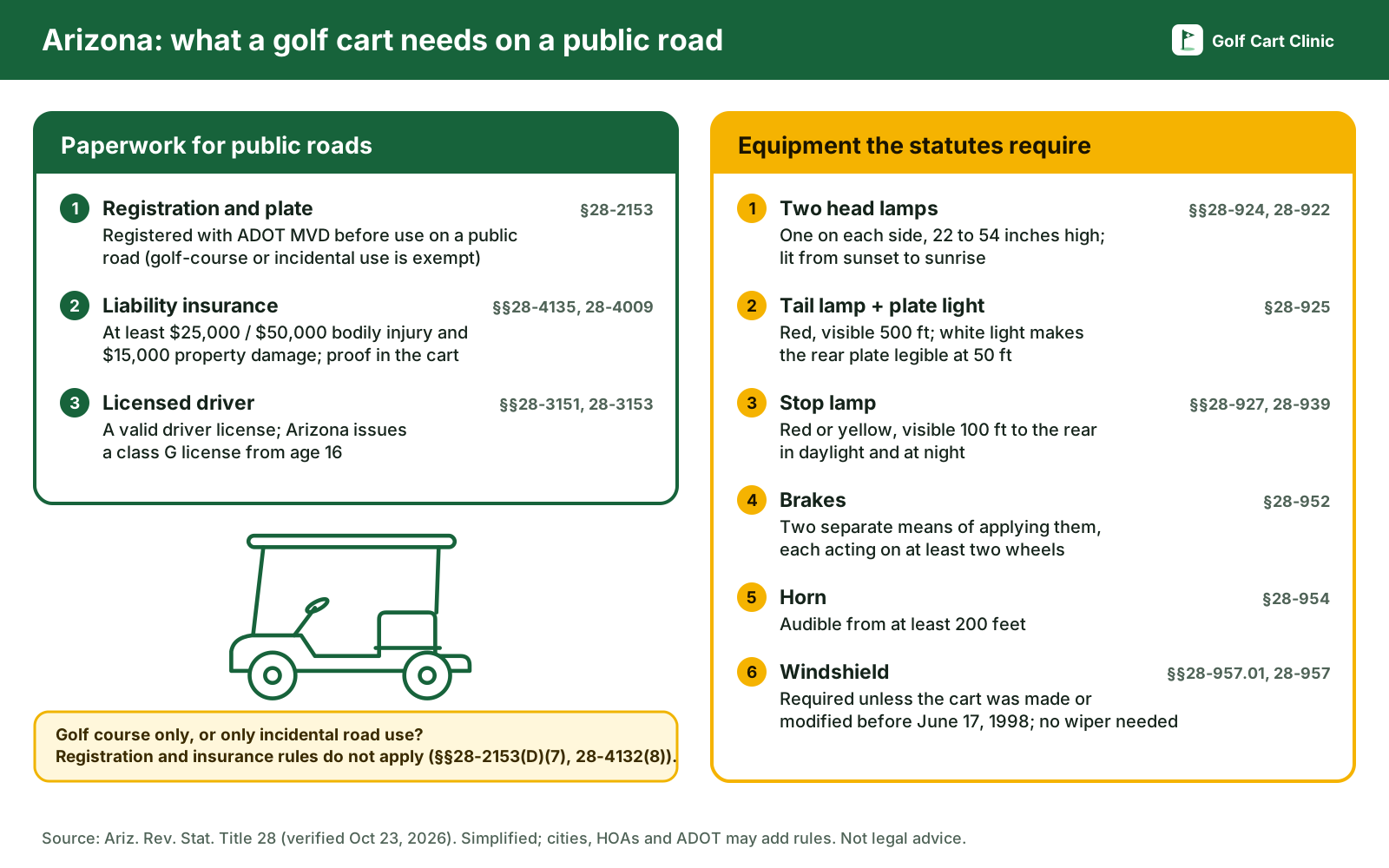
| Item | What the statute says | Section |
|---|---|---|
| Head lamps | At least two, one on each side of the front, mounted 22 to 54 inches high; lit from sunset to sunrise and whenever visibility is under 500 feet | §28-924, §28-922 |
| Tail lamp and plate light | At least one rear tail lamp with red light "plainly visible from a distance of five hundred feet," 15 to 72 inches high; a white light makes the rear plate legible from 50 feet | §28-925 |
| Stop lamp | Required to drive on the highway; red or yellow, visible from 100 feet to the rear in sunlight and at night | §28-927(B), §28-939 |
| Brakes | Adequate to stop and hold the vehicle, with "two separate means of applying the brakes, each of which means is effective to apply the brakes to at least two wheels" | §28-952(A)(1) |
| Horn | In good working order and audible from at least 200 feet | §28-954(A) |
| Windshield | Required, except on a golf cart "manufactured or modified before June 17, 1998" | §28-957.01 |
| Windshield wiper | Not required on a golf cart | §28-957(C) |
| Safety glass | The safety-glass rule for passenger vehicles excludes golf carts | §28-959(B) |
| Mirrors | Two mirrors showing 200 feet to the rear, but only if the cart is built or loaded so the driver can't see to the rear | §28-956 |
Many carts leave the factory without some of these items, especially a stop lamp, a plate light or a second brake control. Adding them is a common upgrade; see our golf cart upgrades section. Communities and cities may also ask for extras such as turn signals or seat belts.
Driver's license and age rules
Arizona sets no separate "golf cart age." On a highway, a golf cart is a motor vehicle, and "a person shall not drive a motor vehicle or vehicle combination on a highway without a valid driver license" (§28-3151(A)). Arizona issues a class G (graduated) license from age 16 and an instruction permit from 15 years and 6 months (§28-3153(A)(1)); a permit holder drives under that permit's conditions. Golf courses, private property and some private community streets set their own rules.
Golf cart vs neighborhood electric vehicle (NEV) in Arizona
Arizona calls factory-built low-speed vehicles neighborhood electric vehicles: emission-free, electrically powered, at least four wheels, and compliant with the federal low-speed vehicle standard (49 C.F.R. §§571.3(b) and 571.500) (§28-101). They have their own operating rules:
| Golf cart | Neighborhood electric vehicle (NEV) | |
|---|---|---|
| Definition | 3+ wheels, under 1,800 lb unladen, designed and operated at 25 mph or less, up to 4 people (§28-101) | Electric, emission-free, 4+ wheels, meets federal low-speed vehicle standard FMVSS 500 (§28-101) |
| Top operating speed | Not more than 25 mph (part of the definition) | Not more than 25 mph (§28-966(A)) |
| Roads | No golf-cart road list in state law; local police apply a 35 mph street limit; shoulder rule in qualifying age-restricted communities (§28-721(C)) | Not on highways posted above 35 mph, except crossing at an intersection (§28-966(B)); same shoulder rule |
| Labels | None required by statute | A notice of its operating restrictions must be attached or painted in clear view of the driver (§28-966(C)) |
| Registration and insurance | Required on public roads unless used on a golf course or only incidentally on a highway | Required like any motor vehicle |
Sources: A.R.S. §28-101; A.R.S. §28-966; A.R.S. §28-721.
Compare this with Texas, which won't register golf carts at all and uses a special golf cart plate instead (Texas golf cart laws), and Florida, where golf carts are limited to roads a city or county has designated (Florida golf cart laws). South Carolina takes a middle path: a $5 permit decal instead of full registration, with a default 4-mile limit (South Carolina golf cart laws). Next door in California, standard golf carts are kept off most public roads: they may only use roads a city or county has designated near a golf course, marked crossings, or a city golf cart transportation plan (California golf cart laws).
Local rules: cities, HOAs and retirement communities
State law is the floor, not the whole picture. Cities and towns adopt their own traffic ordinances, police departments decide how to enforce the speed-limit question above, and HOAs and community associations in places like Sun City, Sun City West or Green Valley set rules for their own streets, paths and parking. Some cities also restrict golf carts used as vehicles for hire; ADOT says "every city has their own requirements" for that (ADOT FAQ). Before driving on a public street, check your city or town code and ask your community association.
Before you drive on an Arizona road: a quick checklist
- Confirm your cart still fits the §28-101 definition (25 mph or less, four seats or fewer). If it's a factory LSV, follow the NEV rules instead.
- Register it with ADOT MVD and put the plate on the rear.
- Buy Arizona liability insurance with at least $25,000/$50,000/$15,000 limits and keep proof in the cart or on your phone.
- Check the lights (two head lamps, tail lamp, plate light, stop lamp), both brake controls, the horn and the windshield.
- Carry your driver license, stay off sidewalks and multi-use paths, and keep to low-speed streets.
- Make sure the battery pack is in good shape before longer trips. Our battery watering guide covers the basic care for flooded lead-acid batteries.
Frequently asked questions
Is a golf cart street legal in Arizona?
It can be. Arizona doesn't have a separate street-legal golf cart category: a golf cart used on public roads must be registered with ADOT MVD (§28-2153), insured (§28-4135), equipped with the lights, brakes and horn the equipment statutes require, and driven by a licensed driver (§28-3151). Local ordinances and police guidance may limit which streets you can use.
Do I need to register my golf cart if I only drive it on the golf course?
No. A golf cart "used in the operation of a golf course or only incidentally operated or moved on a highway" is exempt from registration (§28-2153(D)(7)) and from the insurance requirement (§28-4132(8)).
Can a 14-year-old drive a golf cart in Arizona?
Not on a public road. Driving a motor vehicle on a highway requires a valid driver license (§28-3151), and Arizona doesn't issue a class G license before 16. Private property and golf courses can set their own age rules.
Can I drive my golf cart on the road shoulder in Sun City?
In an age-restricted community in an unincorporated area of Maricopa County, yes: §28-721(C) allows golf carts and NEVs on a paved shoulder, or as close as practicable to the right-hand edge if there's no marked shoulder. You must yield to vehicles turning right (§28-777). Your community association may have more rules.
Does a golf cart need a windshield in Arizona?
Yes, unless the cart was manufactured or modified before June 17, 1998 (§28-957.01). Golf carts don't need a windshield wiper (§28-957(C)).
Can golf carts drive on roads with a 45 mph speed limit in Arizona?
Don't plan on it. Neighborhood electric vehicles are barred from highways posted above 35 mph except to cross at an intersection (§28-966(B)), and police such as Marana's apply the same 35 mph limit to golf carts. A golf cart also can't legally go faster than 25 mph and must not impede traffic (§28-704(A)).
Sources
- Arizona Revised Statutes §28-101 (definitions of golf cart and neighborhood electric vehicle): azleg.gov
- A.R.S. §§28-704 (minimum speed), 28-721 (shoulder rule in age-restricted communities) and 28-777 (yield to vehicles turning right): 28-704, 28-721, 28-777
- A.R.S. §§28-921 to 28-959 (vehicle equipment), including 28-924, 28-925, 28-927, 28-952, 28-954, 28-957.01
- A.R.S. §28-966 (neighborhood electric vehicles; speed and road restrictions): azleg.gov
- A.R.S. §§28-2052 and 28-2153 (title of foreign vehicles; registration requirement and exemptions): 28-2052, 28-2153
- A.R.S. §§28-3151 and 28-3153 (driver license requirement and minimum ages): 28-3151, 28-3153
- A.R.S. §§28-4009, 28-4132 and 28-4135 (insurance limits, exemptions and penalties): 28-4009, 28-4132, 28-4135
- Arizona Department of Transportation, MVD insurance information and requirements: azdot.gov; Title and Registration Application (Form 96-0236): azdot.gov
- Town of Marana Police Department, "Is Your Golf Cart Street Legal?" (Dec. 17, 2025): maranaaz.gov (local example)
- U.S. Census Bureau QuickFacts, Maricopa County, Arizona: census.gov
Questions and comments
No comments yet. Corrections and notes from your own repair are welcome.