
Georgia Golf Cart Laws (2026): PTV Rules, 25 MPH Streets and Local Permits
Georgia calls a street-driven golf cart a personal transportation vehicle. It may only use streets or paths your city or county designates, and under the state rules only streets posted 25 mph or less, with a licensed driver and a set equipment list. Here are the statutes, the pre-2012 exception, real town rules and the LSV alternative.
In Georgia, a street-driven golf cart is legally a personal transportation vehicle (PTV), and it may only use public streets or paths that your city or county has designated by ordinance. Where a town adopted its rules in 2012 or later, state law adds three more limits: a valid driver's license, streets posted 25 mph or less, and a set equipment list. Electric PTVs don't need a state tag (O.C.G.A. §40-2-20(b)(5)), but your town can require a local permit. If you want to drive on any road posted 35 mph or less without a local vote, you need a titled and plated low-speed vehicle (LSV) instead. This guide walks through each rule with links to the Official Code of Georgia Annotated (O.C.G.A.) and to Georgia DPS, DOR and DDS pages so you can check them yourself.
Not legal advice. Last verified: October 24, 2026. This is a plain-English summary of the Official Code of Georgia and guidance from the Georgia Department of Public Safety (DPS), Department of Revenue (DOR) and Department of Driver Services (DDS). Statute links go to Justia's free copy of the official code. In Georgia most golf cart road rules come from a city or county ordinance, and HOAs, private communities and golf courses add their own rules. Check your town or county code, call the local police department or sheriff's office, and ask your community association before you drive a golf cart on a public road.
Golf cart or PTV? How Georgia defines them
Georgia law has a narrow definition of a golf cart and a wider one for the carts people drive around town:
- Golf car or golf cart (O.C.G.A. §40-1-1(17.3)): a motorized vehicle "designed for the purpose and exclusive use of conveying one or more persons and equipment to play the game of golf in an area designated as a golf course," with an average speed of less than 15 mph on a test course.
- Personal transportation vehicle (PTV) (§40-1-1(43.4)): any motor vehicle with at least four wheels, "capable of a maximum level ground speed of less than 20 miles per hour," with "a maximum gross vehicle unladen or empty weight of 1,375 pounds," and able to carry "not more than eight persons." Carts that a town allowed on its roads before January 1, 2012 are also covered if they have at least three wheels, weigh 1,300 pounds or less unladen and can't exceed 20 mph; those older ordinances often call them "motorized carts." ATVs, multipurpose off-highway vehicles and mobility aids for people with disabilities are not PTVs.
The Georgia Department of Public Safety puts it simply: a golf cart used for any purpose other than golf on a golf course is not a golf cart under the definition and is regulated as a PTV (Georgia DPS, Low-Speed & Small Vehicles chart). So once your cart leaves the course, the PTV rules below are the ones that count.
The speed limit in the definition matters for golf cart upgrades. A cart that can reach 20 mph or more is no longer a PTV. For PTVs, Georgia's definition of "manufacturer" even includes anyone "who makes modifications to a vehicle that are not approved by the original equipment manufacturer and which may adversely affect the safe operation and performance of the vehicle" (§40-1-1(26)).
Where can you drive a golf cart in Georgia?
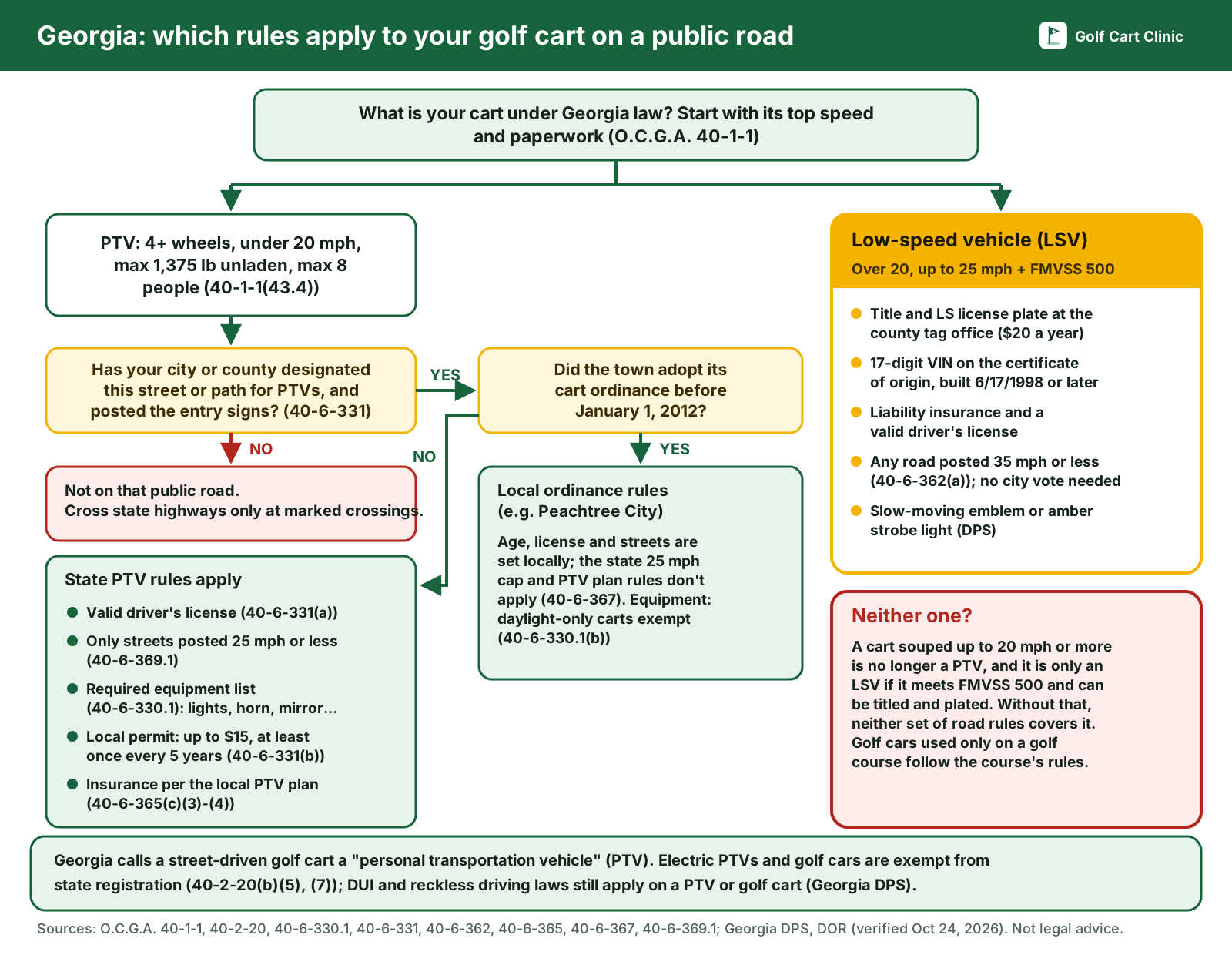
There is no statewide right to drive a golf cart on public roads. The power sits with local governments. Under O.C.G.A. §40-6-331(a), a city or county "may, by ordinance, designate certain public streets or portions thereof or PTV paths that are under its regulation and control" for PTVs, either shared with regular traffic or for PTVs only, and set the conditions for using them. In practice:
- No designation, no road use. If your city or county hasn't designated the street or path, a PTV doesn't belong on it.
- Signs come first. A town that allows PTVs must post signs at least 24 by 30 inches on every state highway where it enters the town or county, warning drivers that PTVs are allowed. The law adds that ordinances setting operating standards "shall not be effective unless appropriate signs giving notice are posted" (§40-6-331(c)).
- Crossing state highways. PTVs may cross a state highway "only at crossings or intersections designated for that purpose" that are built as an active grade crossing under the Manual on Uniform Traffic Control Devices and marked with the W11-11 golf cart warning sign. Crossing a city street or county road is allowed only where the local government has designated a crossing (§40-6-331(d)).
- No sidewalks. Georgia DPS lists PTVs and golf carts as not operable on sidewalks except on driveways (O.C.G.A. §40-6-144, per the DPS chart).
One narrow exception skips the local ordinance: delivery staff of a company with at least 10,000 employees in Georgia may drive marked PTVs in residential subdivisions with speed limits of 25 mph or less, if the cart has the required equipment and the driver is licensed (§40-6-331(e)). It doesn't apply to private owners.
Speed and road limits: the 25 mph rule and the pre-2012 exception
Since 2014, any local government that wants to set operating standards for PTVs must follow the PTV transportation plan rules in Part 6 of the code (§40-6-330). Those rules set the speed ceiling:
- "Personal transportation vehicles shall only be operated on highways where the posted speed limit does not exceed 25 miles per hour" (§40-6-369.1).
- A street shared by regular traffic and PTVs must have a speed limit of 25 mph or less "as established by an engineering and traffic survey," and a qualified traffic engineer must find it can take PTVs without hurting traffic safety (§40-6-368).
- PTVs are entitled to the full use of a lane, may not pass in the same lane, may not ride between lanes, and may not ride two or more abreast in a lane (§40-6-369).
The big exception: Part 6 "shall have no application to any county or municipality that has enacted prior to January 1, 2012, an ordinance authorizing the operation of PTVs" (§40-6-367). In those towns, the local ordinance sets which streets carts may use and at what speed. That is why long-time golf cart towns can look so different from newer ones.
| Vehicle | Roads it may use | Its own speed | State paperwork | Code section |
|---|---|---|---|---|
| Golf car (on a golf course) | The golf course; off the course it is treated as a PTV | Average under 15 mph | No state registration | §40-1-1(17.3), §40-2-20(b)(7) |
| PTV, town ordinance from 2012 or later | Only designated streets or paths posted 25 mph or less; state highways crossed only at designated crossings | Under 20 mph | Electric: no state tag; local permit if required | §§40-6-331, 40-6-368, 40-6-369.1 |
| PTV, town ordinance from before 2012 | Streets and paths the ordinance designates | Up to 20 mph (older definition) | Electric: no state tag; local permit if required | §§40-1-1(43.4)(A), 40-6-331, 40-6-367 |
| Low-speed vehicle (LSV) | Any highway posted 35 mph or less, statewide | Over 20 mph, up to 25 mph | Title, LS license plate, insurance | §40-1-1(25.1), §40-6-362(a) |
Age and driver's license rules
The state rule is short: "All operators of PTVs shall be required to possess a valid driver's license except when operating a PTV within a locality whose local authority has enacted an ordinance permitting the use of PTVs or motorized carts on streets without possession of a driver's license prior to January 1, 2012" (§40-6-331(a)). Towns writing a PTV plan must also require "a valid driver's license" unless an older ordinance allows otherwise (§40-6-365(c)(4)).
Georgia doesn't set a separate golf cart age. In most towns the license rule makes 16 the practical minimum, because applicants "must be at least 16 years of age" for a Class D provisional license (Georgia DDS, Class D license).
Towns with pre-2012 ordinances can be different. Peachtree City's motorized cart ordinance dates back well before 2012 (it was amended by Ordinance 786 in September 2002), and its current code, rewritten by Ordinance 1253 (March 19, 2026), lets (§78-93):
- people 16 and older drive a cart unless their driver's license is suspended or revoked;
- 15-year-olds drive with a licensed adult (18+) or a parent, grandparent or legal guardian in the front seat, or alone with a valid Georgia instructional permit (with limits on passengers);
- 12- to 14-year-olds drive only with a parent, grandparent or legal guardian in the front seat;
- no one under 12 drive "under any circumstances."
Don't assume those rules travel with you. Tybee Island, for example, only lets licensed drivers 16 or older operate carts (City of Tybee Island golf cart rules).
Registration, plates and title
Georgia's general registration law doesn't apply "to any electric powered personal transportation vehicle" or "to any golf car" (O.C.G.A. §40-2-20(b)(5), (7)). The DOR's list of vehicles Georgia does not register or title includes "motorized carts" (Georgia DOR, Vehicles Exempt from Registration), and its motor vehicle manual lists golf carts among vehicles for which no title is required or issued (DOR Motor Vehicle Manual). There is no state golf cart license plate.
Gas carts: the statutory exemption names electric PTVs only, and the Georgia DPS chart lists gas-powered PTVs as needing registration and insurance. If you drive a gas cart on public streets, ask your county tag office how it handles your cart before you rely on the "motorized cart" exemption.
Local registration is where most owners deal with paperwork. A city or county can't make PTVs meet state registration, inspection, title or licensing rules, but "may, by ordinance, require the local registration and licensing of PTVs operated within its boundaries at least once every five years for a fee not to exceed $15.00" (§40-6-331(b)). PTV plans must include a permitting process that can cover permit posting, renewal, operator education and liability insurance (§40-6-365(c)(3)). Carts owned by golf courses or country clubs and used only on their premises are outside these local registration rules. Real examples:
- Peachtree City: register within 10 business days of purchase; two numbered decals go on the front and rear of the cart; $15 per cart per year, billed to residents in three-year cycles ($45), plus an annual path system user fee for non-residents ($235 a year, per the city). Only people 18 or older may register a cart (Peachtree City, Paths & Motorized Carts; Ordinance 1253, §78-92).
- Tybee Island: carts get a T-number and an inspection sticker, must be inspected every year, and the initial registration is $15 with free renewals (City of Tybee Island, Motorized Cart Information).
Buying a used cart? Our serial number lookup helps you confirm a Club Car or Yamaha model year before you fill out a town registration form.
Insurance requirements
Georgia's compulsory insurance law applies to the owner "of a motor vehicle required to be registered in this state" (O.C.G.A. §33-34-4). Because electric PTVs and golf cars are exempt from registration, the DPS chart lists no state insurance requirement for an electric PTV, but "YES if gas powered."
That isn't the end of it, because local rules usually require coverage:
- Towns that adopt a PTV plan must require operators to "comply with the financial responsibility requirements for passenger vehicle operators," unless an older ordinance allows otherwise (§40-6-365(c)(4)).
- Tybee Island requires proof of insurance "showing the state minimum liability standards for automobiles," and says "Home owners insurance policies will not be accepted."
Georgia's minimum liability limits for cars are $25,000 for bodily injury to one person, $50,000 for bodily injury to two or more people, and $25,000 for property damage in one accident (O.C.G.A. §33-7-11(a)(1)(A), applied by §40-9-37; Georgia Insurance Commissioner). Even where it isn't required, ask your insurer in writing whether your policy covers the cart on public streets.
Required equipment
Georgia has a statewide equipment list for street-driven carts. Under O.C.G.A. §40-6-330.1(a), all PTVs must have:
- "A braking system sufficient for the weight and passenger capacity of the vehicle, including a parking brake";
- a reverse warning device that works whenever the cart is in reverse;
- a main power switch that cuts the motive power circuit when off, with a key (if used) removable only in the off position;
- head lamps;
- reflex reflectors;
- tail lamps;
- a horn;
- a rearview mirror;
- safety warning labels; and
- "Hip restraints and hand holds or a combination thereof."
This list doesn't apply to PTVs driven during daylight hours under local ordinances enacted before January 1, 2012 (§40-6-330.1(b)). Towns can ask for more:
| Item | State list (§40-6-330.1) | Peachtree City (Ord. 1253) | Tybee Island |
|---|---|---|---|
| Headlights / taillights | Required | Needed to drive outside daylight hours (§78-93(h)) | Required, plus brake lights |
| Turn signals | Not listed | Not listed | Required |
| Horn / mirror / reflectors | All required | Horn or bell recommended for warning path users (§78-96(f)) | Horn required |
| Seat belts | Hip restraints and hand holds | Required to be worn in LSVs; everyone in a cart must stay seated (§78-96(k)-(l)) | One for every seat |
| Warning light | Not listed | Amber strobe for LSVs (city) | Amber or yellow flashing light visible from all directions |
| Top speed of the cart | Under 20 mph (PTV definition) | Path vehicles limited to 20 mph or less | Must not exceed 20 mph |
If you add lights, turn signals or belts, our upgrades section covers what fits. Don't add speed: a cart that can reach 20 mph is no longer a PTV.
Golf cart vs low-speed vehicle (LSV) in Georgia
A low-speed vehicle is "any four-wheeled vehicle whose top speed attainable in one mile is greater than 20 miles per hour but not greater than 25 miles per hour on a paved level surface and which is manufactured or converted to comply with standards based upon those federal motor vehicle safety standards for low-speed vehicles set forth in 49 C.F.R. Section 571.500" (§40-1-1(25.1); FMVSS 500). An LSV doesn't need a local ordinance:
- It "shall be operated only on any highway where the posted speed limit does not exceed 35 miles per hour" (§40-6-362(a)).
- Its driver has the same rights and duties as any other driver (§40-6-360) and the same lane rules as a PTV (§40-6-361).
- It must be registered and insured, the driver needs a license, and DPS lists lighting as "Same as other motor vehicles" plus either a slow-moving vehicle emblem or an amber strobe light (§40-8-4; DPS chart).
- The DOR's LS plate costs a $20.00 annual registration fee, and ad valorem tax applies if applicable (Georgia DOR, Low Speed Vehicle plate).
Can you turn your golf cart into an LSV? The definition does cover vehicles "converted to comply" with FMVSS 500-based standards, but the paperwork is the hurdle. The Hall County Tax Commissioner's LSV page asks for a manufacturer's certificate of origin or title showing a 17-digit VIN, the federal regulation code (49 C.F.R. 571.500) and an LSV, NEV or ZEV indicator, a manufacture date of June 17, 1998 or later, and proof of insurance, and warns that a vehicle that doesn't meet these requirements "cannot be legally operated on Georgia roads" (Hall County Tax Commissioner). Call your own county tag office before you buy a conversion kit.
| PTV (street-driven golf cart) | Low-speed vehicle (LSV) | |
|---|---|---|
| Definition | 4+ wheels, under 20 mph, max 1,375 lb unladen, max 8 people (§40-1-1(43.4)) | 4 wheels, over 20 and up to 25 mph, FMVSS 500 (§40-1-1(25.1)) |
| Where it may drive | Only streets and paths a city or county designates; 25 mph streets unless the ordinance predates 2012 | Any highway posted 35 mph or less (§40-6-362(a)) |
| State registration and plate | None for electric PTVs (§40-2-20(b)(5)); local permit up to $15 | Title and LS plate, $20 a year |
| Equipment | §40-6-330.1 list plus local rules | Motor vehicle lighting plus emblem or amber strobe (DPS) |
| Insurance | Electric: none under state law; usually required locally | Required |
| Driver | Valid driver's license, unless a pre-2012 ordinance says otherwise | Valid driver's license |
Compare this with Florida, where golf carts also need a city or county to designate a road (Florida golf cart laws), South Carolina, where the SCDMV issues a $5 golf cart permit decal (South Carolina golf cart laws), and North Carolina, where towns may open streets posted up to 35 mph (North Carolina golf cart laws). To the west, Alabama has no statewide golf cart road law; only towns in five counties with local constitutional amendments may open streets posted 25 mph or less (Alabama golf cart laws). To the north, Tennessee doesn't let golf carts on public roads; only registered low-speed and medium-speed vehicles may drive there, with helmets, in daylight and at 35 mph or less (Tennessee golf cart laws).
Local rules: Peachtree City, Tybee Island and your town
Because Georgia leaves street use to local governments, two towns an hour apart can have very different rules. Two examples from official sources:
- Peachtree City (Fayette County). The city describes "a 100+ mile network of shared-use paths for pedestrians, cyclists, and Motorized carts" (Peachtree City). Under Ordinance 1253, where cart paths exist "they must be used in preference to parallel city streets"; carts may not be driven on sidewalks; carts without working headlights and taillights are limited to daylight hours; and carts may not use, or cross except at authorized crossings, Highway 74, Highway 54, Peachtree Parkway and several other main roads listed in §78-93(i). Before leaving a path to enter or cross a road, drivers must stop as if at a stop sign and yield, and carts on the paths after dark must use headlights and taillights (§78-96(m)-(n)). Registered LSVs may use the paths only in a mode limited to 20 mph, and the city says they need an amber strobe light.
- Tybee Island (Chatham County). Registered carts may use all city streets except Highway 80, which they may cross only at listed spots: south of the Park of Seven Flags and at the traffic-controlled intersections of 14th Street, Campbell Avenue and Jones Avenue. Sidewalk driving is prohibited, and the city warns that violators face a fine of up to $1,000 or up to 12 months in jail (City of Tybee Island golf cart rules).
To find your own rules, search your city or county code of ordinances for "personal transportation vehicle," "motorized cart" or "golf cart," check the police department's website, and look for the PTV warning signs at the town limits. If your town hasn't designated a street for PTVs, the safe answer is no golf cart on it.
DUI and other traffic laws still apply
A golf cart is a vehicle under Georgia law, and the DPS chart marks DUI, implied consent and reckless driving laws as applicable to both PTVs and golf carts. The Georgia Court of Appeals upheld a DUI conviction for driving a golf cart in Fayette County (Simmons v. State, 281 Ga. App. 252 (2006)), and an earlier case held that a driver needed a license to drive a golf cart on a highway (Coker v. State, 261 Ga. App. 646 (2003)).
Before you drive on a Georgia road: a quick checklist
- Confirm your cart is a PTV: 4 or more wheels, top speed under 20 mph, 1,375 lb or less unladen.
- Find the ordinance: has your city or county designated the street or path for PTVs?
- Check the date and speed: if the ordinance is from 2012 or later, stay on streets posted 25 mph or less.
- Cross state highways only at designated, signed crossings.
- Get the local permit or decal if one is required, and display it where the ordinance says.
- Make sure the driver has a valid driver's license, unless your town's older ordinance allows otherwise.
- Check the state equipment list: brakes and parking brake, reverse warning, key switch, lights, reflectors, horn, mirror, labels, hip restraints and hand holds.
- Carry proof of liability insurance if your town requires it; the car minimum is $25,000/$50,000/$25,000.
- Check the battery pack before a longer trip; our battery watering guide covers flooded lead-acid batteries.
Frequently asked questions
Are golf carts street legal in Georgia?
Only on streets and paths a city or county has designated for personal transportation vehicles (O.C.G.A. §40-6-331). In towns whose rules date from 2012 or later, those streets must be posted 25 mph or less. Without a local designation, a golf cart doesn't belong on public roads.
Do you need a driver's license to drive a golf cart in Georgia?
Yes, in most places. State law requires PTV drivers to have a valid driver's license, except in towns that allowed unlicensed drivers by an ordinance passed before January 1, 2012. Peachtree City is one example, allowing drivers as young as 12 with a parent, grandparent or guardian in the front seat.
How old do you have to be to drive a golf cart in Georgia?
There's no separate state golf cart age, but the license requirement makes 16 the practical minimum in most towns (the minimum age for a Class D license). Some pre-2012 towns allow younger drivers under their own conditions.
Do golf carts need a license plate or registration in Georgia?
Not from the state if the cart is electric: electric PTVs and golf cars are exempt from registration (O.C.G.A. §40-2-20(b)(5), (7)). Your city or county may require a local permit, for a fee of up to $15 at least once every five years. Gas carts aren't named in the exemption, so ask your county tag office.
Can I drive a golf cart on a 35 mph road in Georgia?
Not under the state PTV rules, which cap PTVs at roads posted 25 mph or less (O.C.G.A. §40-6-369.1). Towns with pre-2012 ordinances set their own street list. A registered low-speed vehicle may use any road posted 35 mph or less.
Do you need insurance on a golf cart in Georgia?
State law doesn't require it for electric carts that are exempt from registration, but towns with PTV plans must require financial responsibility, and many towns ask for proof of liability insurance at the state minimums. LSVs must always be insured.
What is the difference between a golf cart, a PTV and an LSV in Georgia?
A golf car is built and used for golf on a golf course. Off the course, a cart with a top speed under 20 mph is a PTV and can only use streets a town designates. An LSV goes over 20 and up to 25 mph, meets FMVSS 500, has a title and LS plate, and may use any road posted 35 mph or less.
Sources
- O.C.G.A. §40-1-1(17.3) (golf car), (25.1) (low-speed vehicle), (26) (manufacturer), (43.4)-(43.5) (personal transportation vehicle, PTV path): justia.com
- O.C.G.A. §§40-6-330, 40-6-330.1, 40-6-331 (PTV equipment, designated streets, licenses, local registration, signs, crossings): justia.com
- O.C.G.A. §§40-6-363 to 40-6-369.1 (PTV transportation plans, 25 mph limit, pre-2012 exception): justia.com
- O.C.G.A. §§40-6-360 to 40-6-362 (low-speed vehicles): justia.com; §40-8-4 (slow-moving emblem or amber strobe): justia.com
- O.C.G.A. §40-2-20 (registration exemptions), §33-34-4 (compulsory insurance), §40-9-37 and §33-7-11 (minimum limits): justia.com, justia.com
- Georgia Department of Public Safety, Low-Speed & Small Vehicles chart (DPS-34, 07/2024) and Georgia Code: Low Speed Vehicles: dps.georgia.gov, dps.georgia.gov
- Georgia Department of Revenue, Vehicles Exempt from Registration, Motor Vehicle Manual and LS plate details: dor.georgia.gov, mvd.dor.ga.gov; Hall County Tax Commissioner, Low-Speed Vehicles: hallcountytax.org
- Georgia Department of Driver Services, Class D license: dds.georgia.gov; Georgia Office of Insurance and Safety Fire Commissioner, Auto: oci.georgia.gov
- 49 C.F.R. §571.500 (FMVSS 500, low-speed vehicles): ecfr.gov
- Peachtree City, Paths & Motorized Carts and Ordinance 1253 (Chapter 78, Article IV): peachtree-city.org, peachtree-city.org; City of Tybee Island, Motorized Cart Information and Golf Cart Rules: cityoftybee.org, cityoftybee.org (local examples)
Questions and comments
No comments yet. Corrections and notes from your own repair are welcome.