
Florida Golf Cart Laws (2026): Where You Can Drive, Age Rules and LSVs
Golf carts are allowed only on designated, signed roads in Florida, with set equipment and driver rules. LSVs follow different rules. Here's the plain-English summary with the official links.
Florida allows golf carts on some public roads, but only under specific conditions in state law, and your city or county can make the rules stricter. If you want to drive faster or on more roads, the legal route is a low-speed vehicle (LSV): a registered, titled and insured vehicle with a VIN. This guide summarizes both sets of rules from the official sources and links to the statutes so you can read them yourself.
Not legal advice. This is a plain-English summary of the 2026 Florida Statutes and guidance from the Florida Department of Highway Safety and Motor Vehicles (FLHSMV). Local ordinances, HOA and community rules can add restrictions. Confirm with your city or county, or with the local law enforcement agency, before driving on public roads.
What is the difference between a golf cart and an LSV in Florida?
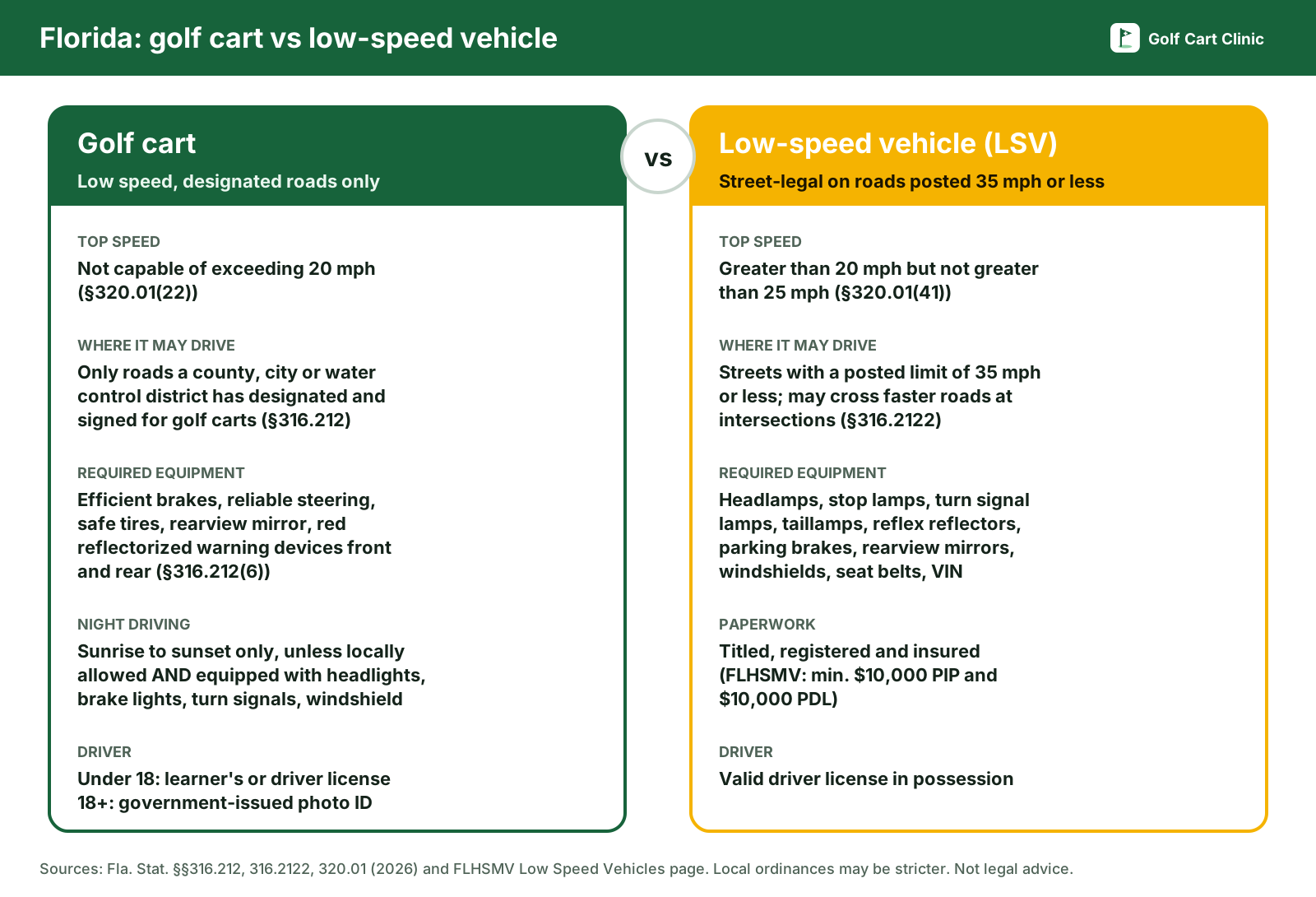
| Golf cart | Low-speed vehicle (LSV) | |
|---|---|---|
| Legal definition | Designed for golf-course use and "not capable of exceeding speeds of 20 miles per hour" (§320.01(22)) | Four-wheeled vehicle with a top speed "greater than 20 miles per hour, but not greater than 25 miles per hour" (§320.01(41)) |
| Where it can drive | Only roads designated for golf carts and signed as such (plus a few specific crossings) | Streets with a posted speed limit of 35 mph or less; may cross faster roads at intersections |
| Title, registration, insurance | FLHSMV lists these requirements for LSVs, not for golf carts | Must be titled, registered and insured (PIP and PDL, minimum $10,000 each per FLHSMV) |
| Driver | Under 18: learner's license or driver license. 18+: government-issued photo ID | Valid driver license in possession |
| Night driving | Sunrise to sunset only, unless the local government allows night use and the cart has headlights, brake lights, turn signals and a windshield | Allowed (LSVs must have full lighting equipment) |
Sources: FLHSMV Low Speed Vehicles page, §316.212, §316.2122.
The speed rating matters. A cart modified to go faster than 20 mph no longer fits the golf cart definition. If you've added a speed upgrade, read the conversion section below.
Where can you legally drive a golf cart in Florida?
Under Florida Statute §316.212, driving a golf cart on public roads is prohibited except in these situations:
- Designated local roads. County roads designated by the county, municipal streets designated by the city, two-lane county roads inside a city designated by that city, and water control district roads designated by the district (with county approval). The local government must first decide golf carts can travel safely there, then post signs saying golf carts are allowed. FLHSMV describes these as designated roadways with a posted speed limit of 30 mph or less.
- Crossing a state highway. Only at crossings the Florida Department of Transportation (FDOT) has reviewed and approved: where the highway intersects a designated golf cart road, or mid-block where a golf course sits on both sides of the highway.
- State roads designated for transfer to local government, if FDOT authorizes and signs them for golf carts.
- Mobile home parks split by a road: residents and guests may cross at an approved crossing.
- State park roads with a posted limit of 35 mph or less, if authorized by the Division of Recreation and Parks.
In practice: if there is no golf cart sign and no local ordinance designating the road, assume you cannot drive a golf cart on it. Call your city or county clerk or the local sheriff's office to find out which roads are designated.
Inside a self-contained retirement community, §316.2125 permits reasonable golf cart operation, with the same hours, equipment and driver rules, unless the county, city or FDOT prohibits it for safety. §316.2126 covers carts used by municipal and state employees and seasonal delivery workers, and doesn't extend road access to private owners.
What equipment does a golf cart need in Florida?
§316.212(6) requires every golf cart driven on public roads to have:
- efficient brakes;
- reliable steering;
- safe tires;
- a rearview mirror;
- red reflectorized warning devices on both the front and the rear.
Lights, mirrors and other add-ons are covered in our golf cart upgrades and parts guides. To drive between sunset and sunrise, the local government must allow it and the cart must have headlights, brake lights, turn signals and a windshield (§316.212(5)).
What is the legal age to drive a golf cart in Florida?
Since October 1, 2023 (chapter 2023-67, Laws of Florida), §316.212(7) says a golf cart may not be driven on public roads or streets by anyone:
- under 18 unless they have a valid learner's driver license or driver license;
- 18 or older unless they have a valid government-issued photo ID.
The FLHSMV confirms the same requirement on its LSV page. Local ordinances can be stricter.
Can cities and counties set stricter rules?
Cities and counties may pass ordinances on golf cart operation and equipment that are more restrictive than state law, as long as they inform residents, for example with signs (§316.212(8)). They may also allow golf carts on certain sidewalks, with conditions: a 15 mph maximum speed, consultation with FDOT, and sidewalks at least 8 feet wide next to state highways. Rules can differ a lot from one town to the next, so check the code of ordinances where you live and where you plan to drive. For other states, see our golf cart laws by state, such as Texas golf cart laws, where carts use a special golf cart license plate instead, Arizona golf cart laws, where street-driven carts are registered and insured like other motor vehicles, and South Carolina golf cart laws, where carts need a $5 DMV permit decal and stay within 4 miles of home unless a local ordinance says otherwise. North Carolina golf cart laws work much like Florida's local designation: each town or county decides, but only on roads posted 35 mph or less. Georgia golf cart laws also start with a local designation, then add a statewide equipment list and, for towns with ordinances from 2012 or later, a 25 mph street limit. Alabama golf cart laws are the most local of all: carts may use public streets only in towns in five counties with a golf cart constitutional amendment, such as Gulf Shores and Orange Beach, and only on streets posted 25 mph or less. Ohio golf cart laws also leave the decision to local governments, but carts there must pass a police inspection and carry Ohio license plates before using streets with limits of 35 mph or less. In Michigan, villages, cities and townships under 65,000 people may allow golf carts by resolution, with a 15 mph cap and daylight-only driving. Delaware goes the other way: golf carts aren't allowed on its public roads at all, and only titled, insured low-speed vehicles may use roads posted 35 mph or less.
What happens if you break Florida golf cart laws?
Violating §316.212 is a noncriminal traffic infraction. Road, crossing and hours violations are moving violations; equipment and driver-ID violations are nonmoving violations, all handled under chapter 318 (§316.212(9)). Fine amounts depend on the county.
What are the rules for low-speed vehicles (LSVs)?
Under §316.2122, an LSV:
- may be driven only on streets with a posted speed limit of 35 mph or less (it may cross a faster road at an intersection);
- must have headlamps, stop lamps, turn signal lamps, taillamps, reflex reflectors, a parking brake, rearview mirrors, a windshield, seat belts and a VIN;
- must be registered, insured and titled;
- must be driven by someone with a valid driver license in their possession.
FLHSMV's checklist adds detail: red reflex reflectors on each side and one on the rear, a driver-side exterior mirror plus an interior mirror or passenger-side exterior mirror, and a seat belt for each designated seat. The minimum insurance is $10,000 personal injury protection (PIP) and $10,000 property damage liability (PDL). Counties, cities and FDOT may still prohibit LSVs on specific roads for safety reasons.
How do you convert a golf cart to a street-legal LSV in Florida?
FLHSMV allows golf carts to be converted to LSVs. The cart must already be street-legal (all LSV equipment installed and a top speed over 20 mph but not over 25 mph) before you apply. According to FLHSMV, you take the following to a Motorist Services Regional Office for inspection, VIN assignment, title and registration:
- photos of the front, back and both sides of the converted cart (4 total);
- the Manufacturer's Certificate of Origin or a bill of sale for the golf cart;
- Form HSMV 84490 (Statement of Builder), completed by you and the compliance examiner/inspector;
- Form HSMV 86064 (Affidavit for Golf Cart Modified to a Low Speed Vehicle);
- original bills of sale or receipts for all conversion parts;
- a certified weight slip;
- Form HSMV 82040 (Application for Title);
- proof of Florida insurance (minimum $10,000 PDL and $10,000 PIP);
- sales tax or exemption information for the parts;
- identification (driver license, ID card or passport);
- inspection, title, plate and registration fees.
Buying a converted cart? FLHSMV warns that on a converted golf cart, the title shows the year it was titled, not the year it was built, so the cart may be older than the title suggests. Our serial number lookup can help you find the real model year for Club Car and Yamaha carts.
Frequently asked questions
Do you need a driver's license to drive a golf cart in Florida?
Not always. On public roads, drivers under 18 need a learner's license or driver license, and drivers 18 or older need a government-issued photo ID (§316.212(7)). An LSV always requires a valid driver license.
Can I drive my golf cart on any road with a 30 mph or lower speed limit?
No. A low speed limit alone isn't enough. The road must be designated for golf carts by the local government (or FDOT for state roads) and posted with signs. Without that designation, golf carts are prohibited on public roads.
Can you drive a golf cart at night in Florida?
Only if your local government allows nighttime operation and the cart has headlights, brake lights, turn signals and a windshield. Otherwise golf carts are limited to sunrise to sunset.
Does a golf cart need a license plate in Florida?
FLHSMV's title, registration and insurance requirements apply to LSVs. A golf cart that stays at 20 mph or less is treated differently. If it has been modified to go faster, it no longer fits the golf cart definition. Your community or insurer may still have its own requirements.
Sources
- Florida Statutes §316.212, Operation of golf carts on certain roadways (2026): flsenate.gov
- Florida Statutes §316.2122, Operation of a low-speed vehicle (2026): flsenate.gov
- Florida Statutes §316.2125 and §316.2126: 316.2125, 316.2126
- Florida Statutes §320.01 (definitions of golf cart and LSV): flsenate.gov
- FLHSMV, Low Speed Vehicles (golf carts, LSVs, converted carts): flhsmv.gov
Questions and comments
No comments yet. Corrections and notes from your own repair are welcome.