
California Golf Cart Laws (2026): 1-Mile Rule, 25 MPH Zones and LSVs
California keeps standard golf carts off most public roads. They may only use roads a city or county designates near a golf course, marked crossings, or a city golf cart transportation plan like Palm Desert's, with a licensed driver. Here are the Vehicle Code rules, the LSV alternative and the official links.
In California, a standard golf cart is not street legal on ordinary public roads. You may drive one only on a road your city or county has designated for golf carts near a golf course (generally within one mile of it), across a marked golf cart crossing, or inside a city or county "golf cart transportation plan" area such as Palm Desert's. Except at a crossing zone or inside a plan area, a golf cart may never use a highway in a speed zone above 25 mph (CVC §21716). The driver needs a valid driver's license. If you want to drive on regular streets posted up to 35 mph, you need a factory-built, registered low-speed vehicle (LSV) instead. This guide walks through each rule with links to the California Vehicle Code (CVC), the Streets and Highways Code and DMV and CHP guidance so you can check them yourself.
Not legal advice. Last verified: October 23, 2026. This is a plain-English summary of the California Vehicle Code, the Streets and Highways Code and DMV and CHP guidance. In California, almost all legal golf cart road use depends on a city or county ordinance, resolution or transportation plan, and HOAs, private communities and golf courses add their own rules. Check your city or county code, call the local police or sheriff, and ask your community association before you drive a golf cart on a public road.
What counts as a golf cart in California?
The Vehicle Code defines a golf cart narrowly. Under CVC §345, a golf cart is "a motor vehicle having not less than three wheels in contact with the ground, having an unladen weight less than 1,300 pounds, which is designed to be and is operated at not more than 15 miles per hour and designed to carry golf equipment and not more than two persons, including the driver."
Two things in that definition matter a lot in practice:
- It's a "motor vehicle." A golf cart is not a toy or a mobility device under California law, so the general rules for drivers of motor vehicles (license, financial responsibility) are the starting point.
- 15 mph and two people. Many carts sold today have four or six seats or are tuned faster than 15 mph. The DMV says a golf cart "modified to travel more than 15 mph or carry more than two persons (including the driver)" is "considered to be a regular motor vehicle" that must comply with the federal safety standards for a passenger vehicle, and a cart weighing more than 1,300 pounds can't be registered as a golf cart (DMV Vehicle Industry Registration Procedures Manual §7.045). A speed upgrade can therefore push your cart out of the golf cart rules entirely. Keep that in mind before you shop our golf cart upgrades for road use.
Golf cart transportation plans use a slightly wider definition: up to 25 mph by design, but still under 1,300 pounds and no more than two people (Streets and Highways Code §1951(b)). A city's own ordinance can go further for its plan area; Palm Desert's allows up to four people (see below).
Where can you drive a golf cart in California?
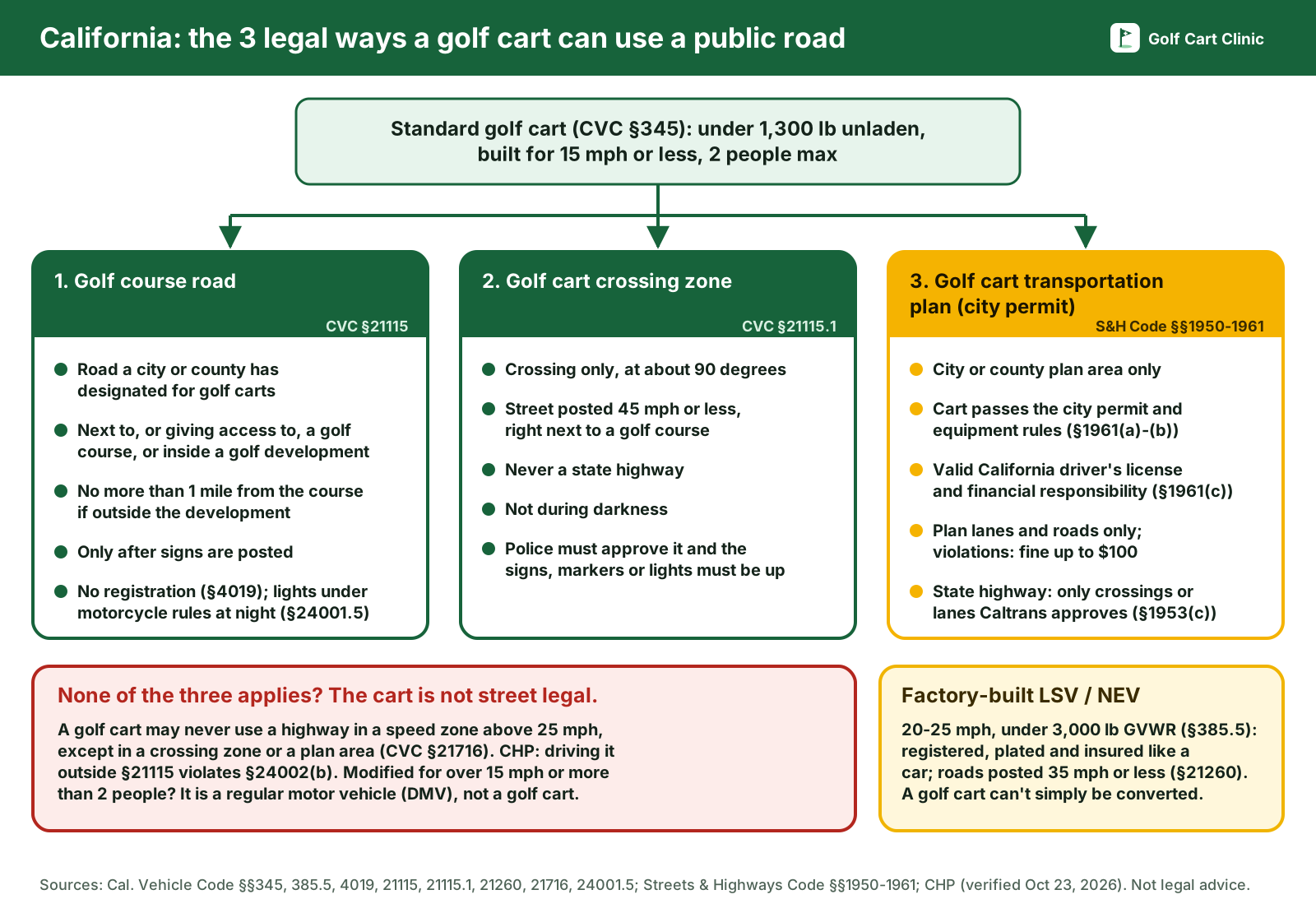
There are only three legal ways for a golf cart to use a public road in California. Outside them, the California Highway Patrol says on-highway operation of a golf cart "is unlawful and a violation of Section 24002(b) CVC" (CHP Information Bulletin, Registration of Golf Carts, Feb. 25, 2022). Section 24002(b) makes it unlawful to operate a vehicle "which is not equipped as provided in this code."
1. Roads designated near a golf course (CVC §21115)
Under CVC §21115, a city or county may, by resolution or ordinance, designate a highway (in the Vehicle Code, a "highway" includes any public street, §360) for combined use by regular traffic and golf carts if it finds that the road:
- is next to, or gives access to, a golf course and runs between the course and where golf carts are parked or stored, or lies within or along a "real estate development offering golf facilities" (homes whose owners or occupants can use the development's golf courses); and
- is designed and built to safely handle both regular traffic and golf carts.
Limits that come with it:
- One mile. "No highway shall be so designated for a distance of more than one mile from the golf course if the highway is not located within a development or beyond the area of a development."
- Signs first. The local rules "shall not be effective until appropriate signs giving notice thereof are posted along the highway affected."
- Local rules have the force of law. They can set crossing zones, speed limits and other operating standards.
- No extra paperwork or gear by local rule. The local rules may not require golf carts to conform to the Vehicle Code's registration, licensing or equipment requirements, except that a cart driven during darkness is subject to CVC §24001.5, which applies the equipment rules for motorcycles to golf carts.
For these designated roads, §21115(b) says a "golf cart" includes a low-speed vehicle.
2. Golf cart crossing zones (CVC §21115.1)
A city or county may also set up golf cart crossing zones on a street posted 45 mph or less that is "immediately adjacent to a golf course," but never on a state highway (CVC §21115.1). The crossing must run at about 90 degrees to the road, it may be used "at any time other than during darkness," and it only takes effect after the law enforcement agency for that street finds it reasonably safe and the signs, markers or lighting it specifies are in place. The law is explicit that a crossing zone is not precedent for driving golf carts along any other street.
3. Golf cart transportation plans (Streets and Highways Code §§1950–1961)
This is the California-specific route that lets a city build a real golf cart network. Any city or county may, by ordinance or resolution, adopt a golf cart transportation plan for a plan area (S&H Code §§1950–1961). CVC §21716 expressly exempts these plans from the 25 mph speed-zone limit. In exchange, the city must adopt:
- Minimum design criteria for the carts, which "may include, but not be limited to, headlights, turn signals, safety devices, mirrors, brake lights, windshields, and other devices," and may require seatbelts and a covered passenger compartment (§1961(a));
- A permit process that only permits carts meeting those criteria (§1961(b));
- Operator rules: operators "shall be required to possess a valid California driver's license and to comply with the financial responsibility requirements" of the Vehicle Code (§1961(c));
- Route limits: carts are limited to the plan's golf cart lanes on the roads it identifies, and violating that is an infraction with a fine of up to $100 (§1961(d)).
A plan can't use a state highway, except for a crossing of, or a golf cart lane along, a state highway that Caltrans and the law enforcement agency for that highway authorize (§1953(c)). The plan must also be reviewed by the designated transportation planning agency and the local traffic enforcement agency before adoption (§1953(b)).
Speed and road limits at a glance
| Situation | Which roads | Speed rule | Who decides | Section |
|---|---|---|---|---|
| General rule | No golf cart on a highway in a speed zone above 25 mph | 25 mph zones or less (a cap, not a permission) | State law | CVC §21716 |
| Designated golf course road | Roads next to or giving access to a golf course, or within a golf development; max 1 mile from the course outside a development | Local rules may set speed limits; the §21716 25 mph zone cap still applies | City council or county board, with signs posted | CVC §21115 |
| Golf cart crossing zone | Crossing a non-state-highway street posted 45 mph or less, next to a golf course | Crossing only, at about 90 degrees, not during darkness | City or county, after police approval | CVC §21115.1 |
| Golf cart transportation plan | The plan's lanes and roads; state highways only for approved crossings or lanes | Set by the plan (exempt from §21716) | City or county plan and permit | S&H Code §§1953, 1961 |
| Low-speed vehicle (LSV/NEV) | Roadways with a speed limit of 35 mph or less; may cross faster roads at about 90-degree intersections | Vehicle itself tops out at 25 mph | State law (NEV plans can allow more) | CVC §§21260, 385.5 |
Age and driver's license rules
California has no special "golf cart license" and no lower golf cart driving age. Because a golf cart is a motor vehicle (§345), the general rule applies: "A person may not drive a motor vehicle upon a highway, unless the person then holds a valid driver's license issued under this code, except those persons who are expressly exempted under this code" (CVC §12500(a)). The license exemptions in CVC §12501 cover federal vehicles, implements of husbandry and certain off-highway vehicles; golf carts are not on the list.
Law enforcement treats it that way. The Los Angeles County Sheriff's Malibu/Lost Hills Station warns that "any unlicensed juvenile found operating a low-speed vehicle or golf cart could be subject to a 12500 CVC unlicensed driver citation," which "could result in the DMV postponing the juveniles licensing until the age of 18," and that a parent who lets a child drive can be cited under CVC §14604(a) (Malibu/Lost Hills Sheriff's Station advisory). Section 14604(a) bars an owner from knowingly letting someone drive the vehicle on a highway without checking that they hold a valid license. In a golf cart transportation plan area, the license requirement is written into the statute itself (S&H Code §1961(c)).
Golf courses, private roads and private communities set their own rules for carts off public roads.
Registration, plates and title
A golf cart driven on a designated golf course road is exempt from registration: "A golf cart operated pursuant to Section 21115 is exempt from registration" (CVC §4019). There is no golf cart license plate in California, and a plan city's permit (like Palm Desert's decal) is a local permit, not DMV registration.
Registration does not make a golf cart street legal. The DMV's manual describes how a golf cart can be registered (an Application for Title or Registration, REG 343; a Verification of Vehicle, REG 31; a Statement of Facts, REG 256, saying the cart is unmodified and meets §345), and notes that a gasoline cart without a label certifying compliance with California emission requirements for on-road use "can only be registered for off-highway use" (DMV §7.045). But the CHP's 2022 bulletin says golf carts are not built or certified to federal motor vehicle safety standards, that "some golf carts ... may have been registered in error," that the DMV may refuse to register a noncompliant cart, and that driving one on the highway outside §21115 is unlawful (CHP bulletin). The California Air Resources Board adds that because non-electric golf carts don't meet on-road emission requirements, "they are not eligible for on-road license and registration" (CARB Enforcement Advisory 410).
Buying a used cart? Our serial number lookup helps you confirm the model year of a Club Car or Yamaha before you deal with any paperwork.
Insurance requirements
California's financial responsibility law says "all drivers and all owners of a motor vehicle shall at all times be able to establish financial responsibility" and must carry evidence of it in the vehicle (CVC §16020). For a policy issued or renewed on or after January 1, 2025, the minimum liability limits are (CVC §16056(a)(2)):
- $30,000 for bodily injury or death of one person in any one accident;
- $60,000 for bodily injury or death of two or more persons in any one accident;
- $15,000 for damage to property of others in any one accident.
Those minimums rise again for policies issued or renewed on or after January 1, 2035, by $20,000, $40,000 and $10,000 respectively (§16056(d)). Golf cart transportation plans must require operators to comply with these financial responsibility rules (S&H Code §1961(c)), and Palm Desert's code says so directly. A homeowner's or golf policy may not cover a cart on public streets, so ask your insurer in writing before you drive on one.
Required equipment
What your cart needs depends on which legal path you use:
- Designated golf course road (§21115), daylight: local rules can't require the cart to meet the Vehicle Code's equipment requirements.
- Designated golf course road, during darkness: the cart is subject to §24001.5, which says a golf cart "shall only be subject to the provisions of this division which are applicable to a motorcycle," so check the motorcycle lighting rules before any night use.
- Crossing zones (§21115.1): no night use at all.
- Golf cart transportation plan: whatever the plan's design criteria list. Palm Desert's list is a good example of how far that goes (see below).
If you add lights, mirrors or a windshield, our upgrades section covers what fits, but remember that adding seats or speed can make the cart a "regular motor vehicle" under DMV rules.
Golf cart vs low-speed vehicle (LSV/NEV) in California
A low-speed vehicle is a four-wheeled motor vehicle that can reach "more than 20 miles per hour and not more than 25 miles per hour" in one mile on a paved level surface and has a gross vehicle weight rating under 3,000 pounds; it "is also known as a 'neighborhood electric vehicle'" (CVC §385.5). An LSV is not a golf cart, except on §21115 roads and §21115.1 crossings.
| Golf cart | Low-speed vehicle (LSV/NEV) | Modified golf cart | |
|---|---|---|---|
| Definition | 3+ wheels, under 1,300 lb, built for 15 mph or less, 2 people max (§345) | 4 wheels, 20 to 25 mph, under 3,000 lb GVWR (§385.5) | Over 15 mph or more than 2 people (DMV §7.045) |
| Where it may drive | Only §21115 roads, §21115.1 crossings or a golf cart plan area; never a speed zone over 25 mph otherwise (§21716) | Roadways posted 35 mph or less; cross faster roads at about 90-degree intersections (§21260) | Treated as a regular motor vehicle that must meet federal passenger-vehicle safety standards |
| Registration and plates | Exempt on §21115 roads (§4019); no plate | Registered under §4000(a), with a 17-digit VIN and FMVSS label (CHP) | Same as any other motor vehicle (DMV) |
| Driver | Valid driver's license (§12500(a)) | Valid driver's license (§21251 applies all motor vehicle rules) | Valid driver's license |
| Insurance | Financial responsibility (§16020) | Same as any motor vehicle | Same as any motor vehicle |
Under CVC §21251, an LSV "is subject to all the provisions applicable to a motor vehicle," and under CVC §21260 it may not be driven on any roadway with a speed limit above 35 mph. It may cross such a road only at an intersection of about 90 degrees with the crossing starting and ending on 35-mph-or-less roads, and it may not cross an uncontrolled intersection with a state highway unless the enforcing agency has approved that crossing. The federal standard, FMVSS 500 (49 C.F.R. §571.500), requires headlamps, turn signals, taillamps, stop lamps, reflex reflectors, mirrors, a parking brake, a windshield, a VIN and seat belts.
You can't just convert a golf cart into an LSV. The CHP says a golf cart "can only be modified to meet U.S. FMVSS by the original equipment manufacturer or a federally listed, final-stage manufacturer," and the City of Norco states that "a golf cart cannot be converted for registration as a neighborhood electric vehicle (NEV) or a low-speed vehicle (LSV)." The Malibu/Lost Hills Sheriff's Station says the same.
NEV transportation plans can let LSVs go further. The Streets and Highways Code authorizes them for the Ranch Plan Planned Community in Orange County, for San Diego County and its cities (that article is set to expire January 1, 2029) and for Los Angeles County and its cities (until January 1, 2040). Those plans can include separate striped NEV lanes on roads posted up to 55 mph (S&H Code §§1965–1966.17), but they cover certified LSVs, not ordinary golf carts.
Compare this with neighboring Arizona, where carts on public streets are registered and insured like other motor vehicles (Arizona golf cart laws), Florida, where carts may use roads a city or county has designated (Florida golf cart laws), and South Carolina's $5 permit decal and 4-mile rule (South Carolina golf cart laws). Texas uses a special golf cart plate (Texas golf cart laws). North Carolina also leaves golf carts to local ordinances, but lets towns open any street posted 35 mph or less (North Carolina golf cart laws).
Local rules: Palm Desert, Malibu, Norco and your town
Because California leaves nearly all golf cart road access to cities and counties, the answer can change at a city line. Three examples from official sources:
- Palm Desert (golf cart transportation plan). The city has run a Golf Cart Transportation Program since its 1993 ordinance (Ord. 703). Under Palm Desert Municipal Code Chapter 10.76, carts must be electric and have brake lights, front and rear turn signals, mirrors, head lamps, rear lights, CVC §24607 reflectors, a parking brake, a horn, a windshield, seat belts for everyone, a locking device, a covered passenger compartment and a backup buzzer (§10.76.100). Operators need a valid driver's license (with a narrow physician-certified disability exception) and must meet CVC §16020 financial responsibility. Carts may use public streets only from one hour before sunrise to one hour after sunset, with at most four people, all belted. They may use residential or business streets posted 25 mph or less, faster streets only on designated golf cart routes, and state highways only to cross at designated controlled intersections (§10.76.110). The permit requires a city inspection and costs $10 for two years, with the decal on the right rear fender (§10.76.120). It is valid only inside city limits.
- Malibu (Point Dume). After an increase in golf cart collisions in the Point Dume area, the Malibu/Lost Hills Sheriff's Station reminded residents that "golf carts are NOT street legal…EXCEPT: if you operate your golf cart on a highway designated for such use by ordinance or resolution within one mile of a golf course," and that LSVs may only be driven by licensed drivers and must be insured and registered (advisory).
- Norco. The city says golf carts "are not street legal and cannot be operated on public roadways or designated pedestrian/equestrian trails in Norco," and lists possible citations for driving without a license (§12500(a)), registration (§4000(a)(1)) or insurance (§16028(a)), plus a possible 30-day impound under §14602.6 (City of Norco).
To find your own rules, search your city or county municipal code for "golf cart," look for posted golf cart signs on the street, and ask the police department or sheriff's station that patrols it. If nothing has been adopted, the default is simple: no golf carts on public roads.
Before you drive on a California road: a quick checklist
- Confirm your cart still meets §345: under 1,300 pounds, built for 15 mph or less, two seats. If not, it's a regular motor vehicle under DMV rules, not a golf cart.
- Find the legal path: a signed §21115 golf course road, a §21115.1 crossing zone, or a city golf cart transportation plan with a permit.
- Stay out of speed zones over 25 mph unless you're in a crossing zone or a plan area that allows it (§21716).
- Make sure the driver has a valid driver's license with them.
- Carry proof of insurance that meets at least $30,000/$60,000/$15,000.
- No night driving unless the cart meets the motorcycle equipment rules (§24001.5) or your plan allows it, and never across a crossing zone in darkness.
- Check the battery pack before a longer trip; our battery watering guide covers the basics for flooded lead-acid batteries.
Frequently asked questions
Are golf carts street legal in California?
Only in limited places. A standard golf cart may use a road a city or county has designated near a golf course (generally within one mile of it, CVC §21115), a golf cart crossing zone (§21115.1), or the lanes and roads of a city or county golf cart transportation plan (S&H Code §§1950–1961). Outside those, the CHP says operating one on a highway is unlawful.
Can I drive my golf cart on a 25 mph street in California?
Not just because the street is posted 25 mph. CVC §21716 bans golf carts from speed zones over 25 mph, but it doesn't give permission to drive on every slower street. The street still has to be designated under §21115 or be part of a golf cart transportation plan.
Do you need a driver's license to drive a golf cart in California?
Yes, on public roads. A golf cart is a motor vehicle (§345), CVC §12500(a) requires a valid license to drive a motor vehicle on a highway, and §12501 has no golf cart exemption. Golf cart transportation plans require a valid California driver's license by statute (S&H Code §1961(c)).
Can a 14-year-old drive a golf cart in California?
Not on a public road. There is no golf cart exception to the driver's license rule, and sheriffs warn that an unlicensed juvenile can be cited under §12500 and a parent under §14604(a). Private property and golf courses set their own rules.
Do golf carts need to be registered in California?
Not when driven on a road designated under §21115: CVC §4019 exempts them. There's no golf cart plate. A city in a golf cart plan may require its own permit, like Palm Desert's $10, two-year decal.
Can I register my golf cart as an LSV in California?
Generally no. LSVs must be built and certified to FMVSS 500 with a 17-digit VIN, and the CHP says only the original manufacturer or a federally listed final-stage manufacturer can bring a golf cart up to those standards. Local agencies state plainly that a golf cart cannot be converted for registration as an LSV or NEV.
What's the difference between a golf cart and an LSV in California?
A golf cart is built for 15 mph or less and up to two people and may only use designated roads, crossings or plan areas. An LSV reaches 20 to 25 mph, must be registered and insured like a car, and may use roadways posted 35 mph or less (§§385.5, 21260).
Sources
- California Vehicle Code §§345 (golf cart), 385.5 (low-speed vehicle), 4019 (registration exemption), 12500 and 12501 (driver's license), 14604, 16020 and 16056 (financial responsibility), 21115 and 21115.1 (local designation and crossing zones), 21251 and 21260 (LSVs), 21716 (25 mph zones), 24001.5 and 24002 (equipment): leginfo.legislature.ca.gov
- California Streets and Highways Code §§1950–1961 (golf cart transportation plans): leginfo.legislature.ca.gov; §§1965–1966.17 (NEV transportation plans): leginfo.legislature.ca.gov
- California DMV, Vehicle Industry Registration Procedures Manual §7.045, Golf Carts: dmv.ca.gov
- California Highway Patrol, Information Bulletin "Registration of Golf Carts" (Feb. 25, 2022): chp.ca.gov
- California Air Resources Board, Enforcement Advisory 410 (golf carts): arb.ca.gov
- 49 C.F.R. §571.500 (FMVSS 500, low-speed vehicles): ecfr.gov
- City of Palm Desert, Golf Cart Transportation Program and Municipal Code Chapter 10.76: palmdesert.gov, ecode360.com (local example)
- Malibu/Lost Hills Sheriff's Station golf cart and LSV advisory: malibucity.org; City of Norco, Golf Carts and Off-Highway Vehicles on Public Roadways and Trails (Dec. 7, 2021): norco.ca.us (local examples)
Questions and comments
No comments yet. Corrections and notes from your own repair are welcome.