
North Carolina Golf Cart Laws (2026): 35 MPH Rule, Age 16 and Town Permits
North Carolina lets each city and county decide whether golf carts may use its streets, but only streets posted 35 mph or less, and never with a driver under 16. The DMV can't plate a golf cart, so the permit comes from your town. Here are the statutes, real town rules and the LSV alternative.
In North Carolina, a golf cart is only allowed on a public street if your city or county has passed a golf cart ordinance, and even then only on streets with a speed limit of 35 mph or less. State law sets a hard minimum age: "No person less than 16 years of age may operate a golf cart on a public street, road, or highway" (G.S. 160A-300.6). Everything else (registration, fees, insurance, lights, hours, and whether you need a driver's license) is set town by town. The NCDMV won't register or plate a golf cart, so if you want to drive on any 35 mph street statewide you need a registered low-speed vehicle (LSV) instead. This guide covers each rule, with links to the North Carolina General Statutes (G.S.), the NCDMV and NCDOT so you can check them yourself.
Not legal advice. Last verified: October 24, 2026. This is a plain-English summary of the North Carolina General Statutes and NCDMV and NCDOT guidance. In North Carolina almost every golf cart road rule comes from a city or county ordinance, and HOAs, private communities and golf courses add their own rules. Check your town or county code, call the local police department or sheriff's office, and ask your community association before you drive a golf cart on a public road.
What counts as a golf cart in North Carolina?
North Carolina's definition turns on top speed, not weight or seats. Under G.S. 20-4.01(12b), a golf cart is "a vehicle designed and manufactured for operation on a golf course for sporting or recreational purposes and that is not capable of exceeding speeds of 20 miles per hour."
That 20 mph line matters when you shop for golf cart upgrades. A speed controller or motor swap that lets the cart go faster can take it outside the golf cart definition, and then the local golf cart ordinance no longer covers it. The Town of Emerald Isle, for example, says a cart "which has been modified so that it no longer meets the definition of golf cart may not be registered as a golf cart" and can't be driven on town streets unless it is registered under state motor vehicle law (Emerald Isle golf cart rules, §11-44(g)).
North Carolina also has three street-legal categories that look like golf carts but are not: the low-speed vehicle, the mini-truck and the modified utility vehicle. Each has its own road rules (see the comparison below).
Where can you drive a golf cart in North Carolina?
Two near-identical statutes give local governments the power to allow golf carts on public roads, both "notwithstanding" the state's registration rules in G.S. 20-50 and 20-54:
- Cities and towns: a city "may, by ordinance, regulate the operation of golf carts ... on any public street, road, or highway where the speed limit is 35 miles per hour or less within its municipal limits or on any property owned or leased by the city" (G.S. 160A-300.6(a)).
- Counties: a county has the same power on roads posted 35 mph or less in its unincorporated areas and on county property (G.S. 153A-245(a)).
So the practical answer has three parts:
- No ordinance, no road use. These statutes are the authority for golf carts on public roads. If your town or county hasn't adopted a golf cart ordinance, don't drive a golf cart on its streets. Oak Island, a popular beach town, states it plainly: "Unregistered (non-street legal) golf carts are not allowed to operate on public streets in the Town of Oak Island" (Town of Oak Island Police).
- 35 mph is the ceiling. No ordinance can open a road with a higher speed limit to golf carts. Many ordinances let carts cross a faster road at a marked or signalized spot, but not drive along it.
- Town limits matter. A city ordinance covers streets inside that city. Drive past the town line and you are under the county's rules, or none at all.
Speed limits on state roads are not easy to lower for golf carts. NCDOT's guidance says that on state-maintained roads a speed change requires an engineering and traffic study and that "the desire to operate golf carts on a roadway is not engineering justification to lowering the speed limit on a state maintained roadway." It also says NCDOT "will not install signing indicating the presence of golf carts" (NCDOT Guidance for Golf Carts).
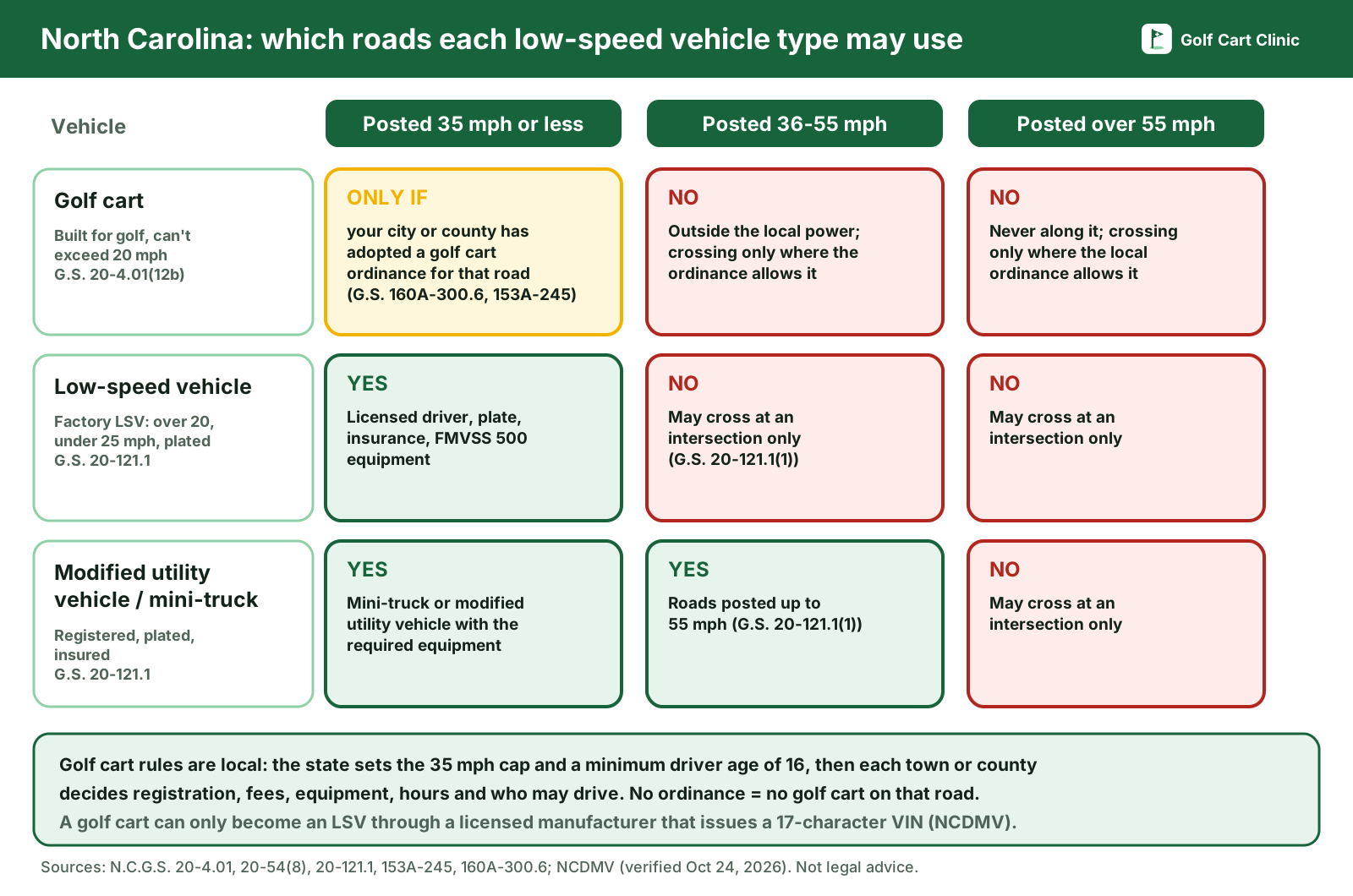
Speed and road limits at a glance
| Vehicle | Roads it may use | Its own speed | Paperwork | Statute |
|---|---|---|---|---|
| Golf cart | Only roads posted 35 mph or less that a city or county ordinance opens to golf carts | Not capable of more than 20 mph (definition); many ordinances also cap driving at 20 mph | Local permit if the ordinance requires one; no DMV plate | G.S. 20-4.01(12b), 160A-300.6, 153A-245 |
| Low-speed vehicle (LSV) | Streets and highways posted 35 mph or less statewide; may cross faster roads at an intersection | Top speed over 20 mph but under 25 mph | DMV title, registration, plate and insurance | G.S. 20-4.01(27)g, 20-121.1 |
| Mini-truck | Streets and highways posted 55 mph or less | No speed set in its definition | DMV registration and insurance | G.S. 20-121.1(1) |
| Modified utility vehicle | Streets and highways posted 55 mph or less | Built for 40 mph or more | DMV registration and insurance; helmet rule if no windshield | G.S. 20-4.01(27)g2, 20-121.1 |
Note the difference from neighboring South Carolina, where the state itself issues golf cart permits. North Carolina has no state golf cart permit at all; a town decal is the only "registration" a golf cart can get.
Age and driver's license rules
The only age rule in state law is the floor: no one under 16 may drive a golf cart on a public street, road or highway (G.S. 160A-300.6(b); G.S. 153A-245(b)). An ordinance can set a higher age and decide "who is authorized to operate golf carts."
The golf cart statutes don't mention a driver's license, but in practice you'll need one. NCDOT's model golf cart ordinance, which many towns copied, says "No person may operate a golf cart unless that person is licensed to drive upon the public streets, roads and highways of North Carolina" and that drivers "must carry their driver's license on their person at all times" (NCDOT model golf cart ordinance). Real examples:
- Pinehurst: the driver must be "licensed to drive upon the streets and highways of North Carolina" and carry the license (Pinehurst Code §71.17(B)(2)).
- Emerald Isle: the driver must be at least 18, licensed in North Carolina or their home state, and a resident, property owner, authorized guest or tenant in town (Emerald Isle §11-45(3)).
So a 16-year-old with a full license may be fine in one town and not allowed in the next. Golf courses, private roads and gated communities set their own rules off public roads.
Registration, plates and title
The NCDMV can't register a golf cart. G.S. 20-54(8) tells the Division to refuse registration or a certificate of title when "the vehicle is a golf cart." There is no golf cart license plate in North Carolina.
Registration happens locally, if at all. Both enabling statutes let a city or county "require the registration of golf carts, charge a fee for the registration," and set equipment, load limits and hours. Fees and terms vary a lot:
- Pinehurst: a village sticker on the front and rear of the cart, with a one-time $20 fee at Village Hall (Village of Pinehurst).
- Emerald Isle: a town golf cart plate and annual decal; every permit expires January 1 and costs $125 per cart, with $25 off for passing the town's online safety quiz (Emerald Isle Golf Cart Registration Program).
Buying a used cart? Our serial number lookup helps you confirm a Club Car or Yamaha model year, and many towns ask for an identifiable serial number on the permit application.
Insurance requirements
State law doesn't set an insurance rule for golf carts by name. North Carolina's insurance requirement is tied to registration (G.S. 20-309(a): "No motor vehicle shall be registered in this State unless the owner ... provides proof of financial responsibility"), and golf carts can't be registered. The requirement comes from local ordinances instead, and most have one: NCDOT's model ordinance requires liability coverage "in an amount not less than required by North Carolina law for motor vehicles operated on public highways," and Emerald Isle requires auto liability insurance at the state minimum for regular motor vehicles.
That state minimum for a motor vehicle liability policy is currently (G.S. 20-279.21(b)(2)):
- $50,000 for bodily injury or death of one person in any one accident;
- $100,000 for bodily injury or death of two or more persons in any one accident;
- $50,000 for damage to property of others in any one accident.
A homeowner's policy may not cover a golf cart on a public street, so ask your insurer in writing before you drive on one.
Required equipment
For golf carts, the equipment list is whatever your local ordinance says. NCDOT's model ordinance asks for the manufacturer's basic equipment, including a vehicle identification or serial number, a rear view mirror and "a rear triangle reflector," and limits carts without lights to daylight hours. Carts with two working headlights and two working taillights visible from 500 feet may run at any time under the model text. Towns often go further:
| Item | NCDOT model ordinance | Pinehurst §71.17 | Emerald Isle §11-44(d) |
|---|---|---|---|
| Headlights / taillights | Needed for night use (500 ft) | Needed before sunrise or after sunset (300 ft front, 200 ft rear) | Always required (250 ft), plus brake lights and turn signals |
| Mirrors | Rear view mirror | Rear view or side view mirrors | Rear vision mirror |
| Reflectors | Rear triangle reflector | Not listed | At least one per side |
| Seat belts | Not listed | Not listed | Every seating position |
| Windshield / parking brake | Not listed | Not listed | Both required |
| Speed while driving | 20 mph maximum | 20 mph maximum | 20 mph maximum |
If you add lights, turn signals or belts, our upgrades section covers what fits. Don't add speed: a cart that can exceed 20 mph is no longer a golf cart under G.S. 20-4.01(12b).
Golf cart vs low-speed vehicle (LSV) in North Carolina
A low-speed vehicle is "a four-wheeled vehicle that is either electrically powered or propelled by a gasoline engine whose top speed is greater than 20 miles per hour but less than 25 miles per hour" (G.S. 20-4.01(27)g). Unlike a golf cart, an LSV doesn't need a local ordinance. Under G.S. 20-121.1:
- It "may be operated only on streets and highways where the posted speed limit is 35 miles per hour or less," but may cross a faster road at an intersection.
- It must have "headlamps, stop lamps, turn signal lamps, tail lamps, reflex reflectors, parking brakes, rearview mirrors, windshields, windshield wipers, speedometer, seat belts, and a vehicle identification number," all kept in working order.
- It must be registered and insured under G.S. 20-50 and 20-309, and must meet the federal LSV safety standard, 49 C.F.R. §571.500.
- NCDOT may ban LSVs from any road if it finds that necessary for safety.
Can you convert your golf cart to an LSV? Not by yourself. The NCDMV says "a licensed manufacturer must be the one to upfit a golf cart to a low-speed vehicle, to include issuing a 17-digit and character vehicle identification number, a Manufacturer's Certificate of Origin," and meeting federal and state LSV requirements (NCDMV, Other Vehicle Types to Title & Register). Oak Island Police add that dealers "might not issue a VIN if they did not install the required safety equipment," so talk to the dealer before you buy parts.
| Golf cart | Low-speed vehicle (LSV) | |
|---|---|---|
| Definition | Built for golf, can't exceed 20 mph (G.S. 20-4.01(12b)) | 4 wheels, top speed over 20 and under 25 mph (G.S. 20-4.01(27)g) |
| Where it may drive | Only roads posted 35 mph or less that a local ordinance opens | Any street or highway posted 35 mph or less, unless NCDOT bans it there |
| Registration and plate | DMV must refuse (G.S. 20-54(8)); local permit only | DMV title, registration and plate |
| Equipment | Set by the ordinance | Full list in G.S. 20-121.1(2) plus FMVSS 500 |
| Insurance | Set by the ordinance (usually state minimums) | Required (G.S. 20-309) |
| Driver | 16 or older by statute; license per the ordinance | Licensed driver (a motor vehicle on a highway, G.S. 20-7) |
Compare this with South Carolina next door, where the SCDMV issues a $5 golf cart permit decal and carts stay within 4 miles of home unless a local ordinance says otherwise (South Carolina golf cart laws), and Florida, where golf carts also need a city or county to designate a road (Florida golf cart laws). California is the strictest of the states we've covered (California golf cart laws). Georgia, to the south, also leaves golf carts to local ordinances, but towns with ordinances from 2012 or later may only open streets posted 25 mph or less (Georgia golf cart laws). Tennessee, across the mountains, gives towns no such power: golf carts stay off public roads, and only registered LSVs and MSVs may use them (Tennessee golf cart laws). Up the coast, Delaware's beach towns work the same way for plain golf carts: they stay off public roads, and only titled LSVs may use roads posted 35 mph or less (Delaware golf cart laws). Next door, Virginia also leaves golf cart streets to local ordinances, but it limits carts to designated roads posted 25 mph or less and requires every driver to carry a valid driver's license (Virginia golf cart laws).
Local rules: Pinehurst, Emerald Isle, Oak Island and your town
Because the state hands golf cart rules to towns and counties, a short drive can take you into a different set of rules. Three examples from official sources:
- Pinehurst (Moore County). Carts may use village streets posted 35 mph or less, but "may not operate on or alongside NC 211" or US 15-501 and may cross them only at signalized intersections. They may cross NC 5, NC 2, Morganton Road, Page Road and Linden Road but not drive along them, and are barred from the hospital district. Other rules: 20 mph maximum, keep to the extreme right and yield to all traffic, no more riders than seats, and daylight only unless the cart has qualifying lights. Breaking §71.17 is an infraction with a maximum penalty of $50 (Pinehurst Code §§71.17, 71.99).
- Emerald Isle (Crystal Coast). Registered carts may use all public streets "EXCEPT" NC 58 (Emerald Drive) and Coast Guard Road, which they may only cross "directly in a straight line." Everyone must be belted, and children who need a car seat in a car need one in the golf cart (Emerald Isle §11-45).
- Oak Island (Brunswick County). Regular golf carts are not allowed on public streets; only a registered LSV or a golf cart registered as a mobility device for a person with a disability. The police department also asks LSV drivers to avoid long trips on Oak Island Drive and to use parallel 35 mph streets (Town of Oak Island Police).
To find your own rules, search your town's or county's code of ordinances for "golf cart," check the police department's website, and ask whether a permit is required before your first drive. If your town has no golf cart ordinance, the safe answer is no golf cart on public streets.
Before you drive on a North Carolina road: a quick checklist
- Confirm your cart still meets the definition: built for golf and not capable of more than 20 mph.
- Find the ordinance: does your city (or county, outside town limits) allow golf carts, and on which streets?
- Stay on streets posted 35 mph or less, and cross faster roads only where the ordinance allows it.
- Get the local permit or sticker if one is required, and display it where the ordinance says.
- Make sure the driver is at least 16 (or older if your town says so) and carries a driver's license if required.
- Carry proof of liability insurance; most towns ask for at least the state minimum of $50,000/$100,000/$50,000.
- Check the battery pack before a longer trip; our battery watering guide covers flooded lead-acid batteries.
Frequently asked questions
Are golf carts street legal in North Carolina?
Only where a city or county has adopted a golf cart ordinance, and only on roads posted 35 mph or less (G.S. 160A-300.6, 153A-245). The ordinance sets the rest: permits, equipment, hours and who may drive. Without one, a golf cart doesn't belong on public streets.
How old do you have to be to drive a golf cart on the road in North Carolina?
At least 16, under state law. Towns can require more: Emerald Isle requires drivers to be 18 and licensed, and Pinehurst requires a valid driver's license.
Do you need a driver's license to drive a golf cart in North Carolina?
The state golf cart statutes only set the age floor, but most local ordinances, following NCDOT's model ordinance, require a valid driver's license carried while driving. Check your town's ordinance.
Can you register a golf cart with the NCDMV?
No. G.S. 20-54(8) requires the DMV to refuse registration or title for a golf cart. Your town may issue its own golf cart permit or sticker instead.
Can I drive a golf cart on a 45 mph road in North Carolina?
No. Local governments can only allow golf carts on roads with a speed limit of 35 mph or less. Some towns let carts cross a faster road at certain intersections, but never drive along it.
How do I make my golf cart street legal in North Carolina?
Either follow your town's golf cart ordinance (permit, equipment, insurance), which only covers that town's 35-mph-or-less streets, or have a licensed manufacturer upfit it as a low-speed vehicle with a 17-character VIN and a Manufacturer's Certificate of Origin. Then you can title, register, plate and insure it with the NCDMV.
What's the difference between a golf cart and an LSV in North Carolina?
A golf cart can't exceed 20 mph and may only use roads a local ordinance opens. An LSV has a top speed over 20 and under 25 mph, carries a plate and insurance, and may use any road posted 35 mph or less statewide (G.S. 20-121.1).
Sources
- N.C. General Statutes §20-4.01(12b) (golf cart), (27)g, g1, g2 (low-speed vehicle, mini-truck, modified utility vehicle): ncleg.gov
- G.S. 160A-300.6 (cities) and G.S. 153A-245 (counties), regulation of golf carts on streets, roads and highways: ncleg.gov, ncleg.gov
- G.S. 20-54(8) (no registration or title for golf carts), 20-121.1 (LSVs, mini-trucks, modified utility vehicles), 20-309 and 20-279.21 (financial responsibility and minimum limits), 20-7 (driver's license): ncleg.gov
- NCDMV, Other Vehicle Types to Title & Register (low-speed vehicles): ncdot.gov
- NCDOT, Guidance for Golf Carts and Model Golf Cart Ordinance: connect.ncdot.gov (guidance), connect.ncdot.gov (model ordinance)
- 49 C.F.R. §571.500 (FMVSS 500, low-speed vehicles): ecfr.gov
- Village of Pinehurst Code §71.17 and golf cart registration: amlegal.com, vopnc.org; Town of Emerald Isle golf cart rules and registration: emeraldisle-nc.org, emeraldisle-nc.org; Town of Oak Island Police, Low Speed Vehicles: oakislandnc.gov (local examples)
Questions and comments
No comments yet. Corrections and notes from your own repair are welcome.