
Michigan Golf Cart Laws (2026): Town Resolutions, 15 MPH, Daylight Only and LSVs
In Michigan, golf carts may use streets only where a village, city or township under 65,000 people allows them by resolution (raised from 30,000 in July 2026). Drivers must be 16 and licensed, carts are limited to 15 mph, streets posted 30 mph or less and daylight hours. Here are the rules, the equipment towns may require and how LSVs differ.
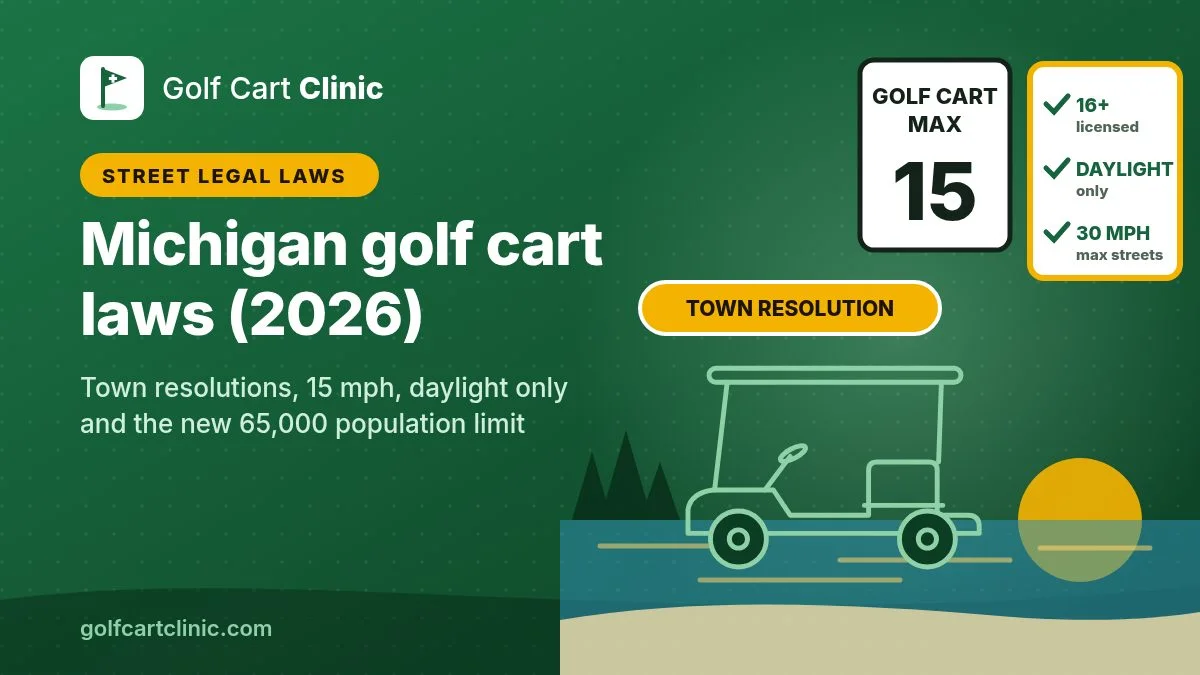
In Michigan, a golf cart may drive on public streets only where your village, city or township has allowed it by resolution, and since July 27, 2026 any community with fewer than 65,000 people can do that (the old cap was 30,000). On those streets the driver must be at least 16 and licensed, the cart may not go faster than 15 mph, it must stay off streets posted over 30 mph and state trunk line highways except to cross them, and it may not be driven from half an hour before sunset to half an hour after sunrise. Golf carts get no state title or plate; street-legal low-speed vehicles (LSVs) are a separate, plated class.
Not legal advice. Last verified: October 25, 2026. This guide summarizes the Michigan Vehicle Code (MCL Chapter 257) as published on the Michigan Legislature's official site, legislature.mi.gov, plus guidance from the Michigan Secretary of State (SOS) and Michigan State Police (MSP). Michigan leaves the yes-or-no decision to each village, city and township, and many add their own rules. Before you drive, read your community's golf cart resolution or call the local police department or clerk.
What changed in 2026: the 65,000 population limit
Michigan's golf cart law is one section of the Vehicle Code, MCL 257.657a. It was first added by 2014 PA 491 and was amended again this year by House Bill 4644, which became Public Act 73 of 2026. The governor approved it on July 21, 2026, and it took immediate effect when it was filed on July 27, 2026.
The Senate Fiscal Agency's bill analysis lists two changes:
- the population threshold for villages, cities and townships that may allow golf carts on their streets went from 30,000 to 65,000; and
- golf carts may not be operated on a freeway, in addition to an interstate highway, under the state trunk line approval process.
Two things did not change. The law still doesn't require any community to allow golf carts; it only lets eligible ones do so. And the separate path for using a state trunk line highway (explained below) is still limited to communities of "not more than 30,000." Some official pages haven't caught up yet: the Michigan State Police traffic laws FAQ (updated September 22, 2026) still says "fewer than 30,000 people." The statute text is what counts.
What counts as a golf cart in Michigan?
Michigan defines a golf cart by what it was built for, not by its speed. For this section, "'golf cart' means a vehicle designed for transportation while playing the game of golf" (MCL 257.657a(21)). That's different from states like Ohio, which use a top-speed and weight test. A UTV, side-by-side or ATV isn't a golf cart under a town's golf cart resolution, and town registration forms say so: Tawas City's form notes that its registration "does not apply to ATVs, UTVs, side-by-sides, mopeds, motorcycles, minibikes, etc." (Tawas City golf cart registration).
A low-speed vehicle is a different thing. Under MCL 257.25b, an LSV is "a self-propelled motor vehicle" that conforms to the federal definition in 49 CFR 571.3(b) and "meets the standard for low-speed vehicles under 49 CFR 571.500" (FMVSS 500). In practice, that means a 4-wheeled vehicle whose top speed is over 20 mph and no more than 25 mph, built with the federal LSV equipment.
| Vehicle | Michigan definition | Where it may drive | Title, plate, insurance |
|---|---|---|---|
| Golf cart | "A vehicle designed for transportation while playing the game of golf" (MCL 257.657a(21)) | Streets of a village, city or township that allowed golf carts by resolution; posted 30 mph or less; daylight only; 15 mph max | No state title or plate (SOS: golf carts "can't be registered as on-road vehicles"); town may keep a free list; insurance only if the town requires it |
| Low-speed vehicle (LSV) | Motor vehicle meeting 49 CFR 571.3(b) and FMVSS 500 (MCL 257.25b) | Streets posted 35 mph or less, 25 mph max; may cross faster roads (MCL 257.660(8)); no local resolution needed | Titled as an LSV and registered with a passenger plate if the MCO shows federal compliance; Michigan no-fault insurance to register |
| ORV, ATV, UTV | Off-road vehicle under MCL 324.81101 (Natural Resources and Environmental Protection Act) | Separate ORV rules: limited crossings, and streets a local government opens to ORVs by ordinance (MCL 324.81131) | ORV rules, not the golf cart section; some can be titled for on-road use as assembled vehicles |
Where can you drive a golf cart in Michigan?
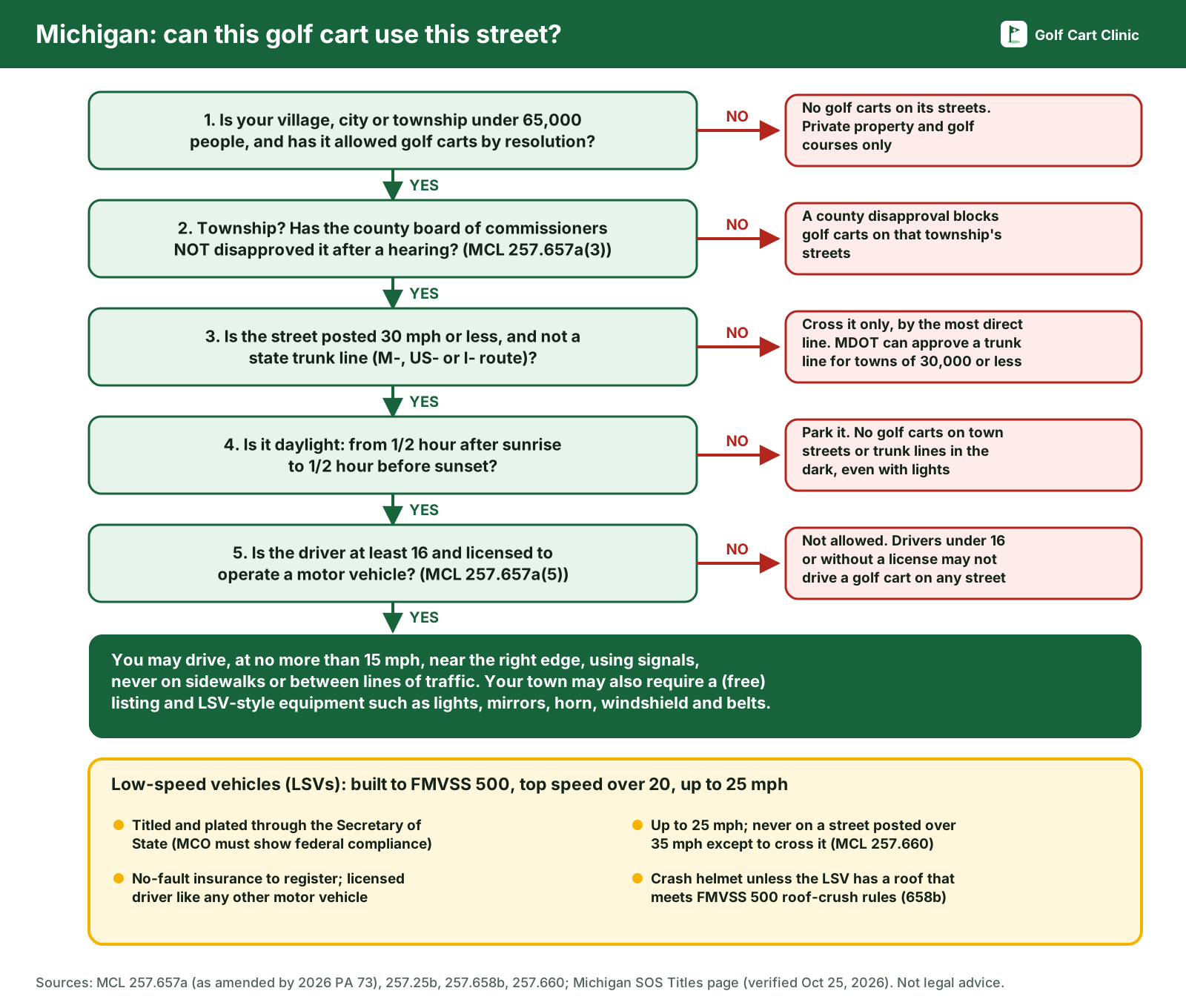
Only on the streets of a community that has said yes. Under MCL 257.657a(1), "a village or city having a population of fewer than 65,000 individuals based on the most recent federal decennial census may by resolution allow the operation of golf carts on the streets of that village or city." A township under 65,000 can do the same by resolution, "unless disapproved by the county board of commissioners." If your community hasn't passed a resolution, a golf cart has no right to use its streets.
Inside a community that allows them, these limits still apply everywhere:
- No streets posted over 30 mph. A golf cart "must not be operated on a state trunk line highway or a highway or street with a speed limit of more than 30 miles per hour except to cross" it (MCL 257.657a(15)). The community may also designate the roads, or classes of roads, carts may use, so a resolution can be narrower than "all 30 mph streets."
- No state trunk line highways except to cross them "using the most direct line of crossing" (MCL 257.657a(8)). State trunk lines are the state-numbered routes (M-, US- and I-routes). Local examples name them: Perry keeps carts off M-52 except to cross, Tawas City off M-55 and US-23, and Bronson off US-12, which carts may cross only at a traffic light.
- No sidewalks. "A golf cart must not be operated on a sidewalk constructed for the use of pedestrians" (MCL 257.657a(14)). Some towns also ban bike paths.
- Designated cart paths. Where "a usable and designated path for golf carts is provided adjacent to a highway or street," a local ordinance may require you to use it (MCL 257.657a(12)).
Golf courses, private land and private communities aren't covered by this section; their owners and associations set the rules there.
Townships: the county board can say no
Townships have one extra step that cities and villages don't. A county board of commissioners may disapprove golf carts on a township's streets by resolution, but only after a hearing, and only if it finds that golf carts there "would cause significant environmental damage" or "a significant concern of public safety" (MCL 257.657a(3)). The county has to give public notice, and written notice to the township, at least 45 days before that hearing (MCL 257.657a(4)).
State trunk lines: the MDOT exception
A community of "not more than 30,000" people that already allows golf carts may ask the Michigan Department of Transportation (MDOT) to let it adopt an ordinance opening a stretch of state trunk line, never an interstate or freeway (MCL 257.657a(9)-(10)). MDOT may approve it only where the trunk line is the only connection between parts of the community and it does at least one of these: gives access to "tourist attractions, food service establishments, fuel, motels, or other services"; connects two segments of the same county road along discontinuous town lines; or includes a bridge or culvert over a river, stream, wetland or gully that no cart-legal street crosses. MDOT must decide within 60 days, and it may later close the route with at least 30 days' written notice (MCL 257.657a(11)). On an approved trunk line, ride "as near to the right side of the roadway as practicable" (MCL 257.657a(18)). Unless your community has this approval, treat every M-, US- and I-route as crossing only.
Speed, daylight and road rules
- 15 mph maximum. "A golf cart must be operated at a speed not to exceed 15 miles per hour" (MCL 257.657a(15)), even on a street posted 25 or 30 mph. Many carts can go faster, so this is a real limit, not a formality.
- Daylight only. A golf cart "must not be operated on a state trunk line highway or the streets of a city, village, or township during the time period from 1/2 hour before sunset to 1/2 hour after sunrise" (MCL 257.657a(16)). Headlights don't change this.
- Stay right. Ride "as near to the right side of the roadway as practicable, exercising due care when passing a standing vehicle or a vehicle proceeding in the same direction" (MCL 257.657a(7)).
- Passing. Don't pass between lines of traffic. You may pass on the left of traffic going your way on a two-way street, or on either side on a one-way street, "in an unoccupied lane" (MCL 257.657a(13)).
- Signals. The driver must follow the turn and stop signal rules of MCL 257.648 that apply to any vehicle (MCL 257.657a(6)). That means hand-and-arm signals or a mechanical or electrical signal device.
- Helmets. Not required: "An individual operating a golf cart or who is a passenger in a golf cart is not required to wear a crash helmet" (MCL 257.657a(17)), unless your town adopts the LSV helmet rule (see equipment below).
Driver's license and age
State law sets one rule for every street: "An individual shall not operate a golf cart on any street unless the individual is at least 16 years old and is licensed to operate a motor vehicle" (MCL 257.657a(5)). No town can lower that. Some towns also ask each driver to register; Bronson, for example, requires every driver of a registered cart to register with the police department each year. An LSV is a motor vehicle, so its driver needs a valid operator's license like any other motor vehicle driver (MCL 257.301).
Registration, title and plates
Michigan doesn't title or plate golf carts for road use. The Secretary of State's Titles page says: "Golf carts can't be registered as on-road vehicles. However, if the vehicle manufacturer's certificate of origin (MCO) indicates the vehicle meets federal regulations for on-road use, the vehicle may be titled as a low-speed vehicle and registered with a passenger license plate (similar to cars and trucks)." Adding lights and a windshield to a golf cart doesn't turn it into an LSV; the MCO has to show federal compliance.
What a community may do is keep a list. Under MCL 257.657a(2), a village, city or township that allows golf carts "may require those golf carts and the operators of those golf carts to be recorded on a list maintained by that village, city, or township," and it "shall not charge a fee for listing golf carts or the operators of those golf carts." In practice many towns run a registration program with a decal and an inspection, and some charge for it: Elsie lists a $10 annual sticker (valid April 1 to March 31), and Bronson charges $20 per driver for police-department registration and an annual sticker. Ask your town what its paperwork involves before you buy a cart for street use.
Insurance
For golf carts, the state's no-fault insurance requirement isn't triggered by street use under this section. MCL 257.657a(20) says a golf cart operated on a village, city or township street under this section "is not required to be registered under this act for purposes of section 3101 of the insurance code of 1956," the section that requires no-fault security for registered motor vehicles (MCL 500.3101). Your town can still require coverage as a condition of its registration. Elsie, for example, won't issue a sticker without "proof of insurance as a rider to a homeowner's or renter's policy, or in any other form of policy, for coverage of personal injury or property damage resulting from operation of the subject golf cart." Even where it isn't required, ask your insurer whether your homeowner's policy covers a cart on public streets; many policies treat street use differently.
LSVs are different. They're registered like cars, and the SOS title and registration page says, "You must provide proof of a valid Michigan No-Fault insurance policy to register your vehicle in Michigan."
Required equipment: what your town may demand
State law doesn't require any specific equipment on a golf cart. Instead, MCL 257.657a(21) lets a village, city or township require a golf cart registered there to meet "any or all" of these low-speed vehicle requirements. Check your resolution to see which ones apply:
| MCL 257.657a(21) | Equipment a town may require | Vehicle Code section it must meet |
|---|---|---|
| (a) | At least 2 headlamps | Section 685 |
| (b) | At least 1 tail lamp | Section 686 |
| (c) | At least 1 stop lamp and 1 lamp or mechanical signal device | Sections 697 and 697b |
| (d) | At least 1 red reflector on each side, as far to the rear as practicable, and 1 red reflector on the rear | LSV rule, 49 CFR 571.500 |
| (e) | Driver's side exterior mirror, plus a passenger side exterior mirror or an interior mirror | LSV rule, 49 CFR 571.500 |
| (f) | Brakes and a parking brake | Section 705 |
| (g) | A horn | Section 706 |
| (h) | A windshield | Section 708a |
| (i) | A manufacturer's identification number permanently affixed to the frame | None listed |
| (j) | Safety belts, used as required | Sections 710a and 710e |
| (k) | Crash helmets as for LSVs | Section 658b |
Towns use this differently. Elsie's FAQ says carts "must have Headlights on the front, and taillights on the rear, visible from 500' affixed to the rear of the cart," and Bronson's police check that a cart "meets safety and ordinance requirements" before issuing a sticker. If you're adding lights, mirrors or belts to meet a local list, our golf cart upgrades guides cover the parts, and the serial number lookup helps you find the frame number and model year your town's form asks for.
Golf cart vs LSV in Michigan
If you want to drive on 35 mph roads, after dark or across town without a local resolution, you need a real LSV, not a modified golf cart. Here's how the two compare under Michigan law:
- Top speed: golf cart 15 mph on streets (MCL 257.657a(15)); LSV "must not be operated at a speed of more than 25 miles per hour" (MCL 257.660(8)).
- Roads: golf cart only on streets posted 30 mph or less in a community that allows it; an LSV "must not be operated on a highway or street with a speed limit of more than 35 miles per hour except for the purpose of crossing that highway or street" (MCL 257.660(8)). MDOT may also ban LSVs from specific roads under its jurisdiction for public safety.
- Hours: golf carts are daylight only; the LSV section has no daylight-only rule.
- Paperwork: golf carts get no state title or plate; LSVs are titled and get a passenger plate, with no-fault insurance, if the MCO shows federal compliance.
- Helmets: not required in a golf cart; in an LSV, "a person operating or riding in a low-speed vehicle shall wear a crash helmet" unless it has a roof that meets the FMVSS 500 roof-crush standard (MCL 257.658b).
- Sidewalks: neither may use them (MCL 257.657a(14); MCL 257.660(7)).
Outside a community that allows golf carts, the Michigan State Police say an untitled, unregistered cart "may only be operated on a highway under very limited circumstances if it meets the definition of an ORV" under MCL 324.81101, such as crossing at a right angle (MCL 324.81122), or on streets a community has opened to ORVs by ordinance (MCL 324.81131) (MSP traffic laws FAQ). Those are ORV rules with their own conditions, so check them separately before relying on them.
Local resolutions: examples
Every resolution repeats the state rules, then adds local ones. These are examples from official city and village pages, not a complete list:
- City of Perry (Shiawassee County): its July 21, 2022 resolution allows golf carts on city streets and adds that carts "may not be used to tow or pull any vehicle or device (i.e., sled, cart, etc.)" and "may not operate on M-52 (except to cross when safe to do so)." The city "reserves the right to rescind this approval" if carts become a safety hazard or nuisance.
- City of Tawas City: its registration form issues a numbered decal, keeps carts off sidewalks and bike paths and off M-55 and US-23 except to cross, says occupants "must adhere to vehicle seating capacity," and reminds owners that "open alcoholic drinks are prohibited on golf carts."
- City of Bronson: golf carts were approved on November 13, 2023 and the rules amended January 12, 2026. Carts are registered through the police department ($20 per driver), inspected, and get a calendar-year sticker; they may cross US-12 only at a traffic light.
- Village of Elsie (Clinton County): its golf cart FAQ requires an annual $10 sticker, proof of insurance and headlights and taillights, and bans driving "during weather events with snow and/or ice on the ground." Violations are civil infractions under the village fine chart. One caution: the FAQ says carts "must not exceed 25 miles per hour," but the statute's limit is 15 mph, and the state limit still applies.
Communities between 30,000 and 65,000 people became eligible on July 27, 2026, so expect new resolutions and changes over the next few seasons. Check your clerk's or police department's page for the current version.
Drinking and other traffic laws
Michigan's drunk-driving law covers golf carts. MCL 257.625(1) says a person "shall not operate a vehicle on a highway or other place open to the general public or generally accessible to motor vehicles" while intoxicated, and the Vehicle Code defines a vehicle as "every device in, upon, or by which any person or property is or may be transported or drawn upon a highway," with exceptions for things like human-powered devices (MCL 257.79). A golf cart doesn't fall under any of those exceptions. The golf cart section doesn't apply to police officers on duty (MCL 257.657a(19)).
Before you drive on a Michigan street: a quick checklist
- Confirm your village, city or township has passed a golf cart resolution, and read it. For a township, make sure the county board hasn't disapproved it.
- Register or list the cart and drivers if your town requires it, and get the decal.
- Add any equipment your town requires from the MCL 257.657a(21) list, plus insurance if required.
- Make sure every driver is at least 16 and holds a valid license.
- Plan routes on streets posted 30 mph or less that your town allows. Cross trunk lines and faster roads only by the most direct line, and where your town says to.
- Drive only from half an hour after sunrise to half an hour before sunset, at 15 mph or less, near the right edge, with signals, and never on sidewalks.
Frequently asked questions
Are golf carts street legal in Michigan?
Only where your village, city or township allows them. Under MCL 257.657a, communities with fewer than 65,000 people may allow golf carts on their streets by resolution. Even then, the driver must be 16 and licensed, the cart may not exceed 15 mph or use streets posted over 30 mph, and it must be off the road from half an hour before sunset to half an hour after sunrise.
What changed in Michigan's golf cart law in 2026?
Public Act 73 of 2026 (House Bill 4644), effective July 27, 2026, raised the population limit for communities that may allow golf carts from 30,000 to 65,000. It also made clear that golf carts can't be approved for freeways, in addition to interstates, under the state trunk line process. The other street rules didn't change.
How old do you have to be to drive a golf cart on the street in Michigan?
At least 16, and licensed to operate a motor vehicle (MCL 257.657a(5)). That applies on every street, whatever the local resolution says.
Can you drive a golf cart at night in Michigan?
No, not on public streets. A golf cart may not be driven on town streets or state trunk lines from half an hour before sunset to half an hour after sunrise (MCL 257.657a(16)), even with headlights. A titled and registered LSV doesn't have that limit.
Do golf carts need a license plate or insurance in Michigan?
No state plate: the Secretary of State says golf carts "can't be registered as on-road vehicles," and MCL 257.657a(20) says a cart used under the golf cart section doesn't have to be registered for no-fault insurance purposes. Your town may still require a free listing, a local decal and proof of insurance. An LSV needs a title, a passenger plate and no-fault insurance.
Can I drive my golf cart on a 35 or 45 mph road in Michigan?
No. A golf cart can't be driven along a street posted over 30 mph or a state trunk line highway; it may only cross one (MCL 257.657a(8) and (15)). The only exception is a trunk line segment MDOT has approved for a community of 30,000 or fewer. An LSV may use streets posted up to 35 mph, but nothing faster except to cross.
Can my township allow golf carts even if the county doesn't want them?
A township under 65,000 may allow them by resolution, but the county board of commissioners can disapprove after a hearing with at least 45 days' notice, and only if golf carts would cause significant environmental damage or a significant public safety concern (MCL 257.657a(3)-(4)). Cities and villages don't face that county review.
Michigan's local-resolution approach is lighter than Ohio's golf cart laws next door, where towns can allow golf carts on streets up to 35 mph but every cart needs a police inspection, an Ohio title and plates. Florida golf cart laws also let local governments designate roads, while Tennessee golf cart laws keep golf carts off public roads almost entirely. For more states, browse our golf cart laws by state.
Sources
- Michigan Vehicle Code, MCL 257.657a (golf carts), as amended by 2026 PA 73: legislature.mi.gov
- 2026 PA 73 (enrolled House Bill 4644): public act text; bill history; Senate Fiscal Agency analysis (legislature.mi.gov)
- Michigan Vehicle Code, MCL 257.25b (low-speed vehicle), 257.33 (motor vehicle), 257.79 (vehicle), 257.301 (operator's license), 257.625 (OWI), 257.648 (signals), 257.658b (LSV helmets), 257.660 (LSV operation): 257.25b, 257.33, 257.79, 257.301, 257.625, 257.648, 257.658b, 257.660 (legislature.mi.gov)
- Michigan Secretary of State: Titles (golf carts and low-speed vehicles); Title transfer and vehicle registration (no-fault insurance) (michigan.gov)
- Michigan State Police, Traffic Laws FAQs, Golf Carts and ORV Laws (updated September 22, 2026; still shows the pre-2026 30,000 figure)
- 49 C.F.R. §571.500 (FMVSS 500, low-speed vehicles): ecfr.gov
- Local examples: City of Perry golf cart resolution (perry.mi.us); City of Tawas City golf cart registration (tawascity.org); City of Bronson golf cart ordinance page (bronson-mi.com); Village of Elsie golf cart FAQ and rules (elsie.org)
Questions and comments
No comments yet. Corrections and notes from your own repair are welcome.