
Tennessee Golf Cart Laws (2026): Street Legal Rules, LSVs, MSVs and the 2025 UTV Law
Golf carts aren't street legal in Tennessee. Only registered low-speed and medium-speed vehicles may use public roads, and since April 2025 they follow the utility terrain vehicle law: licensed driver 16+, insurance, helmets unless exempt, daylight only and 35 mph max. Here's what changed, what the clerk needs and where you may drive.
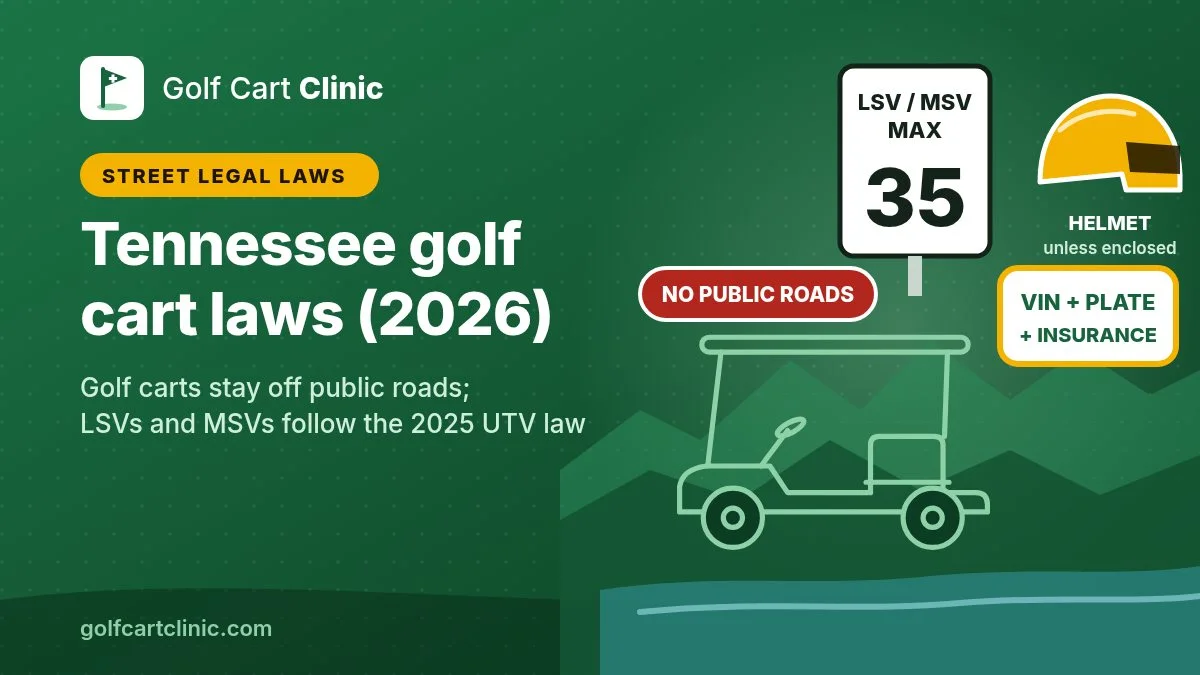
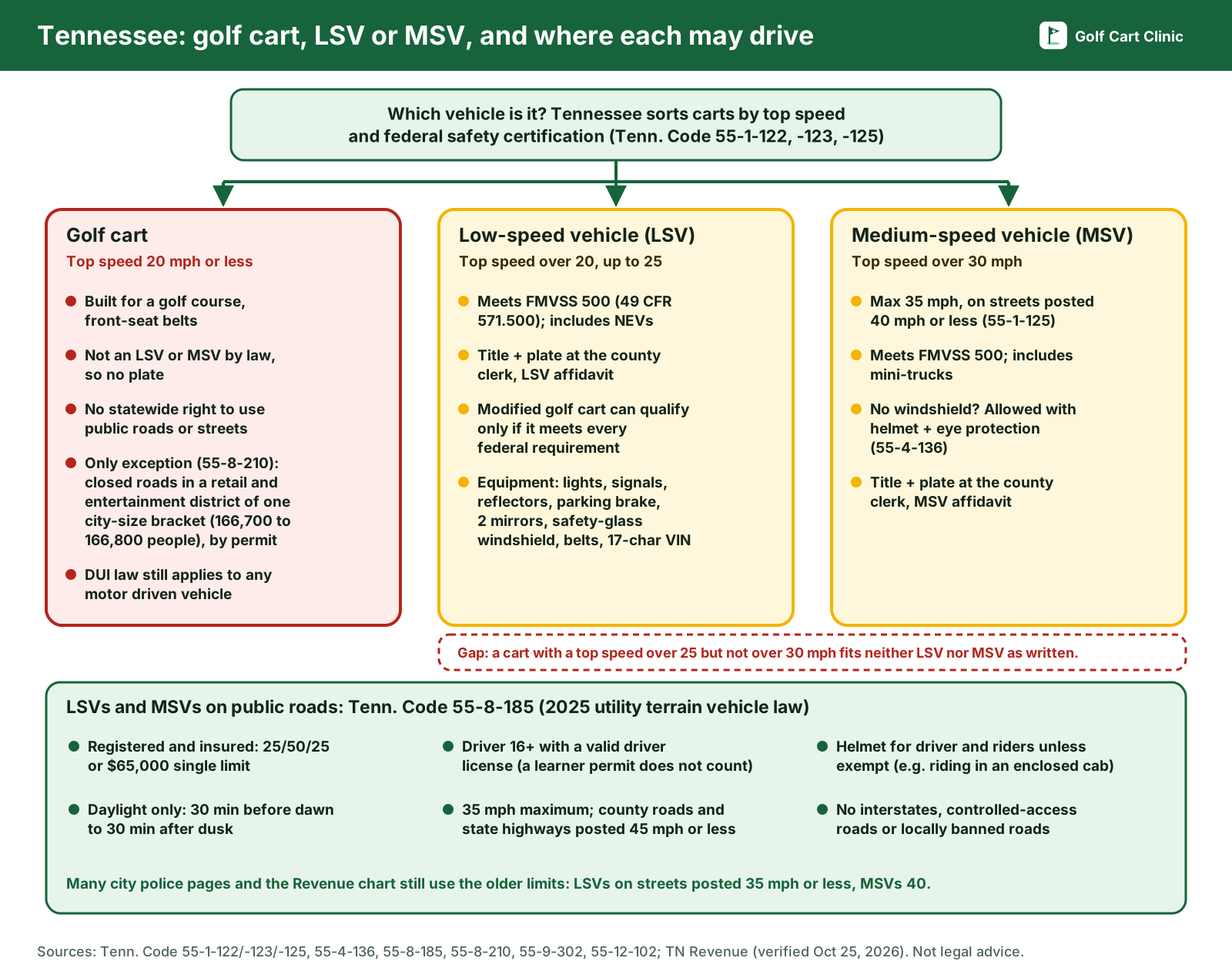
In Tennessee, a regular golf cart is not street legal. State law defines a golf cart as a vehicle built for a golf course that can't go faster than 20 mph, leaves it out of the low-speed and medium-speed vehicle classes, and gives it no general right to use public roads. The only street-legal path is to own (or properly convert) a vehicle that qualifies as a low-speed vehicle (LSV) or medium-speed vehicle (MSV), title and register it at your county clerk, insure it, and follow the 2025 rules in Tenn. Code §55-8-185: a driver 16 or older with a valid license, a helmet unless you're exempt, daylight only, never faster than 35 mph, and only on county roads and state highways posted 45 mph or less.
Not legal advice. Last verified: October 25, 2026. This guide summarizes the Tennessee Code Annotated (Title 55), the public chapters that changed it in 2022, 2025 and 2026, and forms and guidance from the Tennessee Department of Revenue. Statute links go to Justia's free copy of the Tennessee Code, and session laws link to the Tennessee Secretary of State and General Assembly. The 2025 law is new, and some official pages still describe the older rules (see below). Cities, counties, homeowner associations and golf courses can add their own restrictions. Before you drive on a public road, check with your county clerk and your local police department.
The big change: Tennessee's 2025 utility terrain vehicle law
If you read older Tennessee guides, they cite §55-8-191, which let LSVs use streets posted 35 mph or less and MSVs use streets posted 40 mph or less. That section no longer exists. Public Chapter 255 of 2025 (SB 728 / HB 810) repealed §55-8-191 and rewrote §55-8-185, which now treats LSVs and MSVs as "utility terrain vehicles," together with Class I and Class II off-highway vehicles and ATVs. The General Assembly's bill page lists the act as signed on April 24, 2025 and effective that day. Justia's annotation for §55-8-191 confirms it was "repealed by Acts 2025, ch. 255, § 3, effective April 24, 2025."
| Rule for LSVs and MSVs | Before April 24, 2025 (old §55-8-191) | Now (§55-8-185) |
|---|---|---|
| Where you may drive | LSV: streets posted 35 mph or less. MSV: streets posted 40 mph or less | Any county road, and state highways posted 45 mph or less, except interstates, controlled-access highways and roads a county, city or TDOT has closed to them |
| Top legal speed | MSV: 35 mph | 35 mph for every utility terrain vehicle (§55-8-185(d)) |
| Driver | Valid Class D license in possession | 16 or older with a valid driver license; a learner permit doesn't count |
| Helmet | Not in the section | Driver and every passenger, unless exempt under §55-9-302(b) |
| Hours | Not in the section | Daylight only, including 30 minutes before dawn and 30 minutes after dusk |
| Children | Not in the section | No passenger who must ride in a child restraint seat (§55-9-602) |
| Penalty | Not in the section | Class C misdemeanor, fine only of $50 (§55-8-185(i)) |
One more amendment followed. Public Chapter 663 of 2026 (SB 2596), effective April 1, 2026, says the 45 mph limit doesn't apply to a utility terrain vehicle used for agricultural purposes. It changed nothing else for LSV owners.
Where can you drive a golf cart in Tennessee?
Tennessee's definition is narrow. Under §55-1-123 (repeated in §55-8-101(28)), a golf cart is "a motor vehicle that is designed and manufactured for operation on a golf course for sporting or recreational purposes and equipped with safety belts installed for use in the left front and right front seats and that is not capable of exceeding speeds of twenty miles per hour (20 mph)." Both the LSV definition (§55-1-122) and the MSV definition (§55-1-125) say "excluding golf carts," so the 2025 road rules for utility terrain vehicles don't reach a golf cart at all.
That leaves golf carts with private property, golf courses and the places their owners allow. City police departments say the same thing in plain words. Knoxville's FAQ answers "Can I drive a golf cart on the road?" with "No, traditional golf carts are not street legal in the State of Tennessee," and adds that golf carts "cannot be titled or registered for use on roads, including neighborhood streets" (City of Knoxville). Collegedale's police department uses a local example: you can't legally cross Apison Pike "in an unregistered golf cart" to reach shops on the other side (City of Collegedale).
The one statutory exception: closed roads in a retail and entertainment district
§55-8-210, added by Public Chapter 772 of 2022, is the only general statute that opens any public roadway to golf carts, and it's tiny. It applies only to a municipality with a population "not less than one hundred sixty-six thousand seven hundred (166,700) and not more than one hundred sixty-six thousand eight hundred (166,800)" in the 2020 or a later census. The legislature's fiscal note for the bill describes it as authority for the city of Clarksville. Even there, the city must pass an ordinance by a two-thirds vote naming each roadway, notify the Department of Safety first, and issue a permit and sticker for each cart. The roads must be closed to motor vehicle traffic, and only people who own, run or work for a business in or next to the district may drive, on roads posted 35 mph or less, between half an hour after sunrise and half an hour before sunset, belted, licensed, with headlights on. We haven't confirmed that any ordinance has been adopted under it, so ask the city before you count on it.
Speed and road limits for LSVs and MSVs
Under §55-8-185(c), a registered LSV or MSV "may be operated on any state highway where the speed limit is forty-five miles per hour (45 mph) or less or any county road in the state," as long as the road is not:
- part of the interstate and national defense highway system;
- a controlled access highway;
- closed to these vehicles by a county or city for safety reasons (by resolution or ordinance, with a copy sent to the Department of Safety, §55-8-185(j)(2)); or
- closed by TDOT, in consultation with the Department of Safety.
Whatever the posted limit, you may not go faster than 35 mph (§55-8-185(d)). The law also requires the Department of Safety and TDOT to publish a list of interstate segments and banned roads on their websites (§55-8-185(j)(1)). We couldn't find that list, so ask your sheriff's office or police department about local bans.
Crossing a faster road. When you're using county roads, you may cross a state highway or other road posted over 45 mph (never an interstate) to get from one road or area to another. On a two-lane highway, cross at about a 90-degree angle where you can cross quickly and safely. Highways with more than two lanes, or with limited access, may be crossed only at places TDOT or the local government has designated and signed. Come to a complete stop first, yield to oncoming traffic, and have your headlights and taillights on (§55-8-185(c)(2)).
Be careful with city streets and the older 35/40 mph rule
The new section lists state highways and county roads. It doesn't separately mention city streets, and official guidance hasn't caught up. The MSV definition in §55-1-125 still says an MSV's "maximum speed allowed is thirty-five miles per hour (35 mph) only on streets with a forty mile per hour (40 mph) or less posted speed limit, except as provided in § 55-8-185." The Department of Revenue's VR-9 chart of off-highway vehicle plates (updated September 25, 2025) still lists LSVs as permitted on roads with a "posted speed not more than 35mph" and MSVs on roads posted "not more than 40mph." Knoxville, Kingsport and Collegedale police pages give the same 35/40 mph limits. Until the agencies and courts settle it, the safe approach is to meet both sets of rules: keep an LSV to roads posted 35 mph or less and an MSV to roads posted 40 mph or less, and follow every §55-8-185 condition (helmet, daylight, 35 mph, licensed driver 16+).
Age and driver's license rules
For an LSV or MSV on a public road, the operator "must be sixteen (16) years of age or older" and "must possess a valid driver license, which does not include a permit" (§55-8-185(b)(3)-(4)). The County Clerk guide still says "Any person operating a low or medium speed vehicle must have in possession a valid Class D driver license" (Vehicle Services County Clerk Guide), so carry your license every time.
For a golf cart there's no state age rule to quote, because state law doesn't let golf carts use public roads in the first place. Where §55-8-210 applies, the driver needs "a valid driver license." On private land, the owner, HOA or golf course sets the age rules.
Registration, plates and title
A golf cart can't get a Tennessee plate as a golf cart. LSVs and MSVs are titled and registered like other vehicles at your county clerk's office. The Department of Revenue's Off-Highway Vehicles page says you need "requisite proof of ownership documentation" and, for low-speed or medium-speed registration, the Low or Medium Speed Affidavit (RV-F16031). On that form you certify, under penalty of perjury, the vehicle's top speed and that it has every item on the federal list (see the equipment table below), including a VIN that conforms to 49 CFR 565.
Converting a golf cart is possible on paper but demanding. The County Clerk guide says "A golf cart that has been designed and manufactured for on road use, or has been modified to meet all of the requirements and federal safety standards may be registered as a 'Low or Medium Speed Vehicle'," and that the affidavit must certify the vehicle "has been sufficiently modified to meet all low or medium speed vehicle requirements." Two things trip people up:
- The VIN. The affidavit asks for a VIN conforming to 49 CFR 565. A golf cart's manufacturer serial number usually isn't one. Look up what your cart's number means with our golf cart serial number lookup, then ask your clerk before you buy parts.
- The speed band. An LSV's top speed must be over 20 and no more than 25 mph. An MSV's must be over 30 mph. A cart tuned to a top speed above 25 but not above 30 mph doesn't fit either definition as written.
If you only want a title for an off-highway vehicle (for example, to prove ownership), the Department of Revenue page explains that you can get a "title-only" and a non-renewable TDR sticker from the county clerk. That doesn't make the vehicle legal on roads.
Insurance requirements
An LSV or MSV on the road "must be covered by a liability policy that meets the requirements of the financial responsibility law" (§55-8-185(b)(2)). For proof required after December 31, 2022, §55-12-102(12)(D) sets the minimums at $25,000 for bodily injury or death of one person, $50,000 for two or more people in one accident and $25,000 for property damage, or a single-limit policy of at least $65,000. If an officer asks and you can't show proof, it's a Class C misdemeanor "punishable only by a fine of not more than three hundred dollars ($300)" in the usual case (§55-12-139(c)). If you drive a golf cart only on private property, ask your insurer whether your homeowner's policy covers it or whether you need a separate golf cart policy.
Required equipment
Three different equipment lists apply, depending on what you're driving and where:
| Item | LSV / MSV registration (RV-F16031 affidavit, 49 CFR 571) | LSV / MSV on the road (§55-8-185(b)(8): if equipped, must work and be used) | Golf cart on a §55-8-210 closed roadway |
|---|---|---|---|
| Headlights | Yes | Yes (at least two) | Yes, on while driving |
| Tail lamps and stop lamps | Yes | Yes (at least two) | Tail lamp and stop lights |
| Turn signals | Front and rear | Two turn signal lamps | Not listed |
| Reflectors | Red reflex reflector on each side near the rear and one on the rear | Not listed | Reflectors or a slow-moving vehicle emblem |
| Mirrors | Driver-side exterior mirror plus one more (passenger side or interior) | Not listed | A mirror |
| Brakes | Parking brake | Brakes | Brakes |
| Windshield | Safety glazing per 49 CFR 571.205 (MSV may skip it with helmet and eye protection, §55-4-136) | Windshield, or impact-resistant glasses, goggles or a face shield for everyone | Not listed |
| Seat belts | Type 1 or 2 at each seating position | Seat belts for each seat | Belts worn by driver and front passenger |
| Other | VIN conforming to 49 CFR 565 | Horn, roll bar, spark arrester and muffler, if equipped | City permit sticker |
If you're shopping for lights, mirrors or belts, our golf cart upgrades guides explain what to look for, but a parts kit alone doesn't make a cart an LSV. The vehicle has to meet the federal standard and its top speed has to fall in the LSV or MSV band.
Helmets, daylight and passengers
This is the part of the 2025 law that surprises LSV owners. Under §55-8-185(b)(5), "the operator and each passenger must wear a helmet that meets the standards contained in 49 CFR 571.218," and riders 21 or older may instead wear a helmet that meets the alternatives in §55-9-302(a)(1)-(4), "unless exempted under § 55-9-302(b)." The exemptions in §55-9-302(b) cover people riding "within an enclosed cab," in fully enclosed autocycles, in golf carts, in some parades and in funeral processions. An LSV isn't a golf cart under Tennessee law, so the golf cart exemption doesn't help it. "Enclosed cab" isn't defined. The only related definition, "fully enclosed" for autocycles, means "having side panels, a roll bar or roof, and a windshield." A typical open-sided LSV with only a roof and windshield may not qualify, so wear helmets or get your local police department's reading in writing.
The same section limits LSVs and MSVs to "daylight hours, which includes the thirty (30) minutes before dawn and the thirty (30) minutes after dusk" (§55-8-185(b)(7)) and bans carrying any passenger who must ride in a child passenger restraint under §55-9-602 (§55-8-185(b)(6)). An MSV registered without a windshield needs helmets and eye protection for everyone under §55-4-136.
Golf cart vs LSV vs MSV in Tennessee
Tennessee has three classes, and the line between them is top speed plus federal certification:
- Golf cart (§55-1-123): built for a golf course, front-seat belts, can't exceed 20 mph. No plate, no general road use.
- Low-speed vehicle (§55-1-122): four wheels, electric or gas, not a golf cart, top speed "greater than twenty miles per hour (20 mph) but not greater than twenty-five miles per hour (25 mph)," including neighborhood electric vehicles, and it "must comply with the standards in 49 CFR 571.500" (FMVSS 500).
- Medium-speed vehicle (§55-1-125): four wheels, not a golf cart, top speed "greater than thirty miles per hour (30 mph)," held to 35 mph on the road, including NEVs and mini-trucks, and it must meet FMVSS 500 (except the no-windshield option in §55-4-136).
A golf cart that's been sped up past 20 mph isn't a "golf cart" under the definition anymore, but that doesn't make it an LSV. It only becomes one if it meets every LSV requirement and is registered with the affidavit. Compare Georgia, which has a separate "personal transportation vehicle" class that local governments can allow on their streets (Georgia golf cart laws), and North Carolina, where towns may open streets to golf carts by ordinance (North Carolina golf cart laws). Tennessee has no general version of either.
Local rules: cities, counties and communities
Local governments in Tennessee mostly have the power to say no. A county or city may ban LSVs and MSVs on roads under its jurisdiction for safety by passing a resolution or ordinance and sending a copy to the Department of Safety (§55-8-185(c)(1)(C) and (j)(2)). Some cities add their own rules on top. Kingsport, for example, says its municipal ordinance keeps golf carts and low and medium speed vehicles off sidewalks (City of Kingsport). Section 55-8-185(f) also lists specific road segments in Scott, Anderson, Campbell, Morgan, Jackson, Johnson, Perry, Unicoi, Fentress and Hickman counties (several near off-road parks), some only with a two-thirds local vote. Unpaved roads in an adventure tourism district can be opened by a two-thirds vote of the local governing body (§55-8-185(g)).
Lake and retirement communities with lots of carts, such as those around Tellico Lake or on the Cumberland Plateau, often have their own association rules for carts on private streets, cart paths and golf courses. Those rules can add requirements but can't make a golf cart legal on a public road. Ask your property owners' association, and if the roads in your community are public county roads, state law applies there too.
Penalties and DUI
- Breaking §55-8-185 (helmet, hours, age, road or speed limits) is a Class C misdemeanor, "punishable by a fine only of fifty dollars ($50.00)" (§55-8-185(i)).
- Failing to show proof of insurance is a Class C misdemeanor with a fine of up to $300 in most cases (§55-12-139).
- Tennessee's DUI law covers "any automobile or other motor driven vehicle" on public roads, streets and alleys, and on "the premises of any shopping center, trailer park, or apartment house complex, or any other premises that is generally frequented by the public at large" (§55-10-401). That includes golf carts, and Kingsport and Collegedale police both warn that DUI laws apply to them.
Before you drive on a Tennessee road: a quick checklist
- Figure out what you have: a golf cart (20 mph or less, no road use), an LSV (over 20, up to 25 mph, FMVSS 500) or an MSV (over 30 mph, FMVSS 500).
- If it's a golf cart, keep it on private property, the course and community paths where the owner allows it. Don't cross public roads in it.
- For an LSV or MSV, take proof of ownership and the RV-F16031 affidavit to your county clerk and get it titled and registered.
- Buy liability insurance of at least 25/50/25 (or a $65,000 single limit) and keep proof in the vehicle.
- Check the equipment list: lights, signals, reflectors, parking brake, two mirrors, safety-glass windshield, belts at every seat and a proper VIN.
- Make sure every driver is 16 or older with a valid license (no learner permits), and keep helmets for everyone unless you're sure an exemption applies.
- Drive only in daylight (30 minutes before dawn to 30 minutes after dusk), never over 35 mph, and only on allowed roads. To be safe, keep an LSV to roads posted 35 mph or less and an MSV to 40 mph or less.
- Ask your county or city whether it has banned these vehicles on any roads, and never drink and drive.
Frequently asked questions
Are golf carts street legal in Tennessee?
No. A Tennessee golf cart (built for golf, top speed 20 mph or less) can't be titled or registered for road use and has no general right to use public roads, including neighborhood streets. The only statutory exception, §55-8-210, covers roads closed to traffic in a retail and entertainment district of a city with a population between 166,700 and 166,800, by city permit. To drive on the road, you need a registered low-speed or medium-speed vehicle.
Can I make my golf cart street legal in Tennessee?
Only if it truly becomes an LSV or MSV. It must meet the federal FMVSS 500 requirements, have a VIN that conforms to 49 CFR 565 and the listed equipment, and have a top speed in the LSV band (over 20, up to 25 mph) or the MSV band (over 30 mph). You then sign the Low or Medium Speed Affidavit and title and register it at your county clerk. Ask the clerk what they'll accept before you spend money.
Do you need a helmet in a low-speed vehicle in Tennessee?
Under the 2025 law, yes, unless you're exempt. Section 55-8-185(b)(5) requires the driver and every passenger to wear a helmet that meets 49 CFR 571.218 (or, at 21 and older, the alternative standard in §55-9-302(a)) unless an exemption in §55-9-302(b) applies, such as riding within an enclosed cab. The golf cart exemption doesn't cover LSVs.
What roads can an LSV drive on in Tennessee?
Section 55-8-185 allows county roads and state highways posted 45 mph or less, at no more than 35 mph, but not interstates, controlled-access highways or roads a county, city or TDOT has banned. The Department of Revenue's plate chart and many police departments still use the older limits (streets posted 35 mph or less for LSVs, 40 mph for MSVs), so staying under those limits is the safest choice.
How old do you have to be to drive an LSV in Tennessee?
At least 16, with a valid driver license. Section 55-8-185(b)(4) says the license "does not include a permit," so a learner's permit holder can't drive an LSV or MSV on public roads, even with an adult on board.
Do LSVs need insurance in Tennessee?
Yes. An LSV or MSV must carry liability insurance that meets the financial responsibility law: at least $25,000 per person and $50,000 per accident for bodily injury and $25,000 for property damage, or a $65,000 single limit. Not being able to show proof is a Class C misdemeanor with a fine of up to $300 in most cases.
Can I drive an LSV at night in Tennessee?
No. Section 55-8-185(b)(7) limits LSVs and MSVs to daylight hours, which include the 30 minutes before dawn and the 30 minutes after dusk. The only exceptions are vehicles used for farming and public vehicles used for wildlife management, law enforcement or emergency services.
Tennessee is one of the strictest states we've covered for plain golf carts. Next door, Alabama lets towns in five counties open streets posted 25 mph or less to permitted golf carts (Alabama golf cart laws). Ohio takes the opposite approach: towns may open streets posted 35 mph or less to golf carts that pass a police inspection and get Ohio plates (Ohio golf cart laws). Delaware is just as strict as Tennessee: the DMV says golf carts aren't allowed on its highways, and only factory-built LSVs on roads posted 35 mph or less are street legal (Delaware golf cart laws). Virginia, to the northeast, is more open: towns and counties can designate streets posted 25 mph or less for golf carts (Virginia golf cart laws). For more states, browse our golf cart laws by state.
Sources
- Tenn. Code Ann. §55-8-185, utility terrain vehicles (LSVs and MSVs on roads): justia.com; former §55-8-191 (repealed): justia.com
- Public Chapter 255 of 2025 (SB 728): tnsosfiles.com, bill history: capitol.tn.gov; Public Chapter 663 of 2026 (SB 2596): tnsosfiles.com
- Tenn. Code Ann. §55-8-210 (golf carts in a retail and entertainment district) and Public Chapter 772 of 2022: justia.com, tnsosfiles.com; fiscal note HB 1965: capitol.tn.gov
- Tenn. Code Ann. §§55-1-122, 55-1-123, 55-1-125 and 55-8-101 (LSV, golf cart, MSV definitions): 55-1-122, 55-1-123, 55-1-125, 55-8-101 (justia.com)
- Tenn. Code Ann. §55-4-136 (MSVs without a windshield), §55-9-302 (helmets), §55-12-102 and §55-12-139 (financial responsibility), §55-10-401 (DUI): 55-4-136, 55-9-302, 55-12-102, 55-12-139, 55-10-401 (justia.com)
- Tennessee Department of Revenue: Off-Highway Vehicles (tn.gov); Low or Medium Speed Affidavit RV-F16031 (tn.gov); VR-9 Chart of Plates for Off-Highway Vehicles (revenue.support.tn.gov)
- Vehicle Services County Clerk Guide, Low/Medium Speed Vehicles: tnclerks.zendesk.com
- 49 C.F.R. §571.500 (FMVSS 500, low-speed vehicles): ecfr.gov
- Local examples: City of Knoxville, Golf Carts & Road Laws (knoxvilletn.gov); City of Kingsport, Golf Carts on Roadways (kingsporttn.gov); City of Collegedale, Golf Carts in Collegedale (collegedaletn.gov)
Questions and comments
No comments yet. Corrections and notes from your own repair are welcome.