
Alabama Golf Cart Laws (2026): County Amendments, 25 MPH Streets and LSVs
Alabama has no statewide golf cart road law. Only towns in Baldwin, Butler, Covington, Dale and Marengo counties may open designated streets posted 25 mph or less, with a city permit, insurance, a licensed driver and basic lights. Here are the amendments, real town rules from Gulf Shores to Opp, and the LSV alternative.
Alabama has no statewide law that lets you drive a golf cart on public roads. Golf carts are legal on a public street only in a town whose county voters approved a local constitutional amendment, and only on streets the town has designated, signed and posted at 25 mph or less. Five counties have one: Baldwin (Gulf Shores, Orange Beach), Butler, Covington, Dale and Marengo. In those towns, the driver needs a driver's license, the cart needs liability insurance and a city inspection and permit, and it must have headlights, brake lights, turn signals and a windshield. Everywhere else, the only street-legal option is a factory-certified low-speed vehicle (LSV) with a 17-digit VIN and an Alabama license plate.
Not legal advice. Last verified: October 24, 2026. This guide summarizes the Code of Alabama, the county constitutional amendments on golf carts, and guidance from the Alabama Department of Revenue (ADOR) and the Alabama State Law Enforcement Agency (ALEA). Statute links go to Justia's free copy of the Code of Alabama and to bill texts on the Alabama Legislature's ALISON site. Each town writes its own golf cart ordinance, and HOAs, gated communities and golf courses add their own rules. Before you drive a golf cart on a public road, call your city police department, read your town's ordinance and ask your community association.
Why Alabama is different: county amendments, not a state statute
In most states the legislature passed one golf cart law for everyone, usually in the traffic code (see Florida golf cart laws or Georgia golf cart laws). Alabama didn't. Instead, each county that wanted golf carts on its streets passed a local amendment to the Alabama Constitution, approved by that county's voters. The Legislative Services Agency's Local Laws Index (current through the 2026 Regular Session) lists these golf cart amendments:
| County | Golf cart authority | Ratified | Example towns with cart ordinances |
|---|---|---|---|
| Baldwin | Amendment 921 (Act 2016-271), Baldwin County Local Amendments §15.70 | 2016 | Gulf Shores, Orange Beach |
| Marengo | Amendment 938 (Act 2018-186, HB188, 2018) | 2018 | Check with your town |
| Covington | Act 2021-80 (HB311, 2021) | 2022 | Opp |
| Butler | Act 2022-188 (HB436, 2022) | 2022 | Greenville |
| Dale | Amendment 1014 (HB107, 2024) | 2024 | Check with your town |
An amendment only gives towns permission. Nothing changes on your street until your city council passes an ordinance, designates streets and puts up signs. The amendments give that power to municipalities, so county roads outside city limits aren't covered. The same index lists three local laws that deal only with LSVs, not golf carts: Act 2017-150 for Class 2 municipalities (indexed under Mobile), Act 2018-225 for Monroeville, and a 2022 Shelby County amendment (Act 2022-18) that lets the county commission or a town allow low-speed vehicles.
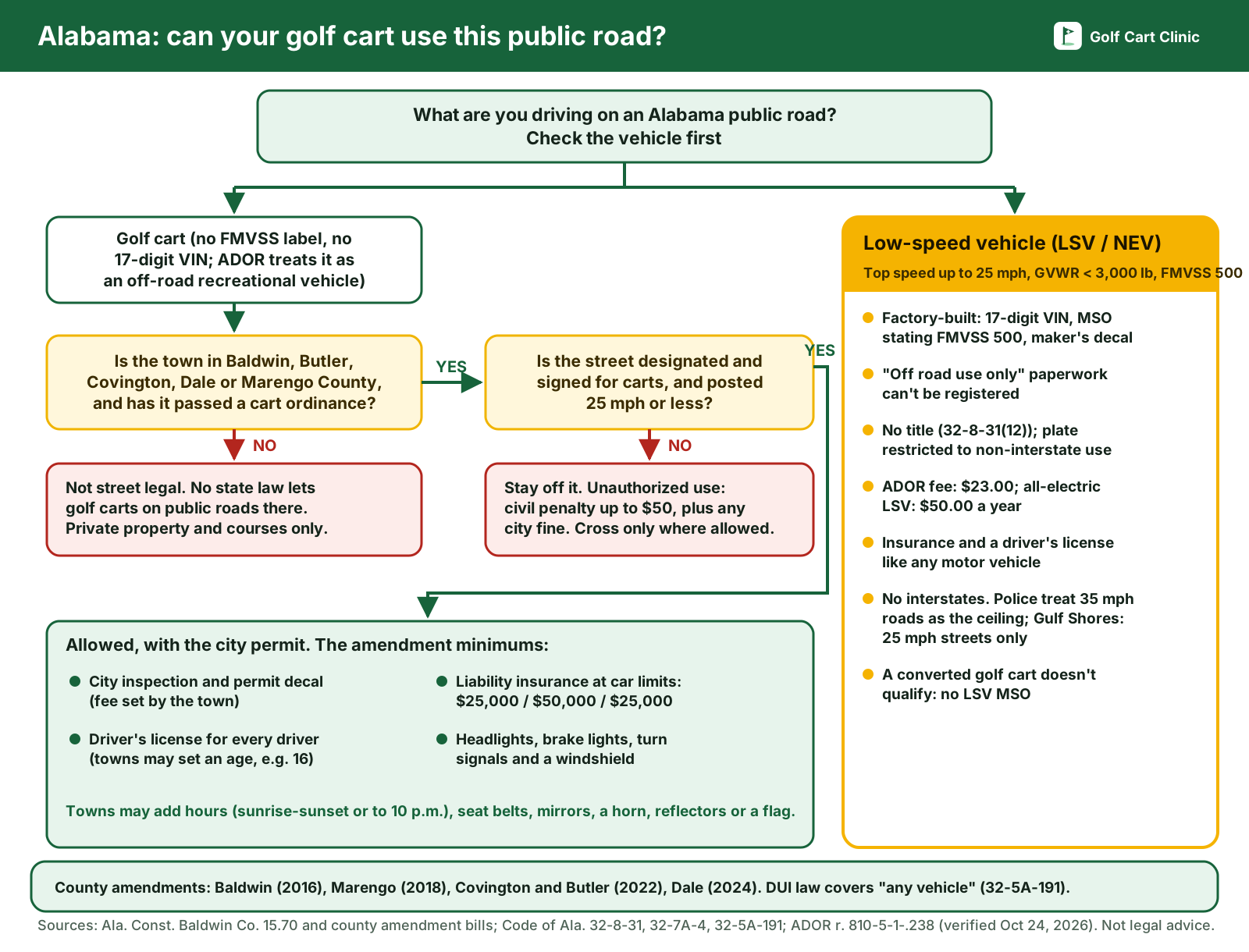
If your county isn't in the table, no state law lets a golf cart use a public road there. ADOR's registration rule describes a golf cart as "an off-road recreational vehicle primarily designed and manufactured for use on a golf course for sporting or recreational purposes" and says that, like UTVs and ATVs, golf carts "cannot be titled or registered in Alabama" unless their paperwork shows they meet federal motor vehicle safety standards (Ala. Admin. Code r. 810-5-1-.238). Police in non-amendment areas say the same thing. Homewood's police page puts it bluntly: a golf cart that isn't equipped as an LSV is "Not street legal" and "Not permitted on public roads" (City of Homewood).
Where can you drive a golf cart in Alabama?
The five county amendments use nearly identical wording. Quoting Baldwin County's version (Ala. Const. Baldwin County §15.70, hosted by the City of Orange Beach), this is how a street gets opened:
- The city designates the street. "A municipality in Baldwin County may designate municipal streets or public roads within the municipality for use by golf carts" (§15.70(a)).
- It checks safety first. Before designating, the city must "determine that golf carts may safely travel on or across the street or road," looking at "the speed, volume, and character of motor vehicle traffic" (§15.70(a)).
- It posts signs. Once a street is approved, "the municipality shall post appropriate signs to indicate that the operation of golf carts is authorized" (§15.70(a)).
- It may set hours. A city "may limit the operation of a golf cart ... to only between the hours of sunrise and sunset" (§15.70(d)).
- It may be stricter. Cities may pass ordinances that are "more restrictive than the restrictions enumerated in this section" and must post signs or otherwise tell residents about them (§15.70(g)).
On a designated street, the amendments add lane rules. A cart is "entitled to full use of a lane," cars may not crowd it out of the lane, carts may not pass in the same lane or ride between lanes, and carts "may not be operated two or more abreast in a single lane" (§15.70(h)-(k)). Driving a cart on a street that isn't authorized is "a violation for which the municipality may collect a civil penalty of up to fifty dollars ($50)" (§15.70(l)). The city ordinance can add fines on top of that. Gulf Shores, for example, also allows a fine of $1 to $200 and up to 30 days in jail on conviction.
There's one more exception for events. A city may pass a looser ordinance for golf carts used "for periods not to exceed 80 hours" at civic events, fundraisers or economic development events (§15.70(m)). That's why you may see golf carts on downtown streets during a festival.
Speed and road limits: the 25 mph ceiling
All five amendments set the same hard limit: "A municipality may not allow a golf cart to operate on a municipal street or public road where the posted speed limit exceeds 25 miles per hour" (Baldwin §15.70(c); the same wording appears in the Butler, Covington, Dale and Marengo bills). A city council can't vote around it. In practice:
- State highways are generally off limits. Orange Beach's ordinance notes that the city's three main roads (State Highways 180, 182 and 161) are "multi-lane state highways with speed limits in excess of 40 miles per hour" (Orange Beach golf cart ordinance findings, Chapter 70, Article VIII, on Municode). Greenville's ordinance says outright: "State highways and roadways are not designated cart streets" (Ord. 2023-05, §12-7).
- Crossings are local decisions. The amendments let a city approve carts "on or across" a street, and some ordinances define cart crossings. Greenville says carts may not cross a non-designated street "except at a designated cart crossing" and must yield to cars before crossing.
- Your cart's top speed matters. Town ordinances define a "cart" by speed. Orange Beach and Greenville both cover four-wheeled vehicles "designed to operate at speeds no greater than 25 miles per hour." A cart modified to go faster may no longer qualify for a permit, so keep that in mind before buying golf cart speed upgrades.
| Vehicle | Roads it may use | Plate / title | Driver | Source |
|---|---|---|---|---|
| Golf cart, county without an amendment | No public roads; private property, golf courses and private communities only | Can't be titled or registered | n/a | ADOR r. 810-5-1-.238(1)(b) |
| Golf cart, amendment county, permitted by the city | Only designated, signed streets posted 25 mph or less; hours may be limited | No state plate; city permit decal | Driver's license | Local amendments (a)-(f); city ordinance |
| Low-speed vehicle (LSV / NEV) | Public roads where it won't impede traffic (police treat 35 mph roads as the ceiling); never interstates; towns may limit further | No title; plate restricted to non-interstate use | Driver's license | Code §32-8-31(12); ADOR r. 810-5-1-.238(5) |
| Mini-truck | Public roads except interstate highways | No title; restricted low-speed plate | Driver's license | Code §32-6-59 |
Age and driver's license rules
The amendments state it plainly: "No person may operate a golf cart on a public street or road without a driver's license" (Baldwin §15.70(f); the other counties use the same wording). Alabama doesn't set a separate minimum age for golf carts, so the license rules decide. Under ALEA's graduated driver license program:
- Stage I (learner's permit), age 15+: may drive only with a parent, legal guardian or licensed driver age 21 or older in the front seat beside the teen.
- Stage II (restricted license), age 16+: after at least six months with a Stage I license if under 18. No driving from midnight to 6 a.m. (with exceptions), and no more than one passenger other than parents, guardians or family members.
- Stage III (unrestricted), age 17+.
Towns can be stricter. Opp tells owners that once a cart is permitted, "only a license driver 16 years of age or older will be allowed to operate the golf cart on municipal streets" (City of Opp). Greenville and Orange Beach accept a valid driver's license from any state or other governmental authority, which matters if you're visiting. Gulf Shores rewrote its license rule on April 13, 2026. Ask Gulf Shores police what age it accepts before letting a teen drive. A golf cart on a public road doesn't change Alabama's DUI law either: §32-5A-191 bans driving "any vehicle" with a blood alcohol level of 0.08% or more, or 0.02% for drivers under 21 (Code of Ala. §32-5A-191). Every town ordinance we read also applies DUI laws to cart drivers.
Registration, plates and title
A golf cart doesn't get a state title or license plate in Alabama. Instead, the amendments require a city permit: the town "shall inspect any golf cart" for the required equipment and verify the insurance, and if both check out, "the municipality shall issue a permit to the owner upon payment of a permit fee" (§15.70(b)). Each city sets its own fee and renewal schedule:
| Town (county) | Permit fee | Inspection / renewal | Notable rules |
|---|---|---|---|
| Gulf Shores (Baldwin) | $25 a year | Inspected every year; sticker each calendar year | Sunrise to 10 p.m.; headlights always on; seat belts for every occupant; no child under 5; orange flag at least 6 ft high |
| Orange Beach (Baldwin) | $25 a year, collected as $100 for a 4-year cycle | Re-inspection every 4 years (2025-28, 2029-32) | Permit needed on designated city streets since March 1, 2022; headlights always on and no higher than 36 in.; rental carts carry a white flag |
| Greenville (Butler) | $50 a year | Inspection at first permit, then every 3 years | Headlights 12 to 36 in. high and always on; seat belts; horn; decal on both sides |
| Opp (Covington) | $10 a year | Inspected every year | Licensed drivers 16+; streets posted 25 mph or less only |
Sources: Gulf Shores golf cart registration and City Code §21-13; Orange Beach Police Department, Codes & Ordinances; Greenville Ordinance 2023-05 (greenvilleal.gov); City of Opp.
Can you put a state plate on a golf cart? Usually not. Under ADOR's rule, the county license plate official must physically inspect the vehicle and its paperwork. A cart can be registered only if the manufacturer's statement or certificate of origin "must state that the vehicle complies with the Federal Motor Vehicle Safety Standards," or if it carries a federal certification label under 49 C.F.R. Part 567. Paperwork marked "for off road use only" means the vehicle "cannot be registered" (r. 810-5-1-.238(2)). That's the LSV route, covered below. When you buy a used cart, write down the serial number. Our golf cart serial number lookup helps you find the model year if a city or an insurer asks for it.
Insurance requirements
Insurance is required in every town that opens streets to golf carts. The amendments require the city to "verify that the operator of the golf cart on a municipal street or public road is covered by a policy of liability insurance held by the owner of the golf cart," and "the liability limits for operation of the golf cart shall be the same as for operation of a motor vehicle" (§15.70(b)). For Alabama motor vehicles, those minimums are $25,000 for bodily injury or death of one person, $50,000 for all injuries or deaths in one accident, and $25,000 for property damage (ADOR, Mandatory Liability Insurance, citing Code §32-7-6). A homeowner's policy may not cover a cart on a public street, so ask your insurer for a golf cart or LSV policy and bring the proof to your inspection. A plated LSV falls under the state's mandatory liability insurance law for any "motor vehicle designed to be used on a public highway" (Code §32-7A-4).
Required equipment
The state minimum in all five amendments is short: "The golf cart shall be equipped with headlights, brake lights, turn signals, and a windshield" (§15.70(e)). Cities usually add to the list. Here is what each town's inspection covers:
- Every amendment county (minimum): headlights, brake lights, turn signals, windshield.
- Orange Beach: headlights no higher than 36 inches, rear view mirror, brake lights, working brakes, front and rear turn signals, windshield, plus the driver's license and insurance check. "If one of the requirements is not met, the cart will fail the inspection."
- Gulf Shores: approved seat belts for each occupant, headlights, brake lights, turn signals, windshield, rear view mirror, efficient brakes, reliable steering, safe tires, red reflectors on the front and rear, and "an orange warning flag displayed at least six (6) feet above the ground."
- Greenville: headlights mounted between 12 and 36 inches, seat belts for the driver and each passenger, brake lights, turn signals, a standard horn, a windshield, a rear-view mirror, efficient brakes and reliable steering.
Most stock golf carts don't ship with turn signals, brake lights or seat belts, so plan on a street-legal kit before the inspection. In towns that require headlights to be on at all times, a weak battery pack shows up fast. Our golf cart battery watering guide helps keep flooded lead-acid packs healthy.
Golf cart vs low-speed vehicle (LSV) in Alabama
Alabama treats a low-speed vehicle as a completely different vehicle from a golf cart. ADOR's rule spells it out: "an LSV is not a golf cart or a UTV." Here's how the two compare:
- Definition. An LSV, "including neighborhood electric vehicles," is "a four-wheeled motor vehicle with a top speed of not greater than 25 miles per hour, a gross vehicle weight rating of less than 3,000 pounds, and complying with the safety standards provided in 49 C.F.R. § 571.500" (Code §32-8-31(12)). That federal standard, FMVSS 500, covers vehicles with a top speed over 20 and up to 25 mph and requires headlamps, turn signals, tail and stop lamps, reflex reflectors, mirrors, a parking brake, a windshield, a VIN and seat belts.
- Title and plate. LSVs are exempt from titling (§32-8-31(12)), but "may be issued a license plate that is restricted to non interstate use" if they meet FMVSS 500 (r. 810-5-1-.238(5)). ADOR's Mini-truck / LSV plate page lists registration fees of $23.00 and "All electric Low Speed Vehicle: $50.00 annually." County fees may be added.
- Paperwork. ADOR told county tag officials that an LSV "must have a 17 digit vehicle identification number (VIN)" and a manufacturer's statement of origin that says it complies with 49 C.F.R. 571.500. The manufacturer also affixes a certification decal. If the MSO or bill of sale says "off road use only," the vehicle can't be registered (ADOR Memorandum 2012-8).
- Converting a golf cart. Adding a light kit doesn't turn a golf cart into an LSV in the eyes of the tag office. Shelby County explains that golf carts "CANNOT be retrofitted to become LSV's as they will not have this MSO from the manufacturer" (Shelby County, Golf Cart vs Low-Speed Vehicles).
- Which roads? No Alabama statute sets a top posted speed for LSV roads statewide. Shelby County and the Opelika Police Department both say that "Alabama does not have a law that directly states a speed limit," but that an LSV can't be driven where it impedes traffic, and "law enforcement officers do interpret this as being on a roadway with a maximum speed of 35 mph." Treat 35 mph roads as the practical ceiling, and never use an interstate. Some towns are stricter. Gulf Shores bars state-tagged carts and LSVs (other than city service vehicles) from any street in city limits posted over 25 mph.
- Mobile's LSV law. In Class 2 municipalities (Act 2017-150, indexed under Mobile), the city may designate streets for LSVs by ordinance. LSVs may run only from sunrise to sunset unless the city allows night driving, need a licensed driver, FMVSS 500 certification, a 17-digit VIN with a decal, and a current plate, and may cross a state highway only where ALDOT has approved the crossing (Code §§11-73-1 to 11-73-7).
The bottom line is simple: a golf cart is a local-permit vehicle for designated 25 mph streets in five counties, and an LSV is a plated motor vehicle that has to be built that way at the factory. For a state where any cart can get a special plate, compare Texas golf cart laws, or browse all our golf cart laws by state. Tennessee, to the north, is stricter still: golf carts can't use public roads at all, and only registered LSVs and MSVs may, under its 2025 utility terrain vehicle law (Tennessee golf cart laws).
Local rules: Gulf Shores, Orange Beach and your town
Baldwin County's beach towns have the most detailed rules in the state, and they're the ones visitors run into:
- Gulf Shores. Golf carts may use only the listed "Designated Cart Streets," mostly neighborhoods such as Craft Farms, Cypress Park, Gulf Pines, Aventura, Cotton Bay and Brigadoon Trail, and "no street on which the speed limit is greater than 25 miles per hour shall be designated." Carts may run from sunrise until 10 p.m. with headlights on. They need a yearly permit sticker from Gulf Shores police, an annual inspection and proof of insurance. Sidewalks and bike paths are off limits, all riders must wear seat belts, and no child under five may ride. Owners must also sign an agreement to hold the city harmless before getting a permit (City Code §21-13 as amended April 13, 2026; Gulf Shores registration page).
- Orange Beach. "Effective March 1, 2022, all golf carts in the City of Orange Beach require permits to operate on designated city streets." Once permitted, carts may use "designated cart streets or multi-use cart paths." Drivers must have a valid license, and headlights must be on at all times. Rental carts must display a white flag naming the rental company and a notice saying the cart "is not allowed on any street with a speed limit over 25 miles per hour" and that "No unlicensed driver shall operate the cart at any time" (Orange Beach Police Department; Ordinances 2021-1398, 2024-1487 and 2024-1486).
- Greenville (Butler County). Any city street posted 25 mph or less is a cart street unless signs say otherwise, and state highways are not. Owners pay $50 a year for a permit valid for three years. Carts must stay off non-designated streets except at designated crossings, and all occupants must be seated and belted (Ordinance 2023-05).
- Opp (Covington County). Owners register online, then bring the cart, a driver's license and an insurance card to an inspection. The yearly permit costs $10 and goes on the front windshield.
Other cities in the five counties have their own ordinances or none at all. To find yours, search your city's code of ordinances for "golf cart," call the police department and look for golf cart signs on your street. If your town has no ordinance, or you're outside those five counties, the safe answer is no golf cart on public roads.
Before you drive on an Alabama road: a quick checklist
- Confirm your town is in Baldwin, Butler, Covington, Dale or Marengo County and has adopted a golf cart ordinance.
- Check the street: is it on the city's designated list or signed for carts, and posted 25 mph or less?
- Add the minimum equipment (headlights, brake lights, turn signals, windshield) plus anything your city requires, such as seat belts, a mirror, a horn, reflectors or a flag.
- Get liability insurance at the 25/50/25 minimums and bring proof to the inspection.
- Pass the city inspection, pay the fee and put the permit decal where the ordinance says.
- Make sure every driver has a valid driver's license and meets your town's age rule.
- Keep to the allowed hours, use designated crossings, stay off sidewalks and state highways, and never drink and drive.
- If you want to drive outside those towns, buy a factory-certified LSV with a 17-digit VIN and register it at the county license office.
Frequently asked questions
Are golf carts street legal in Alabama?
Not statewide. A golf cart may use a public street only in a town within Baldwin, Butler, Covington, Dale or Marengo County that has designated and signed the street under its county's constitutional amendment, and only if the street is posted 25 mph or less and the cart is permitted, insured and equipped. Elsewhere, only a registered low-speed vehicle is street legal.
Can you drive a golf cart in Gulf Shores or Orange Beach?
Yes, on designated cart streets (and in Orange Beach, multi-use cart paths) with a city permit. Gulf Shores charges $25 a year with an annual inspection and allows carts from sunrise to 10 p.m. Orange Beach charges $25 a year, collected as $100 for a four-year permit cycle. Both require a licensed driver, insurance and street equipment.
Do you need a driver's license to drive a golf cart in Alabama?
Yes. Each county golf cart amendment says no one may operate a golf cart on a public street or road without a driver's license. Some towns also set a minimum age, such as 16 in Opp. A learner's permit (15+) requires a licensed adult age 21 or older in the front seat.
Do golf carts need a license plate in Alabama?
No, and in most cases they can't get one. ADOR says golf carts can't be titled or registered unless their paperwork certifies they meet federal safety standards. In amendment counties, a city permit decal takes the place of a plate. A factory-certified LSV can get a plate restricted to non-interstate use.
Do you need insurance on a golf cart in Alabama?
Yes, to drive one on a public street. The amendments require the city to verify liability insurance with the same limits as a car, which are $25,000/$50,000/$25,000 in Alabama. Plated LSVs must carry insurance like any motor vehicle.
Can I turn my golf cart into a street-legal LSV in Alabama?
Generally no. Registration requires a manufacturer's statement of origin or federal label certifying FMVSS 500 compliance and a 17-digit VIN. Shelby County notes that golf carts can't be retrofitted into LSVs because they lack that manufacturer document. A light kit may still help you pass a city golf cart inspection.
Can a golf cart cross a highway in Alabama?
Only where your city has designated a crossing, and many towns ban state highways entirely. Greenville says state highways aren't cart streets and carts may cross non-designated streets only at designated crossings. Mobile's LSV law requires ALDOT approval for state highway crossings.
Sources
- Ala. Const. Baldwin County §15.70 (Amendment 921, golf carts): orangebeachal.gov
- County golf cart amendment bills, enrolled: Marengo HB188 (2018), Covington HB311 (2021), Butler HB436 (2022), Dale HB107 (2024): HB188, HB311, HB436, HB107 (alison.legislature.state.al.us)
- Legislative Services Agency, Local Laws Index (current through the 2026 Regular Session): alison.legislature.state.al.us
- Code of Ala. §32-8-2(12) and §32-8-31(12) (off-road vehicle and LSV definitions, title exemption): justia.com, justia.com; §32-6-59 (mini-trucks): justia.com
- Code of Ala. §§11-73-1 to 11-73-7 (LSVs in Class 2 municipalities): justia.com
- Code of Ala. §32-7A-4 (mandatory liability insurance) and §32-5A-191 (DUI): justia.com, justia.com
- Alabama Department of Revenue: Rule 810-5-1-.238, Registration of Motor Vehicles Not Subject to Titling (admincode.legislature.state.al.us); Mini-truck / LSV plate (revenue.alabama.gov); Memorandum 2012-8, Mini-Trucks and Low Speed Vehicles (revenue.alabama.gov); Mandatory Liability Insurance (revenue.alabama.gov)
- Alabama State Law Enforcement Agency, Graduated Driver License: alea.gov
- 49 C.F.R. §571.500 (FMVSS 500, low-speed vehicles): ecfr.gov
- Local examples: City of Gulf Shores, Golf Cart Registration and Code §21-13 (gulfshoresal.gov); Orange Beach Police Department, Codes & Ordinances (orangebeachal.gov); Greenville Ordinance 2023-05 (greenvilleal.gov); City of Opp golf cart registration (cityofopp.com); Shelby County, Golf Cart vs Low-Speed Vehicles (shelbyal.com); City of Homewood, Riding Safely (cityofhomewood.com)
Questions and comments
No comments yet. Corrections and notes from your own repair are welcome.