
Ohio Golf Cart Laws (2026): Local Permission, Inspection, Plates and 35 MPH Streets
In Ohio, golf carts are under-speed vehicles. They may use public streets only where a city, village, township or county allows them, only on streets of 35 mph or less, and only after a local police inspection, an Ohio title and plates. Here's the process, the equipment list, LSV rules and local examples like Put-in-Bay.
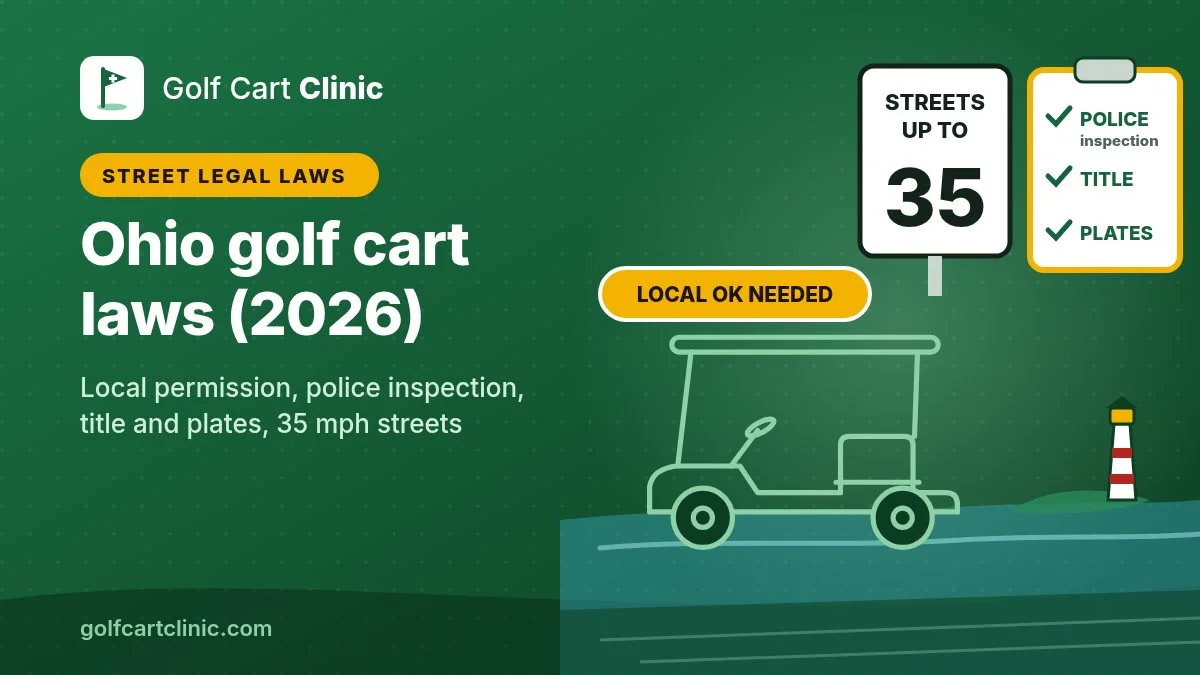
In Ohio, a golf cart can drive on a public street only where your city, village, township or county has allowed it by ordinance or resolution, and only on streets with a speed limit of 35 mph or less. State law calls most golf carts "under-speed vehicles." Before one goes on an approved street, it has to pass an equipment inspection by local law enforcement, get an Ohio title and be registered with license plates at a deputy registrar. Where no local rule exists, a golf cart has no right to use public streets at all.
Not legal advice. Last verified: October 25, 2026. This guide summarizes the Ohio Revised Code (ORC), the Ohio Administrative Code (OAC) and forms and guidance from the Ohio Bureau of Motor Vehicles (BMV). Statute links go to the state's official site, codes.ohio.gov. In Ohio, the local ordinance does most of the work: it decides whether golf carts are allowed at all, which streets they may use and which extra rules apply. Before you drive, call your local police department or sheriff's office and read your community's ordinance.
How Ohio classifies golf carts, LSVs and utility vehicles
Ohio sorts small vehicles by top speed and weight, using the definitions in ORC 4501.01. An under-speed vehicle is "a three- or four-wheeled vehicle, including a vehicle commonly known as a golf cart, with an attainable speed on a paved level surface of not more than twenty miles per hour and with a gross vehicle weight rating less than three thousand pounds." A low-speed vehicle (LSV) is a three- or four-wheeled motor vehicle that can reach "more than twenty miles per hour but not more than twenty-five miles per hour" in one mile on a paved level surface, also with a gross vehicle weight rating under 3,000 pounds. The BMV's own summary is short: "Most golf carts are a USV" (Ohio BMV, Unconventional Vehicles).
| Vehicle class (ORC 4501.01) | What it is | Where it may drive | Before road use |
|---|---|---|---|
| Under-speed vehicle (most golf carts) | 3 or 4 wheels, top speed 20 mph or less, GVWR under 3,000 lb | Only streets with a limit of 35 mph or less that a local authority has opened to them | Local police inspection (DPS 1373), Ohio title, registration and plates |
| Low-speed vehicle (LSV) | 3- or 4-wheeled motor vehicle, top speed over 20 and up to 25 mph, GVWR under 3,000 lb | Any street with a limit of 35 mph or less, unless a local rule is stricter | Title and registration like other motor vehicles; built to federal LSV standards |
| Utility vehicle | Self-propelled vehicle with a bed, built mainly to haul material or cargo (construction, farm, grounds work and similar) | Same as an under-speed vehicle; farm field to field on any road except a freeway, with a slow-moving vehicle emblem | Same as an under-speed vehicle |
| Mini-truck | Small 4-wheeled truck or van with an enclosed cab, 900 to 2,200 lb dry, not built to federal safety standards | Same as an under-speed vehicle | Same as an under-speed vehicle |
Side-by-side UTVs and ATVs are a separate class ("all-purpose vehicles" under ORC 4519.01), and that definition specifically leaves out "any vehicle principally used in playing golf." Inspection agencies point this out too: the Lorain County Sheriff's Office says its golf cart inspection "does not apply to ATVs, UTVs or APVs" (Lorain County Sheriff).
Where can you drive a golf cart in Ohio?
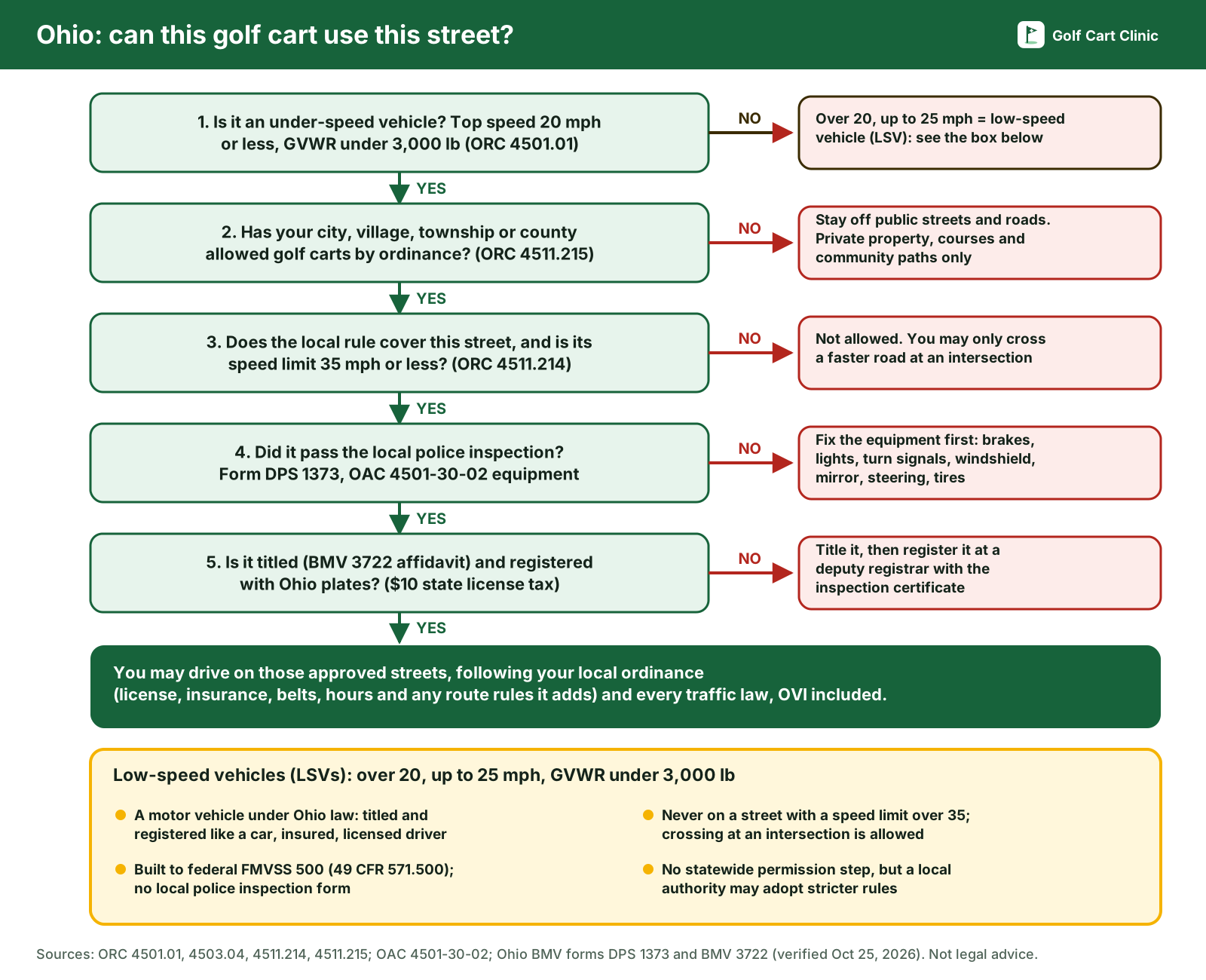
The rule is in ORC 4511.214(B)(2): "No person shall operate an under-speed or utility vehicle or a mini-truck upon any street or highway except" on "a street or highway having an established speed limit not greater than thirty-five miles per hour and only upon such streets or highways where a local authority has granted permission for such operation in accordance with section 4511.215." Both conditions must be true. A 25 mph street in a town that never passed a golf cart ordinance is off limits, and so is a 45 mph road in a town that did.
The one thing you may do on a faster road is cross it. Section 4511.214(C)(1) says the law doesn't stop an under-speed vehicle, utility vehicle, mini-truck or LSV "from proceeding across an intersection of a street or highway having a speed limit greater than thirty-five miles per hour." Crossing at an intersection is allowed; driving along that road is not.
Off the street, Ohio's road rules don't decide where you can ride. Golf courses, private land and private communities set their own rules, and many cities keep golf carts off sidewalks and trails. The City of Powell, for example, lists golf carts as allowed on "roadways with speed limits of 35 mph or lower" and "not permitted on sidewalks or multi-use paths" (City of Powell Police).
What a local authority must do to allow golf carts
Under ORC 4511.215, a local authority "may authorize the operation of under-speed or utility vehicles or mini-trucks on a public street or highway under its jurisdiction" by ordinance or resolution. If it does, it must:
- limit them to streets and highways with an established speed limit of 35 mph or less;
- require each vehicle to pass an inspection by a local law enforcement agency that follows the Department of Public Safety's inspection rules;
- allow only vehicles that pass the inspection and are registered (ORC Chapter 4503) and titled (ORC Chapter 4505); and
- notify the director of public safety that it has authorized them.
The local authority "may establish additional requirements," which is why rules differ so much from one town to the next. "Local authorities" covers "every county, municipal, and other local board or body having authority to adopt police regulations" (ORC 4511.01(AA)), and the BMV tells owners to contact local law enforcement "in your city, township, village, or other jurisdiction." The BMV has also published a list of law enforcement agencies in approved jurisdictions (Golf Cart Approved Jurisdictions, revised June 24, 2022). It includes agencies such as Put-in-Bay, Kelleys Island PD, Toledo PD, Powell PD, Bexley PD and Canal Winchester PD, but it's several years old, so don't treat it as complete or current.
Speed and road limits
- Golf carts (under-speed vehicles): only approved streets with an established speed limit of 35 mph or less (ORC 4511.214(B)(2) and 4511.215(A)(1)). By definition, the cart itself can't go faster than 20 mph on a paved level surface.
- LSVs: "No person shall operate a low-speed vehicle upon any street or highway having an established speed limit greater than thirty-five miles per hour" (ORC 4511.214(B)(1)). Unlike golf carts, LSVs don't need a local ordinance to use slower streets, but section 4511.214(D) lets a local authority adopt "more stringent local ordinances, resolutions, or regulations" for them.
- Penalty: breaking these limits is a minor misdemeanor. It becomes a fourth-degree misdemeanor if you have one earlier conviction for a "predicate motor vehicle or traffic offense" within a year, and a third-degree misdemeanor if you have two or more (ORC 4511.214(E)).
Inspection and required equipment
Ohio's equipment list for golf carts on public streets is in OAC 4501-30-02. An under-speed vehicle, utility vehicle or mini-truck "must include the following equipment":
- adequate brakes and braking system;
- properly working brake lights, headlights, tail lights and "warning devices, also known as turn signals";
- a properly working steering mechanism;
- a windshield "to prohibit injury from any debris from the roadway";
- a rearview mirror; and
- tires "free of major bumps, bulges, breaks, or any condition that would be cause for unsafe conditions."
The officer records the inspection on the state form DPS 1373, Inspection of Under-Speed Vehicle, Utility Vehicle, or Mini-Truck. It checks brakes, two brake lights, two headlights, two tail lights, warning devices or reflectors (such as turn signals), steering, windshield, rearview mirror and tires, and says "all equipment must be in proper working order to pass inspection." The rule's companion section, OAC 4501-30-01, adds that an under-speed vehicle with a gross vehicle weight rating over 3,000 pounds must instead be inspected under ORC 4513.02.
Many inspecting agencies check more than the state minimum, often citing the general Ohio lighting and equipment statutes. The Lorain County Sheriff's Office lists a horn audible from 200 feet, a white light that makes the rear plate readable from 50 feet and two red rear reflectors, alongside the state items. It charges $30 for an inspection at its office or $35 at your location. The City of Powell's inspection certificate has the same horn, plate-light and reflector items plus brackets for a rear license plate (Powell Underspeed Vehicle Inspection Certificate). Ask your agency for its checklist before you buy parts.
Title, registration and plates
A golf cart that never leaves private property doesn't need an Ohio title. The BMV's titling affidavit explains that under-speed vehicles, utility vehicles and mini-trucks are "not required to be titled per Ohio law," but are "titled for ownership purposes only and required for registration purposes on roads of 35 mph or less" (BMV 3722). If you want to drive on approved streets, the steps are:
| Step | Where | What to bring or do |
|---|---|---|
| 1. Inspection | Local police department or sheriff's office in a jurisdiction that allows golf carts | The vehicle, with all required equipment working. Many agencies also ask for proof of insurance. You leave with a signed DPS 1373. |
| 2. Title | County clerk of courts title office | Proof of ownership and the notarized BMV 3722 affidavit, marked "US - Under-Speed Vehicle." A licensed motor vehicle dealer that owns the vehicle doesn't need it notarized. |
| 3. Registration and plates | Any deputy registrar license agency | Ohio title or memorandum title, the completed DPS 1373, and a valid Ohio driver license, state ID or Social Security card (plus a tax ID if it's titled to a business) |
The state license tax for "each low-speed, under-speed, and utility vehicle, and each mini-truck" is $10 (ORC 4503.04(A)(2)). Other title and registration fees are charged at the counter. The BMV's affidavit warns that falsifying it "is punishable by fine and imprisonment," so classify the vehicle honestly: a cart modified to go faster than 20 mph no longer fits the under-speed definition.
Driver's license, age and insurance
Ohio's statewide driver license and insurance rules are written for "motor vehicles," and the general definition in ORC 4501.01 leaves under-speed vehicles out, so the exact driver rules for golf carts mostly come from the local ordinance and the agency that inspects them. In practice, the communities we checked require a licensed driver and insurance:
- Driver's license: Powell's police page says "must have valid driver's license" for golf carts on city streets. Lorain County's sheriff says carts must be run under all Ohio motor vehicle laws, "including the requirement that the operator hold a valid driver's license." Put-in-Bay requires every rented golf cart to carry a windshield sticker that says "you must have a valid drivers license to operate this vehicle" (Put-in-Bay Codified Ordinances 858.02). Ohio has no separate statewide minimum age for golf carts, so the license requirement sets the age floor in these towns.
- Insurance: Ohio's financial responsibility chapter uses its own, broader definition of motor vehicle in ORC 4509.01, and ORC 4509.101 forbids operating a motor vehicle without proof of financial responsibility. Lorain County and Powell both require written proof of state minimum liability insurance at inspection. The state minimum is $25,000 for injury or death of one person, $50,000 for two or more people and $25,000 for property damage in one accident (ORC 4509.01(K)).
- LSVs: an LSV is defined as a "motor vehicle," so it's treated like a car for licensing and insurance: a valid driver's license and the same minimum liability coverage.
Golf cart vs LSV in Ohio
The difference is speed and how the vehicle was built. A golf cart (under-speed vehicle) tops out at 20 mph and needs local permission, a police inspection, a title and plates before it can use 35 mph streets. An LSV goes over 20 and up to 25 mph, is a "motor vehicle" under Ohio law and may use streets with limits of 35 mph or less without a local golf cart ordinance, unless a local rule says otherwise. LSVs sold as new vehicles are built to the federal low-speed vehicle standard, FMVSS 500 (49 CFR 571.500), which requires headlamps, stop lamps, turn signals, tail lamps, reflex reflectors, a parking brake, a windshield, seat belts, mirrors and a VIN.
Don't speed up a golf cart with a new controller or motor and expect it to become an LSV. Once it can go faster than 20 mph, it no longer meets the under-speed definition, so it doesn't qualify for a local golf cart permit, and it still hasn't been certified to federal LSV standards. If you want 25 mph, buy a vehicle sold as an LSV with the manufacturer's paperwork, and ask your title office what it needs before you buy.
Local ordinances: examples
Because Ohio leaves golf carts to local governments, the details vary. A few examples from official sources:
- Put-in-Bay (South Bass Island): Ohio's best-known golf cart town makes the state seat belt and child restraint laws apply to golf carts, requires "a seat belt for each person on the golf cart," and requires each person to wear it (Codified Ordinances 858.02). Rental golf carts pay a $100 annual village vehicle fee (858.01), and the village caps rental golf cart registrations at 865 a year for businesses in the village and 865 for businesses in Put-in-Bay Township (858.06).
- Powell (Delaware County): golf carts may use roadways with limits of 35 mph or lower, not sidewalks or multi-use paths, with a valid driver's license (Powell Codified Ordinance 377.01). Residents get the inspection at home; non-residents must trailer the cart to the police department (Powell information packet).
- Lorain County: the sheriff's office inspects under-speed vehicles, utility vehicles and mini-trucks on Tuesdays, Wednesdays and Thursdays and lists the equipment and paperwork it expects.
Homeowner associations, retirement communities and golf courses can set their own rules on private roads and paths. They can't override the state rule that keeps golf carts off public streets without a local ordinance.
Drinking, seat belts and other traffic laws
- Ohio's OVI law applies to "any vehicle" (ORC 4511.19(A)(1)), and for traffic laws "vehicle" means "every device, including a bicycle, motorized bicycle, and an electric bicycle, in, upon, or by which any person or property may be transported or drawn upon a highway," with exceptions such as motorized wheelchairs that don't include golf carts (ORC 4511.01(A)). You can be charged with impaired driving in a golf cart.
- Utility vehicles get one extra statewide allowance: under ORC 4511.216, you may drive one on any public road or right-of-way other than a freeway "when traveling from one farm field to another for agricultural purposes" if it displays a slow-moving vehicle emblem. That exception doesn't cover golf carts.
- Follow every local add-on. Seat belts, child seats, nighttime limits and route maps all come from the ordinance where you drive, not from one statewide golf cart law.
Before you drive on an Ohio street: a quick checklist
- Confirm what you have: an under-speed vehicle (20 mph or less) or an LSV (over 20, up to 25 mph, built as an LSV).
- Ask your city, village, township or county whether it has authorized golf carts, and get the ordinance and the list or map of allowed streets.
- Check the equipment against OAC 4501-30-02 and your local agency's checklist (horn, plate light and reflectors are common extras).
- Buy liability insurance of at least 25/50/25 and keep proof with the cart.
- Book the inspection and get a signed DPS 1373.
- Title the cart with the BMV 3722 affidavit, then register it and get plates at a deputy registrar.
- Drive only on approved streets with limits of 35 mph or less, cross faster roads only at intersections, carry your driver's license and never drink and drive.
Frequently asked questions
Are golf carts street legal in Ohio?
Only where a local authority allows them. Under ORC 4511.214 and 4511.215, a golf cart (an "under-speed vehicle") may use a public street only if your city, village, township or county has authorized it, the street's speed limit is 35 mph or less, and the cart has passed a local police inspection and is titled and registered with plates.
Do golf carts need license plates in Ohio?
Yes, if you drive them on public streets. ORC 4511.215 lets only inspected, registered and titled golf carts use approved streets. You register at a deputy registrar with the title and the DPS 1373 inspection form, and the state license tax is $10 a year. A golf cart used only on private property doesn't need a title or plates.
Can you drive a golf cart on a 45 mph road in Ohio?
No. Golf carts, utility vehicles, mini-trucks and LSVs can't drive on streets with a speed limit over 35 mph. You may cross a faster road at an intersection (ORC 4511.214(C)).
Do you need a driver's license to drive a golf cart in Ohio?
On public streets, plan on it. The local ordinances and inspection agencies we checked, including Powell, Lorain County and Put-in-Bay, require a valid driver's license to drive a golf cart on public streets. An LSV is a motor vehicle, so its driver needs a license under state law.
Does a golf cart need insurance in Ohio?
For street use, yes. Agencies such as Lorain County and Powell require proof of state minimum liability insurance (25/50/25) at the inspection, and Ohio's financial responsibility law requires proof of insurance to operate a motor vehicle. Check with your insurer that the policy covers street use.
Where do I get my golf cart inspected in Ohio?
At the local law enforcement agency for the jurisdiction that allows golf carts, usually the city or village police department or the county sheriff. The officer completes form DPS 1373. Some agencies charge a fee; the Lorain County Sheriff's Office charges $30 at its office or $35 at your location.
Can I drive a golf cart in Put-in-Bay?
Yes, Put-in-Bay is built around them, but Ohio traffic laws still apply. Village ordinance 858.02 requires a seat belt for each person on the cart, belts worn by everyone and proper child restraints, and rental carts must display a sticker saying you need a valid driver's license and must not drink and drive.
Ohio's local-permission model is close to how North Carolina and Florida handle golf carts, but it adds a police inspection and Ohio plates. Tennessee is much stricter: golf carts can't use public roads at all, and only registered LSVs and MSVs may (Tennessee golf cart laws). Florida lets local governments designate roads, and golf carts there need no plate (Florida golf cart laws). If you're getting a cart ready for inspection, see our golf cart upgrades guides, and use the serial number lookup to find your cart's model year before you fill in the title paperwork. For more states, browse our golf cart laws by state.
Sources
- Ohio Revised Code 4511.214 (operation of low-speed, under-speed, utility vehicles and mini-trucks), 4511.215 (local authorization) and 4511.216 (farm use): 4511.214, 4511.215, 4511.216 (codes.ohio.gov)
- Ohio Revised Code 4501.01 (definitions), 4511.01 (traffic definitions), 4519.01 (all-purpose vehicles): 4501.01, 4511.01, 4519.01 (codes.ohio.gov)
- Ohio Revised Code 4503.04 (license tax), 4509.01 and 4509.101 (financial responsibility), 4511.19 (OVI): 4503.04, 4509.01, 4509.101, 4511.19 (codes.ohio.gov)
- Ohio Administrative Code Chapter 4501-30 (inspection of under-speed vehicles, utility vehicles and mini-trucks): codes.ohio.gov
- Ohio BMV: Unconventional Vehicles registration (bmv.ohio.gov); form DPS 1373 (ohio.gov); form BMV 3722 (ohio.gov); Golf Cart Approved Jurisdictions, revised 06/24/2022 (bmv.ohio.gov)
- 49 C.F.R. §571.500 (FMVSS 500, low-speed vehicles): ecfr.gov
- Local examples: Put-in-Bay Codified Ordinances Chapter 858 (amlegal.com); City of Powell Police, Micro-Mobility Devices (cityofpowell.us) and underspeed vehicle information packet (cityofpowell.us); Lorain County Sheriff's Office, Golf Cart Inspections (loraincountysheriff.com)
Questions and comments
No comments yet. Corrections and notes from your own repair are welcome.