
Club Car Precedent Problems: 10 Common Issues and How to Fix Them
Most Club Car Precedent complaints are batteries, adjustments or worn parts, not a dead controller. Here are the ten most common problems on electric Precedents, in the order to check them, with Club Car's own values for batteries, charger lights, the MCOR pedal sensor, brakes, toe-in, suspension and transaxle oil, plus the recalls to rule out.
Quick answer: most Club Car Precedent complaints come down to ten things: a cart that won't move (usually Tow/Run, the charger cord or the pedal order), a reverse buzzer that won't stop, low top speed, a jerky pedal, short range, a charger that won't finish, dead lights, weak brakes, loose steering and clunks from the rear. Most are batteries, adjustments or worn wear parts, not a dead controller. Below is each problem in the order to check it, with Club Car's own test values from its Precedent service manuals.
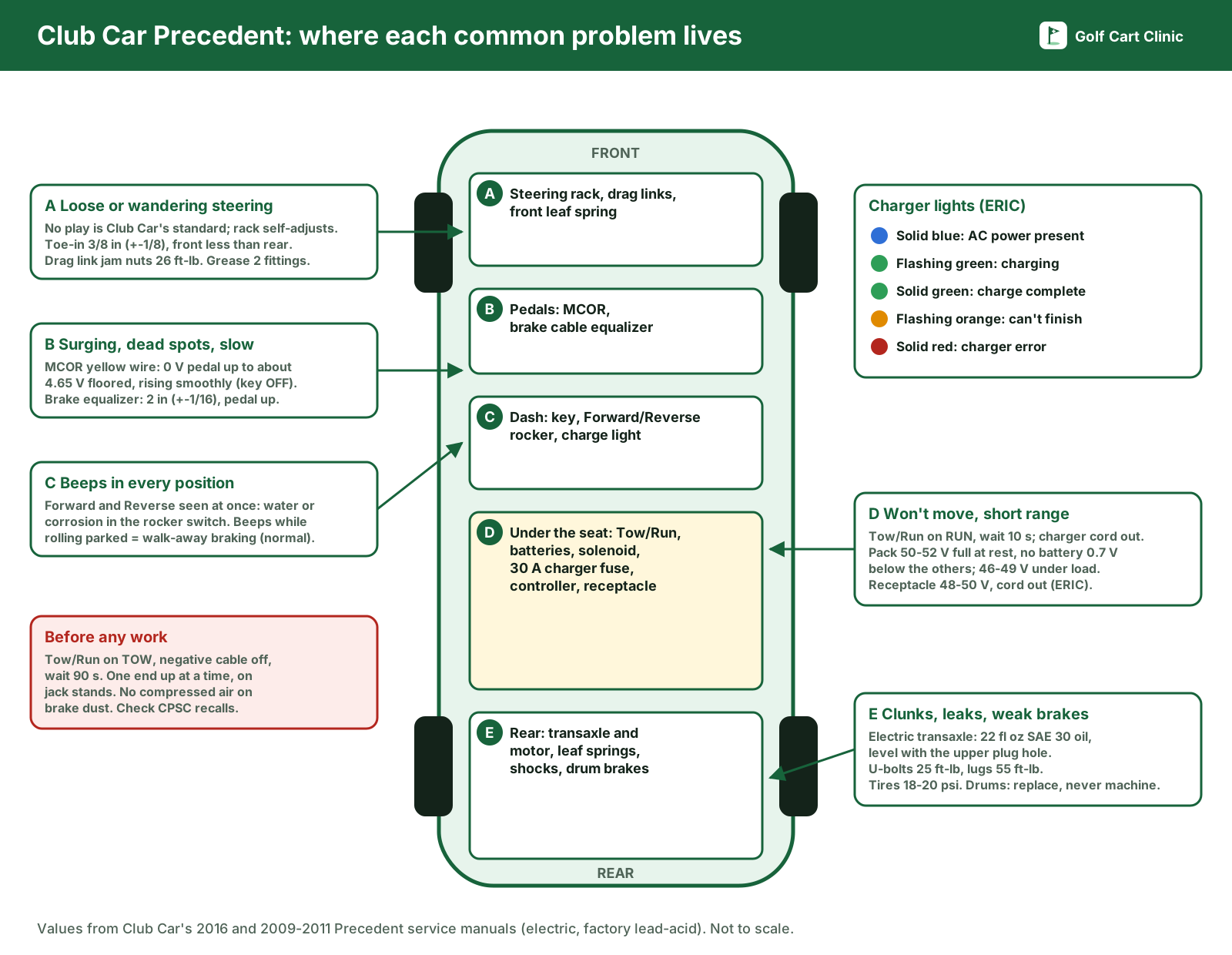
Safety first. An electric Precedent runs on a 48V pack that can push hundreds of amps through a wrench, ring or watch. Wear safety glasses, take off jewelry and use insulated tools. Before any work under the seat or on the brakes, steering or suspension, Club Car's manuals say to disconnect the batteries and discharge the controller: Tow/Run on Tow, negative cable off first, then wait 90 seconds. When you need the cart in the air, chock the wheels that stay down, lift one end only with a jack rated for at least 1,000 lb, and put it on jack stands; never work under a cart held up by the jack. Club Car warns that some aftermarket brake shoes contain asbestos: don't blow out brake drums with compressed air. If a cable has melted, a battery is hot or swollen, or you smell burning, stop and get a technician.
Towing: put Tow/Run on Tow before you push or tow an electric Precedent. Club Car's owner's manual says Tow turns off all motor braking, including walk-away braking, which prevents damage to the cart and its electrical parts while it's towed.
Brakes and steering are not "try it and see" jobs. If the cart swerves when you brake, won't stop, or the steering has play, park it until it's fixed. Club Car's own rule is that any vehicle not working correctly is removed from use until it's repaired.
First: which Precedent do you have?
Club Car has sold the Precedent since late 2003, in gas and 48V electric versions. This guide covers the electric cars, which make up most of the questions we get. Club Car's 2009–2011 Electric Precedent manual covers the IQ and Excel drive systems with an onboard computer (OBC) and PowerDrive charger; its 2016 manual covers Excel with ERIC charging, which has no OBC, a charge light under the steering column and a high-frequency charger. If you're not sure which one you have, our Precedent won't move guide has a table that tells them apart, and the serial number lookup reads the model year from the serial. The serial is above and to the right of the accelerator pedal.
Converted to lithium or fitted with an aftermarket controller? The battery and charger values below are for Club Car's factory lead-acid setup. Use the battery maker's manual, and see lithium BMS keeps tripping if the cart cuts out under load.
Check the recalls first
Before you fix anything, see whether your serial is on one of the Precedent recalls posted by the U.S. Consumer Product Safety Commission. The repairs are free at a Club Car dealer.
| Recall (date) | Which Precedents | Problem |
|---|---|---|
| 05-585 (July 2005) | Precedent and Precedent Champion sold October 2003 to June 2005, serial prefixes CE, CF, PE, PF, PQ or PR | Accelerator pedal can temporarily stick. CPSC says stop using the cart if you hear a grinding noise when you press the pedal |
| 12-706 (December 2011) | 2011 gas Precedent, serials CF1139-233925 to CF1147-250173, PR1139-233918 to PR1147-249956, and PY1144-244648 | Fuel tank seam can split and leak |
| 14-703 (November 2013) | Model year 2013 Precedent, electric and gas, sold June 2013 (model codes PH, PJ, PR, CF, PD; ranges on the notice) | Front wheel spindles can crack and the wheel can come loose |
| 14-715 (February 2014) | Model year 2012 Precedent i2 (ranges on the notice) | Passenger-side hip restraint can fracture |
| 19-770 (August 2019) | 2019 gas Precedent EFI 2P (DF) and Precedent Villager 2 and 4 (BJ, DJ), plus gas Tempo and Onward | Fuel line routed wrong can leak |
The ten problems at a glance
- If it won't move at all → Tow/Run on Run, charger cord out, key before pedal, rocker fully in Forward or Reverse (problem 1).
- If it beeps in every rocker position → the Forward/Reverse switch (problem 2).
- If it runs but slow → pack under load, speed sensor, brakes, tire pressure (problem 3).
- If the pedal surges or has dead spots → MCOR signal test (problem 4).
- If range keeps dropping or the charger won't finish → battery tests and charger lights (problems 5 and 6).
- If it drives but lights and horn are dead → the 12V accessory feed (problem 7).
- If braking, steering or noise is the complaint → park it and work through problems 8 to 10.
1. It won't move at all
This is the most common Precedent call, and usually nothing is broken. Club Car's lockouts stop the cart when:
- Tow/Run is on Tow. The switch is under the seat, behind the batteries. After switching to Run, wait 10 seconds before driving. Battery work almost always leaves it on Tow.
- The charger is still plugged in. While the DC cord is in the receptacle (or, on a cart with an onboard charger, while the AC cord is in the wall), the control circuit is locked out.
- The pedal was down when you turned the key or changed direction. That's High Pedal Detect. Release the pedal and press it again.
- The rocker is halfway between Forward and Reverse.
If all four are right, the step-by-step meter tests (pack voltage, the 15-amp fuse, the charger interlock pin, the key and pedal switches and the solenoid) are in our Club Car Precedent won't move guide. A click with no movement is covered in solenoid clicking but won't move.
2. The reverse buzzer won't stop beeping
First work out which beep you're hearing, because three of them are normal:
- Beeping in Reverse is the backup warning.
- A pattern of beeps while the parked cart rolls is walk-away braking. With Tow/Run on Run and the park brake off, Club Car says the motor resists rolling so the cart moves no faster than about 1 to 3 mph, and the buzzer sounds a distinct pattern. It does not hold the cart on very steep grades.
- Three beeps with three flashes of the dash light when you plug in on an ERIC cart means charging has started.
The one that's a fault: the buzzer sounds in every rocker position and the cart won't drive either way. Club Car's 2016 manual says that happens when the controller sees Forward and Reverse at the same time. The usual causes are water or corrosion inside the Forward/Reverse rocker switch, or a switch that has failed closed. The rocker switch test is in the won't move guide.
3. It runs, but slow or won't reach top speed
Club Car's troubleshooting guide lists these causes for "vehicle runs slowly," and the cheap ones are worth checking first:
- Tires. Club Car specifies 18 to 20 psi front and rear. Soft tires cost speed and range. Check them monthly.
- Dragging brakes. Lift the rear (on stands) and spin each wheel by hand with Tow/Run on Tow. One that drags points to brake adjustment (problem 8).
- Weak pack. A pack can read fine at rest and sag under load. Test it as in problem 5.
- Speed sensor. With a speed sensor fault, Club Car says the controller limits the cart to about half its normal speed. On level ground, Tow/Run on Run, key off, rocker in Neutral, push the cart about 3 feet: the buzzer should sound and motor braking should engage. If neither happens, the sensor is the suspect.
- MCOR not reaching full throttle (problem 4).
- Load and settings. An overloaded cart is slow, and the programmed top speed can only be changed with Club Car's handset, so a cart set to a low speed by a previous fleet owner stays slow until a dealer reprograms it.
If the cart reaches top speed before the pedal is all the way down, Club Car's guide blames a failed throttle resistor in the speed controller. That one's a controller replacement.
4. Jerky, surging, or dead spots in the pedal
The MCOR is the sensor in the pedal box that tells the controller how far the accelerator is pressed (some 2009 cars still have the older throttle position sensor). Club Car lists these MCOR symptoms: no drive at all because there's no foot input, no top speed because it never reaches 100%, a dead spot where the cart won't hold speed or accelerate, and a signal that jumps around with the pedal at rest, partly pressed or floored.
Club Car's test without a handset, rear wheels lifted on stands and key off for the whole test, Tow/Run on Run, meter on DC volts:
| Wire at the MCOR 3-pin plug | Meter leads | Club Car's reading | If not |
|---|---|---|---|
| Purple/white | Red on battery no. 1 positive, black on the wire | 48–50V (full pack) | 0V: check the wire and plug to the controller; if they're good, the controller |
| White (supply) | Black on the last battery's negative, red on the wire | About 4.65V | 0V: same wire and plug checks, then the controller |
| Yellow (signal) | Black on the last battery's negative, red on the wire | 0V pedal up, rising smoothly to about 4.65V floored | Doesn't rise, or jumps: replace the MCOR |
Back-probe or use an insulation-piercing probe rather than cutting wires. With Club Car's CDT handset you can watch throttle % instead: it should climb steadily from 0 to 100%, and if it flickers, or drops from 100% when you rock the floored pedal side to side by hand, Club Car says the MCOR is defective. On a 2004 or 2005 Precedent, also check the 05-585 recall above: a pedal that sticks or grinds is a safety problem, not a tuning issue.
5. Short range, or the batteries don't last
On a lead-acid Precedent, range problems are almost always the batteries or how they're charged. Club Car's habits that prevent most of them:
- Charge after every use, even after 10 minutes or nine holes, and let the charger shut itself off. Never run the batteries until the cart stops; Club Car warns that deep discharges shorten battery life and a completely flat pack may not accept a charge.
- Charge soon after driving in cold weather. Below 65 °F, Club Car says to put the cart on charge as soon as possible after use: warm batteries charge faster.
- Break new batteries in. They don't reach full capacity until they've been cycled 50 to 70 times (the 2016 manual; the 2009–2011 manual says 20 to 50). Go easy on range for the first weeks.
- Water and clean them. Check the electrolyte weekly and add distilled water after charging, unless the plates are exposed: then add just enough to cover them, charge, and top up. Never charge with plates exposed. Wash the tops with 1 cup of baking soda per gallon of water. Our battery watering guide has the details.
- Don't mix batteries. Club Car says never mix part numbers or brands in one pack, and the charging profile must match the battery: on OBC carts the onboard computer is battery-specific, and ERIC chargers have to be reprogrammed for a different battery.
To find a bad battery, Club Car gives three tests for a 48V pack of six 8V batteries:
| Test | How | Good result |
|---|---|---|
| Resting voltage | Fully charged, off the charger; meter from battery no. 1 positive to no. 6 negative, then each battery | Pack 50–52V; no single battery more than 0.7V below the others |
| On-charge voltage (ERIC) | After a full charge, unplug the DC cord 20 to 30 seconds, plug it back in, wait 5 minutes, then measure the pack and each battery | Pack 56.0–63.0V depending on age; compare the batteries with each other |
| Under load | Discharge tester across the pack; Club Car then checks each battery with a meter while under load | Pack 46–49V; 32–46V means discharged or failed batteries; under 32V, deeply discharged or dead |
Club Car's quick charger check on ERIC carts: after a full charge, unplug the DC cord, wait 30 seconds and plug it back in. With sound batteries, the upper half of the battery-shaped light on the charger stops flashing and stays solid green within 10 to 20 minutes. If it keeps flashing, the batteries are near the end of their life. A rested flooded pack also reads about 50.9V on Trojan's state-of-charge chart when full, which matches Club Car's range.
6. The charger won't charge, or the lights are flashing
ERIC carts (high-frequency charger). Read the charger lights first. These are Club Car's meanings:
| Charger light | Meaning | What to check |
|---|---|---|
| No light | No AC power at the charger | Cord, outlet, tripped breaker; the outlet should read between 85 and 270V AC |
| Solid blue | AC power present | Normal |
| Flashing green | Charging | Normal; solid lower half plus flashing upper half means a high state of charge is reached and it's finishing |
| Solid green | Charge complete | Normal |
| Flashing orange | Couldn't complete the charge, usually not the charger's fault | Pack must be 48V (24 cells); a weak or bad battery; loose or corroded connections; a bad receptacle; charger too hot (over 104 °F) or too cold |
| Solid red | Charger error | Reset charger power, try again; if it repeats, try an identical charger, then replace |
The dash light below the steering column on an ERIC cart also warns you: solid means the pack is below 20% charge, flashing means below 10%. If the charger won't start at all, Club Car's receptacle test: batteries connected, DC cord out, meter on DC volts across the receptacle's red and black sockets. It should read 48–50V. If it doesn't, check the 30-amp in-line fuse near the solenoid in the receptacle harness, then the red wire to the solenoid and the cable from battery no. 1.
OBC carts (PowerDrive charger). The charger should switch on two to ten seconds after you push the DC plug in, guided straight and slowly. Club Car's 2016 manual notes that, unlike the ERIC charger, PowerDrive chargers need the pack above 32V before charging will begin, so a pack that was run flat or sat for months may not start charging. If the charger shuts off after 16 hours, the 2009–2011 manual points to new batteries, hard use or cold weather and says a catch-up charge may be needed: any battery with a specific gravity below 1.250 needs one. The onboard computer runs both charging and the drive lockout, so an OBC fault can stop charging and driving at the same time. If you're thinking of replacing the OBC system with an aftermarket charger, read Club Car OBC bypass first.
7. Lights, horn or accessories are dead
The Precedent's 48V drive and the 12V accessories are separate circuits, so a cart that drives fine with dead lights, horn or turn signals usually has a problem in the 12V feed: a blown accessory fuse, a 48V-to-12V reducer that wasn't reconnected, or an accessory lead left off after a battery swap. Our lights not working after new batteries guide walks through it. If you get a steady spark when you connect the last battery cable, something is drawing current: see golf cart sparks when connecting the battery.
8. Brakes weak, pulling or squealing, or the park brake won't hold
Precedents use self-adjusting, mechanically expanding drum brakes on the rear wheels, worked by cables from an equalizer under the floor. Club Car's road test for good brakes: with moderate pedal pressure the cart comes to a smooth, straight stop; firm, steady pressure can lock the wheels; light pressure gives a slow, gradual stop. If the cart swerves, fails to stop, stops abruptly, or grinds or squeals, the brakes need service. The park brake should hold the cart on a slope of 20% or less, and release when you press either the accelerator or the brake pedal.
What to check, cart parked on level ground, wheels chocked, batteries disconnected:
- Equalizer adjustment. Under the floor mat and access plate at the pedal group, with the brake pedal fully up, Club Car's spec is 2 inches (±1/16) from the top of the equalizer to the upper flange surface. Both threaded rods must be visible in the turnbuckle's witness holes. If it's off, Club Car's procedure is to adjust the turnbuckle, put Loctite 242 on the jam nut threads and tighten the rear jam nut first, then the front, each to 208 in·lb, and recheck. The front jam nut has a left-hand thread. Club Car warns that tightening them in the wrong order can reduce braking force.
- Shoes, drums and cables. Club Car's schedule is to check the shoes, cables and equalizer every six months or 50 hours of use. Worn or damaged drums can't be machined; Club Car says replace them. A frayed or sticking cable is a replacement too.
- After any brake work, drive the cart and apply the brakes about 20 times to burnish the shoes, center them and let the self-adjusters work.
A cart that pulls to one side when braking, or a park brake that won't latch, is a reason to stop driving it until it's fixed. If you aren't comfortable with brake work, this is the job to pay a technician for.
9. Loose or wandering steering, or uneven tire wear
Club Car's standard is that the cart steers easily and the steering wheel has no play. The Precedent's rack and pinion has a spring-loaded self-adjuster, and Club Car says it needs no manual adjustment, so play means worn or damaged parts somewhere in the steering or front suspension.
- Tire pressure first: 18 to 20 psi. A soft front tire makes the cart pull.
- Toe-in. Club Car's spec is 3/8 inch (±1/8). On level ground, roll forward with the wheels straight, mark the center of each front tread at frame height on the rear-facing side and measure between the marks; roll forward one and a half wheel turns so the marks come up on the front side and measure again. Front must be smaller than rear; the difference is the toe-in. Adjust by turning both drag links equally (counterclockwise for more toe-in), keep the same thread length on each, tighten the jam nuts to 26 ft·lb and check that the steering wheel is centered.
- Camber. Club Car's check is a framing square against each front tire: the gap at the floor should be equal on both sides.
- After a front impact: Club Car says bent tie rods or drag links can damage the rack internally. With all four tires on the ground, turn the wheel from stop to stop and feel for binding, clunks or tight and loose spots; if you find any, the rack is replaced as an assembly.
- Grease the two front suspension fittings every six months (Club Car calls for EP chassis lube, NLGI grade 2), with the front of the cart raised so the grease gets in. Worn kingpin bushings in the spindles are a replaceable part.
Own a 2013 Precedent? A front wheel that feels loose could be the spindle problem in recall 14-703: stop driving it and call a Club Car dealer.
10. Clunks, rattles and leaks from the rear
The Precedent's rear axle (the transaxle) hangs on two leaf springs, with two shock absorbers between the springs and the frame. A clunk when pulling away, going over bumps or changing direction usually comes from something loose or worn there:
- Lug nuts. Club Car's torque is 55 ft·lb, tightened in a crisscross pattern.
- Spring eye bushings and shackles. Club Car says to replace the bushings and sleeves in the spring eyes if they're worn or damaged. When reinstalling, the U-bolt nuts get 25 ft·lb and the spring mounting bolt nuts 18.5 ft·lb, and the locating bolt on the spring has to sit in the hole in the transaxle saddle.
- Shocks. Replace a shock that's damaged or leaking where the shaft enters the body. Its nuts are tightened only until the rubber bushing expands to the size of the cup washer; cranking them down crushes the bushing.
Oil under the rear? The electric Precedent's transaxle holds just 22 fl oz (0.67 L), and Club Car specifies SAE 30 motor oil (API SE, SF or SG or higher), not gear oil. Gas Precedents are different: 67.6 fl oz of SAE 80W-90 GL-5. With the cart on level ground, the oil should be even with the bottom of the upper plug hole on the transaxle; the lower plug is the drain. Club Car's schedule is to check it once a year. If oil is coming out at a rear wheel, the axle seal is the usual suspect, and oil that reaches the brake shoes ruins braking, so have the brakes inspected along with the seal.
Maintenance that prevents most of these
| How often | What Club Car lists for electric Precedents |
|---|---|
| Every day you use it | Check tires, battery terminals, charger cord and plug; test brakes, park brake, steering, Forward/Reverse and the pedal; charge after use |
| Weekly | Check battery water (carts without single-point watering) |
| Monthly | Water batteries if you have single-point watering; wash battery tops and clean terminals; check tire pressure; wash the cart including underneath |
| Every 50 hours or six months | Brake shoes, cables and equalizer; wiring and connections; front alignment; lube brakes, front suspension fittings and charger receptacle |
| Every 100 hours or yearly | Check transaxle oil; lube the pedal group; check for loose hardware; check safety decals |
Club Car recommends a dealer or trained technician for the six-month and yearly service, and for all repairs.
When to call a technician
- Your serial is on an open recall.
- The brakes pull, grind or won't stop the cart, or the park brake won't hold.
- The steering binds, clunks stop to stop, or a front wheel feels loose.
- Every input test passes and the cart still won't move, or a fault returns after a reset: that needs Club Car's handset.
- A cable has melted, a terminal is burnt, or a battery is hot or swollen.
For problems on any brand, start with our golf cart won't move guide. Have the older Club Car? See Club Car DS won't move. More guides are in the Club Car section.
Frequently asked questions
What are the most common problems with a Club Car Precedent?
On electric Precedents, the most common are a cart that won't move because of the Tow/Run switch, charger interlock or pedal order; weak or mismatched batteries that cut range; charger problems; a failing MCOR pedal sensor that causes surging or no top speed; a Forward/Reverse switch that makes the buzzer sound in every position; worn brake shoes or a brake equalizer out of adjustment; and worn suspension bushings that clunk.
Why does my Club Car Precedent beep constantly?
If it beeps in every Forward/Reverse position and won't drive, the controller is seeing Forward and Reverse at once, usually from water or corrosion in the rocker switch. A pattern of beeps while the cart rolls with nobody on the pedal is walk-away braking, which is normal, and so is beeping in Reverse.
What tire pressure does a Club Car Precedent take?
Club Car specifies 18 to 20 psi front and rear for the Precedent, in both the 2009–2011 and 2016 service manuals.
What oil goes in an electric Club Car Precedent rear end?
22 fl oz (0.67 L) of SAE 30 oil, API class SE, SF or SG or higher, filled to the bottom of the upper plug hole with the cart level. Gas Precedents take 67.6 fl oz of SAE 80W-90 GL-5 gear oil.
How do I know if my Precedent's batteries are bad?
Fully charge them, then measure. Club Car's resting spec for a six 8V pack is 50–52V with no battery more than 0.7V below the others. Under load a good pack holds 46–49V. On an ERIC cart, a charger whose upper light keeps flashing after Club Car's unplug-and-replug test means the batteries are near the end of their life.
Why is my Club Car Precedent so slow?
Check tire pressure (18 to 20 psi), dragging brakes and the batteries under load first. Then do the speed sensor push test: a speed sensor fault limits the cart to about half speed. An MCOR that never reaches full signal also caps top speed.
Where is the serial number on a Club Car Precedent?
The CPSC recall notices put it above and to the right of the accelerator pedal; Club Car's owner's manual also mentions a decal below the passenger-side cup holder. The two-letter prefix is the model code. Our serial number lookup decodes the year.
Sources
- Club Car, 2016 Precedent golf car maintenance and service manual (specifications, performance inspection, service and lubrication schedules, brakes and equalizer adjustment, steering and alignment, rear suspension, wheels, MCOR test, troubleshooting guide 2, batteries, ERIC charger indicators and test procedures, electric transaxle lubrication): PDF hosted by gfretwell.com
- Club Car, Precedent owner's manual, electric vehicle with ERIC charging (Tow/Run location, 10-second waits, Tow disables motor braking for towing): PDF hosted by CartPros
- Club Car, 2009–2011 Electric Precedent maintenance and service manual (IQ and Excel with OBC, PowerDrive charger operation, 16-hour shutoff and catch-up charge, battery break-in, transaxle oil, tire pressure, toe-in): PDF hosted by GolfTechs
- U.S. Consumer Product Safety Commission recall notices 05-585, 12-706, 14-703, 14-715 and 19-770 (linked in the recall table above)
- Trojan Battery, state-of-charge chart: trojanbattery.com
- Your cart's own owner's and service manual. Where it differs from this guide, follow it.
Last checked against the documents above on October 27, 2026. Club Car, Precedent, IQ System, Excel and ERIC are trademarks of their owner; Golf Cart Clinic is independent and not affiliated with Club Car.
Questions and comments
No comments yet. Corrections and notes from your own repair are welcome.