
Club Car DS Won't Move? OBC Lockout, Solenoid and IQ Pin Tests
Which electric DS you have decides the test: a PowerDrive System 48 cart hides its lockout in the onboard computer, an IQ cart reports faults and needs pack voltage on five controller pins. Here are Club Car's own procedures and readings for both.
Quick answer: first figure out which electric DS you have, because Club Car built it with three different drive systems. On a 48V IQ System DS (Tow/Run switch under the seat), check that the switch is on Run and that you waited 10 seconds, that the charger cord is out, and that you didn't press the pedal before turning the key. On an older 48V PowerDrive System 48 DS (no Tow/Run switch), the usual hidden culprit is the onboard computer (OBC), which locks the solenoid out while charging and can get stuck that way. Then test pack voltage, the solenoid coil and the switches that feed it, using the readings below from Club Car's own service manuals.
Safety first. A DS pack is 36V or 48V and can push hundreds of amps through a wrench, ring or watch. Wear safety glasses, use insulated tools and take off jewelry. For any test with the key on and the pedal pressed, chock the front wheels and lift the rear (drive) wheels onto jack stands; Club Car's manuals say to use a jack rated for at least 1,000 lb and never to hold the cart up on the jack alone. On an IQ cart, put Tow/Run on Tow before you connect or disconnect batteries, and wait 90 seconds after disconnecting for the controller capacitors to drain. On a PowerDrive 48 cart, Club Car's way to drain them is: batteries disconnected, key on, Reverse selected, press the pedal slowly until the reverse buzzer stops. Never jump the solenoid's two large posts. If a cable has melted, a battery is hot or swollen, or you smell burning, stop.
First: which DS do you have?
Club Car's 2004 DS owner's manual covers three electric versions side by side, plus the gas car. You can tell them apart in a couple of minutes:
| Version | How to spot it | Pack | How you diagnose it |
|---|---|---|---|
| V-Glide 36-volt | Six 6V batteries. No battery warning light on the dash (that's a PowerDrive and IQ feature). Older speed control with a resistor and contact board instead of a solid state controller. | 36V | Contacts, resistors and wiring per Club Car's V-Glide manual (not covered in detail here) |
| PowerDrive System 48 | Six 8V batteries, onboard computer, a battery warning light on the dash, Forward/Reverse handle with three small limit switches on the switch body. No Tow/Run switch. | 48V | No codes; meter tests on the control circuit and the OBC lockout |
| IQ System | Six 8V batteries (Club Car's 2009–2011 DS manual also shows a four 12V layout), onboard computer, Tow/Run switch under the seat just above the Forward/Reverse switch, Forward/Reverse rocker switch, MCOR accelerator unit, controller with a 16-pin plug. | 48V | IQDM handset faults, or a meter at the 16-pin plug |
The IQ System is the only electric drive in Club Car's 2009–2011 DS service manual, so a late DS is almost certainly IQ. The vehicle serial number is on a bar-code decal on the frame just above the accelerator pedal; our serial number lookup explains how to read the year from it. If the cart has been converted to lithium or has an aftermarket controller, the factory tests below only partly apply: start with the battery maker's and controller maker's manuals.
Five checks before you pick up a meter
- Charger cord out. Club Car's owner's manual says that while the charger plug is in the receptacle, the onboard computer locks out the vehicle's control circuit on both PowerDrive and IQ carts, and the lockout stays on until the plug is pulled. Pull it all the way out.
- IQ only: Tow/Run on Run, then wait. In Tow, Club Car says power to the vehicle electrical components is turned off and the cart will not operate. After switching to Run, wait 10 seconds before driving; after switching to Tow, wait 10 seconds before going back to Run. Carts that just had battery work done are often sitting in Tow.
- IQ only: pedal up when you turn the key. Club Car's High Pedal Detect blocks the drive if the key is turned on, or the direction is changed, with the accelerator already pressed. The cart won't move until you release the pedal and press it again.
- Selector fully in Forward or Reverse. Put it in Reverse and listen for the reverse buzzer. On a PowerDrive 48 cart the F&R anti-arcing limit switch on the Forward/Reverse switch has to close for the solenoid to get power at all.
- Pack voltage. Club Car's test is simple: meter on DC volts across battery no. 1 positive and battery no. 6 negative, at least 48V with the batteries fully charged. A rested flooded 48V pack reads about 50.9V full and 48.4V at half charge, per Trojan's open-circuit voltage chart. Much lower, check for a loose connection or a battery installed backwards, then charge before you go further.
A resting voltage can look fine on a pack that collapses under load. Club Car's IQ supplement says a fully charged pack in good condition should read 46–49V on its discharge tester, and 32–46V means discharged or failed batteries; test each battery under load to find the weak one. Without a discharge tester, measure each battery while a helper holds the pedal down with the drive wheels lifted. The one that drops well below the others is your problem. Watering matters for this, too: see how to water golf cart batteries.
The diagnosis at a glance
- If the cord is in, Tow/Run is on Tow, or the pedal was down at key-on → fix it, cycle the key, wait 10 seconds.
- If the pack is below 48V at rest or sags hard under load → charge it, then test each battery under load.
- If it's a PowerDrive 48 and the solenoid doesn't click → test the control circuit in order, then the OBC lockout.
- If it's an IQ → read faults with an IQDM handset, or test the 16-pin plug: pins 9, 5, 10, 8/16, 6, then 12.
- If the solenoid clicks but the cart sits → test the solenoid contacts, Forward/Reverse switch, cables and motor.
PowerDrive System 48: no click
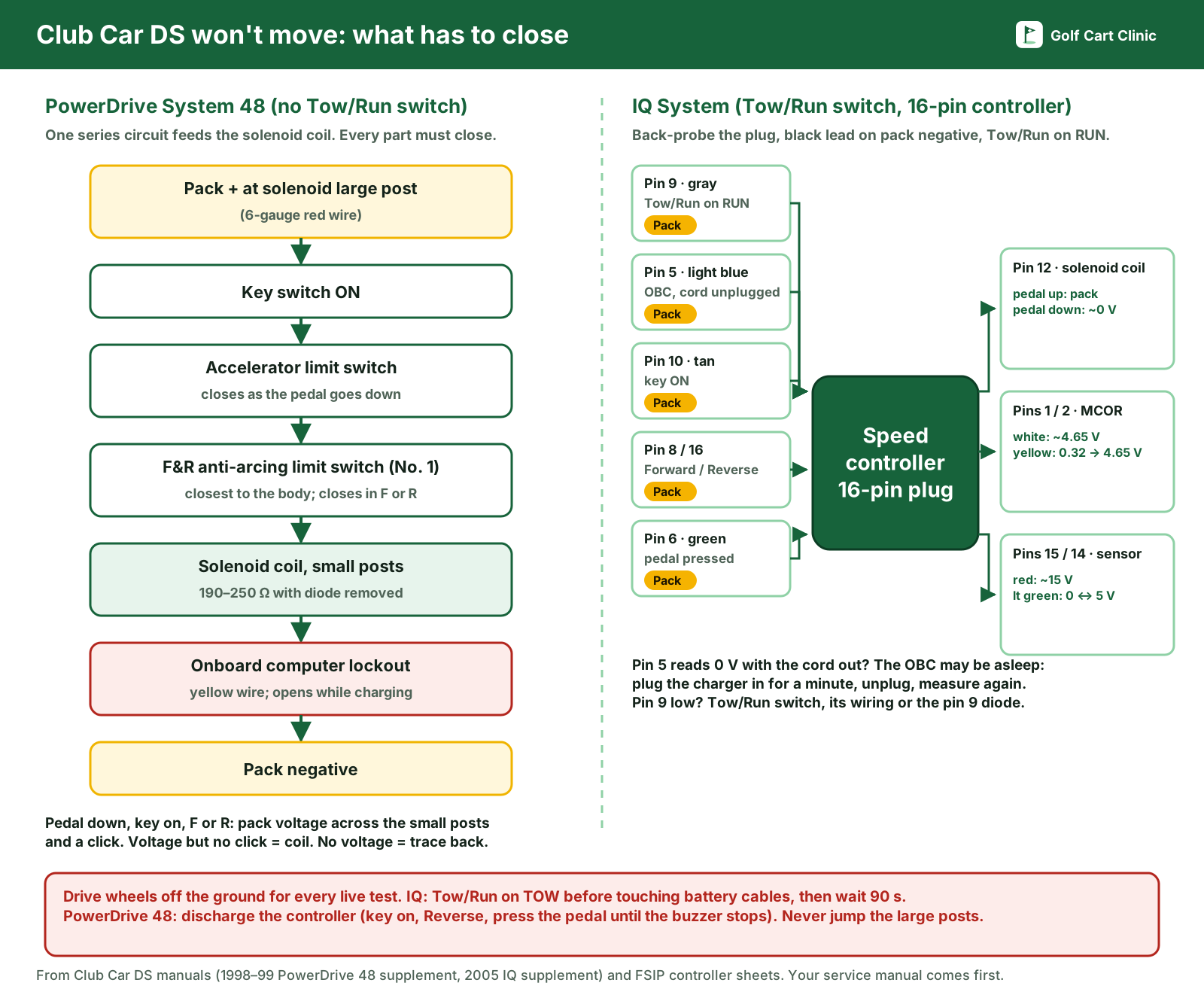
On these carts the solenoid coil sits in one series circuit. Club Car's 1998–1999 PowerDrive System 48 service supplement traces it from the solenoid large post with the red wire (pack positive), through the key switch, the accelerator limit switch and the F&R anti-arcing limit switch, to the coil, and from the coil's other small post (yellow wire) to the onboard computer, which completes the circuit to battery negative unless it's locking the cart out. A break anywhere means no click.
Start with the quick test: drive wheels lifted, key on, Forward selected, pedal down. Measure across the solenoid's two small posts. Club Car and FSIP both say you should see full pack voltage there. Voltage but no click: the coil is bad. No voltage: work through the list below with the batteries disconnected and the controller discharged.
- Key switch and accelerator limit switch: meter on the 200 Ω range from the solenoid large post (red wire) to the green/white wire at F&R limit switch no. 1. Key off: no continuity. Key on with the pedal held down: continuity (Club Car says under 100 Ω). Wrong? Check the key switch, the pedal limit switch, the wires and the pedal adjustment.
- F&R anti-arcing limit switch (no. 1, the one closest to the body): from the coil post with the white/black and red wires to the switch's normally open terminal. Continuity in Forward or Reverse, none in Neutral.
- Solenoid diode: remove the diode's terminal from the small post (the one with the yellow wire) and test it on the meter's diode setting. It must conduct one way only. Club Car's manual says the diode's red terminal goes on the post with the 18-gauge red wire and its clear terminal on the post with the yellow wire. Club Car says the diode is there to protect the limit switches, so if they keep failing, check its orientation.
- Solenoid coil: with the diode and yellow wire off, the two small posts should read 190–250 Ω. If not, replace the solenoid.
If the circuit tests good with the meter but the cart still won't click, suspect the OBC lockout next.
The onboard computer lockout
Club Car's PowerDrive troubleshooting chart lists "onboard computer solenoid lockout failure" as a cause of "will not operate, no solenoid click," and gives this procedure (Test Procedure 11):
- Water in the charge receptacle. Look into the contacts. If they're wet, disconnect the batteries, discharge the controller, take the receptacle out, dry it with a cloth and compressed air, and refit it.
- Sense lead fuse. With the batteries disconnected, check the fuse in the gray wire from the OBC for continuity. Replace it if it's blown. Club Car warns not to bypass it.
- Restart a locked-up OBC. Disconnect the batteries (negative first), discharge the controller, reconnect (positive first) and tighten the terminals to 110 in-lb. Try to drive.
- Wire terminals and the solenoid diode. On carts with serial numbers from 9841-703262 up, make sure no wire terminal is touching another solenoid post. On earlier carts, replace the solenoid diode. If the pack is wet, make sure the OBC's gray wire isn't touching the batteries.
- Isolation test. Club Car's last step: with the batteries disconnected and the controller discharged, run a jumper from the solenoid small post with the yellow wire to battery no. 6 negative, then reconnect. If the cart drives with the jumper, the OBC has failed and must be replaced. If it doesn't, the problem is elsewhere. Do this only with the drive wheels lifted, and take the jumper off afterwards: it defeats the charger lockout.
Club Car notes that a later OBC design (labeled V1.35P, fitted from serial 9841-703262) added protection to the lockout circuit's transistor so it can reset rather than blow.
PowerDrive 48: reading the controller's small wires
The factory controller on these carts is a Curtis 1204-series unit; parts listings for the 1204-410/411/412 describe them as for DS carts with the PowerDrive system and series motor, not IQ (for example this cross-reference). FSIP's troubleshooting sheet for those controllers gives this sequence, drive wheels lifted, meter black lead on main battery negative, using the three small terminals on the controller:
| Terminal | Condition | Should read | If not |
|---|---|---|---|
| Pin 1 | Key on, pedal pressed | Pack voltage, solenoid clicks | Key switch, accelerator switch, wiring open. Voltage but no click: check across the solenoid small posts |
| Pin 2 | Pedal pressed, solenoid engaged | About 8–9V | Remove the pin 2 wire and measure again; still wrong, the controller is suspect |
| Pin 3 | Pedal just at the click / floored | About 0V / about 8–9V | Wiring or throttle open or shorted |
| M- post | Pedal at the click, then floored | Pack voltage, falling toward 0V at full speed | No pack voltage at the click: wiring through the solenoid, motor armature, F&R switch and field |
IQ System: let the controller tell you, or test the 16-pin plug
Club Car recommends an IQDM handset for IQ carts; it plugs into the cart and shows the controller's fault history and live inputs. Club Car's 2005 IQ System service supplement lists these faults, among others, with its corrections:
| IQDM shows | What Club Car says it means | Correction |
|---|---|---|
| HPD | Pedal pressed at key-on or while changing direction | Release the pedal fully, then press again |
| THROTTLE FAULT 1 | MCOR signal problem | Check the MCOR three-pin connector and the 16-pin plug; test the MCOR |
| MAIN CONT DNC | Solenoid didn't close | Reset the controller (disconnect, let capacitors drain); check solenoid and B+ wiring; replace the solenoid |
| MAIN COIL FAULT / MAIN DROPOUT | Solenoid coil open | Replace the solenoid |
| MAIN WELDED | Solenoid contacts stuck closed | Replace the solenoid |
| FIELD MISSING / OPEN ARMATURE | Open motor field or armature circuit | Check motor wires; then the motor (brushes); then the controller |
| HW FAILSAFE | Controller hardware fault | Reset first; if it returns, replace the controller |
| LOW BATTERY | Pack too low | Charge; test the batteries |
| THERMAL CUTBACK / MOTOR STALL | Controller hot or motor held stalled | Check brakes and load; don't hold the cart on a hill with the pedal |
No handset? Use a meter. FSIP's sheet for the Curtis 1510 IQ controller says to leave the plug connected and back-probe from the wire side (a straightened paperclip works), black lead on main battery negative, drive wheels lifted, Tow/Run on Run. Club Car's DS IQ wiring diagram uses the same pin assignments. Measure the main positive post first: that's "pack voltage." Go in order and fix the first wrong reading before moving on.
| Pin (wire) | Condition | Should read | If not |
|---|---|---|---|
| 9 (gray) | Tow/Run on Run | Pack voltage | Tow/Run switch, its wiring, the pin 9 diode, fuse |
| 5 (light blue) | Charger unplugged | Pack voltage (FSIP: the controller is dead below 30V) | Onboard computer asleep or failed; see the next section |
| 10 (tan) | Key on | Pack voltage | Key switch, wiring |
| 8 (brown) / 16 (blue) | Forward / Reverse | Pack voltage on the selected pin only | Forward/Reverse rocker switch, wiring |
| 7 (orange/white) | Reverse | 0V, buzzer sounds | Reverse buzzer or wiring |
| 6 (green) | Pedal up / pressed | 0V / pack voltage | MCOR limit switch shorted / open, pedal adjustment |
| 12 (blue/white) | Pedal up / pressed | Pack voltage / about 0V | Solenoid coil or its wiring open |
| 15 / 13 / 14 | Run; turn a lifted wheel slowly | About 15V / about 0V / toggles 0–5V | Motor speed sensor or its wiring |
The MCOR (the accelerator unit) is easiest to test at its own three-pin connector. Club Car's procedure, key off, Tow/Run on Run: the purple/white wire reads about 48–50V measured from battery no. 1 positive; the white wire reads about 4.65V from battery negative; the yellow wire reads about 0.32V with the pedal up and rises smoothly to about 4.65V with the pedal floored. If the yellow wire doesn't rise, Club Car says to replace the MCOR.
IQ: the onboard computer and the Tow/Run switch
- OBC asleep. Club Car's IQ lockout test: with the charger unplugged, the OBC's blue wire should read 48–50V. If it reads zero, plug the charger's DC cord in. If the dash light comes on for 10 seconds, the OBC has powered up; unplug and measure again. FSIP gives the same advice for pin 5: charge for a minute, unplug, recheck. Club Car also says pressing the accelerator should wake the system. If pin 5 still stays low, the OBC or its wiring is the problem.
- OBC never wakes. If the dash light doesn't come on, Club Car says to check the red wire at the OBC's six-pin connector for about 48V. Wrong reading: test the Tow/Run switch. Right reading on the harness side with good connections: the OBC activation circuit has failed.
- Tow/Run switch. Club Car's test: meter black lead on battery no. 6 negative, red probe on the light green wire near the switch's two-pin connector. Run: about 48–50V. Tow: below about 5V. Above 5V in Tow, replace the switch. Below 5V in Run, check the two-pin connector and the pink wire that feeds the switch from the solenoid large post.
- Pin 9 diode. If a new Tow/Run switch doesn't fix it, test the diode in the pin 9 wire. With the batteries and 16-pin plug disconnected and the meter on diode test: black on the light green wire at the switch, red on pin 9, it should read no continuity. Reversed, about 500 mV (400–600 mV is acceptable).
Solenoid clicks, cart still won't move
A click only proves the coil moved. The heavy contacts may not be passing current. Our solenoid clicking guide has the on-cart voltage-drop test. To check a DS solenoid on the bench:
- Contacts, power off: with the batteries disconnected, take the wires and the resistor off the large posts. Club Car says the large posts must show no continuity; if they do, the contacts are welded and the solenoid must be replaced.
- Contacts, power on: FSIP's sheets say to put the meter on the large posts and feed pack voltage to the coil with jumpers. The reading must drop from open to less than 0.3 Ω.
- Coil: 190–250 Ω on PowerDrive 48 carts, 180–190 Ω on IQ carts per Club Car's IQ supplement, measured with the diode out of the circuit. On an IQ cart with a failed diode, Club Car says you can leave it off: the controller has one built in.
- Pre-charge resistor: the resistor across the large posts should read about 250 Ω. Club Car says it keeps the controller capacitors charged to reduce arcing at the contacts. For how it and the diode work, and which way the diode goes, see our solenoid diode and resistor guide.
On a PowerDrive 48 cart, Club Car's next suspects for "solenoid clicks, won't operate" are the Forward/Reverse switch contacts and the motor. With the batteries disconnected and the handle in Forward, the M- controller terminal should have continuity to the S1 motor terminal and A2 to S2; in Reverse, M- to S2 and A2 to S1. Then check the motor with its wires disconnected. FSIP gives armature A1–A2 at 0.3–1 Ω and field F1–F2 at 1–2 Ω for the PowerDrive (1204) and IQ (1510) controllers' motors, with A1 to F1 open and F1 to the motor case over 5 MΩ. Touch the meter leads together first and subtract that reading, since these values are tiny. FSIP says many cart problems turn out to be burnt or damaged brushes, which the armature check catches.
If it stopped right after new batteries
- IQ: connect everything with Tow/Run on Tow, then switch to Run and wait 10 seconds before driving.
- Compare the cable layout with the battery diagram in your manual. One battery in backwards drops pack voltage and is one of the first things Club Car's pack test tells you to look for.
- Tighten battery terminals to 110 in-lb (12.4 N·m), Club Car's figure for the DS. A loose post can read fine at rest and fall apart under load.
- Club Car's manuals describe the OBC getting "locked up" or going to sleep. On a PowerDrive 48 cart, the restart in step 3 of the lockout test is Club Car's fix; on an IQ cart, plugging the charger in briefly wakes it.
- A steady spark on the last cable means something is drawing current or shorted. Stop and read golf cart sparks when connecting the battery.
When to call a technician
- Every input checks out and the controller still won't close the solenoid, or a fault keeps coming back after a reset.
- The OBC isolation test points to a failed OBC and you're not sure what to replace it with: OBC, charger and receptacle have to match.
- Melted cables, a burnt controller plug pin or a hot, swollen battery.
- The motor turns with the pedal up, or the cart creeps in Neutral.
For symptoms on any brand, start with our golf cart won't move guide. More Club Car guides are in the Club Car section.
Frequently asked questions
Why won't my Club Car DS move after charging?
The onboard computer locks out the control circuit while the charger plug is in the receptacle, and on a PowerDrive 48 cart it can stay locked up. Make sure the plug is fully out. On an IQ cart, check for pack voltage on pin 5 of the controller plug with the cord out. On a PowerDrive 48 cart, follow Club Car's OBC lockout test: dry the receptacle, check the gray wire's sense fuse, then restart the OBC by disconnecting and reconnecting the batteries.
Does my Club Car DS have a Tow/Run switch?
Only IQ System carts do. Club Car puts it under the seat just above the Forward/Reverse switch. PowerDrive System 48 and V-Glide 36-volt carts don't have one.
How do I reset the onboard computer on a Club Car DS?
On a PowerDrive 48 cart, Club Car's restart is to disconnect the batteries (negative first), discharge the controller, then reconnect (positive first) and tighten the terminals to 110 in-lb. On an IQ cart, plugging the charger's DC cord in wakes the OBC; the dash light comes on for 10 seconds when it powers up.
What should a Club Car DS solenoid coil read?
With the diode disconnected: 190–250 Ω on a PowerDrive System 48 cart and 180–190 Ω on an IQ cart, according to Club Car's service supplements. The large posts must show no continuity with the coil unpowered.
Why does my Club Car DS beep but not move?
On an IQ cart, the warning buzzer sounds when zero-speed-detect motor braking stays on for two seconds or more, which happens when the cart rolls without the pedal pressed; it isn't a drive fault by itself. A buzzer in Reverse is normal. If the cart beeps and won't drive, check for High Pedal Detect (pedal pressed before the key), then work through the pin tests.
Can I bypass the onboard computer?
Club Car's own jumper test is for diagnosis only: it tells you whether the OBC is the problem. Leaving the lockout bypassed means the cart can be driven off with the charger cord attached, and the OBC also runs the charging. Replace the failed part instead.
Sources
- Club Car, 2004 DS golf car owner's manual (DS versions, Tow/Run switch location and 10-second waits, charger lockout, 90-second capacitor wait, PowerDrive capacitor discharge, 6V vs 8V batteries, 110 in-lb terminals, serial number location): PDF hosted by Tidewater Carts
- Club Car, 1998–1999 PowerDrive System 48 maintenance and service supplement 101968404 (control circuit, troubleshooting chart, test procedures 1–11 including the OBC lockout, diode orientation, 190–250 Ω coil, 250 Ω resistor, F&R switch continuity): PDF hosted by GolfTechs
- Club Car, 2005 IQ System electric vehicle maintenance and service supplement 102680408 (DS IQ wiring and 16-pin pinout, IQDM troubleshooting guide, OBC lockout, Tow/Run, MCOR, pin 9 diode and under-load tests, 180–190 Ω coil): Scribd
- Club Car, 2009–2011 DS golf car maintenance and service manual 103472703 (IQ System as the DS electric drive, 4×12V and 6×8V layouts, IQDM fault list): PDF hosted by GolfTechs
- FSIP (Flight Systems Industrial Products), troubleshooting sheets: Curtis 1204-410/411/412 for Club Car and Curtis 1510(A) for Club Car IQ (pin voltages, solenoid and motor winding values)
- Vintage Golf Cart Parts, 48V DS controller cross-reference (1204-41x for PowerDrive, series motor): vintagegolfcartparts.com
- Trojan Battery, open-circuit voltage chart: trojanbattery.com
- Your cart's own owner's and service manual. Where it differs from this guide, follow it.
Last checked against the documents above on October 24, 2026. Club Car, DS, IQ System and PowerDrive are trademarks of their owner; Golf Cart Clinic is independent and not affiliated with Club Car.
Questions and comments
No comments yet. Corrections and notes from your own repair are welcome.