
Club Car OBC Bypass: Use an Aftermarket Charger on a 1995–2014 48V Club Car
On 1995–2014 48V Club Car DS and Precedent carts, the onboard computer sits in both the charging circuit and the drive lockout, so a cheap charger won't just plug in. Here's how to test the OBC, your three options, how a bypass kit works by model and year, and which charger to buy.
Quick answer: on a 48V Club Car DS or Precedent built from about 1995 to 2014, the onboard computer (OBC) sits inside both the charging circuit and the drive lockout, so you can't just unplug it and connect a cheap charger. If the OBC has really failed, you have three sound choices: replace it, buy the one aftermarket charger Lester says works with an active OBC, or fit an OBC bypass kit and a stand-alone "smart" 48V charger set for your battery type. Test the OBC first, because many "dead" OBCs are only asleep, and never bypass it in a way that lets the cart drive away with the charger plugged in.
Safety first. You are working inside a 48V pack that can deliver hundreds of amps through a wrench, ring or watch. Wear safety glasses, use insulated tools and take off jewelry. Pull the charger plug out of the cart, put the Tow/Run switch on Tow and take every wire off the negative post of the last battery in the pack before you touch the OBC, the receptacle or the controller wiring; Club Car also says to wait at least 90 seconds for the controller capacitors to discharge. Charge only in a ventilated area with no sparks or flames near the batteries. The most important rule of any bypass: keep the charger lockout working. If the cart can move while the charger cord is plugged in, someone will drive off and rip out the cord or the receptacle. Test the lockout with the rear wheels off the ground before anyone drives the cart. If a wire or terminal is melted, a battery is hot or swollen, or you smell burning, stop and get the cart checked.
Does your Club Car have an OBC?
Only some electric Club Cars have one. Club Car's 2004 DS owner's manual says PowerDrive System 48 and IQ System cars have a battery warning light above the steering column that is "controlled by the onboard computer," which is the easiest outside clue. Lester's bypass kit sheet covers 1995–2014 DS and Precedent cars, and Nivel's listing for the same kit says it is not for 36V (pre-1995) carts or for ERIC charging systems (2014 and up).
| Cart | OBC? | How to spot it |
|---|---|---|
| 36V DS (V-Glide and other 36V carts) | No | Six 6V batteries; the bypass kits don't apply |
| 48V DS, PowerDrive System 48 | Yes | Six 8V batteries, battery warning light on the dash, no Tow/Run switch. The OBC locks out the solenoid circuit. |
| 48V DS or Precedent, IQ System | Yes | Tow/Run switch under the seat, dash warning light, OBC drives the light blue lockout wire to controller pin 5 |
| Precedent, Excel with OBC | Yes | Same layout as IQ; Club Car's 2016 manual identifies the OBC version of the controller as the gray 1515-5201 |
| Precedent, Excel with ERIC charging | No | White 1515-5206 controller; a charge light below the steering column that flashes three times, with three beeps, when charging starts |
Lester also gives a simple way to tell a DS from a Precedent at the charging receptacle: look at the back of it. A DS has a fuse at the connector (the gray sense lead runs through a yellow fuse holder), while a Precedent has its wires attached straight to the connector housing. If you're not sure of the year, our serial number lookup shows how to read it from the serial decal.
What the OBC actually does
Club Car's 2009–2011 Electric Precedent service manual lists six jobs for the OBC: it monitors battery condition, counts the energy used, works out how much charge the batteries need and shuts the charger off when that amount is returned, decides when to activate regenerative motor braking, locks out vehicle movement while the charger is plugged in, and stores operating data for Club Car's diagnostic module. Two of those jobs are wired into the cart in ways that matter for a bypass:
- It's in the charging circuit. The receptacle's 10-gauge black wire doesn't go to the batteries. It goes to the OBC, where a silicon-controlled rectifier (SCR) acts as a switch on the negative side, so the OBC controls the charging current. A charger plugged into that receptacle only charges if the OBC lets it.
- It's in the run circuit. On IQ and Excel cars the OBC feeds the light blue lockout wire to controller pin 5; the controller won't run without voltage there. On a PowerDrive 48 DS, the OBC sits in the solenoid circuit, which is why Club Car's own isolation test for a suspect OBC is a jumper at the solenoid.
That's why unplugging a suspect OBC usually leaves you with a cart that neither charges nor moves, and why a regular 48V charger plugged into the stock receptacle often does nothing.
Before you bypass: is the OBC really bad?
An OBC can be asleep, locked up or deliberately holding off the charger. Rule those out first, because they cost nothing to fix. Meter on 200V DC; the readings are from Club Car's 2009–2011 Precedent manual unless noted.
- Lester's quick check. Lester's charger FAQ says that if your charger does not turn on and the battery pack measures above 20V, the OBC may be malfunctioning. If the pack is much lower than that, the problem may be the batteries, not the OBC: see how to water golf cart batteries for checking and caring for a flooded pack.
- Restart after a long power cut. Club Car says that if AC power is off for 7 days or longer, the OBC won't charge again until it's restarted: with AC power back, unplug the DC cord from the cart (or the AC cord of an onboard charger), wait five seconds and plug it back in.
- Storage-mode hold. The OBC counts time in storage and can stop the charger when it thinks the electrolyte may be low. Check and top up the water, then unplug and replug the cord the same way; Club Car says that tells the OBC the water has been checked.
- Reboot a locked-up OBC. Club Car's procedure: disconnect the batteries, wait at least 90 seconds for the controller capacitors to discharge (they must be fully discharged for the reboot to work), put Tow/Run on Tow, reconnect the batteries, then switch to Run and test drive. On a Precedent, the battery warning light should come on for 10 seconds the first time the cart is driven after a reboot.
- SCR test (charging side). Red probe on battery no. 1 positive, black probe on the receptacle socket with the 10-gauge black wire: about 36–42V. Zero volts with good wires and connections means the SCR has failed and the OBC needs replacing. Plug in the AC and DC cords: when the charger relay clicks on, the reading should rise to about full pack voltage (about 48V).
- Gray wire test. DC cord out, pull back the boot on the gray wire at the OBC. Red probe on battery no. 1 positive, black probe on the gray wire: about 48V. Plug in the DC cord: it should drop to about 4.0V before the charger relay clicks on, then rise back to about 48V. If it doesn't, Club Car says the OBC's gray wire circuit has failed.
- Lockout test (run side). With the cord out and Tow/Run on Run, the OBC's light blue wire should be at about full pack voltage, and near zero with the cord in. If it reads zero with the cord out, plug the DC cord in briefly: if the dash light comes on for 10 seconds, the OBC has woken up. If the dash light never comes on, Club Car says to check for about 48V on the red wire at the OBC's six-pin connector; good voltage on the harness side with clean pins means the OBC's activation circuit has failed.
For the model-specific version of these tests, including the PowerDrive 48 isolation jumper, see Club Car DS won't move and Club Car Precedent won't move.
It only charges when a fuse is pulled
This comes up a lot with older DS and Precedent carts, often after someone has tried a non-Club Car charger. We can't tell from a description which fuse is involved, but the pattern always means the same thing: the OBC and the charger aren't working together the way Club Car designed. Either the OBC is failing, or a charger that expects a direct battery connection is plugged into an OBC receptacle. Don't make it a habit. On a DS the fuse in the gray sense lead protects the OBC circuit, and Club Car's PowerDrive 48 service supplement warns against bypassing it; with the wrong fuse out you can also lose the charger lockout. Run the tests above, then pick one of the fixes below.
Your three options
| Option | What you keep | Watch out for |
|---|---|---|
| Replace the OBC and keep a Club Car PowerDrive charger | Everything the factory designed: dash warning light, charge control, lockout, data | The OBC, charger and receptacle have to match your model. Old chargers may need work too. |
| Keep the OBC, buy an OBC-compatible charger | The OBC's functions, with a newer charger | Lester says its 26610-21 is the only aftermarket charger that works with an active OBC, and the OBC still has to be healthy. |
| Bypass kit plus a stand-alone smart charger | Charging and, if the kit is wired for it, the lockout | All OBC functions are disabled, including the dash light and charge history. The original PowerDrive charger won't work afterwards. |
Lester's FAQ says a Club Car PowerDrive charger can be replaced with a Lester Links charger (29840-21) or a Summit Series II, and that the Summit II "may require the purchase of additional wiring harnesses to disable the onboard computer." That harness is the bypass kit.
How an OBC bypass works
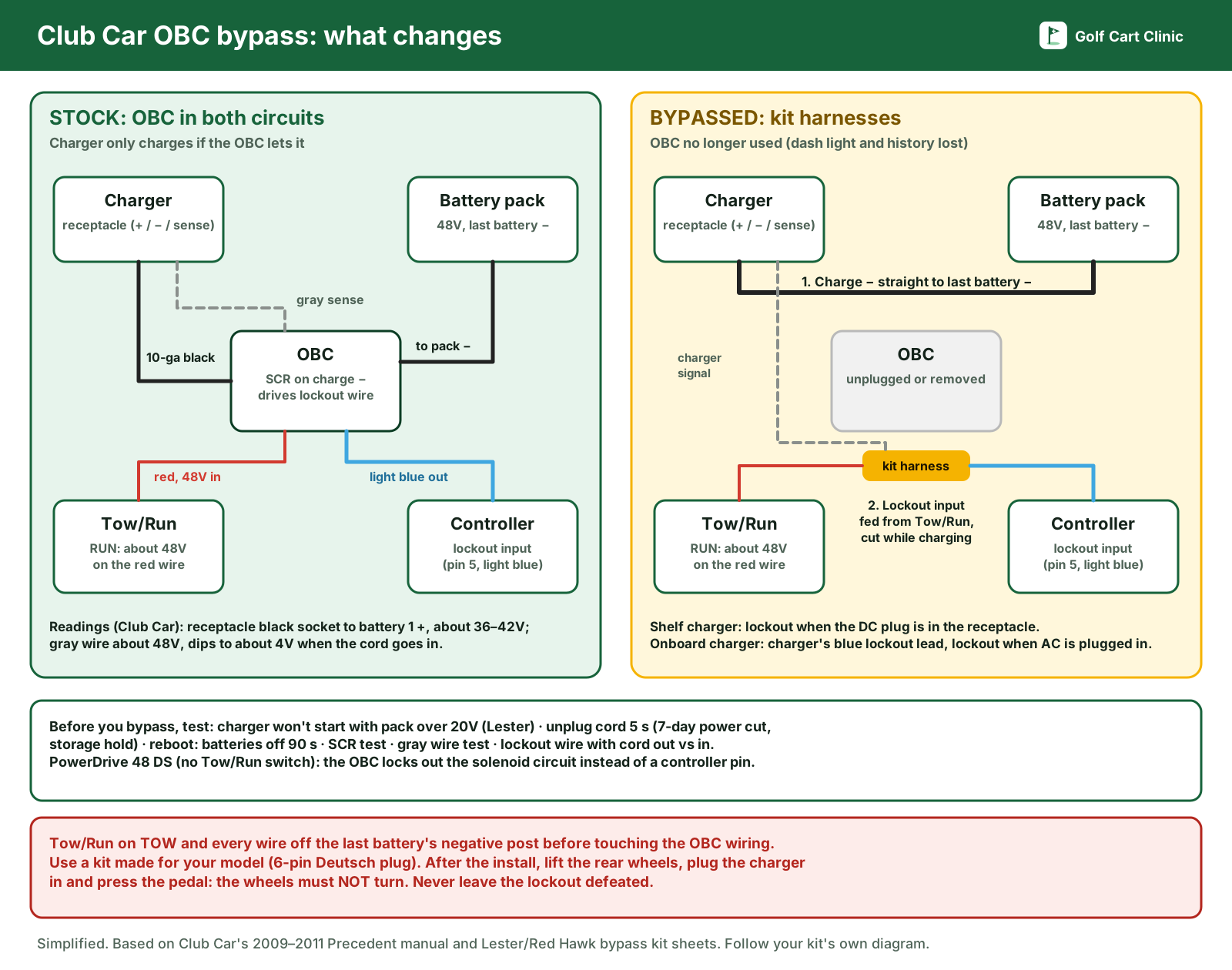
Every bypass kit we found does the same two jobs:
- Charge negative to pack negative. The kit adds a wire from the receptacle's negative circuit straight to the negative post of the last battery, so the charger sees the pack directly instead of through the OBC's SCR. On a Precedent this is a Y-wire at the single Packard connector between the receptacle and the OBC. On a DS it's a wire from the fuse stud on the back of the receptacle; Red Hawk's sheet gives 22 in·lb for that nut.
- Keep the controller enabled, and locked out while charging. A plug-in harness goes on the cart side of the OBC's six-pin Deutsch connector and supplies the lockout circuit that the OBC used to power. The optional lockout wiring in the Lester and Red Hawk kits uses the charger connection so the cart still can't drive while charging: with a shelf (off-board) charger, the lockout works when the DC plug is in the receptacle; with an onboard charger, the charger's blue lockout lead is connected and the lockout works when the charger's AC plug is in the wall.
Lester's kit sheet is clear that its kit is only compatible with OBCs and carts that have the 6-pin Deutsch connector. If your OBC has a different plug, ask the kit maker before buying.
Where the parts are, by model and year
- Precedent 2004 to mid-2008: Red Hawk's sheet says the OBC, controller and solenoid are under a protective cover in the center of the battery compartment.
- Precedent mid-2008 and later: they're behind the battery pack, reached through the access panel in the bag well. Lester suggests laying a towel over the motor so you don't scrape your arm on the motor terminals.
- DS: the kits work at the back of the receptacle and at the six-pin connector behind the rear access panel near the bag well. The gray sense lead with its yellow fuse holder is near the receptacle.
The install, in outline
Use the sheet that comes with your kit; DS and Precedent steps are different, and onboard-charger installs need extra connections. The common order is:
- Unplug the charger cord, set the park brake, key off, Tow/Run on Tow.
- Remove every wire from the negative post of the last battery in the pack.
- Open the access panel and the cover over the OBC and controller (Precedent), or the rear access panel (DS).
- Disconnect the connections the kit replaces (Packard connector, six-pin Deutsch plug and, for the lockout option, the gray wire or its fuse holder) and fit the kit harnesses exactly as drawn.
- Route the kit's ring terminal to the battery compartment, refit the covers, and put the ring terminal on the last battery's negative post together with all the original wires. Tighten to your battery maker's torque spec; don't overtighten.
- Tow/Run back to Run, refit the seat, then test the lockout (below) before driving.
Choosing the replacement charger
- It must be a 48V charger. Lester says a 36V charger won't charge a 48V cart and will show an under-voltage error within 10 minutes.
- It must be a stand-alone "smart" charger. Red Hawk says that after its bypass the original OBC-dependent charger won't charge the cart and that a charger with a built-in microprocessor is needed.
- Shelf or onboard mode. Lester explains that onboard chargers start charging when they detect AC power, while shelf-mode chargers start when they detect DC voltage from the batteries. Set the charger to match how you'll mount it, and wire the lockout for that mode.
- The right battery profile. Lester's FAQ says flooded (wet) lead-acid batteries need a constant-current finish, and AGM or gel batteries need a constant-voltage finish; the wrong profile undercharges or overcharges the pack. For lithium, Lester says its standard wet-cell profile is used and the battery's own controller limits the voltage, but check with your battery maker first.
- The right plug. Match the charger's DC plug to your cart's receptacle, or replace the receptacle with one that matches. Lester warns that DC plugs have different current ratings, so a cordset must be rated for the current the charger produces; ask the charger maker before swapping plugs.
- Charge in Run. Lester says to charge with the cart's Tow/Run switch in Run; Tow is for storage or battery removal.
After the bypass: test the lockout
- Chock the front wheels and lift the rear wheels clear of the ground on jack stands.
- Tow/Run on Run, key on, Forward selected. Plug the charger in (DC plug in the receptacle for a shelf charger, AC plug in the wall for an onboard charger).
- Press the pedal gently. The wheels must not turn. If they do, the lockout isn't wired; unplug, go back to Tow and fix it before the cart is used.
- Unplug the charger and confirm the cart drives normally.
- Watch the first full charge: the charger should start, finish and shut off on its own. Check the battery water level afterwards on flooded batteries.
Expect the dash battery warning light to stop working after a bypass; Lester's sheet says all OBC functions are disabled, including the dash light and future charge-history recording.
When to call a technician
- The OBC tests are unclear, or the cart won't move and you can't tell whether the OBC, the controller or the solenoid is at fault.
- Your OBC doesn't have the six-pin Deutsch connector, or the wiring has already been modified by a previous owner.
- You want to keep the OBC's functions and need an OBC, charger and receptacle that match your car.
- You smell burning, see melted insulation or find a battery that's hot or swollen.
More Club Car guides are in the Club Car section, and battery care is under batteries. If you get a spark every time you connect the pack after the work, read why a golf cart sparks when connecting the battery.
Frequently asked questions
Can I just unplug the OBC and use any 48V charger?
Usually not. The OBC sits between the charger receptacle's negative wire and the pack, and it powers the drive lockout, so with it unplugged the charger has no path to charge and the cart may not run. An OBC bypass kit reroutes both circuits. Wire the kit's lockout option so the cart can't move while the charger is connected.
Will a normal 48V charger work on a Club Car that still has an OBC?
Not reliably. Lester says its 26610-21 is the only aftermarket charger that works with an active OBC. Other stand-alone chargers, including its Summit Series II, may need a bypass harness to disable the OBC first.
Which Club Cars have an OBC?
48V DS and Precedent cars with the PowerDrive System 48, IQ System or Excel-with-OBC systems, covered by the bypass kits as 1995 to 2014 models. 36V carts and Precedents with ERIC charging (2014 and up) don't have one. A battery warning light above the steering column is the quickest clue on a DS.
How do I know if my Club Car OBC is bad?
Lester's rule of thumb: the charger won't turn on even though the pack reads over 20V. Before replacing anything, restart the OBC by unplugging the charger cord for five seconds, reboot it by disconnecting the batteries for 90 seconds, and run Club Car's SCR, gray wire and lockout tests described above.
What do I lose with an OBC bypass?
Lester says all OBC functions are disabled, including the dash warning light and the record of charge and discharge history. Club Car's Precedent manual also lists deciding when to use regenerative motor braking among the OBC's jobs; the kit sheets don't say how a bypass affects that on your car, so ask the kit maker if you rely on it.
Is an OBC bypass safe?
It can be, if you use a kit made for your model, keep the charger lockout working, and use a 48V charger set for your battery type. The unsafe versions are the ones that leave the lockout defeated, because the cart can then be driven off with the charger cord attached.
Sources
- Club Car, 2009–2011 Electric Precedent maintenance and service manual (OBC functions, storage mode and 7-day restart, solenoid lockout test, red activation wire, OBC SCR test, gray wire test, OBC reboot and battery warning light): PDF hosted by GolfTechs
- Club Car, 2016 Precedent golf car maintenance and service manual (Excel controller 1515-5201 with OBC vs 1515-5206 with ERIC): PDF hosted by gfretwell.com
- Club Car, 2004 DS golf car owner's manual (battery warning light controlled by the onboard computer on PowerDrive System 48 and IQ System cars): PDF hosted by Tidewater Carts
- Club Car, 1998–1999 PowerDrive System 48 maintenance and service supplement 101968404 (OBC lockout of the solenoid circuit, OBC isolation test, gray sense lead fuse warning): PDF hosted by GolfTechs
- Lester Electrical, OBC bypass kit #38836 installation instructions for Club Car Precedent and DS (6-pin Deutsch requirement, DS receptacle 10-gauge black wire to the OBC and gray wire fuse holder, shelf and onboard charger versions, OBC functions disabled): PDF
- Lester Electrical, OBC bypass kit #43212S instructions, 1995–2014 Precedent and DS (Y-wire at the Packard connector, DS fuse-stud wire, optional vehicle lockout wiring): PDF hosted by Nivel Parts, and the kit listing (not for 36V or ERIC carts): nivelparts.com
- Red Hawk, CGR-123 OBC bypass for Club Car IQ with 6-pin plug, installation instructions (Precedent 2004–2008.5 vs 2008.5+ locations, DS receptacle fuse-stud nut 22 in·lb, charger requirements, lockout option): PDF
- Lester Electrical, battery charger FAQs (OBC malfunction check, 26610-21, replacements for PowerDrive chargers, DS vs Precedent receptacle, 36V vs 48V, shelf vs onboard mode, battery profiles, DC cordset ratings, charge in Run): lesterelectrical.com
- Your cart's own owner's and service manual and your kit's instructions. Where they differ from this guide, follow them.
Last checked against the documents above on October 26, 2026. Club Car, Precedent, DS, IQ System, Excel, PowerDrive and ERIC are trademarks of their owner; Lester Electrical, Links, Summit and Red Hawk are trademarks of their owners. Golf Cart Clinic is independent and not affiliated with any of these companies, and earns nothing from the products named here.
Questions and comments
No comments yet. Corrections and notes from your own repair are welcome.