
Indiana Golf Cart Laws (2026): Local Ordinances, ID-Card Drivers and LSVs
In Indiana a golf cart may not be driven on any public road or alley unless the city, town or county that controls it passes an ordinance and posts signs. Here is what IC 9-21-8-57 and the rest of Title 9 require: a driver's license (or a state ID card at 16 years and 180 days where the ordinance allows it), liability insurance, no BMV registration, county crossing rules for state highways, and how low-speed vehicles differ.
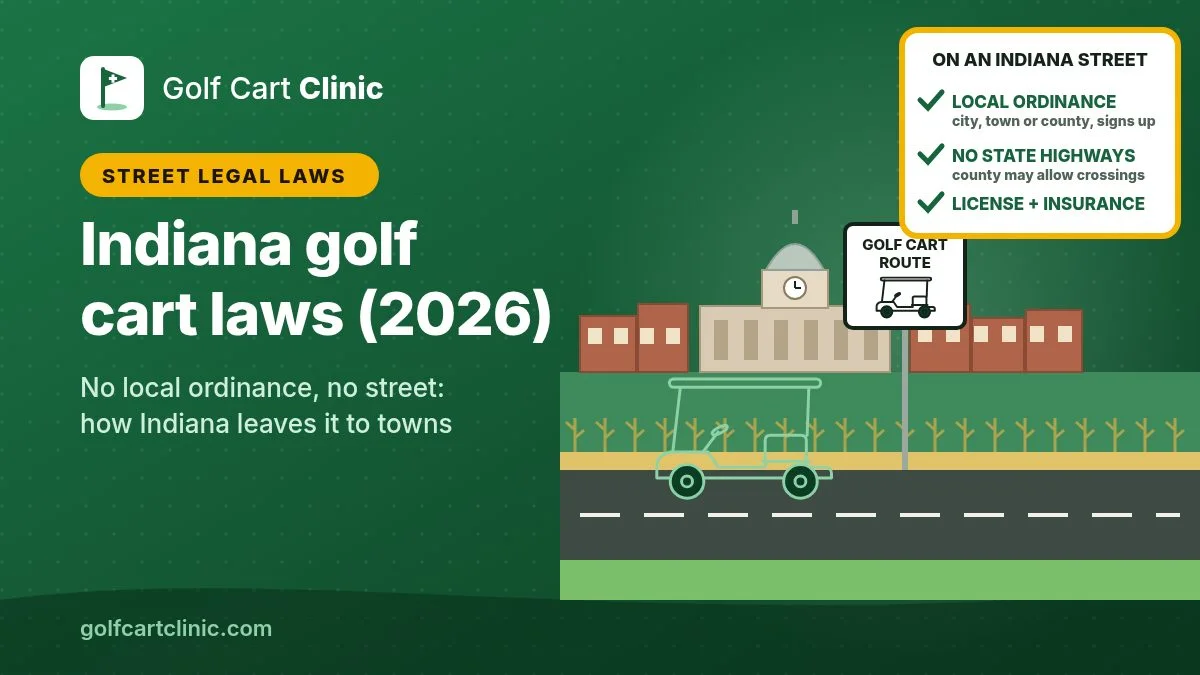
In Indiana, a golf cart may not be driven on any public street, road or alley unless the city, town or county that controls that road has passed an ordinance allowing it, and the ordinance only takes effect once signs are posted. Where one exists, the driver needs a driver's license (or, if the ordinance allows it, a state ID card and an age of at least 16 years and 180 days), the cart needs liability insurance, and the BMV issues no plate because it may not register golf carts at all. Everything else, from the roads to the hours and equipment, is set by the local ordinance. Factory-built electric low-speed vehicles (LSVs) are different: titled and plated, they may use roads with a speed limit of 35 mph or less.
Not legal advice. Last verified: October 28, 2026. This guide summarizes the 2026 Indiana Code (Title 9: the golf cart and low-speed vehicle definitions, IC 9-21-8-57 on golf carts on highways, IC 9-21-1-3 and 3.3 on local ordinances, and the licensing, registration, insurance and penalty sections linked below), Indiana DNR and BMV guidance, and published local ordinances. Whether golf carts may use your road is decided by your city, town or county. Read its ordinance, or ask the local police department or sheriff, before you drive a cart on a public road.
Safety first. A golf cart on an Indiana road shares it with cars, pickups and farm equipment, and it has no crash protection, no airbags and usually no doors. Indiana's state law doesn't require lights, turn signals or seat belts on a golf cart; your local ordinance may, and you should fit them anyway if you'll be on the road at all. Keep everyone seated with hands and feet inside, belt in children wherever the cart has belts, and never carry more people than there are seats. A cart may never run along a numbered State Road or US highway, and Indiana's drunk driving law applies to a golf cart even on a golf course or private land. If the trip needs a state highway or a road your ordinance doesn't cover, put the cart on a trailer.
Indiana golf cart and LSV rules at a glance
Indiana law treats golf carts and low-speed vehicles as two different vehicles with very different starting points:
| Rule | Golf cart | Low-speed vehicle (LSV) |
|---|---|---|
| Legal definition | "A four (4) wheeled motor vehicle originally and specifically designed and intended to transport one (1) or more individuals and golf clubs for the purpose of playing the game of golf on a golf course" (IC 9-13-2-69.7) | A four-wheeled, electrically powered motor vehicle with a maximum design speed of not more than 25 mph that meets federal standard FMVSS 500, has the listed equipment and was not privately assembled (IC 9-13-2-94.5) |
| Starting rule for public roads | "May not be operated on a highway" except as a local ordinance allows (IC 9-21-8-57) | Allowed on highways with a speed limit of 35 mph or less (IC 9-21-5-8.5); local authorities may regulate or prohibit them (IC 9-21-1-3(a)(14)) |
| Who decides | The city, town or county that has jurisdiction over the road (IC 9-21-1-3.3(a)) | State law, with local restrictions allowed |
| Highest speed limit on the road | No state number; set by the ordinance (Elkhart County uses 30 mph) | 35 mph |
| State highways | Not along them; a county ordinance may allow right-angle crossings (IC 9-21-1-3.3(c)) | Only where the speed limit is 35 mph or less |
| Title and plates | None: the BMV "may not register" a golf cart (IC 9-18.1-3-6(8)) | BMV title and registration as a passenger motor vehicle (IC 9-18.1-5-2) |
| Driver | Driver's license, or age 16 years and 180 days with a state ID card if the ordinance allows it (IC 9-24-1-7(b)) | Driver's license (IC 9-24-1-1) |
| Insurance | Financial responsibility for a motor vehicle on a public highway (IC 9-25-4-1) | Same |
How Indiana defines a golf cart
Under IC 9-13-2-69.7, a golf cart is "a four (4) wheeled motor vehicle originally and specifically designed and intended to transport one (1) or more individuals and golf clubs for the purpose of playing the game of golf on a golf course." Three things follow for owners:
- It is a motor vehicle. The definition says so, which matters for insurance and for drunk driving law (both below).
- It's about what the cart was built for. Gas or electric doesn't matter, and neither do the lights or seats you add later. A cart that started life as a golf car is still a golf cart.
- It's not an off-road vehicle. Indiana registers ATVs, side-by-sides and other off-road vehicles, but golf carts are left out of that class. The BMV lists "a golf cart vehicle" among the vehicles that "are not considered off-road vehicles" (BMV off-road vehicle page), so an ORV decal isn't a way to put a golf cart on the road.
The street rules reach every public way. In Indiana a "highway" or "street" is "the entire width between the boundary lines of every publicly maintained way when any part of the way is open to the use of the public for purposes of vehicular travel," and "the term includes an alley in a city or town" (IC 9-13-2-73). A quiet alley behind your house counts.
Where can you drive a golf cart in Indiana?
Off public roads: on your own land, on a golf course, and on private property where the owner allows it. On public roads, the default is a ban. IC 9-21-8-57 says: "A golf cart or off-road vehicle may not be operated on a highway except in accordance with: (1) an ordinance adopted under IC 9-21-1-3(a)(14) and IC 9-21-1-3.3(a) authorizing the operation of a golf cart or an off-road vehicle on the highway."
A local ordinance is the only way onto the road
Two sections give local governments the power. Among the things a local authority may do on highways under its jurisdiction is "regulate or prohibit the operation of low speed vehicles, golf carts, or off-road vehicles on highways" (IC 9-21-1-3(a)(14)). And "a city, county, or town may adopt by ordinance traffic regulations concerning the use of golf carts or off-road vehicles, or both on a highway under the jurisdiction of the city, county, or town" (IC 9-21-1-3.3(a)). That ordinance "may not: (1) conflict with or duplicate another state law; or (2) conflict with a driver's licensing requirement of another provision of the Indiana Code."
The statute names cities, towns and counties. Inside a city or town, the town's ordinance covers its streets; out in the unincorporated county, it's the county's call. An ordinance doesn't take effect on the day it passes: it "is effective when signs giving notice of the local traffic regulations are posted upon or at the entrances to the highway or part of the highway that is affected" (IC 9-21-1-3(b)). No signs, no golf cart route.
No ordinance means no streets
Many Indiana towns have never passed one, and their streets are closed to golf carts. Brownsburg police put it plainly in 2023: "Currently, the Town of Brownsburg has no such ordinance and all golf carts are therefore prohibited from being operated on the roadway" (Brownsburg Police news flash, Aug. 24, 2023). Being local or only going two blocks doesn't change that.
State highways and crossings
Local governments can only open roads "under the jurisdiction of the city, county, or town." Numbered State Roads and US highways belong to the state highway system, and a town's control over the state highway routes running through it "includes only the power of enforcement" (IC 9-21-1-5). So a town ordinance can't put golf carts on the State Road that serves as Main Street.
Counties get one narrow extra. A county ordinance "may allow an operator of a golf cart or off-road vehicle to cross a highway in the state highway system, at right angles, in order to travel from one (1) highway under the jurisdiction of the county to another highway under the jurisdiction of the county when the operation can be done safely" (IC 9-21-1-3.3(c)(1)). That's a straight-across crossing, never travel along the state road. And breaking a golf cart ordinance on a state highway "is considered to be an ordinance violation" (3.3(d)).
Speed limits
Indiana's golf cart statutes set no top speed for the cart and no maximum posted speed for the roads a local ordinance may open. Both are left to the ordinance and to the ordinary speed laws. In practice, ordinances set the cap. Elkhart County allows golf carts in its unincorporated areas only "on public roadways that have a posted speed limit of 30 miles per hour or less" (Elkhart County Code § 70.60(B)).
Indiana's general rule on slow traffic still applies: on a road with one lane each way, a driver going slowly enough that "three (3) or more other vehicles are blocked and cannot pass" must pull off to the right "at the earliest reasonable opportunity" and let them by (IC 9-21-5-7). In a golf cart, expect to do that often.
Age and driver's license
This is where Indiana is unusual. Every local golf cart ordinance must require one of two things (IC 9-24-1-7(b)):
- "An operator hold a driver's license"; or
- "An operator hold a driver's license or be at least sixteen (16) years and one hundred eighty (180) days of age and hold: (A) an identification card issued under IC 9-24-16; or (B) a photo exempt identification card issued under IC 9-24-16.5."
So an unlicensed driver must be at least 16 years and 180 days old, carry a state ID card, and live under an ordinance that chose the second option. The town picks; the state doesn't let it go lower. Many ordinances choose the license-only option: Fishers allows only "persons possessing a valid driver's license issued by the State of Indiana, another state of the United States of America or an international agency" (Fishers Code § 94.02(F)), and Elkhart County allows "only persons 16 years of age or older and holding a driver's license" (Elkhart County § 70.60(C)(1)). A learner's permit is not one of the options the statute lists.
Registration, title and plates
Indiana doesn't plate golf carts, and it isn't optional: "The bureau may not register the following vehicles: ... (8) A golf cart" (IC 9-18.1-3-6). The registration law also exempts "golf carts when operated in accordance with an ordinance adopted under IC 9-21-1-3(a)(14) or IC 9-21-1-3.3(a)" (IC 9-18.1-2-2(6)). Since Indiana's title requirement follows registration (IC 9-17-2-1), there's no state title for a golf cart either. The Indiana DNR answers the question directly: "Can I register my golf cart? No." (DNR ORV/Snowmobile Registration FAQs).
What you may need instead is a local permit. Many towns register carts through the police department, with an inspection, a fee and a sticker, and those permits are only good where they were issued.
LSVs go through the BMV like a car. The BMV classifies "a low speed vehicle" as a passenger motor vehicle, with a registration fee of $21.35 (IC 9-18.1-5-2), and a registered vehicle needs a certificate of title, which costs $15 (IC 9-17-2-14.5(c)). The BMV also won't register a vehicle until the excise tax is paid or shown to be exempt (IC 9-18.1-3-4). Before you buy a used cart, use our golf cart serial number lookup to confirm the make, model and year: a golf cart serial number is not the vehicle identification number an LSV needs.
Insurance
Indiana's financial responsibility law says a person may not "operate a motor vehicle on a public highway in Indiana if financial responsibility is not in effect with respect to the motor vehicle" (IC 9-25-4-1(b)). The section lists its own exceptions, "an electric personal assistive mobility device," "an off-road vehicle," and "a snowmobile," and golf carts aren't among them, while the golf cart definition calls a cart a "motor vehicle." The minimums are $25,000 for injury or death of one person, $50,000 for two or more, and $25,000 for property damage (IC 9-25-4-5).
Ordinances spell it out too. Elkhart County requires the operator to "satisfy financial responsibility," with "written proof of financial responsibility" on the cart or carried by the driver (§ 70.60(C)(2)), and Fishers defines proof of financial responsibility with the same $25,000 / $50,000 / $25,000 limits. A homeowner's policy may not cover a cart on a public road; ask your insurer for a golf cart policy and keep proof on board.
Required equipment
Indiana has no statewide equipment list for golf carts. Even the slow-moving vehicle rules skip them: the chapter "does not apply to ... a golf cart or off-road vehicle," except that a local ordinance "may require a golf cart or off-road vehicle to display a slow moving vehicle emblem" or "a red or amber flashing lamp" (IC 9-21-9-0.5). In other words, the ordinance is the equipment list. Two published examples show how much they vary:
| Item | Elkhart County (unincorporated roads) | Fishers (designated neighborhood streets) |
|---|---|---|
| Seat belts | For each designated seating position; everyone belted while moving | Required only to drive outside sunrise to sunset |
| Brakes | "Brakes as specified in I.C. 9-19-3-1" | Not listed |
| Turn signals | Front and rear | Required only to drive outside sunrise to sunset |
| Mirror | Rear view mirror | Required only to drive outside sunrise to sunset |
| Headlights, taillights, brake lights | Not listed (carts allowed only sunrise to sunset) | Required only to drive outside sunrise to sunset |
| Riders | No more than the factory seats, all seated, no body parts outside the cart | Not listed |
Sources: Elkhart County Code § 70.60(C); Fishers Code § 94.02(E). Whatever your ordinance says, working lights, turn signals, a mirror and seat belts are what keep a cart visible and its riders inside it. If your lights quit after a battery swap, see golf cart lights not working after new batteries.
Counties have one more item they must set: a county golf cart ordinance "must set a limit as to the number of passengers (other than the operator) that may be permitted on a golf cart" (IC 9-21-1-3.3(c)(2)). Elkhart County's limit is the number of factory seats.
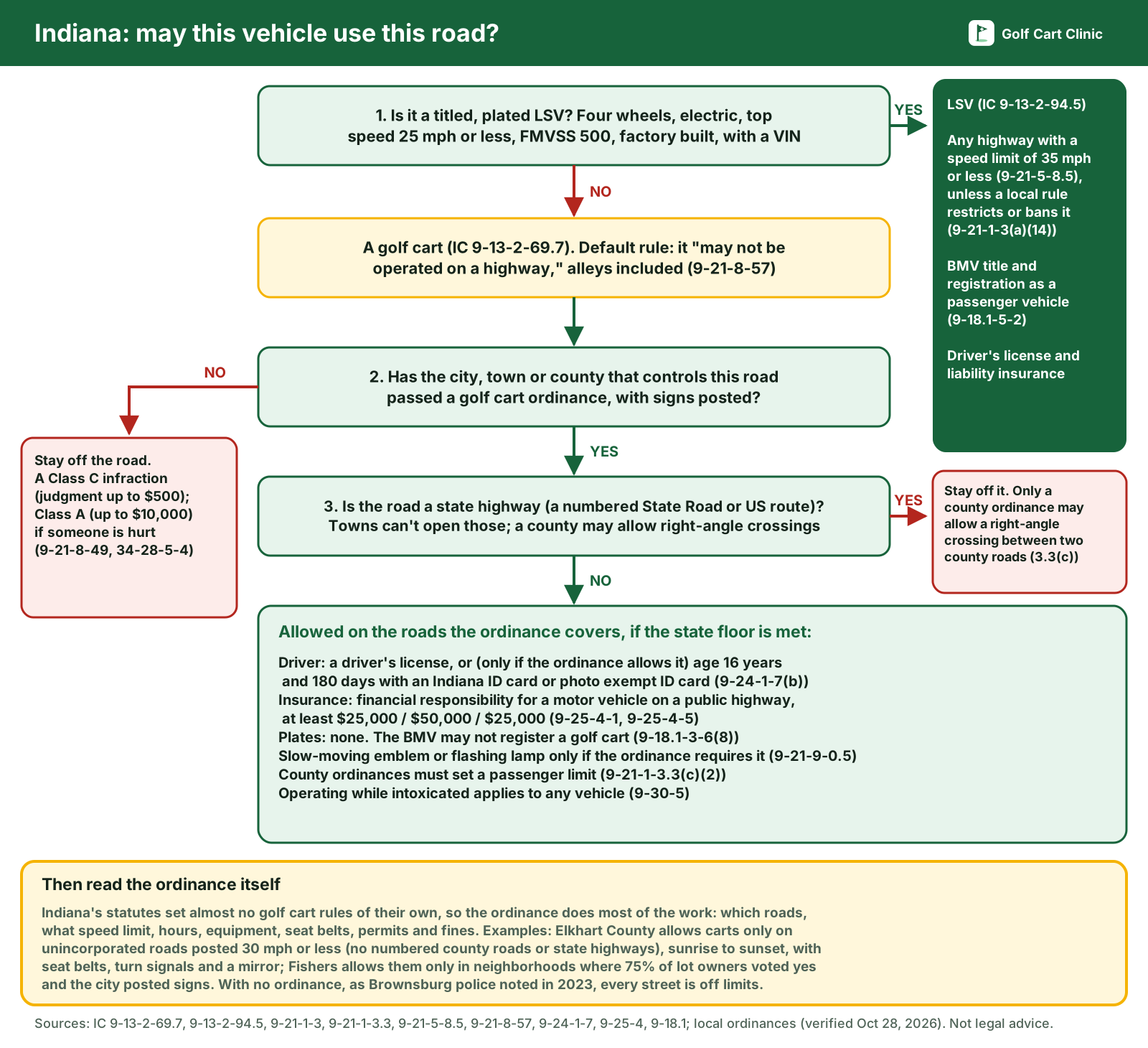
Golf carts vs LSVs in Indiana
An LSV starts with a right to the road that a golf cart doesn't have. The only state limit on where it goes is the road's speed: "A person may not operate a low speed vehicle on a highway that has a speed limit in excess of thirty-five (35) miles per hour," a Class C infraction (IC 9-21-5-8.5). Local authorities may still "regulate or prohibit" LSVs on their roads (IC 9-21-1-3(a)(14)).
Indiana's LSV definition is stricter than the federal one in two ways that matter to buyers (IC 9-13-2-94.5):
- It must be electric. The definition says "a four (4) wheeled electrically powered motor vehicle." A gas-powered low-speed vehicle doesn't fit it.
- It must not be privately assembled. The vehicle must not have "been privately assembled as described in IC 9-17-4-1," and "the term does not include a golf cart." It also needs headlamps, front and rear turn signals, tail and stop lamps, reflex reflectors, mirrors, brakes, a windshield, a vehicle identification number and "a safety belt installed at each designated seating position," and must meet FMVSS 500 (49 C.F.R. § 571.500).
Can you turn a golf cart into an LSV? Not under Indiana's definitions. A golf cart is defined by what it was "originally and specifically designed" for, and the LSV definition excludes golf carts and privately assembled vehicles. A street kit gives a cart the lights and belts many ordinances want, but it stays a golf cart, limited to the roads an ordinance opens. If a seller calls a converted cart "street legal," ask to see an Indiana title showing it as a low-speed vehicle. Thinking about golf cart upgrades such as a speed kit? Check your ordinance first: more speed doesn't open more roads to a golf cart.
Drunk driving and penalties
Indiana's operating while intoxicated law covers any "vehicle," and a golf cart is one. "A person who operates a vehicle while intoxicated commits a Class C misdemeanor," a Class A misdemeanor if the driving "endangers a person" (IC 9-30-5-2). The law adds that "it is not a defense in an action under this chapter that the accused person was operating a vehicle in a place other than on a highway" (IC 9-30-5-9). In plain terms, a drunk drive across a golf course, campground or private lane can still be charged.
Driving a golf cart on a road no ordinance opens breaks IC 9-21-8-57, and a violation of that chapter is a Class C infraction, or a Class A infraction if it "results in bodily injury to a person" (IC 9-21-8-49). A court may enter a judgment of up to $500 for a Class C infraction and up to $10,000 for a Class A infraction (IC 34-28-5-4). Breaking the terms of a local ordinance is an ordinance violation with the town's or county's own fines: Elkhart County's civil penalty is up to $200 per offense plus court costs (§ 70.99(D)), and Fishers charges $50, then $100, then $250 within a year (§ 94.02(H)).
Local ordinances: what Indiana towns and counties do
Because the state sets so little, two Indiana golf cart towns can look nothing alike. Three published examples:
- Elkhart County (unincorporated areas): golf carts and LSVs on roads posted 30 mph or less, but not on any numbered county road (the list names roads such as Mishawaka Road, County Road 20, the county line roads, Old US 20 and Old US 33), state highways, sidewalks or bike paths; right-angle crossings between county roads allowed when safe; drivers 16 or older with a license; proof of insurance; riders limited to the factory seats and belted; sunrise to sunset only; no parking on the travel lanes (Elkhart County Code § 70.60, Ord. 2016-504 as amended in 2018).
- Fishers (Hamilton County): golf carts only on designated streets inside neighborhoods, and only after the city finds them safe there, the HOA or developer surveys lot owners and "at least 75% of all lot owners have voted in favor," and city-approved signs go up. Carts run sunrise to sunset unless they have headlights, taillights, brake lights, seatbelts, turn signals and a rearview mirror; never on sidewalks; licensed drivers only (Fishers Code § 94.02).
- Brownsburg (Hendricks County): no ordinance, so no golf carts on town roads at all, as the police department noted in 2023.
To find your own rules, search your city, town or county code for "golf cart," look for golf cart signs at the entrances to your streets, or call the police non-emergency line or sheriff's office. If you live outside town limits, the county's ordinance (if it has one) is the one that counts, and HOA rules may add more inside a subdivision.
Before your golf cart goes on an Indiana road: a checklist
- Your city, town or county has a golf cart ordinance covering that road, and the signs are up.
- No part of the trip runs along a State Road or US highway; any crossing is straight across, and only where a county ordinance allows it.
- The driver has a driver's license, or is at least 16 years and 180 days old with a state ID card where the ordinance allows that.
- The cart has liability coverage of at least $25,000 / $50,000 / $25,000, with proof on board.
- Everything the ordinance requires is fitted and working: often lights, turn signals, a mirror and seat belts, and sometimes a slow-moving emblem or flashing lamp.
- Any local permit, inspection and sticker is current, and you know the ordinance's hours, speed limits and passenger limit.
- The driver is sober and everyone is seated.
How Indiana compares with nearby states
Indiana's model is closest to its neighbors to the west and north. Illinois golf cart laws also start from a ban and leave streets to local governments, but the state itself caps those streets at 35 mph and requires lights, reflectors and a slow-moving emblem, where Indiana leaves all of that to the ordinance. Michigan golf cart laws let local governments open streets too, with state limits of 15 mph, roads posted 30 mph or less and daylight hours. Ohio golf cart laws also need local approval, but add a police inspection, an Ohio title and plates, which Indiana's BMV is barred from issuing. For more states, browse our golf cart laws by state.
Frequently asked questions
Are golf carts street legal in Indiana?
Only where a local ordinance allows them. "A golf cart or off-road vehicle may not be operated on a highway except in accordance with" an ordinance adopted under IC 9-21-1-3(a)(14) and 3.3(a) (IC 9-21-8-57). Cities, towns and counties can pass one for roads they control, and it takes effect when signs are posted.
Do golf carts need license plates in Indiana?
No. The BMV "may not register" a golf cart (IC 9-18.1-3-6(8)), and carts used under a local ordinance are exempt from registration (IC 9-18.1-2-2(6)). Your town may require its own permit or sticker. LSVs are different: they need a BMV title and registration.
How old do you have to be to drive a golf cart on the road in Indiana?
Without a driver's license, at least 16 years and 180 days with a state ID card, and only if the local ordinance chooses that option; otherwise you need a driver's license (IC 9-24-1-7(b)). Many ordinances, including Fishers and Elkhart County, require a license.
Can you drive a golf cart on a state highway in Indiana?
No. Local ordinances cover only roads under the city's, town's or county's jurisdiction, and towns have only enforcement power over state highway routes (IC 9-21-1-5). A county ordinance may allow a golf cart to cross a state highway "at right angles" between two county roads when it can be done safely (IC 9-21-1-3.3(c)).
Do golf carts need insurance in Indiana?
On a public road, yes. Indiana requires financial responsibility for any motor vehicle operated on a public highway, with exceptions only for mobility devices, off-road vehicles and snowmobiles (IC 9-25-4-1), at minimums of $25,000 / $50,000 / $25,000 (IC 9-25-4-5). Ordinances commonly require proof in the cart.
Can you get a DUI on a golf cart in Indiana?
Yes. Operating a vehicle while intoxicated is a crime (IC 9-30-5-2), and it is "not a defense" that you weren't on a highway (IC 9-30-5-9), so it applies on golf courses and private property too.
Can you drive a golf cart at night in Indiana?
State law doesn't say; your ordinance does. Elkhart County allows carts on county roads "only between sunrise and sunset," while Fishers allows night driving only on carts with headlights, taillights, brake lights, seatbelts, turn signals and a rearview mirror.
Sources
- Indiana Code 2026, golf carts and local ordinances: IC 9-21-8 (section 57, golf carts on highways; section 49, penalties), IC 9-21-1 (sections 3, 3.3 and 5, local authority), IC 9-13-2 (sections 69.7 golf cart, 73 highway, 94.5 low speed vehicle), IC 9-21-9 (slow moving vehicles, section 0.5)
- Indiana Code 2026, licensing, registration, title and insurance: IC 9-24-1 (sections 1 and 7), IC 9-18.1-2 (section 2), IC 9-18.1-3 (sections 4 and 6), IC 9-18.1-5 (section 2), IC 9-17-2 (sections 1 and 14.5), IC 9-25-4 (sections 1 and 5)
- Indiana Code 2026, speed and penalties: IC 9-21-5 (sections 7 and 8.5), IC 9-30-5 (sections 2 and 9), IC 34-28-5 (section 4, infraction judgments)
- Indiana agencies: Indiana DNR, ORV/Snowmobile Registration FAQs; Indiana BMV, Off-Road Vehicles and Snowmobiles
- 49 C.F.R. (federal): § 571.500 (FMVSS 500, low-speed vehicles)
- Local: Elkhart County Code § 70.60, Golf Cart and Low Speed Vehicle Usage on Certain County Roadways (and § 70.99(D)); City of Fishers Code § 94.02, Golf Carts; Town of Brownsburg Police, Can We Drive Golf Carts in Town? (Aug. 24, 2023)
Questions and comments
No comments yet. Corrections and notes from your own repair are welcome.