
Pennsylvania Golf Cart Laws (2026): Crossings Only, Age 12 and NEV Rules
Pennsylvania is one of the strictest golf cart states: it is unlawful to drive a golf cart on any public road, and no township or HOA can change that. A cart may only make a direct crossing (full stop, straight across, yield) or a short maintenance trip, and no one under 12 may drive one. Here is what 75 Pa.C.S. Chapter 77A says, how official golf cart crossings work, and why only electric NEVs, not gas LSVs or kit-converted carts, can be titled and plated for roads posted 25 mph or less.
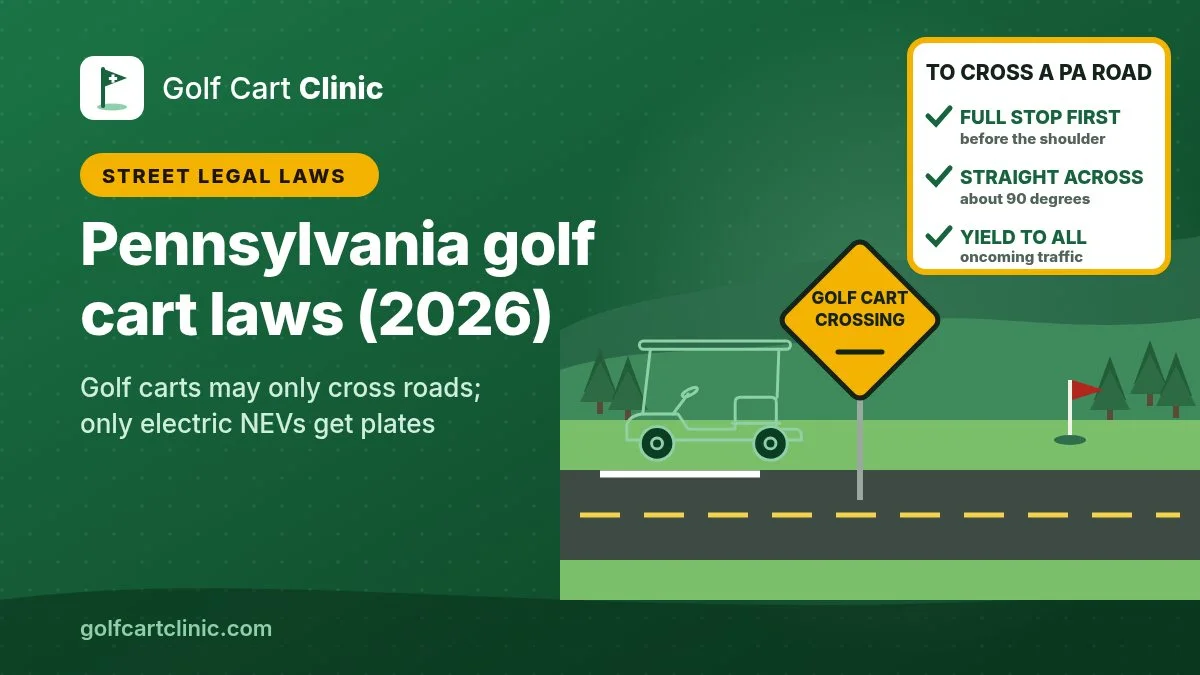
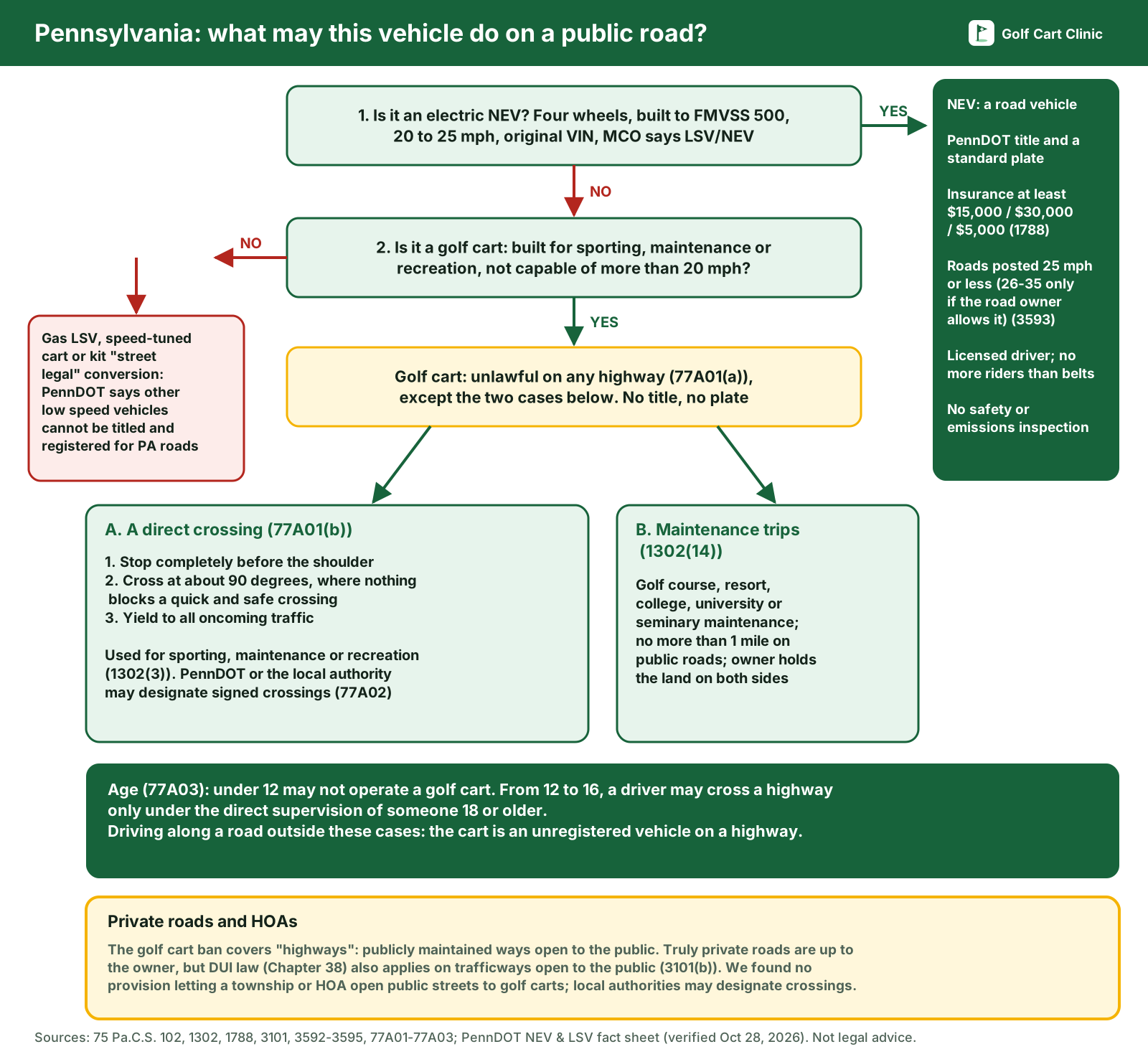
In Pennsylvania, a golf cart may not be driven along any public road. State law makes it "unlawful to operate a golf cart on any highway," with two narrow exceptions: a golf cart may make a direct crossing of a road (stop first, cross at about 90 degrees, yield to all traffic), and maintenance carts of a golf course, resort or campus may travel up to one mile of public road between their own land. No city, township or HOA can open streets to golf carts, and PennDOT won't title or plate one. The only small street vehicle Pennsylvania registers is a neighborhood electric vehicle (NEV): an electric, federally compliant low-speed vehicle, plated and insured, on roads posted 25 mph or less.
Not legal advice. Last verified: October 28, 2026. This guide summarizes the Pennsylvania Vehicle Code (75 Pa.C.S. Chapter 77A on golf carts, Subchapter F of Chapter 35 on neighborhood electric vehicles, and §§ 102, 1301, 1302, 1788, 3101, 4703 and 6502), PennDOT's NEV and LSV fact sheet and its 2018 bulletin on Act 57, and published township guidance. Your township or borough, and PennDOT for State routes, decide where official golf cart crossings are. Check with them, or ask local police, before you take a cart near a road.
Safety first. A road crossing is the most dangerous few seconds of any golf cart ride. A cart is low, slow to accelerate and hard to see, and it has no crash protection, no airbags and usually no doors. Stop fully before the shoulder, look both ways twice, and only go when there is a gap big enough to cross at a crawl. Never cross on a blind curve or hill crest, and cross with everyone seated, hands and feet inside. Pennsylvania doesn't let anyone under 12 drive a golf cart, and drivers from 12 to 16 may cross a road only under an adult's direct supervision. A cart trip that needs more than a straight-across crossing belongs on a trailer.
Pennsylvania golf cart, NEV and LSV rules at a glance
Pennsylvania splits small four-wheelers into three groups, and only one of them may use public roads as a vehicle:
| Rule | Golf cart | Neighborhood electric vehicle (NEV) | Other low-speed vehicles (gas LSVs and similar) |
|---|---|---|---|
| Legal definition | "A self-propelled motor vehicle designed and manufactured for the transportation of persons or equipment for sporting, maintenance or recreational purposes that is not capable of exceeding a speed of 20 miles per hour" (75 Pa.C.S. § 102) | "A four-wheeled electric vehicle that has a maximum design speed of not less than 20 miles per hour and of not more than 25 miles per hour" that complies with FMVSS 500 (§ 102) | Low-speed vehicles that aren't electric NEVs |
| Public roads | Not allowed, except a direct crossing or a short maintenance trip (§ 77A01) | Roads posted 25 mph or less; 26 to 35 mph only where PennDOT or the local authority allows it (§ 3593) | Not allowed: PennDOT says they "cannot be titled and registered for operation on PA roadways" |
| Title and plate | None; exempt from registration only while crossing or on a qualifying maintenance trip (§ 1302) | PennDOT title (body type NEV) and a standard passenger plate | None for road use |
| Insurance | Not required by the Vehicle Code | At least $15,000 / $30,000 bodily injury and $5,000 property damage (§ 1788) | Not applicable on roads |
| Driver | No one under 12; ages 12 to 16 may cross a highway only under direct supervision of someone 18 or older (§ 77A03) | Licensed driver, as for any passenger car (§ 3594, § 1501) | Not applicable on roads |
| Safety inspection | None | Exempt from safety and emissions inspection (§ 4703(b)(14)) | Not applicable |
How Pennsylvania defines a golf cart
Pennsylvania added a legal definition of "golf cart" with Act 57 of 2017 (SB 785), which took effect January 29, 2018. Under 75 Pa.C.S. § 102, a golf cart is "a self-propelled motor vehicle designed and manufactured for the transportation of persons or equipment for sporting, maintenance or recreational purposes that is not capable of exceeding a speed of 20 miles per hour."
Three things in that wording matter for owners:
- It's a "motor vehicle." That is why the general Vehicle Code rules on registration and highways reach it, and why Act 57 had to carve out the crossing exceptions.
- Gas or electric doesn't matter. The definition says "self-propelled," with no power source named.
- 20 mph is the ceiling. A cart tuned or geared to go faster no longer fits the definition. It doesn't become an NEV either (see below), so it falls into the group PennDOT won't register at all. If you are shopping for golf cart upgrades, speed kits have legal consequences in Pennsylvania.
Golf carts are also not ATVs: the Vehicle Code's ATV definition says the term "does not include ... golf carts" (§ 7702). DCNR's ATV FAQ adds that golf carts are not allowed on State Forest ATV trails, where "only registered, titled and insured ATVs" may ride (DCNR ATV FAQ).
Where can you drive a golf cart in Pennsylvania?
Off public roads: on your own land, on a golf course, and on private property where the owner allows it. On public roads, the rule in § 77A01(a) is short: "Except as described under section 1302(3) or (14) ... or otherwise provided under this chapter, it is unlawful to operate a golf cart on any highway." A "highway" is "every way publicly maintained when any part thereof is open to the use of the public for purposes of vehicular travel," and it expressly includes public roads on college, university, school and park grounds (§ 102).
That leaves exactly two ways onto a public road.
1. A direct crossing
Under § 77A01(b), "a golf cart may make a direct crossing of a highway" if:
- "The crossing is made at an angle of approximately 90 degrees to the direction of the highway and at a place where no obstruction prevents a quick and safe crossing";
- "The golf cart is brought to a complete stop before crossing the shoulder or main-traveled way of the highway"; and
- "The driver yields the right-of-way to all oncoming traffic."
The matching registration exemption covers "any self-propelled golf cart used for the transportation of persons or equipment for sporting, maintenance or recreational purpose while crossing certain public highways" (§ 1302(3)). Act 57 deleted the old wording that tied this exemption to persons "engaged in the game of golf" crossing "during any game of golf," so it now covers sporting, maintenance and recreational trips, not just golf. A crossing means straight across. Turning onto the road and driving along it, even for a few hundred feet, is not a crossing.
2. Short maintenance trips
§ 1302(14) exempts "any vehicle used for golf course maintenance, resort maintenance or college, university or seminary campus maintenance when such vehicle does not travel on public roads in excess of one mile and the property on both sides of the public road is owned by said golf course, resort or college, university or seminary." This is for grounds crews, not residents: the trip has to be maintenance work, one mile or less, with the same owner on both sides of the road.
Official golf cart crossings
Act 57 also lets road owners mark crossings. Under § 77A02(a), "the department on State-designated highways and a local authority on highways within the local authority's jurisdiction may designate a crossing within the jurisdiction as a golf cart crossing with official traffic-control devices." The notice must be "sufficiently and prominently displayed" (§ 77A02(b)), and the State and local governments can't be held liable for designating one (§ 77A02(d)).
Who pays is spelled out too: "If a golf cart crossing is beneficial to residents of a homeowners association, a private college or other private entity, the homeowners association, private college or other private entity shall be responsible for costs incurred by the department or political subdivision" (§ 77A02(c)). So if your community wants signs at the spot where residents cross a township road, expect the township to ask the HOA to pay for them.
Age and driver's license
§ 77A03 sets Pennsylvania's only golf cart age rule: "A person under 12 years of age may not operate a golf cart. A person between 12 and 16 years of age may not drive a golf cart across any highway unless the person is under the direct supervision of a person 18 years of age or older." The first sentence isn't limited to highways, so read it as applying wherever the Vehicle Code reaches, and as good practice everywhere.
The golf cart chapter doesn't set a license requirement for crossings, and its own age rule contemplates supervised 12 to 16 year olds crossing. Driving an NEV is different: an NEV is treated as a passenger car for title, registration and licensing (§ 3594), so the driver needs a valid driver's license like any car driver (§ 1501(a)).
Drinking and driving rules don't stop at the property line either. Chapter 38 (DUI) applies "upon highways and trafficways throughout this Commonwealth" (§ 3101(b)), and a trafficway includes any way "open to the public for purposes of vehicular travel as a matter of right or custom" (§ 102), which can include private community roads open to the public.
Registration, title and plates
Golf carts: no title and no plate. PennDOT's 2018 bulletin to its agents on Act 57 describes the law as setting "the guidelines for operation on highways, designation of golf cart crossings, liability information and establishes age restrictions," and the registration exemptions in § 1302(3) and (14) are the only reason a cart may touch a public road at all (PennDOT Bulletin 18-03C). Outside those cases, § 1301(a) applies: no one may drive "upon any highway any vehicle which is not registered in this Commonwealth unless the vehicle is exempt from registration."
NEVs: titled and registered. PennDOT's NEV and LSV fact sheet says "a NEV shall be considered a passenger vehicle for the purpose of titling and registration," the title uses the body type NEV, and "a standard issue registration plate is issued." PennDOT identifies an NEV from the ownership papers: the Manufacturer's Certificate of Origin "will list an indicator of LSV/NEV/ZEV in the series or model field or designate that the vehicle complies with the Federal Motor Vehicle Safety Standard (FMVSS)."
Other low-speed vehicles: not registrable for the road. The same fact sheet says: "Low speed vehicles do not meet PA equipment standards. This type of vehicle is not equipped as required by the Vehicle Code and the regulations of the Department to be operated on PA roadways. Consequently, these vehicles cannot be titled and registered for operation on PA roadways." PennDOT titles them with the Off Road Vehicle (ORV) body type instead. Because the NEV definition requires an electric vehicle, a gas-powered LSV that would be street legal in many states lands in this group in Pennsylvania.
Insurance
Pennsylvania's general insurance rule covers "every motor vehicle of the type required to be registered under this title which is operated or currently registered" (§ 1786(a)). A golf cart isn't registered, so the Vehicle Code doesn't require insurance for it. That doesn't mean you're covered: ask your homeowner's insurer whether your policy covers the cart when it crosses a road, and consider a separate golf cart policy.
An NEV "that is registered or operated on a highway shall be covered by financial responsibility in the amount of $15,000 for injury to one person in any one accident, in the amount of $30,000 for injury to two or more persons in any one accident and in the amount of $5,000 for damage of property of others in any one accident" (§ 1788(a)). Under § 1788(b), no one has to buy, and no insurer has to offer, the other coverages in the financial responsibility chapter for an NEV.
Required equipment
Golf carts: Pennsylvania sets no equipment list for golf carts, because they aren't allowed to drive on roads. Lights, mirrors or turn signals don't change that. They are still worth having on any cart that crosses a road at dusk, and if yours went dark after a battery swap, see golf cart lights not working after new batteries.
NEVs: under § 3592(a), an NEV on any highway or roadway must "comply with the equipment requirements and standards as set forth in 49 CFR § 571.500" (FMVSS 500: headlamps, turn signals, tail and stop lamps, reflex reflectors, mirrors, a parking brake, a windshield, a VIN and seat belts) and also have:
- "Brakes adequate to control the movement of and to stop such vehicle";
- "An odometer" and "a speedometer";
- "The original manufacturer's vehicle identification number die stamped upon the body or frame, or both, of the vehicle" or on the engine or motor;
- "A windshield wiper," "a horn" and "a battery charge indicator."
The NEV also needs the manufacturer's safety decal on the rear that reads "25 MPH Vehicle," at least 4 inches high by 10 inches long (§ 3592(c)). It may not carry more passengers than it has seat belts (§ 3595), and it is exempt from Pennsylvania's periodic safety inspection (§ 4703(b)(14)). When you buy a new NEV, you sign a waiver certifying you bought it "with full knowledge of the potentially hazardous characteristics of such vehicles" (§ 3596).
Where an NEV may drive
§ 3593 sets the road limits, in effect since May 1, 2015:
- Roads posted 25 mph or less. An NEV "may not be operated upon any highway or roadway" of PennDOT or a local authority "with a posted speed in excess of 25 miles per hour."
- 26 to 35 mph roads by permission only. The Secretary of Transportation may allow NEVs on State roads posted over 25 but not over 35 mph by an order published in the Pennsylvania Bulletin, and local authorities may do the same on their roads "by ordinance or resolution." Either may also ban NEVs on a road it finds hazardous.
- Crossings. An NEV may cross a road posted 35 mph or less, but if the road "is more than two lanes or is divided, such crossing shall only occur at a signalized intersection." A road posted over 35 mph may be crossed "only at a signalized intersection."
Violations of the NEV road and equipment rules are summary offenses under § 6502 (§ 3592(d), § 3593(e)).
Golf carts vs NEVs in Pennsylvania
The difference that matters most: a golf cart can only cross a road; an NEV can drive on one. And you can't turn the first into the second. To be titled as an NEV, PennDOT looks for a certificate of origin showing an LSV or NEV built to FMVSS 500, and § 3592 requires the original manufacturer's die-stamped VIN. A golf cart with an aftermarket "street legal" kit has neither, so adding lights, belts and a horn leaves it a golf cart, or, if it now goes faster than 20 mph, a low-speed vehicle PennDOT won't register.
Before you buy a cart sold as "street legal" for use in Pennsylvania, check:
- Is it electric? Gas LSVs can't be registered for Pennsylvania roads.
- Does the certificate of origin or out-of-state title say LSV or NEV, and does it carry a 17-character VIN from the original manufacturer?
- Does it have the FMVSS 500 equipment plus Pennsylvania's extras: odometer, speedometer, wiper, horn, battery charge indicator and the "25 MPH Vehicle" decal?
- Are the roads you need posted 25 mph or less, or has your township approved NEVs on 26 to 35 mph roads?
Not sure what you have? Our golf cart serial number lookup helps you identify the make, model and year.
Penalties
Chapter 77A has no penalty section of its own. Under § 6502(a), violating a Vehicle Code provision "for which another penalty is not provided" is a summary offense with "a fine of $25." A golf cart driven along a road outside the exemptions is also an unregistered vehicle, and § 1301(d) sets the fine for that at "$75 or double the registration fee, whichever is greater." Other offenses, such as DUI, carry their own, much heavier penalties.
Local rules: what townships and HOAs can do
Many states let towns or counties open streets to golf carts. Pennsylvania doesn't: we found no provision in the Vehicle Code letting a municipality authorize golf carts along its streets, and § 77A01 bans them on "any highway." Local power is limited to crossings and NEV speed limits:
| Who | What they can do | Source |
|---|---|---|
| PennDOT (State-designated highways) | Designate official golf cart crossings with traffic-control devices; by Secretary's order, allow NEVs on roads posted 26 to 35 mph or ban them on hazardous roads | § 77A02(a); § 3593(a) |
| Township, borough or city (local roads) | Designate official golf cart crossings; by ordinance or resolution, allow NEVs on roads posted 26 to 35 mph or ban them on hazardous roads | § 77A02(a); § 3593(b) |
| HOA, private college or other private entity | Can't designate crossings on public roads, but pays the government's costs when a crossing benefits its residents | § 77A02(c) |
| Owner of a truly private road | Sets its own rules; the highway ban doesn't reach roads that aren't publicly maintained, but DUI law applies on trafficways open to the public | § 102; § 3101(b) |
Two local examples show how this plays out. Findlay Township (Allegheny County) tells residents there are "no designated Golf Cart Crossings within Findlay Township" and that, outside the crossing and maintenance cases, "you can primarily drive your golf cart on private property" (Findlay Township, Golf Carts and Pennsylvania Law). In Guilford Township (Franklin County), the supervisors' March 19, 2026 minutes record the Penn National Community Association asking to proceed with buying and installing "golf cart crossing signs," with the township ordering them (Guilford Township minutes). If your community has a cart path that meets a public road, ask the township (or the PennDOT district office for a State route) whether the crossing is designated, and cross there.
Before your golf cart goes near a Pennsylvania road: a checklist
- You only need to cross the road, straight across, not drive along it.
- The trip is for sporting, maintenance or recreation, or it's a grounds crew trip of one mile or less between the owner's land.
- You'll stop completely before the shoulder, cross at about 90 degrees where nothing blocks the view, and yield to all oncoming traffic.
- Use the official golf cart crossing if your township or PennDOT has marked one.
- The driver is at least 12, and anyone 12 to 16 has an adult 18 or older directly supervising.
- The driver is sober, and everyone is seated.
- Your insurer has confirmed coverage for the cart off your property.
How Pennsylvania compares with nearby states
Pennsylvania is one of the strictest states in the region. New Jersey golf cart laws also keep golf carts off public roads and only let titled, insured LSVs drive. Maryland golf cart laws are looser: counties and towns can designate roads posted 30 mph or less for golf carts, between dawn and dusk. To the west, Ohio golf cart laws let local governments allow golf carts on their streets once a cart passes inspection and gets Ohio plates. For more states, browse our golf cart laws by state.
Frequently asked questions
Are golf carts street legal in Pennsylvania?
No. "It is unlawful to operate a golf cart on any highway" in Pennsylvania (75 Pa.C.S. § 77A01(a)). A golf cart may only make a direct crossing of a road, or travel up to one mile of public road on golf course, resort or campus maintenance between land the same owner holds on both sides (§ 1302(14)).
Can I register or get a license plate for my golf cart in Pennsylvania?
No. Golf carts are exempt from registration only while crossing a road or on a qualifying maintenance trip (§ 1302(3) and (14)), and there is no road registration for them. Only an electric NEV built to FMVSS 500 gets a PennDOT title and a standard plate.
Can I cross a road in a golf cart in Pennsylvania?
Yes, if you stop completely before the shoulder, cross at about 90 degrees at a place where nothing prevents a quick and safe crossing, and yield to all oncoming traffic (§ 77A01(b)). PennDOT and local authorities may also mark official golf cart crossings (§ 77A02).
How old do you have to be to drive a golf cart in Pennsylvania?
At least 12. "A person under 12 years of age may not operate a golf cart," and a driver between 12 and 16 may cross a highway only "under the direct supervision of a person 18 years of age or older" (§ 77A03).
Can my township or HOA allow golf carts on our streets?
Not on public streets. Pennsylvania law gives townships and PennDOT power to designate golf cart crossings, not routes, and an HOA has to pay the government's costs for a crossing that benefits its residents (§ 77A02). Roads that are truly private and not publicly maintained are up to their owner.
What roads can a neighborhood electric vehicle use in Pennsylvania?
Roads posted 25 mph or less. PennDOT (by Secretary's order) or a local authority (by ordinance or resolution) may allow NEVs on roads posted up to 35 mph. NEVs may cross 35 mph or slower roads, but multi-lane or divided roads and anything over 35 mph only at a traffic signal (§ 3593).
Can I make my golf cart street legal in Pennsylvania with a kit?
No. PennDOT titles an NEV from a certificate of origin showing an LSV or NEV built to federal FMVSS 500, and the law requires the original manufacturer's die-stamped VIN (§ 3592). A kit doesn't change a golf cart into an NEV, and PennDOT says other low-speed vehicles "cannot be titled and registered for operation on PA roadways."
Sources
- Pennsylvania Vehicle Code, golf carts: Chapter 77A, §§ 77A01 to 77A03 (highways, crossings, age), § 1302 (exemptions from registration), § 102 (definitions); enacted text: Act 57 of 2017 (SB 785), effective January 29, 2018
- Pennsylvania Vehicle Code, NEVs: § 3592 (equipment), § 3593 (roads and crossings), § 3594, § 3595, § 3596, § 1788 (insurance), § 4703 (inspection exemption)
- Pennsylvania Vehicle Code, general: § 1301 (registration), § 1501 (licensing), § 1786 (financial responsibility), § 3101 (highways and trafficways), § 6502 (summary offenses), § 7702 (ATV definition)
- PennDOT: Neighborhood Electric Vehicle (NEV) & Low Speed Vehicles (LSV) fact sheet (April 2025); Driver and Vehicle Services Update, Bulletin 18-03C (Act 57, February 2018)
- DCNR: ATV FAQ (State Forest ATV trails)
- 49 C.F.R. (federal): § 571.500 (FMVSS 500)
- Local: Findlay Township, Golf Carts and Pennsylvania Law; Guilford Township supervisors' minutes, March 19, 2026
Questions and comments
No comments yet. Corrections and notes from your own repair are welcome.