
Maryland Golf Cart Laws (2026): Designated Roads, Dawn to Dusk and LSV Rules
Since October 1, 2024, Maryland lets any county or town open its own roads to golf carts, but only roads it designates. On those roads a golf cart needs no registration, if the road is posted 30 mph or less (35 in Golden Beach Patuxent Knolls), it's daylight, the cart has the MVA's lights and reflectors, and the driver is licensed. Here is what Transportation Article § 21-104.2 and COMAR 11.13.13 say, why State highways and HOA roads are different, how LSVs are titled and limited to 30 mph roads, and what Baltimore, St. Mary's, Allegany and Queen Anne's counties have done.
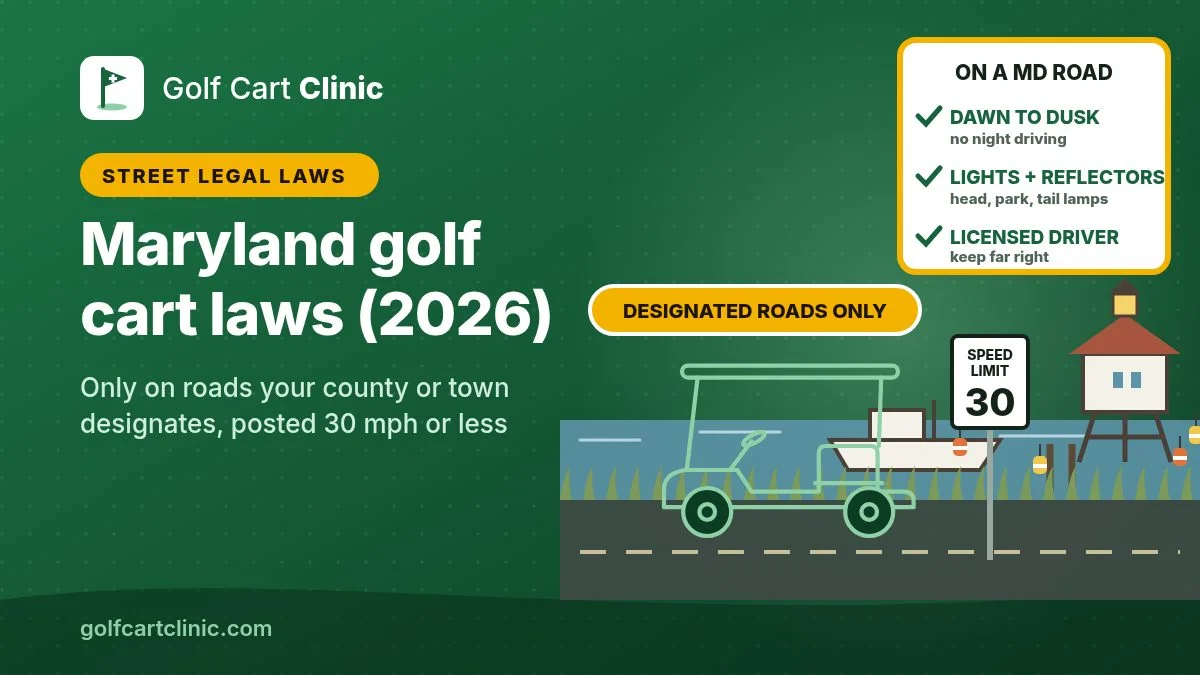
In Maryland, a golf cart may use a public road only where your county or town has designated that road for golf carts. On a designated county or municipal road, state law lets you drive an unregistered golf cart if the road is posted 30 mph or less (35 mph in Golden Beach Patuxent Knolls, St. Mary's County), only between dawn and dusk, with the lights and reflectors the MVA requires, as far to the right as feasible, and only if you hold a valid driver's license. Everywhere else, including State highways and any road your county or town hasn't designated, a golf cart stays off. A low-speed vehicle (LSV) is different: it is titled, registered and insured like a car, and may use roads posted 30 mph or less unless a local ordinance bans it.
Not legal advice. Last verified: October 27, 2026. This guide summarizes the Maryland Transportation Article (§ 21-104.2, § 13-402, § 25-102, § 11-130.1, § 21-1125 and related sections), the MVA's golf cart and low-speed vehicle regulations (COMAR 11.13.13 and 11.15.32), an MVA business bulletin, and a few counties' published actions. Maryland's golf cart law only works where a county or town has acted, so your county or town code and the road signs decide whether a given street is open. Check them, or ask local police, before you drive.
Safety first. A golf cart has no crash protection, no airbags and usually no doors, and on a public road you share the lane with pickups and school buses. Maryland's rule keeps carts to slow, posted roads in daylight for a reason: don't stretch it to dusk, and don't drive a cart whose headlamp, tail lamp or reflectors are missing or broken. Keep to the right as the law requires, let traffic pass, and pull over if a line builds behind you. Seat only as many people as the cart has seats, keep hands and feet inside, and never let anyone ride standing on the back or on a rear-facing seat without a grab bar. Children belong in a seat, held by an adult or a proper restraint, away from the edge. The driver needs a valid driver's license, so a cart is not a ride for kids to drive on the road. If a route needs even a short stretch of a faster or undesignated road, trailer the cart.
Maryland golf cart and LSV rules at a glance
Since October 1, 2024, Maryland has one statewide golf cart street rule that only switches on where local government designates roads. LSVs follow a separate, older set of rules. Here is how they compare:
| Rule | Golf cart | Low-speed vehicle (LSV) |
|---|---|---|
| Legal definition | Small four-wheeled gas or electric vehicle with seating for more than one, "a maximum capable speed of not more than 20 miles per hour," a windshield and a steering wheel (COMAR 11.13.13.02) | "A four-wheeled motor vehicle that has a maximum speed capability that exceeds 20 miles per hour but is less than 25 miles per hour" (Transp. § 11-130.1) |
| Which roads | Only county or municipal roads that the county or town has designated (Transp. § 21-104.2(b)) | Any road posted 30 mph or less, except signed controlled access highways and roads where a county or town bans LSVs (Transp. § 21-1125) |
| Posted speed limit | 30 mph or less; 35 mph in Golden Beach Patuxent Knolls, St. Mary's County | 30 mph or less |
| Crossing a road | No statewide crossing rule; in Allegany County, the county may designate golf course crossings of county highways | May not cross a road posted over 45 mph except at a traffic signal or an intersection with a stop sign on every approach |
| Time of day | Between dawn and dusk only | No time limit in the statute |
| Title, registration, plates | None; the MVA says a golf cart "cannot be titled or registered" | Required; the MVA titles and registers LSVs as Class R (COMAR 11.15.32.06) |
| Insurance | Not required by the golf cart statute | Required before registration; Maryland minimums are $30,000/$60,000 bodily injury and $15,000 property damage |
| Driver | Valid driver's license | Valid driver's license |
| Equipment | Headlamp, amber or yellow park lamp, red tail lamp, red rear and amber front and side reflectors (COMAR 11.13.13.03) | Federal FMVSS 500 equipment plus an odometer (COMAR 11.15.32.05) |
How Maryland defines a golf cart and an LSV
Maryland's statutes use the term "golf cart" without defining it. The definition is in the MVA's golf cart regulation, which took effect January 20, 2025. Under COMAR 11.13.13.02, a golf cart "means a small, four-wheeled vehicle powered by a gasoline or electric motor with: (a) Seating designed to carry more than one occupant; (b) A maximum capable speed of not more than 20 miles per hour; (c) A windshield; and (d) A steering wheel." It does not include a motor vehicle, a low-speed vehicle, an off-highway recreational vehicle, or anything "capable of being registered as any other vehicle classification."
A low-speed vehicle is a motor vehicle in Maryland (Transp. § 11-135(a)(2)), defined as "a four-wheeled motor vehicle that has a maximum speed capability that exceeds 20 miles per hour but is less than 25 miles per hour" (§ 11-130.1). The MVA's LSV chapter applies to "vehicles originally manufactured as low speed vehicles" (COMAR 11.15.32.01).
Two practical points follow:
- Gas or electric doesn't matter for a golf cart. Both fit the COMAR definition, and both may use designated roads on the same terms.
- Speed upgrades can take a cart out of the golf cart rules. The golf cart definition stops at 20 mph. A cart tuned to run faster no longer fits it, and the MVA's LSV rules cover only vehicles originally manufactured as LSVs, so a modified cart can end up fitting neither category. If you are looking at golf cart upgrades, keep that in mind before you drive on a designated road.
Where can you drive a golf cart in Maryland?
Maryland requires every motor vehicle driven on a highway to be registered (Transp. § 13-402(a)), and a golf cart can't be registered. Two exemptions let a golf cart onto public roads anyway:
- Designated county and town roads, statewide. § 13-402(c)(11) exempts "a golf cart that is operated on a highway in accordance with § 21-104.2." That section covers "a county or municipal highway," and its subsection (b) says "the governing body of a county or municipality may designate the county or municipal highways under their respective jurisdictions" for golf carts. No designation, no golf cart.
- Allegany County golf course crossings. § 13-402(c)(12) exempts a golf cart operated on an Allegany County highway as allowed by the county under § 25-102(a)(16), which lets the county designate "crossings on county highways where a person operating a golf cart may cross the highway for continued access to any portion of a golf course."
What that leaves out:
- State highways. § 21-104.2 covers only county and municipal highways. We found no provision that lets a golf cart drive along a State highway, so numbered State routes are off limits even if a nearby county road is designated.
- Undesignated roads. A low speed limit alone isn't enough. The road has to be designated by the county or town that owns it.
- Public roads inside private communities. If the roads in your neighborhood are dedicated county roads, the homeowners association can't open them to carts. Queen Anne's County's administrator made exactly this point in a September 8, 2026 action item about Prospect Bay, a golf course community in Grasonville: its roads "are dedicated County roads. As a result, the HOA does not have the legal authority to independently authorize golf cart operation on those roads" (Queen Anne's County action item).
Truly private roads, golf courses and private property are up to the owner. State registration rules apply to highways.
Speed limits and time of day
On a designated road, § 21-104.2(a)(1) says you may operate the golf cart only:
- "On a highway on which the maximum posted speed limit does not exceed" 30 miles per hour, or 35 miles per hour "in Golden Beach Patuxent Knolls, St. Mary's County";
- "Between dawn and dusk"; and
- "If the golf cart is equipped with lighting devices as required by the Administration."
And under § 21-104.2(a)(2), you "shall keep the golf cart as far to the right of the roadway as feasible." There is no nighttime option: even with full lights, a golf cart may not use a public road between dusk and dawn. That is a change for Smith Island, where the old law allowed carts after dusk if they had lights. The 2024 law's fiscal note says that under the new law, "the operation of a golf cart on Smith Island between dusk and dawn is prohibited" (HB 43 fiscal and policy note).
The statute doesn't set a top speed for the cart itself, but the COMAR definition already limits a golf cart to a maximum capable speed of 20 mph.
Driver's license and age
A golf cart driver on a public road "shall possess a valid driver's license" (§ 21-104.2(a)(3)). Maryland issues a learner's instructional permit at 15 years and 9 months at the earliest, a provisional license at 16 years and 6 months, and a full license at 18 (Transp. § 16-103(c)). The golf cart statute doesn't say whether a learner's permit counts, and we found no MVA guidance on it, so ask your local police before a permit holder drives a cart on a road. Off public roads, on private property or a course, the statute doesn't apply, but the owner's rules and common sense do.
LSV drivers need a valid driver's license too, and an LSV "may not be used for skills testing to obtain a driver license" (COMAR 11.15.32.10).
Registration, title and plates
Golf carts: none, and none available. An MVA business bulletin to dealers and title services states: "A golf cart is not considered a low-speed vehicle and cannot be titled or registered" (MVA bulletin, December 6, 2023). The exemption in § 13-402(c)(11) is what makes an unregistered cart legal on a designated road. Some counties may still add their own permit or sticker; check your local ordinance.
LSVs: required. Under COMAR 11.15.32.07, the owner must apply for a certificate of title, register the vehicle "in order to operate a low speed vehicle on Maryland highways," show proof of insurance before registration, pay the title and registration fees, and "upon transfer of ownership, produce an inspection certificate issued by an authorized Maryland Vehicle Inspection Station, that the vehicle passed a safety standards inspection, before subsequent registration." The same MVA bulletin says that "when the Certificate of Origin specifies low speed vehicle (LSV), it is required to be titled as a low-speed vehicle."
Insurance
The golf cart statute doesn't require insurance, and because a golf cart isn't registered, Maryland's vehicle insurance rule, which applies to vehicles "required to be registered," doesn't reach it (Transp. § 17-104(b)). That doesn't mean you're covered. A homeowner's policy may not cover a cart on a public road, so ask your insurer about golf cart liability coverage before you drive one on a designated road.
An LSV must be insured before the MVA will register it (COMAR 11.15.32.07C). Maryland's minimum liability coverage is $30,000 for one person and $60,000 for two or more people for bodily injury, and $15,000 for property damage (Transp. § 17-103(b)).
Required equipment on a golf cart
The "lighting devices as required by the Administration" are spelled out in COMAR 11.13.13.03. To operate on a designated road, a golf cart "shall be equipped with":
- "Red reflectors at the rear of the vehicle, and yellow or amber reflectors to the front and sides of the vehicle";
- "At least one red tail lamp to illuminate the rear of the vehicle, and to indicate the direction of travel";
- "At least one amber or yellow park lamp to illuminate the front of the vehicle, and to indicate the direction of travel"; and
- "At least one white projecting beam lamp (head lamp) mounted so that the lamp does not adversely affect the vision of the operators of other vehicles."
Other DOT automotive lighting "may be installed on the golf cart, but is not required." Off-road lighting, "including spotlights, floodlights, and other lights that are not intended for vehicle on road use, may not be operated while the golf cart is being operated on designated highways, including road shoulders." So a light bar can stay on the cart, but it has to stay off on the road.
The state list stops there: it doesn't require turn signals, mirrors, seat belts or a horn. Those are still worth having, and a county ordinance can ask for more. If your lights quit after a battery swap, our guide to golf cart lights not working after new batteries walks through the fixes.
Required equipment on an LSV
An LSV and its equipment "shall meet the safety standards requirements of 49 CFR §571.500" (FMVSS 500) and the state equipment rules in COMAR 11.14.09. That federal list includes headlamps, front and rear turn signals, tail lamps, stop lamps, red reflex reflectors, mirrors, a parking brake, a windshield, a VIN and a seat belt at each seat. Maryland adds that "all low speed vehicles shall be equipped with an odometer," and doesn't require exhaust, emissions or fuel systems (COMAR 11.15.32.05).
Dealers have to give LSV buyers a signed disclosure that the vehicle "may not be operated on a public highway with a speed limit in excess of 30 miles per hour" and "may subject the driver to citations for impeding traffic," and fix a 3 by 5 inch decal with that statement under the roof near the windshield on the driver's side (COMAR 11.15.32.08 and .09).
Golf carts vs LSVs in Maryland
The difference that matters most: a golf cart needs a local designation, an LSV needs paperwork. A golf cart can only use roads a county or town has opened to it, in daylight. An LSV can use any road posted 30 mph or less, day or night, unless the road is a signed controlled access highway or a county or town has banned LSVs there (§ 21-1125; local power at § 25-102(a)(17)). In return, the LSV carries a title, registration, plates, insurance and full FMVSS 500 equipment.
Before you buy a cart sold as "street legal" in Maryland, check:
- Does it have a 17-character VIN and a certificate of origin or title that says low-speed vehicle? Without that, the MVA treats it as a golf cart.
- Was it originally manufactured as an LSV? Lights and belts added to a golf cart don't change what it is.
- Does it have the Maryland LSV disclosure decal under the roof, an odometer, and the federal equipment?
- If it's used, has it passed a Maryland safety inspection for the new owner's registration?
If you only have a golf cart, it's still legal on designated roads, on the golf cart terms above. Our golf cart serial number lookup helps you confirm the model and year.
Penalties
The golf cart section doesn't set its own fine. Under Transp. § 27-101, a violation of the Maryland Vehicle Law is a misdemeanor and, "except as otherwise provided," carries "a fine not exceeding $500." Counties may add their own penalties in their ordinances.
Local rules: where Maryland counties stand
Before October 1, 2024, Maryland allowed golf carts on roads only in a short list of places named in state law. Chapters 491 and 492 of 2024 (SB 316 and HB 43) replaced those with today's statewide local option. According to the fiscal and policy note, the new authorization "replaces similar authorizations that only apply in certain jurisdictions (Smith Island, the community of Golden Beach Patuxent Knolls in St. Mary's County, the Town of Vienna in Dorchester County, Hoopers Island or Taylors Island, and the City of Crisfield in Somerset County)." Since then, counties have taken different paths:
| County | Golf cart rule | Source |
|---|---|---|
| Baltimore County | Pilot program: the County Council may authorize by resolution designated county roads, one councilmanic district per resolution; roads posted 30 mph or less with golf cart signs; dawn to dusk; lights; valid license. The act "shall expire on December 31, 2026" | Bill 104-24, County Code § 18-2-609 (enacted Dec. 17, 2024; effective Dec. 31, 2024) |
| St. Mary's County | Golden Beach Patuxent Knolls county roads designated by ordinance (35 mph limit allowed there by state law); the 2017 ordinance was repealed and replaced in May 2025, adding Old Horse Landing Road in Mechanicsville | 2017 hearing notice (road list); Southern Maryland Chronicle, May 14, 2025 |
| Allegany County | May designate crossings of county highways for golf carts to reach other parts of a golf course | Transp. § 25-102(a)(16) |
| Queen Anne's County | No ordinance yet. On September 8, 2026, commissioners were asked to form a Golf Cart Usage Committee after requests from Prospect Bay | County action item |
If you live on Smith Island, Hoopers Island, Taylors Island, in Vienna or in Crisfield, the special state laws you may remember are gone; the statewide rules now apply, including dawn to dusk only. Whether your streets are still open depends on what your county or town has designated. Baltimore County's pilot is set to expire at the end of 2026 unless the council extends it, so check the current county code. Wherever you are, look up the county or town's vehicles and traffic chapter, watch for golf cart signs, and call the sheriff's office or local police if you're not sure.
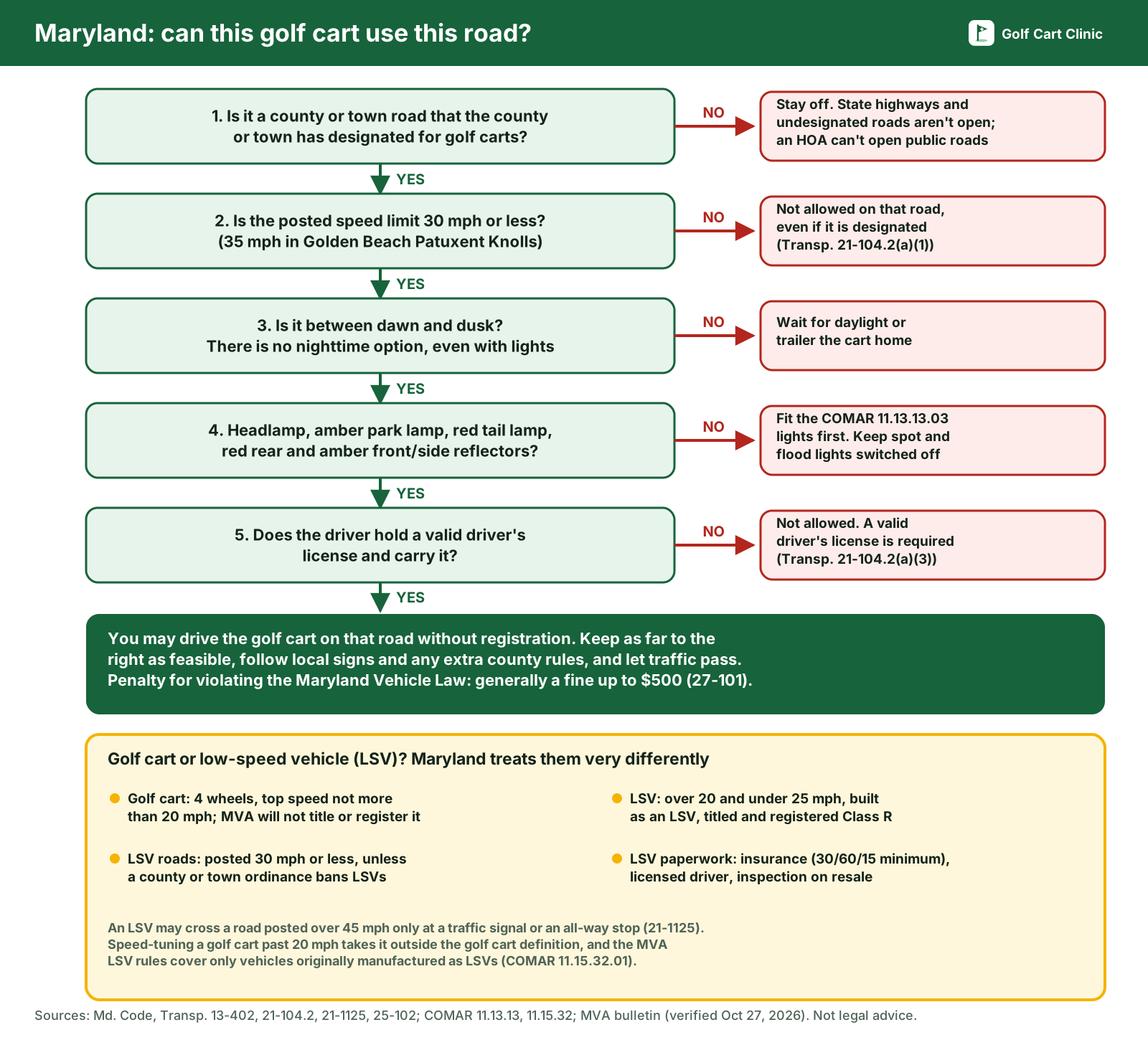
Before you drive a golf cart on a Maryland road: a checklist
- Your county or town has designated the road for golf carts, and you can point to the ordinance, resolution or sign.
- The road is a county or town road, not a State highway, and it's posted 30 mph or less (35 mph in Golden Beach Patuxent Knolls).
- It's daylight: after dawn and before dusk.
- The cart has a working headlamp, amber park lamp, red tail lamp, red rear reflectors and amber front and side reflectors, and the light bar is off.
- The driver has a valid driver's license on them and is sober.
- You'll keep as far right as feasible and let traffic by.
- Everyone is seated, with no more riders than seats.
- Your insurer has confirmed you're covered on public roads.
How Maryland compares with nearby states
Maryland now sits between its neighbors. Delaware golf cart laws keep plain golf carts off public roads and only allow registered LSVs, and New Jersey golf cart laws are just as strict. Virginia golf cart laws work most like Maryland's: localities designate streets by ordinance, but there the cap is 25 mph roads rather than 30. For more states, browse our golf cart laws by state.
Frequently asked questions
Are golf carts street legal in Maryland?
Only on county or town roads that the county or town has designated for golf carts, posted 30 mph or less (35 mph in Golden Beach Patuxent Knolls), between dawn and dusk, with MVA-required lights and reflectors, and with a licensed driver keeping as far right as feasible (Transp. § 21-104.2). Everywhere else, no.
Can I register my golf cart in Maryland?
No. The MVA says a golf cart "is not considered a low-speed vehicle and cannot be titled or registered." On designated roads, you don't need to register it: § 13-402(c)(11) exempts golf carts operated under § 21-104.2.
Can I drive a golf cart at night in Maryland?
Not on a public road. § 21-104.2 allows golf carts only "between dawn and dusk," even if the cart has full lights. That now includes Smith Island, where the old law allowed carts after dusk.
Do you need a driver's license to drive a golf cart on Maryland roads?
Yes. The driver "shall possess a valid driver's license" (§ 21-104.2(a)(3)). Maryland issues provisional licenses starting at 16 years and 6 months.
Can golf carts cross or use State highways in Maryland?
The golf cart law covers county and municipal highways only, and we found no provision allowing carts along State highways. Maryland law doesn't set a general rule for golf carts crossing them; the only crossing provision we found lets Allegany County designate golf course crossings of county highways. Ask your county before crossing any State route.
What roads can an LSV use in Maryland?
Roads posted 30 mph or less, except signed expressways and controlled access highways and roads where a county or town ordinance bans LSVs. An LSV may cross a road posted over 45 mph only at a traffic signal or an intersection with a stop sign at each approach (Transp. § 21-1125).
Can my HOA allow golf carts on our neighborhood roads?
Only if the roads are private. If they are dedicated county roads, only the county can designate them, as Queen Anne's County noted about Prospect Bay in 2026.
Sources
- Maryland Transportation Article, golf carts: § 21-104.2 (designated roads, speed, dawn to dusk, lights, license), § 13-402 (registration and exemptions), § 25-102 (local powers, Allegany crossings, LSV restrictions); enacted text: Chapter 492 of 2024 (HB 43), effective October 1, 2024, and its fiscal and policy note
- Maryland Transportation Article, LSVs and general rules: § 11-130.1 (LSV definition), § 11-135 (motor vehicle), § 21-1125 (LSV road limits), § 16-103 (license ages), § 17-103 and § 17-104 (insurance), § 27-101 (penalties)
- Code of Maryland Regulations: COMAR 11.13.13 (golf carts, effective January 20, 2025), COMAR 11.15.32 (low speed vehicles)
- MDOT Motor Vehicle Administration: Titling and Registrations of Golf Carts, ATV's, UTV's and Off-Road Vehicles (business bulletin, December 6, 2023)
- 49 C.F.R. (federal): § 571.500 (FMVSS 500)
- Local: Baltimore County Bill 104-24; St. Mary's County golf cart hearing notice (2017); Southern Maryland Chronicle, May 14, 2025; Queen Anne's County action item, September 8, 2026
Questions and comments
No comments yet. Corrections and notes from your own repair are welcome.