
Illinois Golf Cart Laws (2026): Local Ordinances, 35 MPH Streets and LSVs
In Illinois a golf cart is a "non-highway vehicle": banned from every public street unless the city, village, township or county that controls it passes an ordinance allowing it, and even then only on streets posted 35 mph or less. Here is what 625 ILCS 5/11-1426.1 requires (a licensed driver, liability insurance, lights, turn signals, reflectors and a slow-moving vehicle emblem), how local permits work, and why titled LSVs may use any street posted 30 mph or less.
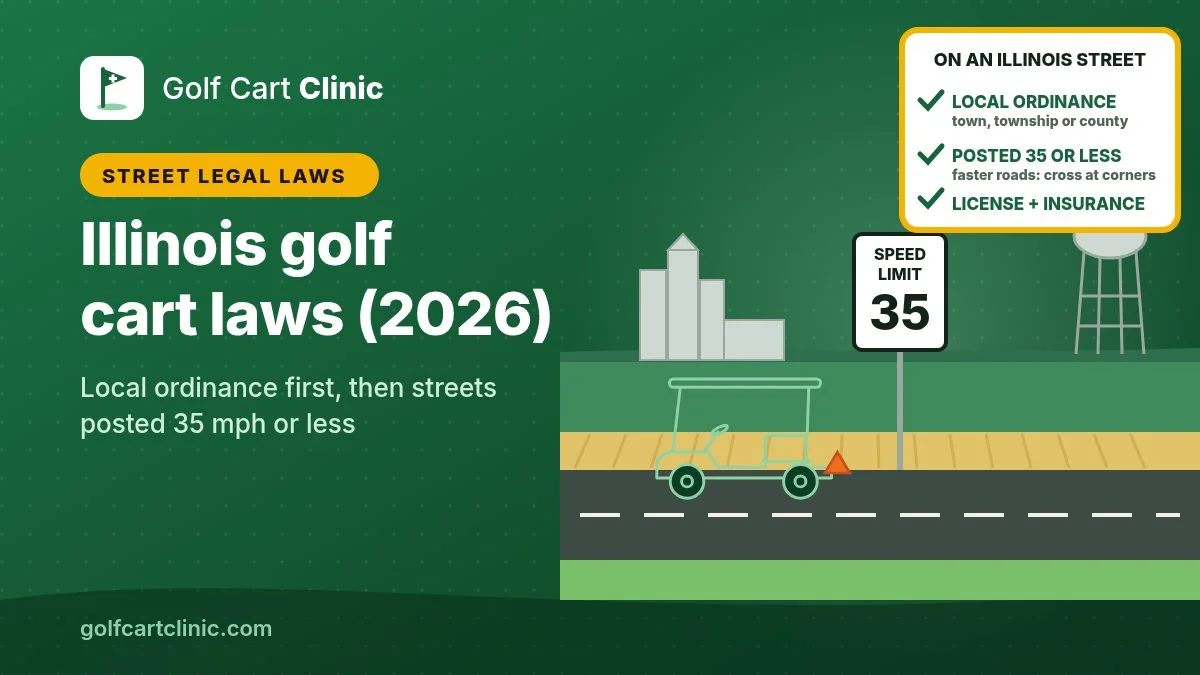
In Illinois, a golf cart may not be driven on any public street unless the local government that controls that street has passed an ordinance or resolution allowing it. Where a town, township or county (or IDOT, for its roads) has opted in and posted signs, a golf cart may use streets posted 35 mph or less, with a licensed driver, liability insurance and the state's minimum equipment: lights, turn signals, brake lights, mirror, reflectors and an orange slow-moving vehicle emblem. Golf carts get no state title or plate. Factory-built low-speed vehicles (LSVs) are different: titled and plated, they may use any street posted 30 mph or less unless a local government bans them.
Not legal advice. Last verified: October 28, 2026. This guide summarizes the Illinois Vehicle Code (625 ILCS 5/11-1426.1 on non-highway vehicles, 5/11-1426.2 on low-speed vehicles, and the definitions, title, fee, insurance and licensing sections linked below), the Secretary of State's low-speed vehicle affirmation form, and published village ordinances. Whether golf carts may use your street is decided by your city, village, township or county. Check its ordinance, or ask the local police department, before you drive a cart on a public road.
Safety first. A golf cart on an Illinois street shares the road with cars, pickups and farm traffic, and it has no crash protection, no airbags and usually no doors. Illinois requires headlights, tail lamps, brake lights, turn signals and a slow-moving vehicle emblem for a reason: drivers behind you need to see that you are slow. Keep everyone seated with hands and feet inside, belt in children wherever the cart has belts, and never cross a busy road anywhere but an intersection. Illinois only lets licensed drivers take a cart on the road, so a child or young teen may not drive one there, even in a golf cart town. If the trip needs a road posted over 35 mph, put the cart on a trailer.
Illinois golf cart and LSV rules at a glance
Illinois law puts golf carts and low-speed vehicles in two separate sections of the Vehicle Code, with very different starting points:
| Rule | Golf cart (a "non-highway vehicle") | Low-speed vehicle (LSV) |
|---|---|---|
| Legal definition | "A vehicle specifically designed and intended for the purposes of transporting one or more persons and their golf clubs or maintenance equipment" for golf or golf course grounds work (625 ILCS 5/1-123.9) | "Any 4-wheeled vehicle with a maximum speed greater than 20 miles per hour but not greater than 25 miles per hour" that meets federal standard FMVSS 500 (5/1-140.7) |
| Starting rule for public streets | Unlawful on any street, highway or roadway, unless the local government (or IDOT) authorizes it (5/11-1426.1(b), (d)) | Lawful on any street posted 30 mph or less, unless IDOT or the local government prohibits it (5/11-1426.2(a), (c)) |
| Highest posted speed limit | 35 mph, and only where authorized | 30 mph statewide; up to 35 mph where a local ordinance allows it (11-1426.2(e-5)) |
| Crossing faster roads | At an intersection only; never a tollroad, interstate or controlled-access highway (11-1426.1(b), (c)) | At an intersection if the road is posted 45 mph or less; faster roads only at a traffic light or 4-way stop (11-1426.2(b)) |
| Title and plates | No state title or registration; many towns issue their own permit sticker | Title ($30) and registration ($18 a year) with the Secretary of State (5/3-821, 5/3-805.5) |
| Driver | Valid driver's license (11-1426.1(b-5)) | Valid driver's license (11-1426.2(g)) |
| Insurance | Mandatory liability insurance applies on the road (11-1426.1(g)) | Mandatory liability insurance applies (11-1426.2(i)) |
How Illinois defines a golf cart
Under 625 ILCS 5/1-123.9, a golf cart is "a vehicle specifically designed and intended for the purposes of transporting one or more persons and their golf clubs or maintenance equipment while engaged in the playing of golf, supervising the play of golf, or maintaining the condition of the grounds on a public or private golf course."
The street rules don't treat golf carts on their own. Section 11-1426.1(a) groups them as "non-highway vehicles," meaning motor vehicles "not specifically designed to be used on a public highway," together with all-terrain vehicles, off-highway motorcycles and recreational off-highway vehicles (side-by-sides and UTVs). That is why most Illinois town ordinances talk about "non-highway vehicles" rather than golf carts, and why a town may allow golf carts but ban ATVs: the statute lets a local government "restrict the types of non-highway vehicles that are authorized to be used on its streets" (11-1426.1(d)).
Two practical points for owners:
- Gas or electric doesn't matter. The definition turns on what the vehicle was designed for, not its power source.
- Speed doesn't make it an LSV. The golf cart definition names no top speed, but the LSV definition requires both a 20 to 25 mph top speed and compliance with FMVSS 500. A cart tuned past 20 mph is still a non-highway vehicle in Illinois. If you're shopping for golf cart upgrades, a speed kit won't open any more streets to you, and many local ordinances cap cart speed lower.
Where can you drive a golf cart in Illinois?
Off public roads: on your own land, on a golf course, and on private property where the owner allows it. On public roads, 11-1426.1(b) starts with a ban: "Except as otherwise provided in this Section, it is unlawful for any person to drive or operate a non-highway vehicle upon any street, highway, or roadway in this State."
Local opt-in is the only way onto the street
The exception is in subsection (d): "A municipality, township, county, or other unit of local government may authorize, by ordinance or resolution, the operation of non-highway vehicles on roadways under its jurisdiction if the unit of local government determines that the public safety will not be jeopardized." The Illinois Department of Transportation (IDOT) has the same power over its own roads. Before opting in, the government "must consider the volume, speed, and character of traffic on the roadway," and once it does, "appropriate signs shall be posted."
Two details catch owners out:
- Each road belongs to someone. Your village's ordinance covers village streets. A county highway or a State route through town is controlled by the county or IDOT, and the village can't open it for you.
- Shared roads need everyone's yes. "If a roadway is under the jurisdiction of more than one unit of government, non-highway vehicles may not be operated on the roadway unless each unit of government agrees and takes action" (11-1426.1(d)).
Streets posted 35 mph or less
Even where a local government has opted in, "the non-highway vehicle may be operated only on streets where the posted speed limit is 35 miles per hour or less" (11-1426.1(b)). A town can't authorize golf carts on a 40 or 45 mph road.
Crossing faster roads and State highways
The 35 mph limit "does not prohibit a non-highway vehicle from crossing a road or street at an intersection where the road or street has a posted speed limit of more than 35 miles per hour" (11-1426.1(b)). Two hard limits apply under subsection (c):
- No direct crossing "upon or across any tollroad, interstate highway, or controlled access highway in this State."
- No direct crossing of "any other highway under the jurisdiction of the State except at an intersection of the highway with another public street, road, or highway."
So you may cross a faster road at a corner, but not mid-block from a driveway or a cart path.
The farm exception doesn't cover golf carts
Subsection (h) lets ATVs and recreational off-highway vehicles use county and township roads for farming operations without a local ordinance. It applies only to the vehicles in "paragraphs (1) and (4)" of the definition, which are ATVs and recreational off-highway vehicles. Golf carts (paragraph 2) are not included.
Speed limits
Illinois law sets no top speed for a golf cart itself. The state limit is on the road: posted 35 mph or less (11-1426.1(b)). Local ordinances often add a cart speed cap. Lakewood, for example, allows golf carts on village streets "at speeds of 20 miles per hour or less" (Lakewood Village Code 15.16).
Age and driver's license
"A person may not operate a non-highway vehicle upon any street, highway, or roadway in this State unless he or she has a valid driver's license issued in his or her name by the Secretary of State or by a foreign jurisdiction" (11-1426.1(b-5)). The state sets no separate golf cart age, but the license requirement does the work: Illinois issues no driver's license to an applicant under 18 unless they are at least 16 and have held an instruction permit for at least 9 months (625 ILCS 5/6-107).
Towns can set a higher age. Lakewood limits street driving to "drivers eighteen (18) years of age and older properly licensed to operate motor vehicles," and Wayne City requires a valid Illinois driver's license and an age of "16 years of age or older" (Wayne City Ordinance 580).
Registration, title and plates
Illinois has no state title or registration for golf carts. The Secretary of State's title fee schedule lists low-speed vehicles, ATVs and off-highway motorcycles, but no golf cart class (625 ILCS 5/3-821). What many towns do instead is run their own permit program, usually a registration with the police department, a safety inspection and a sticker or plate for the cart. Those permits are only good in the town that issued them.
LSVs go through the state. "Every owner of a low-speed vehicle which may be operated upon a highway shall secure a certificate of title and display valid registration" (11-1426.2(l)). The title fee is $30 (3-821) and registration is "at the annual fee of $18" (3-805.5). The Secretary of State's Affirmation for Low-Speed Vehicle (form VSD 796) has the owner affirm that the vehicle "meets Federal Motor Vehicle Safety Standard No. 500" and acknowledge where it may be driven. It goes in with the Application for Vehicle Transaction (VSD 190), the tax forms and the fees.
Before you buy a used cart or apply for anything, use our golf cart serial number lookup to confirm the make, model and year. A golf cart serial number is not a 17-character VIN, and an LSV needs "a vehicle identification number" (11-1426.2(f)).
Insurance
"Any person who operates a non-highway vehicle on a street, highway, or roadway shall be subject to the mandatory insurance requirements under Article VI of Chapter 7 of this Code" (11-1426.1(g)). That law requires a liability policy "in amounts no less than the minimum amounts" in Section 7-203 (625 ILCS 5/7-601): $25,000 for injury or death of one person, $50,000 for two or more, and $20,000 for property damage (5/7-203). LSV owners are covered by the same mandatory insurance law (11-1426.2(i)).
A homeowner's policy may not cover a cart on a public street. Ask your insurer for a golf cart or non-highway vehicle policy, and keep proof in the cart: town permit programs usually ask for it. Wayne City, for example, requires proof of liability insurance at the application and in the vehicle "at all times while the vehicle is operated on the roadways."
Required equipment
"No non-highway vehicle may be operated on a roadway unless, at a minimum, it has the following" (11-1426.1(e)):
| Required item | State minimum | What to check on a typical golf cart |
|---|---|---|
| Brakes, steering, tires | "brakes, a steering apparatus, tires" | Brakes that hold on a hill, no loose steering, tires with tread and the right pressure |
| Rearview mirror | "a rearview mirror" | Most carts need one added; a wide interior mirror is common |
| Reflectors | "red reflectorized warning devices in the front and rear" | Note the law says red, front and rear |
| Slow-moving vehicle emblem | "a slow moving emblem (as required of other vehicles in Section 12-709 of this Code) on the rear" | The orange and red triangle used on farm equipment, mounted on the back |
| Headlight | "a headlight that emits a white light visible from a distance of 500 feet to the front" | Factory or kit LED headlights |
| Tail lamp | "a tail lamp that emits a red light visible from at least 100 feet from the rear" | Red rear lamps that work with the headlights |
| Brake lights and turn signals | "brake lights, and turn signals" | Usually part of a street kit with a brake switch and signal stalk |
"When operated on a roadway, a non-highway vehicle shall have its headlight and tail lamps lighted as required by Section 12-201 of this Code" (11-1426.1(e)), which requires lights from sunset to sunrise and when weather or poor light makes vehicles hard to see (5/12-201). If your lights quit after a battery swap, see golf cart lights not working after new batteries.
Towns can add equipment. Lakewood also requires a horn and "seat belts for all passenger seats" and wants headlights and tail lamps on "at all times" on the road. Wayne City requires a windshield unless the driver and each passenger wear eye protection, and bans LED light bars.
Pending, not law: House Bill 4085 would remove the front red reflector and rear slow-moving emblem requirements. It passed the House 101 to 2 on April 9, 2026 and was referred to the Senate Assignments Committee on April 16, 2026, with no further action as of October 28, 2026 (HB 4085 bill status). Until it becomes law, keep both on the cart.
Golf carts vs LSVs in Illinois
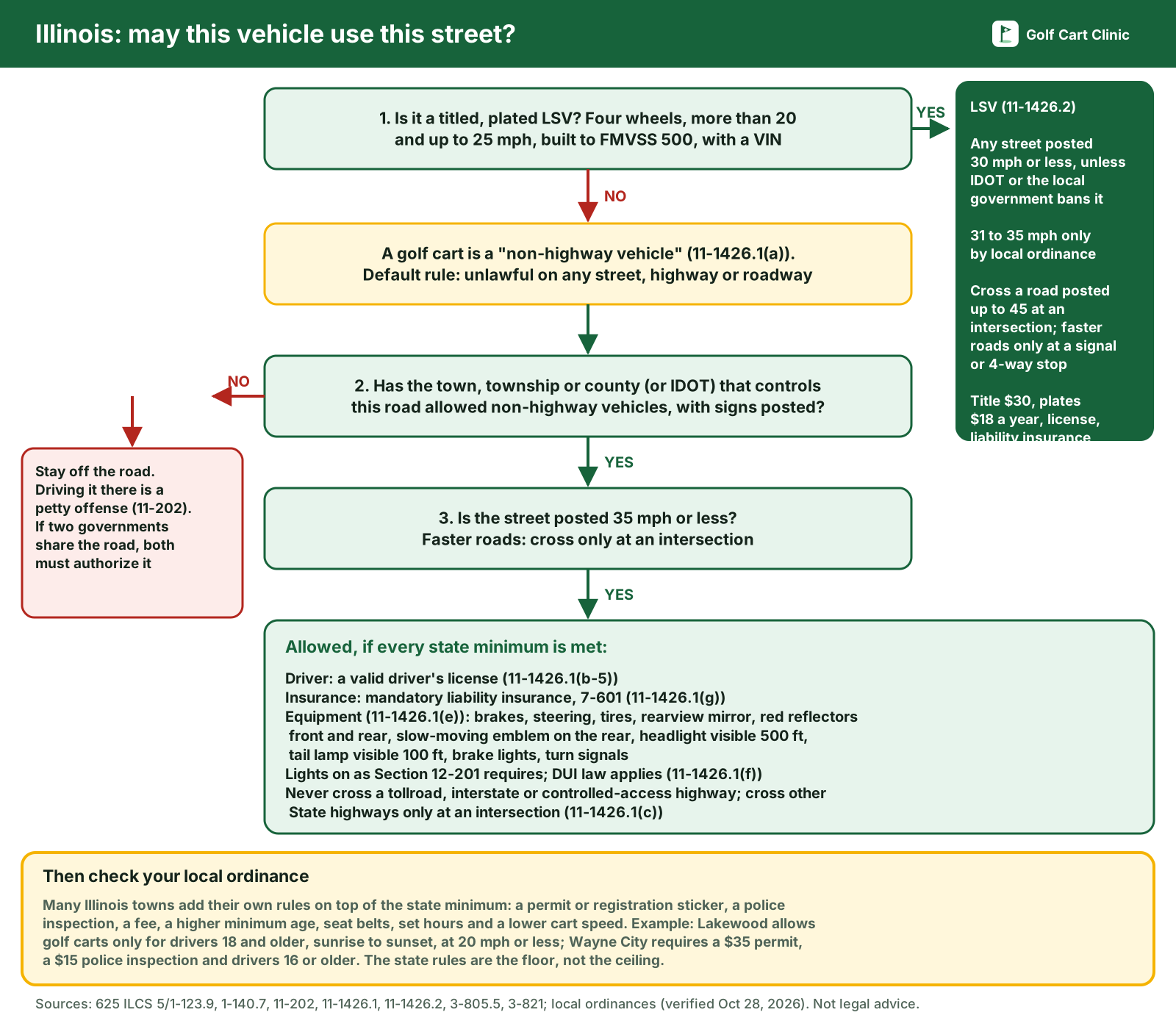
An LSV starts with a right to the road that a golf cart doesn't have. "It is lawful for any person to drive or operate a low-speed vehicle upon any street in this State where the posted speed limit is 30 miles per hour or less" (11-1426.2(a)), unless IDOT or the local government prohibits it by regulation, ordinance or resolution and posts signs (11-1426.2(c), (d)). A local government may also open streets posted over 30 and up to 35 mph to LSVs by ordinance (11-1426.2(e-5)).
LSV crossing rules are looser too: an LSV "may cross a street at an intersection where the street being crossed has a posted speed limit of not more than 45 miles per hour," and a faster street only "at an intersection controlled by a traffic light or 4-way stop sign" (11-1426.2(b)).
The equipment list is longer than for golf carts. An LSV must have "a parking brake, a steering apparatus, tires, a windshield that conforms to the federal vehicle safety standards on glazing materials," a vehicle identification number, seat belts, a rearview mirror plus "an exterior rearview mirror mounted on the driver's side,", red reflectors "on each rear side and one on the center rear," the same 500-foot headlight and 100-foot tail lamp, brake lights, and front and rear turn signals (11-1426.2(f)). It follows the Rules of the Road and local ordinances like any car (11-1426.2(h)), and dealers who sell LSVs need a motor vehicle dealer license (11-1426.2(j)).
Can you turn a golf cart into an LSV? Not with paperwork alone. The LSV definition requires a vehicle that "conforms with" FMVSS 500, and the Secretary of State's VSD 796 form has the owner sign that it "meets Federal Motor Vehicle Safety Standard No. 500." Adding a street kit gives a golf cart the lights Illinois requires for local golf cart streets, but it doesn't by itself make the cart a federally compliant LSV. If a seller calls a converted cart "street legal," ask for an Illinois title showing it as an LSV.
DUI and penalties
"A person who drives or is in actual physical control of a non-highway vehicle on a roadway while under the influence is subject to Sections 11-500 through 11-502" (11-1426.1(f)), Illinois's DUI law. That applies on any roadway where you take the cart, not only on authorized streets.
Section 11-1426.1 sits in Chapter 11 of the Vehicle Code, where breaking a rule is "a petty offense" unless the Chapter says otherwise (625 ILCS 5/11-202). For a petty offense, "the minimum fine is $75" and the maximum is $1,000 (730 ILCS 5/5-4.5-75). Local ordinances add their own fines and can revoke the town permit. Wayne City's are "not less than $100 for a first offense, $250 for a second offense, and $500 and impounded for a third offense."
Local ordinances: what Illinois towns can do
Because the state only sets the floor, Illinois golf cart rules really live in local ordinances. Under 11-1426.1(d) a local government decides whether to allow non-highway vehicles at all, which types (golf carts only, or UTVs too), and on which of its roads. Most ordinances also add a permit, an inspection and operating rules. Two examples from official village sources:
- Lakewood (McHenry County): golf carts registered with the village may use village streets posted 35 mph or less "from sunrise to sunset at speeds of 20 miles per hour or less," with drivers 18 or older; carts need seat belts for every seat and a horn on top of the state list; crossing Ackman Road is allowed only at Haligus Road at a 90 degree angle; registration through the Chief of Police costs an initial $50 and includes a waiver and release of claims (Village Code 15.16).
- Wayne City (Wayne County): Ordinance 580, approved December 2, 2019, allows golf carts and UTVs on village streets posted 35 mph or less but bans ATVs and off-highway motorcycles. Owners need a $35 yearly permit and a $15 police inspection; drivers must be 16 or older with a valid Illinois license; carts may not run between 11:00 p.m. and 5:00 a.m.; and passengers under 16 must wear a helmet if the cart has no cab or roll bar (Ordinance 580).
One more thing local governments get from the statute: allowing non-highway vehicles does not make their use an "intended or permitted use of property" under the Local Governmental and Governmental Employees Tort Immunity Act (11-1426.1(i)). In plain terms, a town that opens its streets to golf carts isn't promising they're safe for them, and Lakewood's ordinance says riders go "at their own risk and peril." To find your own rules, search your village or city code for "golf cart" or "non-highway vehicle," or call the police non-emergency line. If your street is a county or township road, ask the county or township too.
Before your golf cart goes on an Illinois street: a checklist
- Your city, village, township or county has an ordinance or resolution allowing golf carts on that road, and signs are posted.
- Every road on your route is covered, including county roads and State routes, and each is posted 35 mph or less.
- You'll cross faster roads only at intersections, and never a tollroad, interstate or controlled-access highway.
- The driver has a valid driver's license and meets any higher local age.
- The cart has a liability policy at or above $25,000 / $50,000 / $20,000, with proof on board.
- Brakes, steering, tires, mirror, red reflectors front and rear, slow-moving emblem, headlight, tail lamp, brake lights and turn signals all work.
- Any local permit, inspection and sticker is current, and you know the local hours and speed cap.
- The driver is sober and everyone is seated.
How Illinois compares with nearby states
Illinois's local opt-in model is close to Michigan's: Michigan golf cart laws also leave the decision to local governments, but cap carts at 15 mph on streets posted 30 mph or less in daylight. Ohio golf cart laws let towns open streets posted 35 mph or less too, but every cart needs a police inspection, an Ohio title and plates, which Illinois doesn't require. Tennessee golf cart laws keep golf carts off public roads almost entirely, and Pennsylvania golf cart laws only let golf carts cross roads. Next door, Indiana golf cart laws also start from a ban and leave streets to cities, towns and counties, but set no statewide speed cap or equipment list for golf carts, and the BMV can't plate them. For more states, browse our golf cart laws by state.
Frequently asked questions
Are golf carts street legal in Illinois?
Only where your local government allows them. It is "unlawful for any person to drive or operate a non-highway vehicle upon any street, highway, or roadway in this State" (625 ILCS 5/11-1426.1(b)), unless a municipality, township, county or IDOT authorizes it on its own roads by ordinance or resolution and posts signs (11-1426.1(d)). Even then, only on streets posted 35 mph or less.
Do golf carts need license plates in Illinois?
No. The Secretary of State doesn't title or register golf carts. Many towns require their own permit sticker or plate, an inspection and a fee before a cart may use local streets. LSVs are different: they need an Illinois title ($30) and registration ($18 a year).
Do you need a driver's license to drive a golf cart in Illinois?
On any street, highway or roadway, yes: a valid driver's license from the Secretary of State or another jurisdiction (11-1426.1(b-5)). Off public roads, on private property or a golf course, the state rule doesn't apply, but the owner's rules do.
How old do you have to be to drive a golf cart on the street in Illinois?
Old enough to hold a valid driver's license, which in Illinois means at least 16 (625 ILCS 5/6-107). Some towns set a higher age: Lakewood requires drivers 18 or older.
Can you drive a golf cart on a 45 mph road in Illinois?
Not along it. Golf carts may only use streets posted 35 mph or less, but may cross a faster road at an intersection (11-1426.1(b)). They may never cross a tollroad, interstate or controlled-access highway, and may cross other State highways only at intersections (11-1426.1(c)).
Do golf carts need insurance in Illinois?
Yes, on a street, highway or roadway. Operators are "subject to the mandatory insurance requirements under Article VI of Chapter 7" (11-1426.1(g)), which means liability coverage of at least $25,000 / $50,000 / $20,000 (5/7-203).
Can you drive a golf cart at night in Illinois?
State law has no daylight-only rule for golf carts, but the cart's headlight and tail lamps must be lighted as Section 12-201 requires (11-1426.1(e)). Many towns restrict hours: Lakewood allows carts only from sunrise to sunset, and Wayne City bans them from 11:00 p.m. to 5:00 a.m.
Sources
- Illinois Vehicle Code, golf carts and non-highway vehicles: 625 ILCS 5/11-1426.1 (operation on streets, roads and highways), 5/1-123.9 (golf cart), 5/1-101.8 (all-terrain vehicle), 5/1-168.8 (recreational off-highway vehicle), 5/12-709 (slow-moving vehicle emblem), 5/12-201 (lighted lamps)
- Illinois Vehicle Code, low-speed vehicles: 5/11-1426.2 (operation on streets), 5/1-140.7 (definition), 5/3-805.5 (registration fee), 5/3-821 (title fees), 5/3-101 (certificate of title)
- Illinois Vehicle Code, general: 5/7-601 (required liability insurance), 5/7-203 (minimum limits), 5/6-107 (graduated license), 5/11-202 (petty offense); Unified Code of Corrections 730 ILCS 5/5-4.5-75 (petty offense fines)
- Illinois Secretary of State: Affirmation for Low-Speed Vehicle (VSD 796); Title and Registration Publications and Forms
- Illinois General Assembly: HB 4085 bill status (104th General Assembly, pending)
- 49 C.F.R. (federal): § 571.500 (FMVSS 500, low-speed vehicles)
- Local: Village of Lakewood, Village Code 15.16, Operation of Golf Carts on Village Streets; Village of Wayne City, Ordinance 580 (December 2, 2019)
Questions and comments
No comments yet. Corrections and notes from your own repair are welcome.