
Louisiana Golf Cart Laws (2026): Designated Roads, OMV Decal, Insurance and LSVs
Louisiana keeps golf carts off public roads except parish roads and town streets that a parish or municipality has designated and signed. Carts driven there must be titled with OMV as off-road vehicles with a decal, insured at 15/30/25, fitted with lights and turn signals and driven by a licensed driver. Here are the state highway crossings named in law, the OMV paperwork, the LSV rules and what Bossier Parish, Haughton and Golden Meadow add.
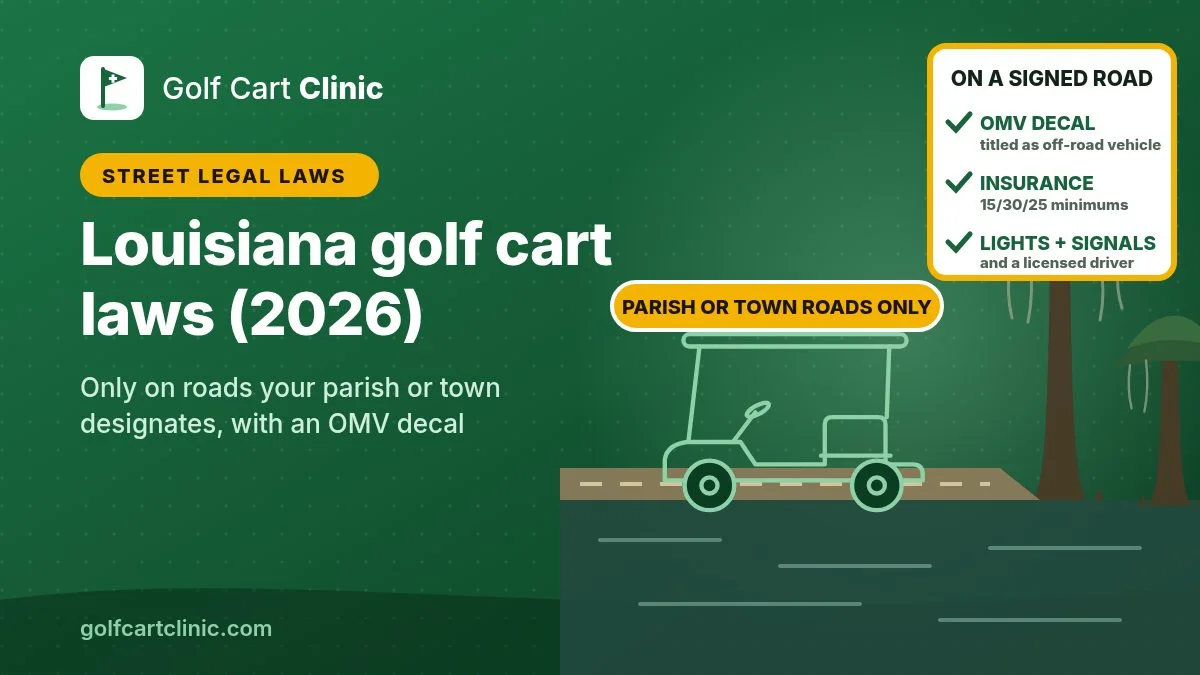
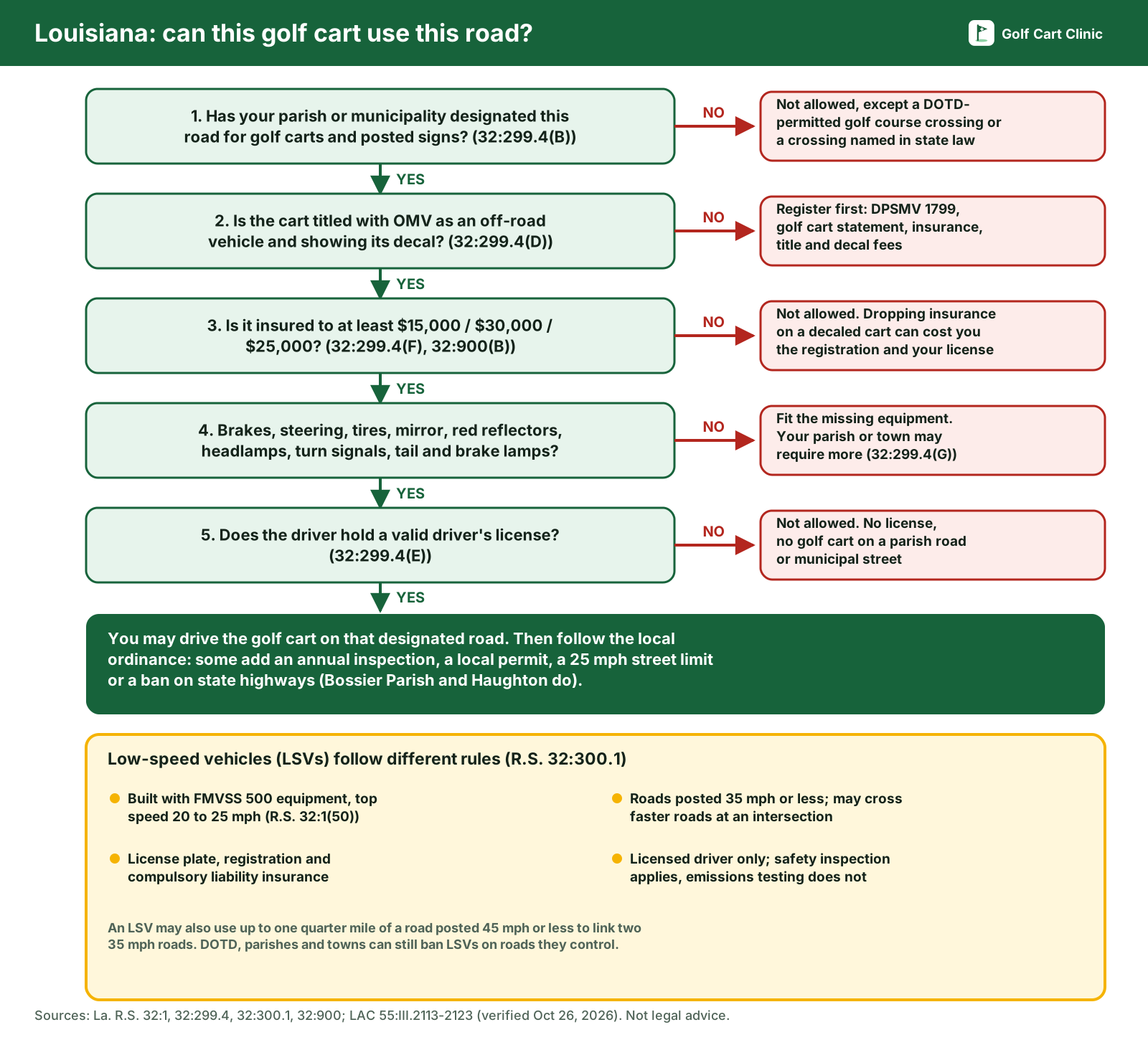
In Louisiana, a golf cart may use a public road only if your parish has designated that parish road, or your town or city has designated that municipal street, for golf carts and posted signs saying so. Every cart driven on a designated road must be titled with the Office of Motor Vehicles (OMV) as an off-road vehicle and show an OMV decal, carry liability insurance of at least $15,000/$30,000/$25,000, have headlamps, turn signals, brake lamps and the other required equipment, and be driven by someone with a valid driver's license. State highways aren't on that list: carts may only cross them where state law or a DOTD permit allows. Factory-built low-speed vehicles (LSVs) are plated like cars and may use roads posted 35 mph or less without any local designation.
Not legal advice. Last verified: October 26, 2026. This guide summarizes the Louisiana Revised Statutes as published by the Louisiana State Legislature (legis.la.gov), the Office of Motor Vehicles' golf cart rules in the Louisiana Administrative Code and its published policies, and the ordinances of one parish and one town. Your parish or municipality decides which roads, if any, are open to golf carts, and it can add stricter rules or ban carts outright. Before you drive, check your local ordinance and look for the golf cart signs on the road.
Safety first. A golf cart has no doors, airbags or crash structure, and most have no seat belts. On a road shared with pickups and trucks, even a slow crash can throw riders out, and a low cart is easy to miss in a mirror. Seat only as many people as the cart has seats, keep everyone seated with hands and feet inside, and never let anyone ride on the bag rack or stand on the back. Many Louisiana roads run along ditches, canals and bayous with no shoulder, so slow down near the edge, and stay off the road in heavy rain, fog or high water. Young children need a proper seat and belt, which most carts don't have. If a route has fast traffic, find another one or leave the cart at home.
Louisiana golf cart rules at a glance
Louisiana sets one statewide rulebook for golf carts on designated roads (La. R.S. 32:299.4) and a separate one for low-speed vehicles (R.S. 32:300.1). Here is how they compare:
| Rule | Golf cart | Low-speed vehicle (LSV) |
|---|---|---|
| Which roads | Only parish roads or municipal streets your parish or municipality has designated, with signs posted (R.S. 32:299.4(B)(1)) | Any road with a posted speed limit of 35 mph or less, unless DOTD, the parish or the town bans LSVs there (R.S. 32:300.1(A), (F)) |
| State highways | No driving along them; crossing only with a DOTD permit between two parts of a golf course, or at crossings named in state law | Allowed if posted 35 mph or less; may cross faster roads at an intersection |
| Title and registration | Titled with OMV as an off-road vehicle, with an OMV decal (R.S. 32:299.4(D)) | Registered like a personal car, with a license plate (R.S. 32:300.1(C)(1)) |
| Insurance | Liability limits of R.S. 32:900(B): $15,000 / $30,000 / $25,000 | Compulsory motor vehicle liability security (R.S. 32:861 and 862) |
| Driver | "A valid driver's license" (R.S. 32:299.4(E)) | No unlicensed drivers (R.S. 32:300.1(D)) |
| Equipment | Brakes, steering, safe tires, rearview mirror, red reflectors front and rear, headlamps, front and rear turn signals, tail lamps, brake lamps | Full FMVSS 500 list, including seat belts, windshield, wiper and a VIN |
| Local extras | Parishes and towns may require more equipment or ban carts (R.S. 32:299.4(G)) | Parishes and towns may ban LSVs on their roads |
How Louisiana defines a golf cart and an LSV
Louisiana's golf cart law starts with a short definition. Under R.S. 32:299.4(A), a golf cart "means an electric four-wheeled vehicle originally intended for use off-road on golf courses and other green spaces whose maximum speed is twenty-five miles per hour." The OMV's rule repeats that definition word for word (LAC 55:III.2113).
A low-speed vehicle is a different class. The definitions section, R.S. 32:1(50), counts an LSV as a motor vehicle: "a four-wheeled, electric-powered vehicle with a maximum speed of not less than twenty miles per hour but not more than twenty-five miles per hour and is equipped with the minimum motor vehicle equipment appropriate for vehicle safety as required in 49 CFR 571.500." That federal standard (FMVSS 500) is what LSV makers build to, and it includes seat belts, a safety-glass windshield and a 17-digit VIN.
Two things follow from the wording:
- The golf cart definition says "electric." Section 299.4 doesn't say how a gas-powered golf cart is handled. If you own a gas cart and want to drive it on a designated road, ask your OMV office and your parish or town before you register it.
- Adding parts doesn't make an LSV. A golf cart with a light kit is still titled as a golf cart (an off-road vehicle), not plated as an LSV. If you need 35 mph roads, buy a vehicle that was built and certified as an LSV. Our serial number lookup helps you tell a golf cart serial from a real VIN.
Where can you drive a golf cart in Louisiana?
The starting rule is a ban: "The operation of a golf cart upon the public roads or streets of this state is prohibited," except as R.S. 32:299.4(B) allows. Louisiana's definition of a highway covers "the entire width between the boundary lines of every way or place of whatever nature publicly maintained and open to the use of the public for the purpose of vehicular travel" and is "synonymous with the word 'street'" (R.S. 32:1(34)). Quiet subdivision streets maintained by the parish or the town are public roads.
Section 299.4 opens two doors:
- Designated local roads. "A golf cart may be operated only upon a parish road that has been designated by a parish or a municipal street that has been designated by a municipality for use by a golf cart." Once a road is designated, "the responsible governmental entity shall post appropriate signage indicating that such operation is authorized." No signs is a strong hint that the road isn't designated.
- Golf course crossings of state highways. A cart "may be used to cross a part of a state highway where a golf course is constructed on both sides of the state highway if the Department of Transportation and Development has issued a permit for the crossing."
The designation power belongs to parishes and municipalities, so state highways (the LA, US and interstate routes) aren't on the list. Even in a town that allows carts, a state highway through the middle of town is off-limits for driving along it, and you may cross it only where a statute or a DOTD permit allows. Golf carts are also free to use private property with the owner's permission, golf courses under the course's rules, and private community roads under the association's rules.
State highway crossings and parks named in state law
Because a town can't open a state highway on its own, the Legislature has passed separate laws for a few places. Each one is narrow, and most require daylight and a valid driver's license:
- Grand Isle: golf carts and all-terrain vehicles may cross Louisiana Highway 1 "on marked or designated paths or crossings" within the town limits "between sunrise and sunset," with a valid driver's license (R.S. 32:127).
- Welsh: once DOTD gives final approval, golf carts may cross US Highway 90 and Louisiana Highway 99 at marked crossings in town, sunrise to sunset, with a valid license (R.S. 32:127.1).
- Westlake: golf carts may cross Louisiana Highway 378 at McKinley Street and Highway 379 at Hilma Street and Gray Street, sunrise to sunset, with a valid license (R.S. 32:127.4, added in 2024).
- Church Point: after DOTD approval, golf carts may cross Louisiana Highways 95, 35, 1104 and 178 at marked crossings, sunrise to sunset. Each year the driver must submit a copy of a valid driver's license and liability insurance, a signed liability waiver and a $75 permit fee with a utility terrain vehicle permit application (R.S. 32:127.5, added in 2024).
- Lake Arthur: after DOTD approval, golf carts may cross Louisiana Highway 26 at marked crossings, sunrise to sunset, with a valid license (R.S. 32:127.6, added in 2024).
- Two state parks: golf carts may be driven between sunrise and sunset on the park roads of Palmetto Island State Park and Lake Fausse Pointe State Park by an operator "in possession of a valid driver's license and liability insurance" (R.S. 32:127.2 and R.S. 32:127.3).
Golden Meadow has its own section too, covered under local rules below. Crossing signs and marked paths are what make these crossings legal, so cross only where they are posted.
Speed limits and hours
Louisiana's golf cart statute doesn't set a maximum posted speed limit for designated roads, and it doesn't limit carts to daylight. Instead it leaves those choices to the parish or town, which picks the roads and may add conditions. Two things still cap your speed and hours:
- The cart itself. A golf cart is defined as a vehicle "whose maximum speed is twenty-five miles per hour." A cart modified to go faster no longer fits the definition, and at least one town (Haughton) treats a cart faster than 25 mph as a regular motor vehicle subject to full state and federal rules.
- Local rules and crossing laws. Haughton allows carts only on town streets with a speed limit of 25 mph or less, and the state crossing laws listed above work only between sunrise and sunset.
Because every cart on a designated road must have headlamps, tail lamps, brake lamps and turn signals, keep them working and switch the lights on whenever visibility drops. A slow-moving vehicle triangle or a tall flag isn't on the state list, but it helps drivers coming up from behind see you sooner.
Driver's license and age
"No person shall operate a golf cart upon a parish road or municipal street without a valid driver's license" (R.S. 32:299.4(E); LAC 55:III.2115(B)). The state law sets no separate golf cart age. In practice the license sets the floor: Louisiana issues a Class E learner's license from age 15, and that license only lets the holder drive with a licensed parent or guardian, an adult 21 or older, or a licensed sibling 18 or older; an intermediate license comes at 16 at the earliest (R.S. 32:407). The same license rules and restrictions apply behind the wheel of a cart, and an ordinance can set a higher age. Kids without a license can't drive a golf cart on any designated road.
Registration, title and the OMV decal
This is where Louisiana is stricter than many states. "Any golf cart operated upon a parish road or municipal street shall be registered with the state of Louisiana through the Department of Public Safety and Corrections, office of motor vehicles, as an off-road vehicle and shall display a decal issued by the office of motor vehicles" (R.S. 32:299.4(D)). A cart that never leaves private property or the golf course doesn't need an OMV title, according to OMV Policy 122.02, Golf Carts.
The OMV rule (LAC 55:III.2119, Louisiana Register, October 2018) and Policy 122.02 list what to bring:
- A completed Vehicle Application (form DPSMV 1799).
- Proof of ownership: the manufacturer's statement of origin for a new cart, or a title assigned before a notary. If you can't produce a title, OMV accepts an affidavit of physical inspection, done by a full-time POST-certified law enforcement officer certified by State Police to inspect vehicles.
- The dealer's itemized invoice or a notarized bill of sale, and lien paperwork if the cart is financed.
- Proof of liability insurance.
- A signed Statement of Golf Carts (form DPSMV 1809), in which you confirm the cart has the required equipment, that only licensed drivers will use it and that it will run only on designated roads.
- Fees and sales or use tax. Policy 122.02 (last revised February 25, 2022) lists a $76.50 title fee, an $8.00 handling fee and a $12.00 decal fee, plus $10 to record a security agreement or $15 for a UCC-1. The off-road decal itself runs $3 a year on a four-year cycle (OMV Policy 82.00). Ask OMV for current amounts before you go.
If you bought a cart without registering it and later want to drive it on a designated road, OMV calls that reclassifying it for on-road use; the same documents apply, and you must show that sales tax was paid or OMV will assess it. Golf carts get an off-road decal, not a license plate.
Insurance
A golf cart on a parish road or municipal street "shall have liability insurance with the same minimum limits as required by the provisions of R.S. 32:900(B)" (R.S. 32:299.4(F)). R.S. 32:900(B) sets those limits at $15,000 for bodily injury to or death of one person, $30,000 for two or more people in one accident and $25,000 for property damage.
Don't simply cancel the policy if you stop driving on the road. The OMV rule warns that for a decaled golf cart, "If liability insurance is cancelled, it will result in a revocation of the registration and the driver's license" (LAC 55:III.2123). To stop on-road use, cancel the off-road decal or surrender the title for a title correction that reclassifies the cart as an off-road vehicle first, then change the insurance. A title fee applies.
Required equipment
Under R.S. 32:299.4(C), a golf cart on a parish road or municipal street "shall be equipped with":
- efficient brakes;
- a reliable steering apparatus;
- safe tires;
- a rearview mirror;
- red reflectorized warning devices in both the front and rear;
- headlamps;
- front and rear turn signal lamps;
- tail lamps; and
- brake lamps.
The OMV rule adds a "vehicle identification number or serial number" to the list and says these items are "the only equipment required to title the vehicle" (LAC 55:III.2117). A parish or town may require more, such as an annual inspection, but it must post signs or otherwise tell residents about its ordinance (R.S. 32:299.4(G)(1)). Seat belts aren't on the state list, but a belt for every seat is one of the best upgrades you can make; our golf cart upgrades guides cover lights, mirrors and belts.
Low-speed vehicles in Louisiana
If you want more road access, an LSV is the legal route. Under R.S. 32:300.1:
- Roads: an LSV "may be operated on any divided highway, highway, roadway, or street where the posted speed limit is thirty-five miles per hour or less." It may cross a road posted over 35 mph at an intersection, and it may use a road posted no more than 45 mph "for a distance not exceeding one quarter mile" to connect two roads posted 35 mph or less.
- Equipment: the FMVSS 500 list, including headlamps, front and rear turn signals, taillamps, stop lamps, reflex reflectors, a driver's side exterior mirror plus a passenger side or interior mirror, a parking brake, a safety-glass windshield, a wiper, a speedometer, an odometer, braking on each wheel, a seat belt at each seat and a VIN.
- Registration: registered with OMV "in the same manner as motor vehicles intended for personal use," with a license plate and a registration fee collected every two years.
- Insurance and driver: compulsory liability security under R.S. 32:861 and 862, and "No low-speed vehicle shall be operated by an unlicensed driver."
- Inspection: LSVs must comply with the state's vehicle inspection law (R.S. 32:1301 et seq.) but are exempt from emissions requirements.
- Bans: DOTD may prohibit LSVs on a state highway, and a parish or town may prohibit them on its roads, for safety.
Drinking and other traffic laws
Louisiana's impaired driving law covers "any motor vehicle, aircraft, watercraft, vessel, or other means of conveyance," at a blood alcohol concentration of 0.08 percent or more or when impaired by alcohol or drugs (R.S. 14:98). A golf cart on a parade route or a neighborhood street is no exception. The local ordinances we reviewed also make cart drivers subject to all state traffic regulations, so stop signs, right-of-way and lane rules apply as they do in a car.
Buying a golf cart in Louisiana: the 2026 dealer law
Since August 1, 2026, Louisiana's motor vehicle dealer law counts golf carts as all-terrain vehicles, and anyone who sells golf carts at retail is a dealer for that purpose, even if selling carts isn't their main business (Act 967 of the 2026 Regular Session, HB 848; résumé digest). Dealers need adequate repair and service facilities or an arrangement for warranty service. If warranty work will be done mainly at a remote facility, the dealer must tell you in writing before you sign, with the facility's name and address and its distance from the dealership, and you sign an acknowledgment. Ask for that disclosure, and ask whether the dealer will send the title paperwork to OMV if you plan to use the cart on designated roads.
Local ordinances: what parishes and towns add
Section 299.4 lets parishes and municipalities pass golf cart ordinances, require more equipment and ban carts on their roads for safety. It also contains a grandfather clause: "any parish or municipal ordinance that was in effect prior to January 1, 2015, shall be exempt from the requirements of this Section" (R.S. 32:299.4(G)(2)). If your town's golf cart rules date from before 2015, read them closely, because they may differ from the state list. Three examples we verified:
- Bossier Parish: Ordinance No. 4818 (adopted January 20, 2021; Code ch. 118, art. V) requires the state equipment, an annual inspection by the Police Jury's Commercial Vehicle Enforcement Unit, a $5 annual permit that expires December 31, proof of insurance in the driver's possession, the OMV registration and decal, and a licensed driver. Passengers must be seated, no more than the cart was designed for, and carts may not be driven on any state highway. As adopted, it covered the streets of the Forest Hills Subdivision, and residents or a homeowners' association can ask the Police Jury to add their streets, so check the current list.
- Town of Haughton: Ordinance 5 of 2021 (Code Sec. 38-27, adopted June 8, 2021) allows carts only on town streets with a speed limit of 25 mph or less, and not on parish or federal roads, including crossing them. Carts need an annual police inspection, a $5 annual permit that expires December 31 with a signed release of claims against the town, the OMV registration and decal, insurance at the $15,000/$30,000/$25,000 limits with proof in the driver's possession, and a licensed driver.
- Golden Meadow: a state law written for this Lafourche Parish town lets its council allow golf carts, low-speed vehicles and, since Act 554 of 2026 (HB 503, effective August 1, 2026), utility terrain vehicles "only on the shoulder of a public road and street," except Louisiana Highway 3235, with a speed limit of thirty miles per hour or less. Drivers must be licensed and carry proof of insurance, and each vehicle is registered with the town and shows its decal (R.S. 32:297.1).
Other parishes and towns, including lake, bayou and golf communities, set their own maps, fees and inspections, and some have no golf cart ordinance at all. Ask your parish government or town hall before you buy a cart for road use.
Before you drive on a Louisiana road: a checklist
- Find your parish or town golf cart ordinance and the list of designated roads, and look for the posted signs. No designation means no public roads.
- Plan a route that stays off state highways, and cross one only at a marked crossing allowed by state law or a DOTD permit.
- Title the cart with OMV as an off-road vehicle and put the decal on it.
- Buy liability insurance of at least $15,000/$30,000/$25,000 and keep proof in the cart.
- Check the equipment: brakes, steering, tires, rearview mirror, red reflectors front and rear, headlamps, front and rear turn signals, tail lamps and brake lamps.
- Make sure every driver has a valid driver's license and follows its restrictions.
- Get any local permit or inspection your parish or town requires.
- If you need 35 mph roads, buy a factory-built LSV and register, plate and insure it.
Frequently asked questions
Are golf carts street legal in Louisiana?
Only on parish roads or municipal streets that your parish or municipality has designated for golf carts and posted with signs (La. R.S. 32:299.4(B)). The cart must be titled with OMV as an off-road vehicle with a decal, insured at the R.S. 32:900(B) minimums, equipped with lights, turn signals and the other required items, and driven by a licensed driver. Everywhere else, golf carts stay off public roads.
Do I need to register a golf cart in Louisiana?
Yes, if you drive it on a designated road. Section 299.4(D) requires registration with the Office of Motor Vehicles as an off-road vehicle and an OMV decal. Golf carts used only on private property or a golf course don't need an OMV title, according to OMV Policy 122.02. Golf carts get an off-road decal, not a license plate.
Do golf carts need insurance in Louisiana?
Yes, on parish roads and municipal streets. The minimums are $15,000 per person and $30,000 per accident for bodily injury and $25,000 for property damage (R.S. 32:299.4(F) and 32:900(B)). OMV warns that cancelling the insurance on a decaled cart leads to revocation of the registration and the driver's license, so reclassify the cart as off-road before you cancel.
How old do you have to be to drive a golf cart on the road in Louisiana?
Old enough to hold a valid driver's license (R.S. 32:299.4(E)). Louisiana issues learner's licenses from age 15, with an adult or licensed sibling required in the vehicle, and intermediate licenses from age 16 (R.S. 32:407). Children without a license may not drive a golf cart on a designated road, and your town can set a higher age.
Can I drive a golf cart on a state highway in Louisiana?
Not along it. Only parishes and municipalities can designate roads for golf carts, and they designate parish roads and municipal streets. You may cross a state highway only between two parts of a golf course with a DOTD permit, or at the crossings the Legislature has authorized in Grand Isle, Welsh, Westlake, Church Point and Lake Arthur, which are limited to sunrise to sunset.
Can I drive a golf cart at night in Louisiana?
State law doesn't ban it on a designated road: section 299.4 has no daylight-only rule and requires headlamps, tail lamps and turn signals. Your parish or town ordinance may limit hours, and the special state highway crossings and the two state park exceptions apply only between sunrise and sunset.
What is the difference between a golf cart and an LSV in Louisiana?
A golf cart is an electric cart built for golf courses with a top speed of 25 mph; it is titled as an off-road vehicle with a decal and may use only designated local roads. An LSV is a motor vehicle with a top speed of 20 to 25 mph that meets FMVSS 500; it gets a license plate and may use any road posted 35 mph or less without local designation (R.S. 32:1(50) and 32:300.1).
Louisiana sits between its neighbors. Texas golf cart laws give carts a special license plate and some roads without a local ordinance, while Alabama golf cart laws allow carts only in towns in five counties. Like Louisiana, Florida golf cart laws leave street use to local designation, but Florida doesn't make you register a golf cart with the state. For more states, browse our golf cart laws by state.
Sources
- Louisiana Revised Statutes, Title 32: R.S. 32:299.4 (golf carts), R.S. 32:300.1 (low-speed vehicles), R.S. 32:1 (definitions), R.S. 32:900 (liability limits), R.S. 32:407 (licenses for minors), R.S. 32:297.1 (Golden Meadow) (legis.la.gov)
- Crossings and parks: R.S. 32:127 (Grand Isle), 32:127.1 (Welsh), 32:127.2 (Palmetto Island State Park), 32:127.3 (Lake Fausse Pointe State Park), 32:127.4 (Westlake), 32:127.5 (Church Point), 32:127.6 (Lake Arthur); R.S. 14:98 (operating a vehicle while impaired)
- 2026 Regular Session: Act 554 (HB 503, enrolled) and Act 967 (HB 848, résumé digest)
- Office of Motor Vehicles rule, LAC 55:III.2113 to 2123 (Golf Carts), Louisiana Register Vol. 44, No. 10, October 20, 2018, pp. 1913-1914 (doa.la.gov)
- Office of Motor Vehicles policies: 122.02 Golf Carts, 82.00 Off-Road Vehicles, 55.00 Off-Road Vehicle Decals
- 49 C.F.R. § 571.500 (FMVSS 500, low-speed vehicles): ecfr.gov
- Local: Bossier Parish Police Jury Ordinance No. 4818 (2021); Town of Haughton Ordinance 5 of 2021, Sec. 38-27
Questions and comments
No comments yet. Corrections and notes from your own repair are welcome.