
New Jersey Golf Cart Laws (2026): LSV Roads, Plates, Insurance and Licenses
New Jersey keeps plain golf carts off public roads: the MVC lists them as exempt from titling and registration. The only street-legal cart-style vehicle is an electric low-speed vehicle (LSV) with an MVC title, a rear LSV plate, insurance and a licensed driver, on roads posted 25 mph or less (35 mph where a town, county or NJDOT allows). Here is what N.J.S.A. 39:4-31.1 to 31.5 say, why gas carts never qualify, what titling and registration cost, the crossing rules, and what shore towns like Cape May, Ocean Gate, Surf City and Stone Harbor add.
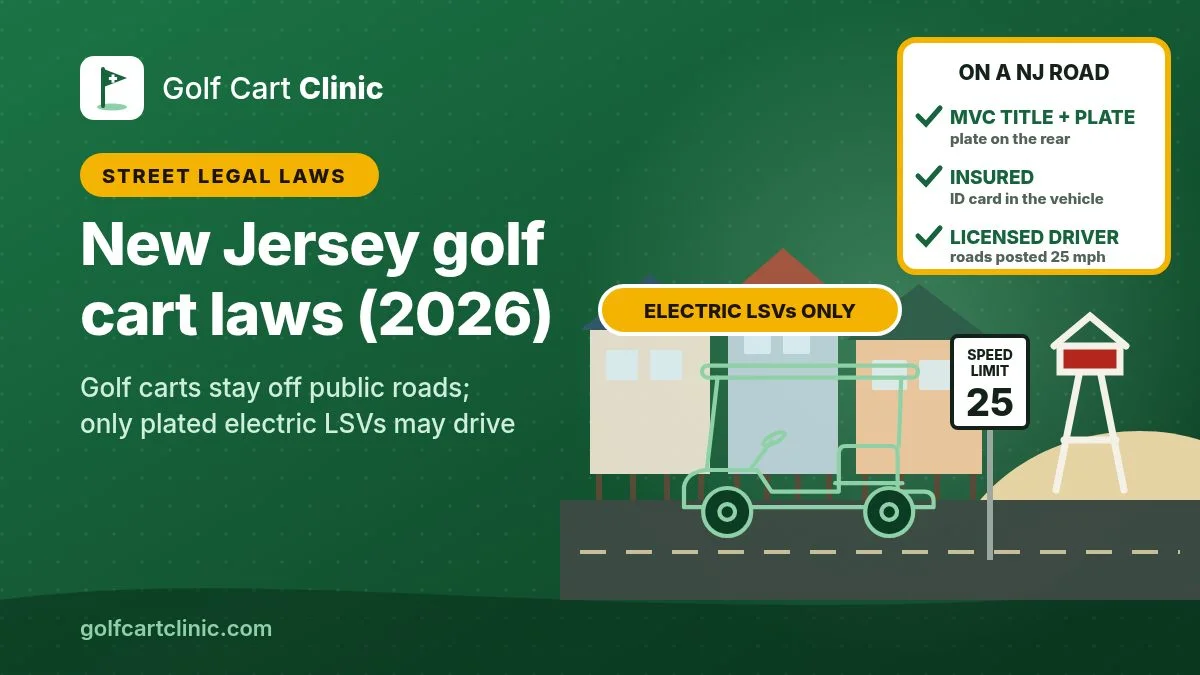
In New Jersey, an ordinary golf cart may not be driven on public roads. The Motor Vehicle Commission (MVC) lists golf carts among vehicles that are "exempt from titling and registration," and a vehicle that can't be registered can't legally use the road. The only cart-style vehicle allowed on New Jersey streets is a low-speed vehicle (LSV): four wheels, electric only, a top speed over 20 and up to 25 mph, federal safety equipment, an MVC title, registration, insurance and a rear license plate, driven by someone with a valid driver's license. LSVs may use roads posted 25 mph or less, and roads posted up to 35 mph only where the town, county or NJDOT allows it. Towns can also ban LSVs on streets they find hazardous.
Not legal advice. Last verified: October 27, 2026. This guide summarizes the New Jersey statutes on low-speed vehicles (N.J.S.A. 39:1-1 and 39:4-31.1 to 39:4-31.5, enacted by P.L.2005, c.273), related Title 39 definitions, and published guidance from the MVC, the Attorney General's Division of Highway Traffic Safety and the Department of Banking and Insurance, plus a few towns' published rules. Your town can limit or ban LSVs on its streets, so check the local code and posted signs before you drive.
Safety first. Even a fully legal LSV isn't built to car crash standards: the federal LSV rule requires lights, mirrors, seat belts and a windshield, not crash protection, and most LSVs have no doors or airbags. You share the road with SUVs and delivery trucks. New Jersey makes every buyer of a new LSV sign a waiver acknowledging "the potentially hazardous characteristics of such vehicles" (N.J.S.A. 39:4-31.4(b)). Everyone rides seated, one person per seat belt, with hands and feet inside. Children need the same car seat or booster they would use in a car: the MVC says "child restraints in LSVs must meet the same standards as those used in passenger vehicles." The MVC also warns that LSVs "may be difficult to see," so use your lights, stay off busy roads, and cross wide or divided roads only at a signal or an approved crossing. A plain golf cart is not built or allowed for the street at all; if your only route uses a public road, trailer it or leave it home.
New Jersey golf cart and LSV rules at a glance
New Jersey has no golf cart street law. It has a low-speed vehicle law, passed in 2005 and effective in 2006, and golf carts fall outside it. Here is how the two compare:
| Rule | Golf cart | Low-speed vehicle (LSV) |
|---|---|---|
| Legal status | A "nonconventional type motor vehicle" in the title law (N.J.S.A. 39:10-2); the MVC lists golf carts as "exempt from titling and registration" | Four wheels, "attainable speed is more than 20 miles per hour but not more than 25 miles per hour," "not powered by gasoline or diesel fuel," meets FMVSS 500 (N.J.S.A. 39:1-1) |
| Public roads | Not allowed (can't be registered; N.J.S.A. 39:3-4) | Roads posted 25 mph or less; up to 35 mph only where NJDOT, the county or the town allows it (N.J.S.A. 39:4-31.1) |
| Crossing a road | No state rule for golf carts | May cross roads posted 35 mph or less; if more than two lanes or divided, or posted over 35 mph, only at signalized or approved intersections (39:4-31.1(c), (d)) |
| Title and registration | None | MVC title ($60, or $85 with a lien) and registration ($46.50 a year, $34 once the LSV is two model years old) |
| Plate | None | One "LSV" plate, mounted on the rear |
| Insurance | Not available as road coverage | Required (39:4-31.3(b)); the MVC points to the New Jersey Personal Automobile Insurance Plan and voluntary insurers |
| Driver | Not applicable on roads | Valid driver's license, with registration and insurance card in hand (39:4-31.3) |
| Inspection | Not applicable | Exempt from MVC inspection; owner must keep it in proper condition (39:4-31.5) |
| Gas power | Gas carts are still golf carts | Never: an LSV can't be powered by gasoline or diesel |
How New Jersey defines a golf cart and an LSV
New Jersey's motor vehicle law never defines "golf cart." It names golf carts in two lists. The title chapter calls a "nonconventional type motor vehicle" one "not designed or used primarily for the transportation of persons or property and only incidentally operated or moved over a highway," and the list ends with "scooters, go-carts, gas buggies and golf carts" (N.J.S.A. 39:10-2). The off-road vehicle chapter says an all-terrain vehicle "shall not include golf carts" (N.J.S.A. 39:3C-1), so a cart can't be registered as an ATV either. On its Non-Conventional Vehicles page, the MVC puts golf carts on its list of "non-conventional vehicles exempt from titling and registration," next to go-karts and road rollers.
A low-speed vehicle is defined precisely. Under N.J.S.A. 39:1-1, it "means a four-wheeled low-speed vehicle, as defined in 49 CFR s. 571.3(b), whose attainable speed is more than 20 miles per hour but not more than 25 miles per hour on a paved level surface and which is not powered by gasoline or diesel fuel and complies with federal safety standards as set forth in 49 CFR s. 571.500." The federal definition it points to adds a weight limit: a gross vehicle weight rating under 3,000 pounds (49 CFR 571.3).
Three parts of that definition rule out most carts on the market:
- Electric only. A gas golf cart can never be an LSV in New Jersey, however it is equipped. Federal law doesn't exclude gas LSVs, but New Jersey does.
- Over 20 mph. A cart that tops out at 20 mph or less is below the LSV range.
- Federal standard. The vehicle must meet FMVSS 500 (listed below), and a new LSV comes with a manufacturer's certificate of origin that must "identify the vehicle as a low-speed vehicle" (N.J.S.A. 39:4-31.4(a)).
Many of the golf-cart-style vehicles you see at the shore are LSVs. They qualify because they were built and certified as LSVs, not because they look like golf carts.
Where can you drive a golf cart in New Jersey?
A plain golf cart: on private property, on a golf course, and in private communities where the owner allows it. Not on public roads. A motor vehicle "shall not be driven unless so registered," and an owner may not let an unregistered vehicle "be parked or to stand on a public highway"; police may tow it, and the fine can reach $100 (N.J.S.A. 39:3-4). We found no New Jersey statute that lets a town open its streets to golf carts that aren't LSVs, the way Florida or Virginia do.
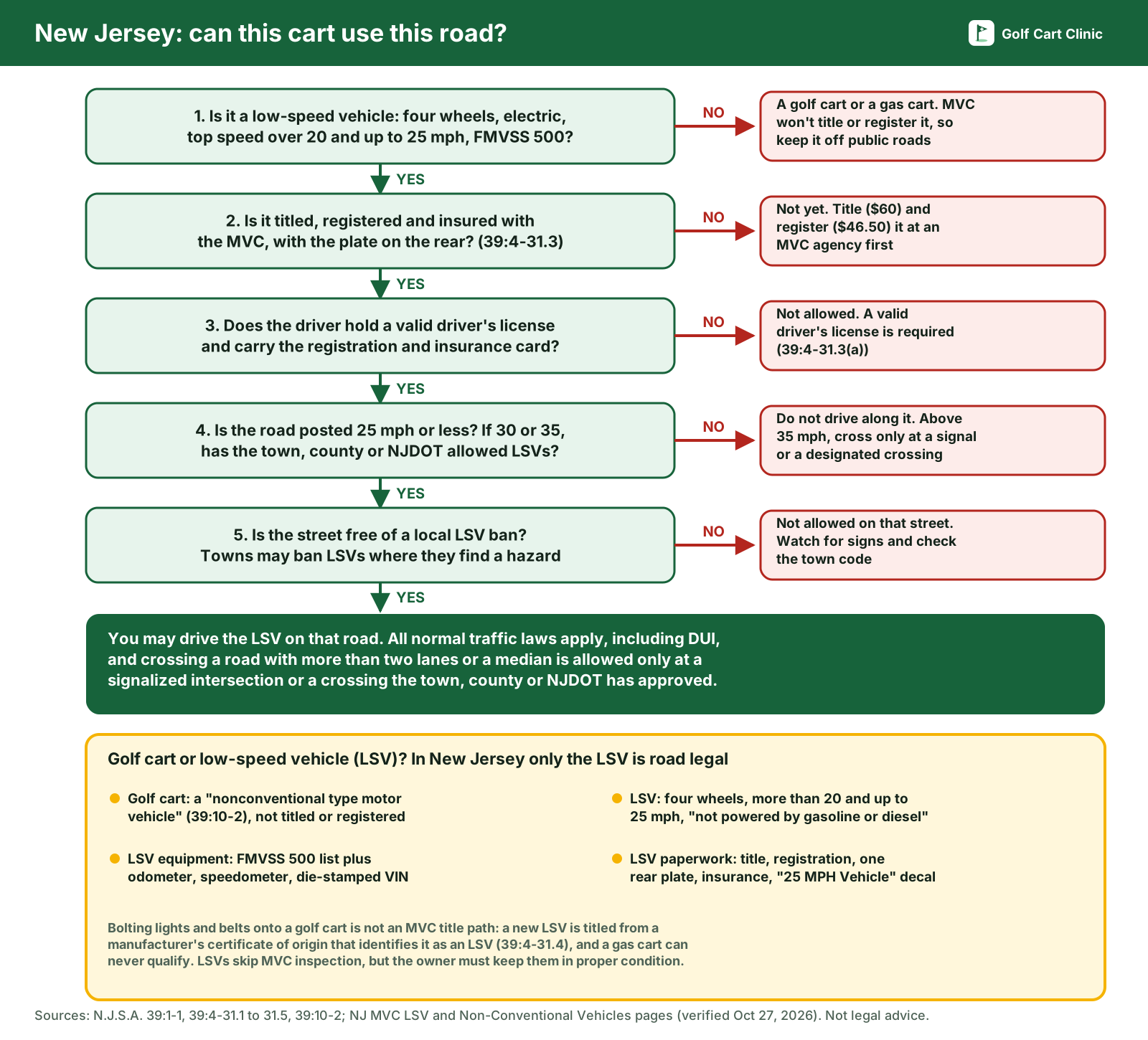
A registered LSV follows N.J.S.A. 39:4-31.1, which works by posted speed limit, not road type:
- Roads posted 25 mph or less: allowed, whether the road belongs to the state, a county or a town (39:4-31.1(a), (b)).
- Roads posted over 25 and up to 35 mph: only if the road's owner allows it. For state roads, the Commissioner of Transportation may do this "by order"; for county and town streets, the town may act "by ordinance" and a county "by ordinance or resolution."
- Roads posted over 35 mph: never along them. You may only cross.
- Bans: the state, a county or a town may "prohibit the use of low-speed vehicles on any street" where it "determines that the operation of low-speed vehicles would constitute a hazard." The MVC puts it more bluntly: "Municipalities can impose a LSV ban on ALL roadways within their jurisdiction."
Crossing roads in an LSV
The statute has its own crossing rules (39:4-31.1(c), (d)):
- A road posted 35 mph or less may be crossed at an intersection. If it has more than two lanes or is divided, cross only at a signalized intersection or at a non-signalized one that NJDOT (state roads) or the town or county (local roads) has approved.
- A road posted over 35 mph may be crossed only at a signalized intersection or an approved non-signalized one.
Breaking the road or crossing rules brings "the general penalties of this chapter" (39:4-31.1(e)).
Speed limits
There are two different limits to keep straight:
- The vehicle: an LSV's attainable speed must be more than 20 and not more than 25 mph (39:1-1). The federal standard also caps the maximum speed at 25 mph (40 km/h) in its one-mile test (FMVSS 500, S5(a)). Tuning a controller to go faster takes the vehicle out of the LSV definition.
- The road: 25 mph posted by default, 35 mph posted at most where allowed. In shore towns, many streets are slower still. Cape May, for example, tells LSV drivers that "Most Streets are 20 MPH," narrow streets are 15 mph, and only Lafayette Street, Pittsburgh Avenue, Beach Avenue, Madison Avenue, Broadway and Mount Vernon Avenue are 25 mph.
The LSV statute sets no daylight-only rule. LSVs have the headlamps and taillamps FMVSS 500 requires; use them, because the MVC's driver manual warns that LSVs "may be difficult to see."
Driver's license and age
"Any person operating a low-speed vehicle" on New Jersey roads "shall be in possession of a valid driver's license" (N.J.S.A. 39:4-31.3(a)), and the driver must carry "the driver's license, the registration certificate of a motor vehicle and an insurance identification card" at all times. The state sets no separate LSV age. In practice, the youngest licensed drivers in New Jersey are 17: the New Jersey Driver Manual says you "must be at least 17 years old" for a probationary license and 18 for a basic license. The LSV statute doesn't address learner's permit holders, so if a teen with a permit wants to drive an LSV, ask the MVC first. Kids under the license age may not drive an LSV on the road, and nobody may drive a plain golf cart there.
Title, registration and the LSV plate
An LSV is titled and registered like a car, at an MVC agency or through the selling dealer if it offers that service. From the MVC's LSV page:
- Title: $60, or $85 with a lien. A new LSV needs the Manufacturer's Statement or Certificate of Origin (MSO/MCO). For a used, untitled LSV from out of state, bring a completed OS/SS-UTA title application with the original MSO/MCO, or a registration plus a bill of sale listing seller, buyer, year, make, model and VIN.
- Registration: $46.50 a year at first (form BA-49), dropping to $34 once the LSV is two model years or older. LSVs aren't part of the four-year registration program for new cars.
- Plate: a standard plate with the letters "LSV," inscribed "Low Speed Vehicle." Privately owned LSVs get one plate, which "must be affixed to the rear of the vehicle." Courtesy and personalized plates cost a one-time $50 extra; wheelchair symbol plates aren't available (use a placard).
- Who can register: an individual, a business or a government entity. The Attorney General's micromobility rules sheet adds that an LSV "may not be used as a commercial vehicle." You may rent or lease a properly titled, registered and insured LSV for temporary use.
- Sales tax: LSVs are exempt from state sales tax "ONLY if they are certified by the Commissioner of the New Jersey Department of Environmental Protection," according to the MVC.
- Inspection: none. "No low-speed vehicle shall be subject to a motor vehicle inspection," but the owner must keep it in proper condition (N.J.S.A. 39:4-31.5).
Golf carts, by contrast, get no title, no registration and no plate. If you want to drive on the road, you need a vehicle that was built and certified as an LSV, which you can check with the VIN and the certificate of origin. Our serial number lookup helps you identify a used cart's make and year, which is a good first step before you pay "street legal" money for one.
Insurance
LSVs "shall be properly registered and insured in accordance with the provisions of R.S.39:3-4" (39:4-31.3(b)), and the insurance card must be in the vehicle. The MVC calls LSVs "specialty vehicles" and says "coverage will be available through the New Jersey Personal Automobile Insurance Plan (NJPAIP) and other voluntary insurers," so ask an agent or broker.
For context, New Jersey's minimum liability limits for standard auto policies rose on January 1, 2026: policies issued or renewed on or after that date must carry at least $35,000 per person and $70,000 per accident for injury or death, and $25,000 for property damage, under P.L.2022, c.87 (DOBI Bulletin 25-06). The bulletin notes that this increase doesn't apply to the Basic Policy. Ask your insurer which policy type and limits it writes for an LSV. A homeowner's policy that covers a golf cart in your driveway is not road insurance for an LSV.
Required equipment on an LSV
New Jersey requires the federal LSV standard "as amended and supplemented" (N.J.S.A. 39:4-31.2(a)). FMVSS 500 lists:
- headlamps;
- front and rear turn signal lamps;
- taillamps and stop lamps;
- reflex reflectors: one red on each side as far to the rear as practicable, and one red on the rear;
- a driver's side exterior mirror, plus a passenger side exterior mirror or an interior mirror;
- a parking brake;
- a windshield that meets the federal glazing standard (FMVSS 205);
- a VIN that meets federal rules;
- a Type 1 or Type 2 seat belt at each designated seating position;
- rear visibility as required by FMVSS 111, and an alert sound as required by FMVSS 141 (current federal additions).
New Jersey adds four items (39:4-31.2(a)): brakes "adequate to control the movement of and to stop such vehicle," an odometer, a speedometer, and "the original manufacturer's vehicle identification number die stamped" on the body, frame, engine or motor. Every LSV must also carry the manufacturer's safety decal "in a conspicuous place on the rear of the vehicle" reading "25 MPH Vehicle" (39:4-31.2(b)). Driving without the required equipment brings a fine "as provided in R.S.39:3-79" for each violation (39:4-31.2(c)).
If you are shopping for accessories, our golf cart upgrades section covers lights and other add-ons. Keep in mind that in New Jersey, adding parts to a golf cart doesn't make it road legal; only a certified LSV can be titled.
Golf carts vs LSVs in New Jersey
The short version: a golf cart is a nonconventional vehicle for private ground; an LSV is a registered motor vehicle. An LSV driver "shall be subject to the provisions of chapter 4 of Title 39," New Jersey's traffic code, and to the criminal code chapters on homicide and assault "applicable to the drivers of motor vehicles" (39:4-31.3(c)). The MVC says LSV drivers "are subject to the same violations as other vehicles (except for the regular inspection requirements)." That includes stop signs, red lights, cell phone rules and drunk driving.
When you look at a used cart sold as "street legal," check these:
- Is it electric? Gas rules it out.
- Does it have a 17-character VIN stamped by the manufacturer, and a certificate of origin or title that calls it a low-speed vehicle?
- Does it have the "25 MPH Vehicle" decal, odometer and speedometer?
- Does the seller have a current registration in New Jersey or another state? If the paperwork can't show an LSV, expect the MVC to treat it as a golf cart.
Drinking and other traffic laws
Because LSV drivers are subject to all of chapter 4 of Title 39 (39:4-31.3(c)), that includes New Jersey's drunk driving law, N.J.S.A. 39:4-50. Cape May reminds visitors that LSV drivers must not "operate the vehicle if you are under the influence of drugs or alcohol," and must use seat belts and child restraints and obey posted speed limits.
Local rules: what shore towns add
Because state law lets towns open 30 and 35 mph streets to LSVs, or ban LSVs where they see a hazard, the rules change from town to town. Examples from official sources:
| Town | LSV rule | Source |
|---|---|---|
| Ocean Gate Borough (Ocean County) | LSVs may use "any public road or highway within the boundary" posted 35 mph or less; roads with more than two lanes or divided may be crossed only at signalized intersections | Code ch. 588, art. III (Ord. No. 653-21, adopted Dec. 29, 2021) |
| Cape May City | Most streets 20 mph, narrow streets 15 mph, six named streets 25 mph; full stops, no turn on red unless allowed, yield to pedestrians, licensed driver, seat belts and child restraints | Low Speed Vehicle Regulations |
| Surf City (Long Beach Island) | Police say the borough has not imposed an all-road LSV ban ("Surf City Has not"); state rules apply | Surf City Police Department, LSV page |
| Stone Harbor | LSVs registered and insured, "all LSV passengers must wear a seatbelt and children under 8 years old must be secured in an approved child safety seat" | 2026 borough information guide |
State law gives none of these towns a way to allow plain golf carts, so any rental cart driven on their streets has to be a registered LSV. Before you drive somewhere new, look up the town's vehicles and traffic chapter, watch for signs that prohibit LSVs, and ask the local police if you're not sure. A street posted 25 mph can still be closed to LSVs by ordinance.
Before you drive an LSV on a New Jersey street: a checklist
- The vehicle is electric, built and certified as an LSV, with a VIN and the "25 MPH Vehicle" decal.
- It is titled and registered with the MVC, with the LSV plate on the rear.
- It is insured, and the insurance card and registration are in the vehicle.
- The driver has a valid driver's license on them and is sober.
- Your route uses only roads posted 25 mph or less, or 30 to 35 mph roads your town, county or NJDOT has opened to LSVs.
- No local ban or sign prohibits LSVs on the streets you'll use.
- Wide or divided roads are crossed only at a signal or an approved crossing.
- Everyone is belted in a seat, and children are in the right car seat or booster.
Compare this with Delaware golf cart laws, just across Delaware Bay, where golf carts are also barred from public roads and only titled, insured LSVs may drive. Virginia golf cart laws are looser: localities can designate streets posted 25 mph or less for golf carts by ordinance. Florida golf cart laws go further still, letting cities and counties designate roads for plain golf carts. For more states, browse our golf cart laws by state.
Frequently asked questions
Are golf carts street legal in New Jersey?
No. The MVC lists golf carts as exempt from titling and registration, and an unregistered vehicle may not be driven on public roads (N.J.S.A. 39:3-4). Only a low-speed vehicle that is electric, goes more than 20 and up to 25 mph, meets FMVSS 500 and is titled, registered, insured and plated may use New Jersey roads.
Can I register my golf cart as an LSV in New Jersey?
Only if it actually is one. The MVC titles a new LSV from a manufacturer's certificate of origin that identifies it as a low-speed vehicle (N.J.S.A. 39:4-31.4), and a used out-of-state LSV from that certificate or a prior registration plus a bill of sale. A gas golf cart can never qualify, because New Jersey's LSV definition excludes vehicles "powered by gasoline or diesel fuel."
What roads can an LSV drive on in New Jersey?
Roads posted 25 mph or less, unless the town, county or state has banned LSVs there. Roads posted over 25 and up to 35 mph are allowed only if NJDOT (by order), the county (by ordinance or resolution) or the town (by ordinance) permits it. Roads posted over 35 mph may only be crossed, at a signal or an approved crossing (N.J.S.A. 39:4-31.1).
Do you need a driver's license to drive an LSV in New Jersey?
Yes. The driver must have a valid driver's license and carry it, plus the registration and insurance card (N.J.S.A. 39:4-31.3). New Jersey issues probationary licenses starting at age 17.
Does an LSV need insurance and inspection in New Jersey?
It needs insurance, but not inspection. LSVs must be registered and insured (39:4-31.3(b)); the MVC says coverage is available through the New Jersey Personal Automobile Insurance Plan and voluntary insurers. LSVs are exempt from MVC inspection, but the owner must keep them in proper condition (39:4-31.5).
How much does it cost to register an LSV in New Jersey?
According to the MVC, the title is $60 ($85 with a lien), and registration is $46.50 a year, dropping to $34 once the LSV is two model years old. A personalized or courtesy plate is a one-time $50 extra.
Can my town ban LSVs?
Yes. A town or county may prohibit LSVs on any street where it determines they "would constitute a hazard" (N.J.S.A. 39:4-31.1(b)), and the MVC notes that municipalities can ban LSVs on all their roads. Check your town code and posted signs.
Sources
- New Jersey Statutes, low-speed vehicles: N.J.S.A. 39:4-31.1 (roads and crossings), 39:4-31.2 (equipment and decal), 39:4-31.3 (license, registration, insurance), 39:4-31.4 (certificate of origin, buyer waiver), 39:4-31.5 (no inspection); enacted text: P.L.2005, c.273 (approved January 6, 2006)
- Other New Jersey Statutes: N.J.S.A. 39:1-1 (definitions), 39:3-4 (registration), 39:10-2 (nonconventional type motor vehicles), 39:3C-1 (ATV definition)
- New Jersey Motor Vehicle Commission: Low Speed Vehicles (LSV), Non-Conventional Vehicles, New Jersey Driver Manual
- Office of the Attorney General, Division of Highway Traffic Safety: Micromobility Operating Rules and Regulations
- Department of Banking and Insurance: Bulletin No. 25-06 (auto coverage limits under P.L.2022, c.87)
- 49 C.F.R. (federal): § 571.3 (LSV definition), § 571.500 (FMVSS 500)
- Local: Borough of Ocean Gate Code ch. 588, art. III; City of Cape May, Low Speed Vehicle Regulations; Surf City Police Department, Low Speed Vehicles; Borough of Stone Harbor 2026 information guide
Questions and comments
No comments yet. Corrections and notes from your own repair are welcome.