
Mississippi Golf Cart Laws (2026): City Streets, Decals, Insurance and LSVs
Mississippi lets golf carts on public streets only where a city or town has opened them by ordinance, inside city limits. Carts and LSVs need a city registration decal on the left rear fender, a driver with a license or permit and proof of 25/50/25 insurance, and they may only cross state and US highways. Here is what the 2021 law says, why counties can't open their roads (except one DeSoto County subdivision), how DOR treats golf carts and LSVs, and what towns like Ocean Springs, Long Beach and Farmington add.
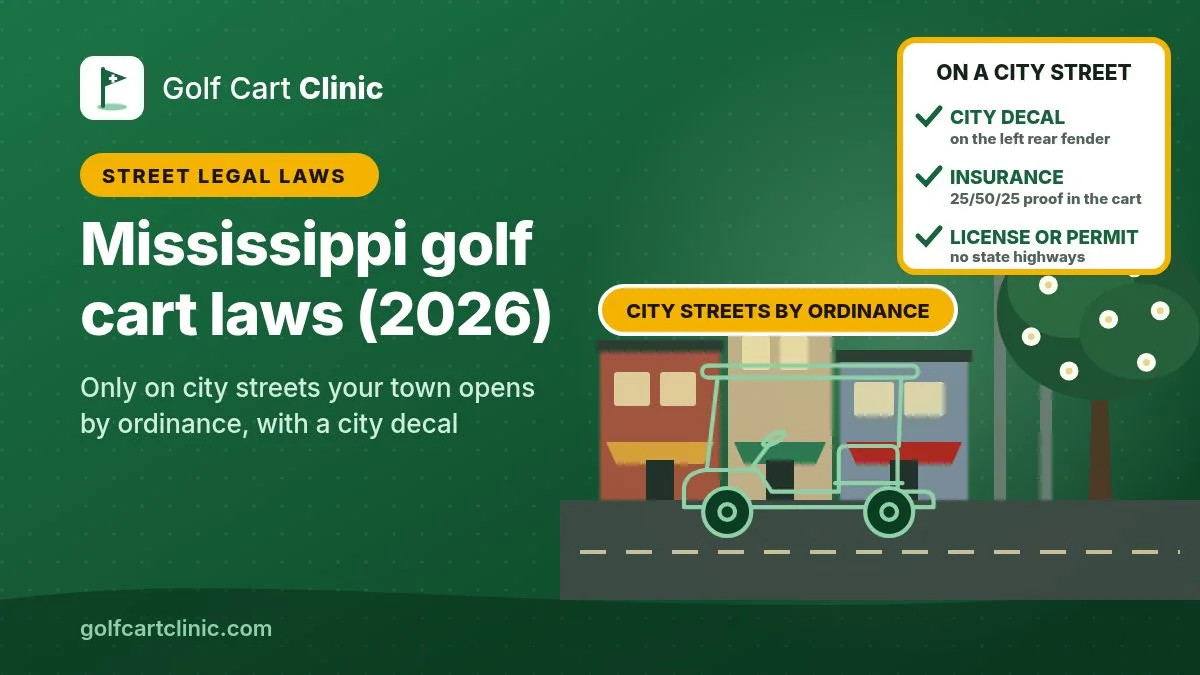
In Mississippi, a golf cart may use a public street only if your city or town has opened that street to golf carts by ordinance, and only inside the city limits. Every cart driven there must be registered with the city and show its decal on the left rear fender, and the driver must carry a valid driver's license or learner's permit plus proof of liability insurance (at least $25,000/$50,000/$25,000). State and US highways are off-limits except to cross them by the shortest route. Counties have no general power to open county roads to golf carts, and low-speed vehicles (LSVs) follow the same city-street rules as golf carts.
Not legal advice. Last verified: October 27, 2026. This guide summarizes the Mississippi Code sections on golf carts and low-speed vehicles (Title 63, Chapter 32), the session laws passed by the Mississippi Legislature (billstatus.ls.state.ms.us), the Department of Revenue's titling rule and published guidance, and one city's published golf cart rules. Your city or town decides which streets, if any, are open to golf carts, and its ordinance can add stricter rules. Before you drive, get your city's ordinance and street map.
Safety first. A golf cart has no doors, airbags or crash structure. On a street shared with pickups and log trucks, even a slow crash can throw riders out, and a low cart is easy to miss in a mirror. Seat only as many people as the cart has seats, keep everyone seated with hands and feet inside, and never let anyone stand on the back or ride on the bag rack. Buckle up where the cart has belts, and put young children in a proper car seat: Ocean Springs tells parents a child must ride in a 5-point harness car seat "just like in a vehicle." Stay in the outside lane, cross highways only at intersections and straight across, and if a route has fast traffic, find another one or leave the cart at home.
Mississippi golf cart rules at a glance
Since 2021, one short chapter of the Mississippi Code (Sections 63-32-1 to 63-32-5) covers golf carts and low-speed vehicles together. Here is how the two compare:
| Rule | Golf cart | Low-speed vehicle (LSV) |
|---|---|---|
| Definition | Built for a golf course, "not capable of exceeding speeds of twenty (20) miles per hour," with FMVSS 500 safety equipment (Miss. Code § 63-32-1(a)) | Four wheels, electric or gasoline, top speed "greater than twenty (20) miles per hour but less than twenty-five (25) miles per hour," with FMVSS 500 safety equipment (§ 63-32-1(b)) |
| Which streets | Only public roads and streets your city designates by ordinance, inside the city limits, and only where bicycles may legally ride (§ 63-32-3(1), (2)) | |
| Highways | Not on state or federal highways, except to cross them by the shortest route; outside lane only on multilane streets (§ 63-32-3(2)) | |
| Driver | Valid driver's license or temporary driver's permit in your possession (§ 63-32-3(3)) | |
| Insurance | Proof of financial responsibility under § 63-15-1 et seq.: $25,000 / $50,000 / $25,000 (§ 63-15-3(j)) | |
| Registration | With the city; decal from the county or municipal tax collector on the left rear fender, valid as long as you own the vehicle (§ 63-32-5) | |
| State title | Not titled or registered by the Department of Revenue, even if modified | Titled only if the certificate of origin says LSV and it has an LSV-specific VIN |
How Mississippi defines a golf cart and an LSV
Mississippi's golf cart chapter was created by Senate Bill 2605 (Laws 2021, ch. 367), signed March 17, 2021 and effective on passage. Under Section 63-32-1:
- A golf cart "means a motor vehicle that is designated and manufactured for operation on a golf course for sporting or recreational purposes, is not capable of exceeding speeds of twenty (20) miles per hour, and is equipped with safety equipment as required under 49 CFR Section 571.500."
- A low-speed vehicle "means any four-wheeled electric or gasoline-powered vehicle that has a top speed greater than twenty (20) miles per hour but less than twenty-five (25) miles per hour and is equipped with safety equipment as required under 49 CFR Section 571.500."
Three things stand out:
- Gas carts count. Unlike some neighbors, the definitions don't say "electric" only. The LSV definition names "electric or gasoline-powered" vehicles, and the golf cart definition doesn't mention the power source at all.
- The equipment bar is the LSV standard. Both definitions point to 49 CFR 571.500, the federal low-speed vehicle standard (FMVSS 500). That list is covered under required equipment below. Ask your city what its inspection checks before you buy parts.
- A sped-up cart doesn't fit either box neatly. A golf cart must not be capable of more than 20 mph. If a cart has been modified to go faster, don't assume it has become an LSV: the state titles an LSV only when the factory certificate of origin says LSV (see registration below). Our serial number lookup helps you tell a golf cart serial from a real VIN.
Where can you drive a golf cart in Mississippi?
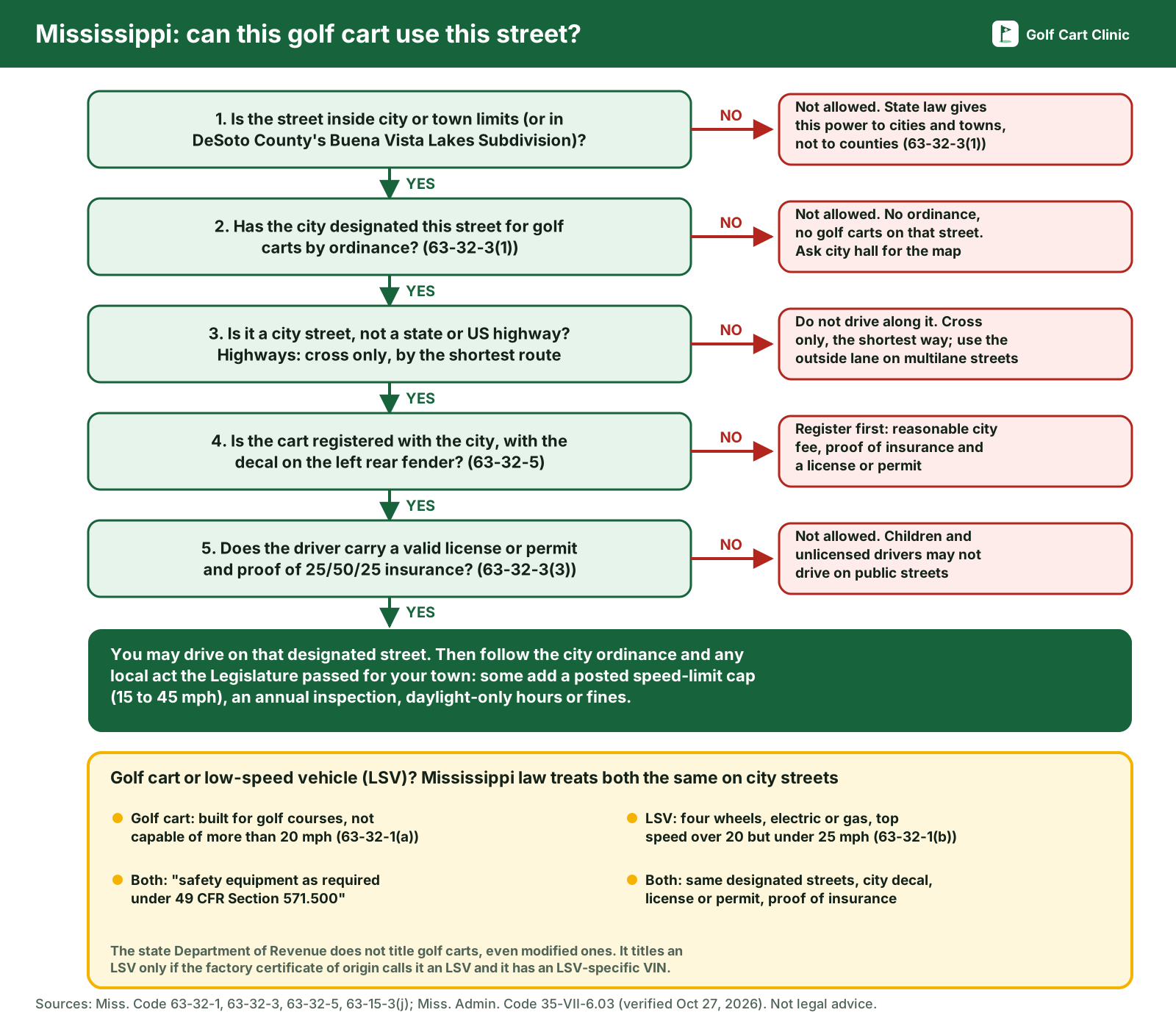
Only where your city or town says so. Section 63-32-3(1) reads: "The governing authorities of a municipality may, in their discretion, authorize the operation of golf carts and low-speed vehicles only on public roads and streets as designated by ordinance, within the corporate limits of the municipality." Four limits follow from Section 63-32-3(2):
- Designated streets only. If your city hasn't passed an ordinance, or your street isn't on its list, golf carts aren't allowed on it. The city must give you a map of the allowed areas when you register (Section 63-32-5(1)).
- Bicycle streets only. Carts and LSVs "may be operated on public roads and streets upon which bicycles are authorized by law to be operated."
- No state or US highways. They "may not be operated on state highways or federal highways that are not interstate highways except for the crossing of these streets, in which case the shortest traveling distance to do so shall be required." In practice: cross straight over, don't drive along the highway to reach the next street.
- Outside lane. "Drivers are required to operate golf carts and low-speed vehicles only in the outside lane of multilane streets and roads, where applicable."
Golf carts may also be used on private property with the owner's permission, on golf courses under the course's rules, and on private community roads under the association's rules.
What about county roads?
The 2021 law gives this power to municipalities only. Bills that would have let county boards of supervisors open county roads to golf carts died in committee in 2022 (HB 1004) and 2025 (HB 265). So outside city limits, a golf cart has no general right to a public road. The one exception we found is a 2026 local law for DeSoto County: Senate Bill 3386 (Local and Private Laws 2026, ch. 929, approved April 8, 2026) lets the Board of Supervisors allow golf carts and LSVs "only on the public roads and streets" of the Buena Vista Lakes Subdivision, by an ordinance or resolution recorded on its minutes. The same state rules apply there: licensed driver, proof of insurance, county registration and a decal on the left rear fender issued by the county tax collector.
Speed limits and hours
The state chapter doesn't set a maximum posted speed limit for golf cart streets, and it has no daylight-only rule. The limits come from two other places:
- The vehicle itself. A golf cart must not be capable of more than 20 mph, and an LSV must top out between 20 and 25 mph (Section 63-32-1).
- Your city. Cities choose the streets, and many have picked a posted-speed cap. Local laws passed for individual towns use caps from 15 mph (Walnut Grove) to 25 mph (Bay St. Louis, Gautier, Wesson, Georgetown, Guntown) and 45 mph (Farmington), and Ocean Springs allows carts on streets posted 30 mph or less. Long Beach's local law allows carts only "during daylight hours," and Magee's requires working headlights and tail lights from dusk through dawn.
Driver's license and age
"Any person operating a golf cart or low-speed vehicle on the public roads and streets under this chapter must have in his or her possession a valid driver's license or temporary driver's permit and proof of financial responsibility" (Section 63-32-3(3)). There is no separate golf cart age in state law, so the license sets the floor:
- A learner's permit may be issued at age 15, and it only lets the holder drive "when accompanied by a licensed operator who is at least twenty-one (21) years of age and who is actually occupying the seat beside the driver" (Miss. Code § 63-1-21(2)). On a two-seat cart, that adult takes the passenger seat.
- A regular license holder under 18 may drive unsupervised from 6:00 a.m. to 10:00 p.m. Sunday through Thursday and until 11:30 p.m. Friday and Saturday, with exceptions for trips to work, school and activities (§ 63-1-21(3)).
One wrinkle: the registration section says the operator must have "a valid driver's license" in his or her possession at all times (Section 63-32-5(1)), without repeating the permit. If a teen will drive on a learner's permit, ask your city how it applies the rule. Children without a license or permit may not drive a golf cart on a public street, and a city can set a higher age.
Registration and the city decal
Mississippi registers golf carts locally, not with the state. Under Section 63-32-5:
- "Every golf cart and low-speed vehicle to be operated, as authorized under this chapter, on a public road or street shall be required to be registered with the city."
- You pay "a reasonable fee that may be charged by the city to cover the costs of administration" and show proof of financial responsibility and a valid driver's license or temporary permit.
- You get "a registration decal by the county or municipal tax collector that must be displayed on the left rear fender of the vehicle."
- The registration "shall remain valid for as long as the registering owner owns the golf cart or low-speed vehicle," and the city must hand you a map of the areas where carts may run. The fee goes into the city's general fund.
Cities can still make you come back: Ocean Springs, for example, requires an inspection and registration every January (see local rules below).
The state doesn't title golf carts. The Department of Revenue's motor vehicle FAQ says plainly: "Golf carts are not titled nor registered." Its titling rule goes further: "Any vehicle originally manufactured as a recreational off-highway vehicle, including golf carts, will not be titled by the Department, regardless of whether it receives aftermarket modifications" (Miss. Admin. Code 35-VII-6.03, Rule 103). So a lift kit, lights and a windshield won't get a golf cart a state title or a license plate.
Insurance
The driver must carry "proof of financial responsibility as required under Section 63-15-1 et seq." (Section 63-32-3(3)). Mississippi's financial responsibility law defines that as the ability to pay at least $25,000 for bodily injury to or death of one person, $50,000 for two or more people in one accident and $25,000 for property damage (Miss. Code § 63-15-3(j)). In practice that means a liability policy that covers the golf cart on public streets, with the card in the cart. Your auto or homeowner's policy may not cover a cart on the road, so ask your agent for golf cart liability coverage. Some local laws set their own floor: Farmington requires "at least Fifty Thousand Dollars ($50,000.00) of liability insurance."
Required equipment
Both definitions in Section 63-32-1 require "safety equipment as required under 49 CFR Section 571.500." That federal standard (FMVSS 500) lists:
- headlamps;
- front and rear turn signal lamps;
- taillamps and stop lamps;
- reflex reflectors: one red on each side as far to the rear as practicable, and one red on the rear;
- a driver's side exterior mirror, plus a passenger side exterior mirror or an interior mirror;
- a parking brake;
- a windshield that meets the federal glazing standard;
- a VIN that meets 49 CFR part 565;
- a Type 1 or Type 2 seat belt at each designated seating position;
- plus, for vehicles built to the current standard, rear visibility and pedestrian alert sound requirements.
Most stock golf carts don't come with all of that. What a city actually checks varies. Ocean Springs' annual inspection, for example, looks for headlights, taillights and brake lights, front and rear turn signals, a horn, reflectors (one per side and one on the rear), a parking brake, a windshield, seat belts for all seats and a rear-view mirror, and its rules page also lists a VIN. Our golf cart upgrades guides cover lights, mirrors and belts.
Golf carts vs LSVs in Mississippi
In many states an LSV gets a license plate and much wider road access than a golf cart. Mississippi is different: the 2021 chapter puts golf carts and LSVs under the same rules. Both need a city ordinance, a designated street, city registration and decal, a licensed driver and proof of insurance, and both stay off state and US highways except to cross. We found no Mississippi statute that gives LSVs their own statewide road access: bills to do that died in committee in 2014, 2015, 2016, 2017 and 2020.
Titling is where an LSV differs. The Department of Revenue's rule says it "will only issue a title for a LSV if the manufacturer's certificate of origin clearly identifies the vehicle as a LSV. In addition, the vehicle identification number (VIN) assigned to the LSV by the original manufacturer must be a LSV-specific VIN" (Miss. Admin. Code 35-VII-6.03, Rule 102). DOR's FAQ adds that an LSV "that conforms to Federal Regulation" requires "a standard passenger plate." If you buy a factory LSV, take its certificate of origin to your county tax collector and ask how it should be titled and tagged, then register it with your city too if you'll use the city's golf cart streets.
Drinking and other traffic laws
Mississippi's DUI law makes it unlawful "to drive or otherwise operate a vehicle within this state" while under the influence or at a blood alcohol concentration of 0.08 percent or more (0.02 percent for drivers under 21) (Miss. Code § 63-11-30). A golf cart is a vehicle. Ocean Springs' FAQ answers the question directly: "Yes. You can be charged with DUI on a golf cart." Stop signs, right-of-way and parking rules apply as they do in a car, and Magee's local law says violations "may result in the issuance of traffic citations in the same manner as if the infraction occurred while driving a car."
Local rules: towns with their own golf cart laws
Before 2021, a Mississippi town that wanted golf carts on its streets had to ask the Legislature for a local and private law of its own. Many did, and those acts still shape local rules. A few examples, quoted from the bills as sent to the Governor:
| Town (law) | Where carts may go | Other rules in the act |
|---|---|---|
| Long Beach (HB 1662, 2018) | Streets south of the railroad and north of Highway 90, between South Lang Avenue and Beach Park Avenue | Shortest route between home and the next allowed street or cart path, daylight hours only, never on or across Highway 90; parade routes allowed |
| Bay St. Louis (SB 3026, 2018) | Streets with a speed limit of 25 mph or less | Valid license from any state and proof of insurance; city registration and fee |
| Magee (HB 1686, 2018) | City streets other than US 49 and Simpson Highway 149, as listed by the city | Lights from dusk through dawn, no towing, everyone seated, bodily injury coverage of $25,000 per person and $50,000 per occurrence |
| Walnut Grove (SB 2150, 2020) | Streets with a speed limit of 15 mph or less | Valid license and proof of insurance; town registration and fee |
| Farmington (HB 1697, 2023) | City streets posted 45 mph or less; may cross, but not travel on, Kimberly Clark Road (Alcorn County Roads 206, 106 and 106A) | At least $50,000 liability insurance; fine up to $500 per occurrence for no decal, an expired decal or someone else's decal; permit can be refused or revoked after three violations in a year |
Other towns with golf cart acts include Madison, D'Lo and Pascagoula (2017); Mendenhall, Clinton, Ocean Springs, Crystal Springs, Waveland, Oxford and Sumrall (2018); Seminary, Moss Point, Newton and Diamondhead (2019); Pass Christian and Gautier (2020); and Wesson, Georgetown and Guntown (2021). Several limit carts to residential neighborhoods or keep them off arterial streets. Since 2021, any city or town can use the general law in Chapter 63-32 instead. Either way, the ordinance your city adopted is what you'll be held to.
Ocean Springs is a good example of a full city program. Its golf cart page (Code ch. 14, art. V) says golf carts and LSVs may run only on streets with a speed limit of 30 mph or lower, may not travel on Highway 90 or Highway 609 except to cross, and must use the right lane on four-lane roads. Every cart needs an on-site inspection and registration at City Hall each January, for $51 a year ($50 plus a $1 records fee), with the decal on the left rear fender. Drivers need a valid license and current golf cart liability insurance, ATVs and UTVs can't be registered, and the city lists a $420 fine for driving an unpermitted golf cart on public roads.
Before you drive on a Mississippi street: a checklist
- Confirm you're inside city or town limits (or in Buena Vista Lakes in DeSoto County) and get the city's golf cart ordinance and map.
- Check that your street is on the map, and plan a route that stays off state and US highways except to cross them.
- Register the cart with the city and put the decal on the left rear fender. Pass any city inspection.
- Buy liability insurance of at least $25,000/$50,000/$25,000 and keep proof in the cart.
- Check the equipment against your city's list and the FMVSS 500 items: lights, turn signals, reflectors, mirrors, parking brake, windshield and seat belts.
- Make sure every driver carries a valid license or permit, and that permit holders have a licensed adult 21 or older in the seat beside them.
- Follow your city's extra rules: speed-limit streets, hours, passenger seating and lane use.
- If you're buying a factory LSV, keep the certificate of origin and ask your county tax collector about the title and tag.
Frequently asked questions
Are golf carts street legal in Mississippi?
Only on streets your city or town has designated by ordinance, inside its limits (Miss. Code § 63-32-3). The cart must be registered with the city and show its decal, and the driver must carry a valid license or temporary permit plus proof of insurance. Without a city ordinance, golf carts stay off public roads.
Can I drive a golf cart on a county road in Mississippi?
Generally no. State law lets municipalities, not counties, open streets to golf carts, and county bills failed in 2022 and 2025. The exception is DeSoto County's Buena Vista Lakes Subdivision, where a 2026 local law lets the Board of Supervisors allow golf carts and LSVs.
Do golf carts need a license plate or title in Mississippi?
No. The Department of Revenue doesn't title or register golf carts, even modified ones. Instead, a cart used on city streets is registered with the city and gets a decal for the left rear fender, valid as long as you own it (§ 63-32-5). A factory LSV is different: it can be titled if its certificate of origin says LSV and it has an LSV-specific VIN.
Do you need insurance on a golf cart in Mississippi?
Yes, to drive on public streets. The driver must carry proof of financial responsibility, which means at least $25,000 per person and $50,000 per accident for bodily injury and $25,000 for property damage (§ 63-15-3(j)). Some towns require more, such as Farmington's $50,000 liability minimum.
How old do you have to be to drive a golf cart in Mississippi?
Old enough for a driver's license or learner's permit. Permits start at 15, and a permit holder must have a licensed driver 21 or older in the seat beside them (§ 63-1-21). Children without a license or permit can't drive a golf cart on a public street, and a city can set a higher age.
Can I drive a golf cart on a highway in Mississippi?
Not along a state or US highway. You may only cross one, by the shortest route (§ 63-32-3(2)), and on multilane streets you must use the outside lane. Some cities also ban specific roads, such as Highway 90 and Highway 609 in Ocean Springs except at crossings.
What is the difference between a golf cart and an LSV in Mississippi?
A golf cart is built for golf courses and can't go faster than 20 mph; an LSV has a top speed over 20 but under 25 mph. Both need FMVSS 500 safety equipment, and on city streets Mississippi treats them the same: designated streets only, city decal, licensed driver and insurance. Only an LSV can get a state title.
Mississippi's neighbors handle golf carts very differently. In Louisiana golf cart laws, parishes and towns designate roads, and every cart needs a state OMV title, decal and insurance. Alabama golf cart laws allow carts only in towns in five counties. Tennessee golf cart laws are stricter still: plain golf carts can't use public roads at all. For more states, browse our golf cart laws by state.
Sources
- Mississippi Code, Title 63, Chapter 32 (Laws 2021, ch. 367): § 63-32-1 (definitions), § 63-32-3 (municipal authorization, highways, driver), § 63-32-5 (registration and decal); enacted text: SB 2605 (2021), as sent to the Governor
- Other Mississippi Code sections: § 63-15-3 (financial responsibility limits), § 63-1-21 (learner's permits and under-18 hours), § 63-11-30 (DUI)
- Local and private laws (Mississippi Legislature): SB 3386 (2026, DeSoto County), HB 1662 (2018, Long Beach), SB 3026 (2018, Bay St. Louis), HB 1686 (2018, Magee), SB 2150 (2020, Walnut Grove), HB 1697 (2023, Farmington); failed county bill HB 1004 (2022)
- Mississippi Department of Revenue: Miss. Admin. Code Title 35, Part VII, Subpart 6, Chapter 03 (Low Speed Vehicles); Motor Vehicle Frequently Asked Questions
- 49 C.F.R. § 571.500 (FMVSS 500, low-speed vehicles): ecfr.gov
- Local: City of Ocean Springs, Golf Carts (Code ch. 14, art. V; police department guidance and FAQ)
Questions and comments
No comments yet. Corrections and notes from your own repair are welcome.