
Gas Golf Cart Battery Keeps Dying With Lights On? Why the Generator Can't Keep Up
On a gas golf cart the 12V starting battery gets no charge while you're stopped, and the generator is small. Here's why light bars and underglow drain it, the battery and charging specs E-Z-GO, Club Car and Yamaha publish, how to do the amp math and what to fix first.
Quick answer: on a gas golf cart like E-Z-GO's EFI models, the engine only runs while you're pressing the pedal, so the 12-volt battery gets nothing while you're stopped. Every light bar, flood light, underglow strip and USB charger you add runs straight off that one starting battery, and the charging system is small: E-Z-GO lists 30 amps for its current EFI carts and Club Car lists 35 amps for the 2009 to 2015 gas Precedent. Park with the extras on for a while (trick or treating, a parade, a night at the beach) and you can pull the battery down far enough that it won't crank, and driving home won't bring it back. Add up your accessory watts, divide by 12 to get amps, cut the load when you're stopped, and recharge a flat battery with a proper 12-volt charger instead of jump starting it.
Safety first: don't jump start a gas golf cart, and don't let it move on you. E-Z-GO says not to use jumper cables because the clutches engage as soon as the engine starts and the cart moves, which makes jump starting dangerous. Club Car's gas Precedent manual also says not to jump start a dead battery with another battery and jumper cables. Before you touch the battery or any wiring: set the park brake, put the direction selector in neutral, turn the key off and take it out, and chock the wheels. Club Car's procedure then has you disconnect the negative (-) cable first and pull the spark plug wire so the engine can't start, and reconnect positive (+) first. Keep wrenches off the frame while a cable is loose. Batteries give off explosive hydrogen gas while charging, so charge in a ventilated spot with no sparks or flames, and wear eye protection. A battery that's hot, swollen, leaking or smells like rotten eggs should be replaced, not charged.
Time estimate: adding up your accessory load takes 10 minutes. The voltage checks with a multimeter take 15 to 20 minutes. Recharging a flat starting battery with a small charger is several hours, often overnight. Rewiring the extras onto their own switch or battery is an afternoon job.
What you need
- A digital multimeter set to DC volts (the 20V range is fine on a manual-ranging meter).
- The watt (or amp) rating for each accessory. It's usually printed on the light, its box or the seller's listing.
- A 12-volt battery charger rated 10 amps or less. E-Z-GO says to use one designed for sealed batteries; Club Car says an automotive-type 12-volt charger rated 10 amps or less.
- Basic hand tools for the battery terminals, and wheel chocks.
- Your owner's manual. Battery size, charging output and the do-not-jump warning are in it.
What not to do
- Don't jump start it from a car, another cart or a jump pack. The clutches grab when the engine fires. If you've already done it to get home, it worked, but do it with the brake set and wheels chocked or not at all.
- Don't count on driving to recharge a dead battery. E-Z-GO says the generator can keep the battery charged with short run times, but it will not charge a discharged battery.
- Don't use a big fast charger. Both E-Z-GO and Club Car say 10 amps or less, and E-Z-GO warns that overcharging can overheat the battery and cause an explosion.
- Don't leave it flat. Club Car says never leave the battery discharged any longer than absolutely necessary, not even overnight.
- Don't just clamp a second battery in parallel with the starting battery. They'll drain down together and you'll be stuck with two flat batteries instead of one. If you add one, keep it separate (more on that below).
- Don't add an accessory without a fuse at its power source. A pinched, unfused wire on a 12V battery can start a fire.
Why a gas golf cart battery dies with accessories on
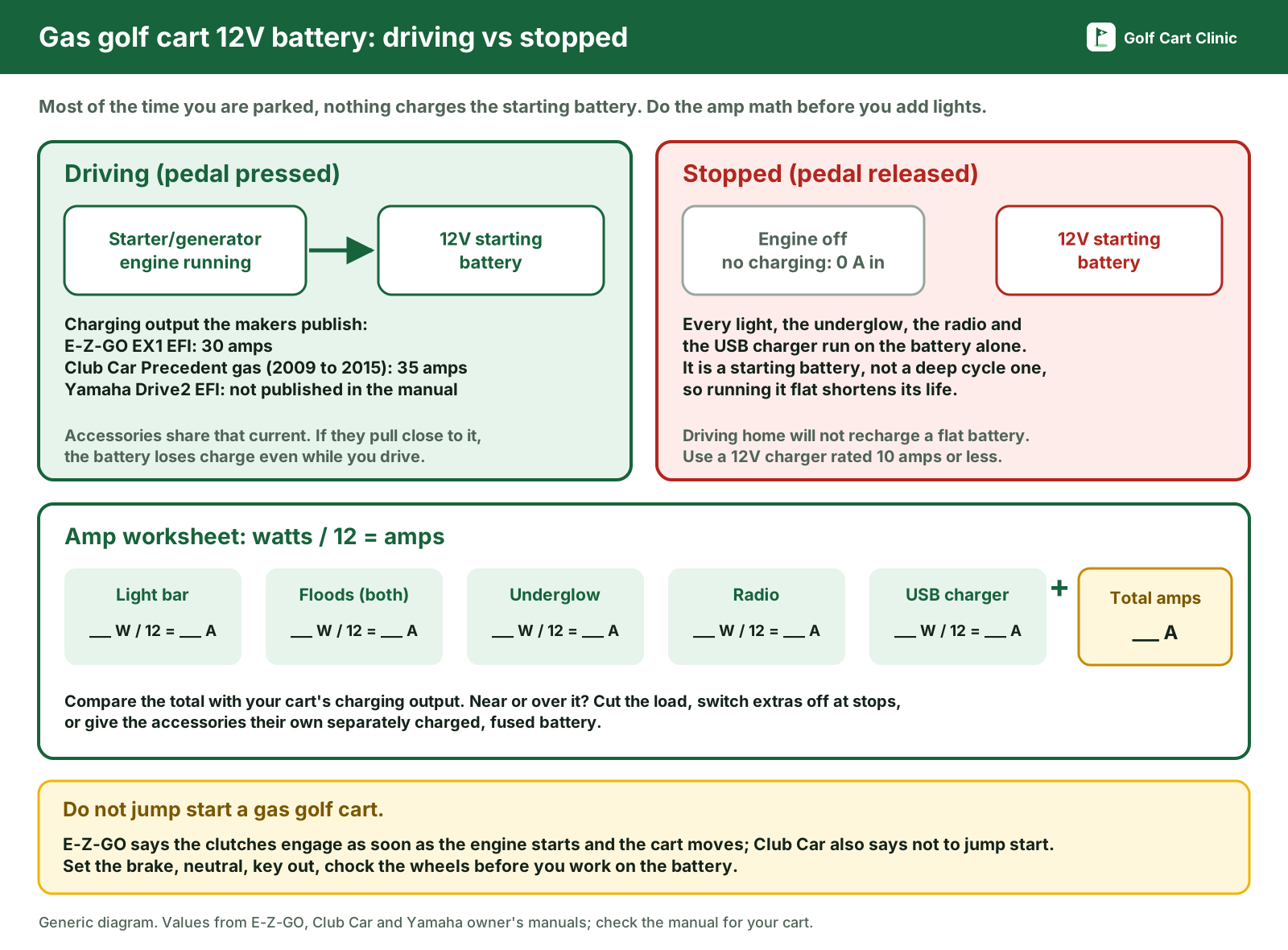
A gas cart isn't wired like a car. On carts like E-Z-GO's EFI models the engine shuts off when you take your foot off the pedal, and a starter/generator spins the engine to start it, then turns into the generator once it's running. E-Z-GO's EFI owner's manual says it plainly: the engine does not idle, so the battery does not charge while the vehicle is stopped, and you should turn off all accessories when you're stopped.
Two more lines in that same manual explain almost every "my battery died at the end of the night" story:
- The generator is small. E-Z-GO says it can supply 30 amps, and that running all the accessories can discharge the battery even while the engine is running and the generator is working.
- The battery isn't built for it. It's a starting battery, not a deep cycle battery. E-Z-GO says discharging it is deep cycling, and that repeated deep cycling causes early failure. So each night you run it flat costs you some battery life, even if it recharges fine afterward.
Some accessories keep drawing power with the key off, too. E-Z-GO notes that certain factory accessories stay on with the key switch OFF and can discharge the battery if you leave them on after you park. Aftermarket lights wired straight to the battery behave the same way.
Battery and charging specs by brand
These are the numbers the makers publish in their owner's manuals. "Not published" means we couldn't find it in the maker's owner's manual; it doesn't mean the cart has no charging system.
| Cart (manual) | Factory battery | Charging output | Charging a flat battery | Jump starting |
|---|---|---|---|---|
| E-Z-GO Fleet, Freedom, Freedom 2+2, Valor 2, Valor 4 (RXV EX1 EFI, model year 2024 and later) | One 12V U1 maintenance-free, 340 CCA, 41-minute reserve | Generator can supply 30 amps; engine does not idle, no charging while stopped | 12V charger rated 10 amps or less, designed for sealed batteries; 12.8V or higher means fully charged | Don't. The clutches engage when the engine starts and the cart moves |
| Club Car Precedent gas (2009 to 2011 and 2012 to 2015 owner's manuals) | 12V low-maintenance, 500 CCA at 0°F, 650 at 32°F, 105-minute reserve | 35-amp charging capacity | Have a weak battery charged with an automotive-type 12V charger rated 10 amps or less; don't leave it discharged overnight | Don't jump start a dead battery with another battery and jumper cables |
| Yamaha Drive2 EFI (DR2A17 PTV) and Drive2 QuieTech | BCI group 24, minimum 75-minute reserve, minimum 400 CCA | Not published in the owner's manual (QuieTech lists an electric starter/generator) | If the battery loses its charge, have an experienced mechanic charge it; in storage, recharge every 60 to 90 days | Not addressed in the owner's manual |
Yamaha's Drive2 EFI manual also lists the factory fuses: a 25-amp main fuse near the negative battery terminal, a 15-amp light fuse and a 10-amp fuse for the optional DC outlet. That tells you the factory 12V circuits were never meant to feed a big aftermarket light bar.
Do the amp math before you buy anything
This is the step that tells you whether you have a battery problem or a load problem. On a 12-volt system, amps = watts / 12 (close enough for this job). Add up everything you run at the same time:
| Accessory | Rated watts | Amps at 12V (watts / 12) |
|---|---|---|
| Front light bar | (from its label) | |
| Rear flood lights (count both) | ||
| Underglow / rock lights | ||
| Speakers / sound bar | ||
| USB charger (with a phone plugged in) | ||
| Total | Compare with 30 A (E-Z-GO) or 35 A (Club Car) |
For scale, Yamaha lists the Drive2 EFI's factory LED headlights at 14.5 watts each. Two of them are about 29 watts, or roughly 2.4 amps. Most aftermarket light bars and flood lights are rated well above that, so check the label.
While driving, the generator has to cover the accessories and the engine's own electrical needs before anything goes back into the battery. If your total is anywhere near the generator rating, the battery slowly loses ground even on the move, which is exactly what E-Z-GO warns about.
While stopped, it's all battery. Reserve capacity gives you a feel for how little is there. The Battery Council International defines it as the minutes a new, fully charged battery can deliver 25 amps at 80°F before it drops to 1.75 volts per cell (10.5 volts on a 12V battery, which is completely flat). E-Z-GO's factory U1 battery is rated 41 minutes. That's brand new, warm, and run all the way to dead, so in real life, with an older battery on a cool night and enough charge left to crank, you get a lot less than that. A cart parked for an hour with a big light bar on can easily end up too weak to start.
How to tell if it's the battery, the load or the charging
Disable the cart first (park brake, neutral, key out, wheels chocked) for steps 1 and 2.
- Resting voltage. Let the cart sit with everything off for a few hours, then measure across the battery posts. E-Z-GO says 12.8V or higher is fully charged and anything less needs recharging. → Low? Charge it fully with a 10-amp-or-less charger, let it rest, and measure again. If it can't get back to 12.8V, the battery is probably worn out from deep cycling. Have it load tested by a parts store or your dealer.
- Load check, key off. Turn on each accessory one at a time and watch the voltage, then all of them together. → A big drop with one item tells you which accessory is the heavy draw. If the voltage keeps creeping down with everything switched off, something is still drawing current (a factory accessory that stays on with the key off, or an aftermarket light wired straight to the battery).
- Charging check, engine running. With the rear wheels safely off the ground on jack stands, the cart in neutral, and someone keeping clear of the wheels and belt, run the engine at a moderate speed and measure again, first with the accessories off, then with them on. → The reading should rise above your resting voltage when the generator is charging. If it stays at or below resting voltage with nothing turned on, have the starter/generator and voltage regulator checked by a dealer. If it only sags when the accessories are on, the load is bigger than the generator can handle.
- Battery age. → A factory starting battery that's been run flat a few times is often done, even if it still cranks on a warm day. If it's several seasons old and fails the resting test after a full charge, replace it with the size your manual lists before you blame the generator.
How to fix it, cheapest first
- Switch the extras off at every stop. This is what E-Z-GO actually tells owners to do, and it costs nothing. If you're parked for a while with the lights on, you're draining the battery the whole time.
- Put the accessories on a switched feed. Run them through a fused relay triggered by the key switch so they can't stay on after you walk away. Use a fuse sized for the wire at the battery end.
- Cut the load. A smaller or dimmer light bar, or not running every light at once, often gets the total under what the generator can supply while driving.
- Keep the battery charged. After a long night with the lights, put a 10-amp-or-less 12V charger on it instead of hoping the next drive tops it off. E-Z-GO's manual says the generator keeps a charged battery charged on short run times, but won't recharge one that's been run down.
- Replace a worn battery with the right size. Use the group size and cold cranking amps your manual lists (see the table). A bigger reserve rating buys you more parked time, but it doesn't make the generator any bigger.
- Add a separate accessory battery only if the math says you need one. If your accessories pull more than the generator can supply, a second battery that powers only the accessories, on its own fused wire to the accessory switches, keeps the starting battery out of it so you can always get home. Treat it as a separate system that you charge at home after every outing, because the cart's generator can't keep up with it either. It adds weight and wiring, so talk to your dealer before you modify a cart that's still under warranty.
E-Z-GO also warns against installing accessories it hasn't approved and modifications that can create a safety hazard. Club Car says accessories should be installed by trained technicians. If your cart is still under warranty, ask the dealer before you wire anything into the factory harness.
When to stop and call the dealer
Stop and get help if the battery is hot, swollen, cracked or leaking, if it smells like rotten eggs, if a wire or fuse holder has melted, or if the running-voltage check shows the generator isn't charging at all. Those aren't accessory-load problems. If you're not comfortable working around the battery and a running engine, a dealer can load test the battery and test the charging system in one visit.
For electric carts, the 12V accessory power comes from the main battery pack or a reducer instead, so see lights and accessories not working after new batteries. If you see sparks when you hook a battery back up, read golf cart sparks when connecting the battery before you go further. Not sure what year your cart is? Use our serial number lookup to find the right manual. And if you're adding lights to drive on the street, check your state's rules on our street legal laws pages.
FAQ
Why does my gas golf cart battery keep dying when I use the lights?
On carts like E-Z-GO's EFI models the engine shuts off when you stop, nothing charges the battery while you're parked, and the generator is small even when you're driving. E-Z-GO lists 30 amps on its current EFI carts and says running all the accessories can drain the battery even with the engine running. A big light bar, flood lights and underglow can add up to more than that.
Does a gas golf cart charge its battery while it idles?
Not on E-Z-GO's EFI carts. E-Z-GO says the engine does not idle, so the battery doesn't charge while the cart is stopped. It only charges while the engine runs, which means while you're pressing the pedal.
Can I jump start a gas golf cart?
E-Z-GO and Club Car both say not to. E-Z-GO explains that the clutches engage when the engine starts and the cart moves, which makes jump starting dangerous. Charge the battery with a 12-volt charger rated 10 amps or less instead.
What charger should I use on a gas golf cart battery?
A 12-volt charger rated 10 amps or less. E-Z-GO specifies one designed for sealed batteries and says 12.8V or higher at rest means fully charged. Club Car specifies an automotive-type 12-volt charger rated 10 amps or less. Don't use the 36V or 48V charger from an electric cart.
Should I add a second battery for my golf cart accessories?
Only if your accessory amps (watts divided by 12) are more than the generator can supply, or you spend a lot of time parked with the lights on. Keep it separate from the starting battery, feed it to the accessories on its own fused wire, and plan to charge it at home, because the cart's generator can't refill it. Switching the extras off at stops and keeping the starting battery charged fixes most cases without one.
Sources
- E-Z-GO, Owner's Manual RXV EX1 EFI (Fleet, Freedom, Freedom 2+2, Valor 2, Valor 4), model year 2024 and later, 10036460-E (engine does not idle, no charging while stopped; generator can supply 30 amps; accessories can discharge the battery even with the engine running; starting battery, not deep cycle; some accessories operate with the key off; 12.8V or higher is fully charged; generator will not charge a discharged battery; 12V charger rated 10 amps or less, designed for sealed batteries; no jumper cables because the clutches engage; 12V U1 340 CCA, 41-minute reserve; approved accessories only): ezgo.txtsv.com (PDF)
- Club Car, 2012 through 2015 Precedent Golf Car Owner's Manual (12V, 500 CCA at 0°F, 650 at 32°F, 105-minute reserve and 35-amp charging capacity; don't jump start with another battery and jumper cables; automotive-type 12V charger rated 10 amps or less; don't leave discharged overnight; disabling the vehicle, negative cable first, spark plug wire; accessories installed by trained technicians): Club Car document, dealer-hosted copy (PDF)
- Club Car, 2009-2011 Precedent Golf Car Owner's Manual (same battery rating and 35-amp charging capacity; jump start warning): Club Car document, dealer-hosted copy (PDF)
- Yamaha, Drive2 EFI PTV (DR2A17) Owner's/Operator's Manual, LIT-19626-19-18 (BCI group 24, minimum 75-minute reserve, minimum 400 CCA; have an experienced mechanic charge it; recharge every 60 to 90 days in storage; 25A main, 15A light and 10A DC outlet fuses; LED headlights 13.5V / 14.5W x 2; USB powered only with the key on): Yamaha document, dealer-hosted copy (PDF)
- Yamaha, Drive2 PTV QuieTech Owner's/Operator's Manual, LIT-19626-A3-81 (electric starter/generator; BCI group 24, minimum 400 CCA): golfcars.yamaha-owners-manuals.com (PDF)
- Battery Council International, Glossary of Common Battery Terms (reserve capacity rating: minutes at 25 amps, 80°F, to 1.75 volts per cell): batterycouncil.org (PDF)
- Your cart's own owner's manual. It takes priority where it differs from this guide.
Last checked against the documents above on November 3, 2026.
Questions and comments
No comments yet. Corrections and notes from your own repair are welcome.